
- Buy Crypto
- Markets
 Futures
- Spot
- Copy Trade
- Earn
- More
$20 Billion Valuation, Is Kalshi Engaging in an Arms Race with Polymarket?

Original Article Title: "A $20 Billion Valuation - Kalshi and Polymarket Kick Off Arms Race?"
Original Article Author: Mach, Foresight News
Recently, according to The Wall Street Journal, top prediction markets Polymarket and Kalshi have been in talks with potential investors, with valuations around $20 billion each. In November 2025, news broke that Polymarket was discussing funding at a $12 billion valuation. In December of that year, Kalshi completed a $1 billion funding round, valuing the company at $11 billion.
In just a few months, these valuations are estimated to have doubled once again.
Based on public market data and industry reports, as of the end of February 2026, the global prediction market's cumulative nominal trading volume has reached $127.5 billion, with Polymarket at $56.07 billion and Kalshi at $44.71 billion, together accounting for 79% of the market share.
While leading in cumulative trading volume, Kalshi's growth rate in 2025 was more remarkable, not only reversing its market share from a minority at the beginning of the year to over 60%, but also driving monthly active users from 600,000 to over 5.1 million, demonstrating a faster pace of scale expansion. In comparison, leveraging its native crypto advantage, Polymarket maintained global event coverage and cumulative trading advantages, but user growth was relatively stable, with monthly active peaks hovering around 700,000. The two core metrics - trading volume and monthly actives - clearly outline Kalshi's explosive catch-up and Polymarket's sustained deep cultivation, forming a pattern of the two prediction market giants standing side by side.
Specifically in terms of trading volume performance, Kalshi's growth trajectory shows a leap from a low base to a high volume.
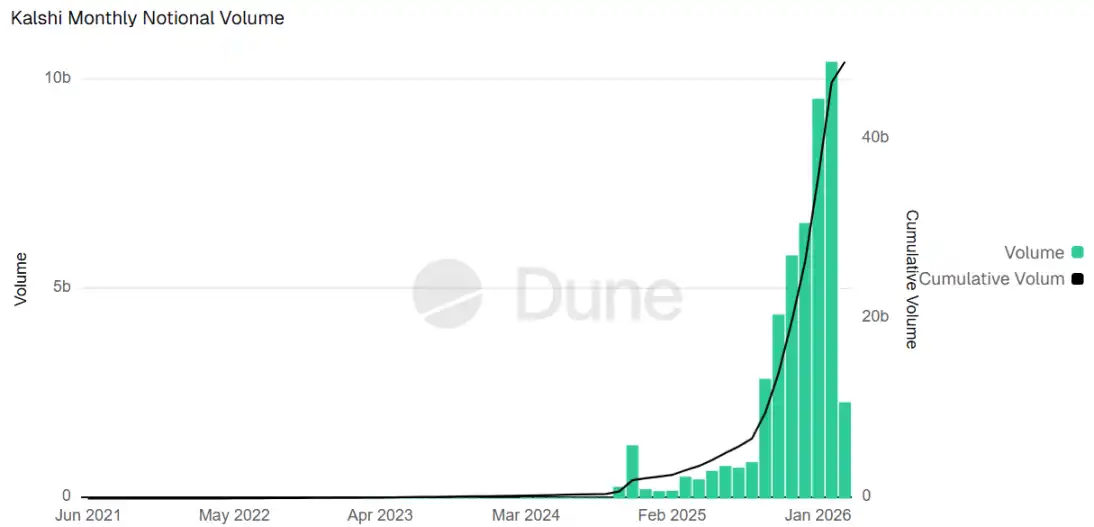
In 2024, Kalshi's annual nominal trading volume was approximately $1.9 billion, limited by early regulatory frameworks and market awareness, mainly relying on a few event-driven activities. By 2025, this number soared to around $23.8 billion, representing a year-on-year increase of over 1100%. This surge is directly reflected in monthly and weekly records: September saw a monthly trading volume of $28.6 billion, climbing further to $43.9 billion in October, and then skyrocketing to $65.8 billion in December. The strong start to 2026 continued, with January's monthly trading volume exceeding $104 billion.
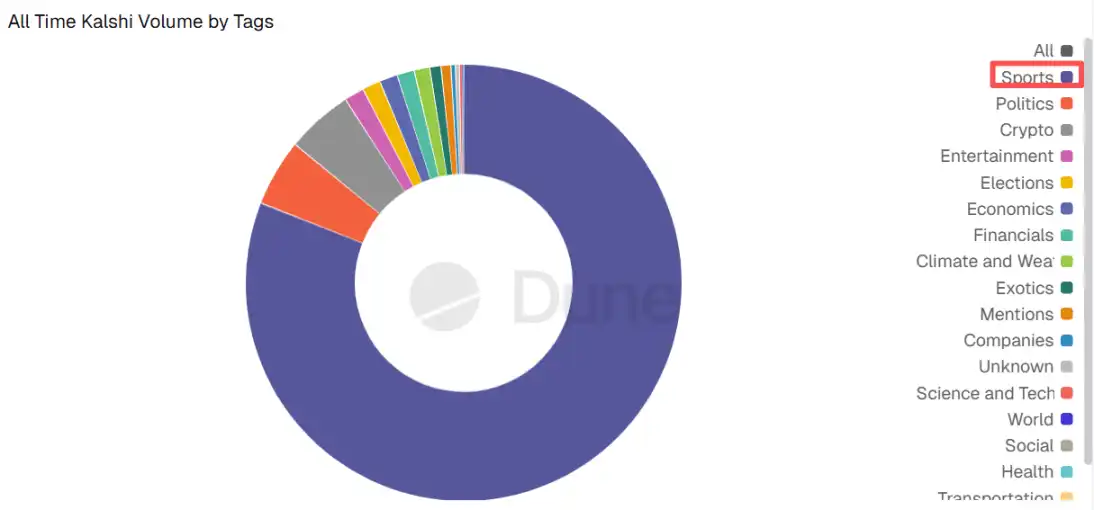
The sports event contract contributed approximately 81% of the trading volume.
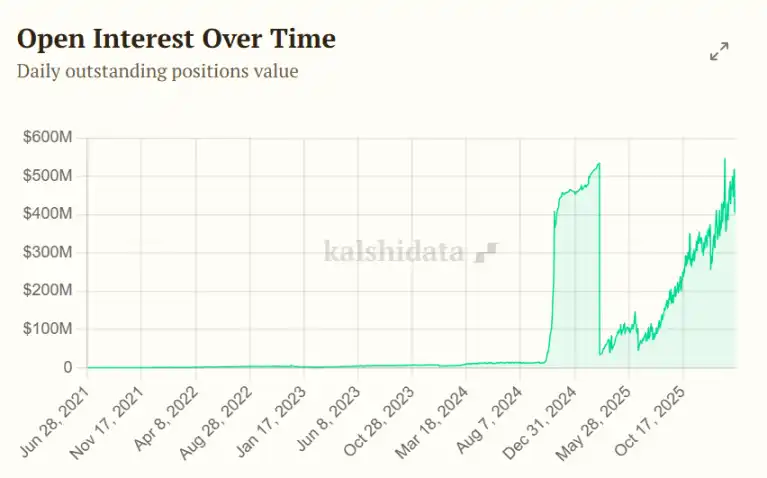
As of March 9, Kalshi's total cumulative trading volume has exceeded $48.6 billion. The current open interest hovers around $500 million.
Polymarket's trading volume reflects earlier accumulation advantages and later robust maintenance. According to Dune data, in 2024, Polymarket's monthly nominal trading volume experienced explosive growth, with the October 2024 monthly trading volume reaching $42.66 billion, hitting a historical high, and its cumulative trading volume rising to $7.6 billion.
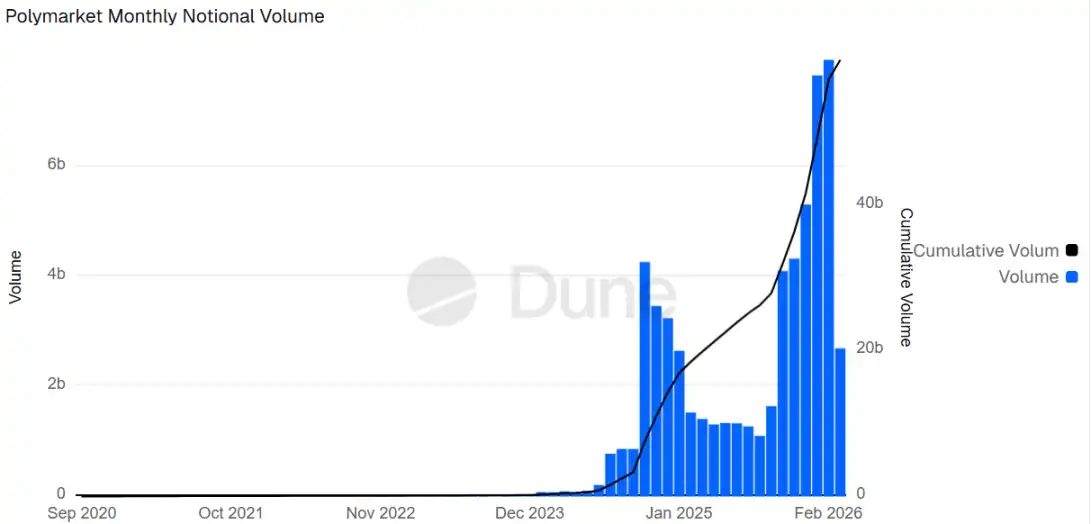
Subsequently, although its monthly trading volume slowly declined, it still maintained at a high level. The turning point occurred in September 2025 when Polymarket began its pulse-like surge in trading volume.
In October, the monthly trading volume exceeded $41 billion, and in November, it surpassed $43 billion.
Fast forward to 2026, in just January, its trading volume surpassed $76.58 billion, and in February, it surpassed $79 billion. As of March 9, its cumulative trading volume exceeded $599 billion.
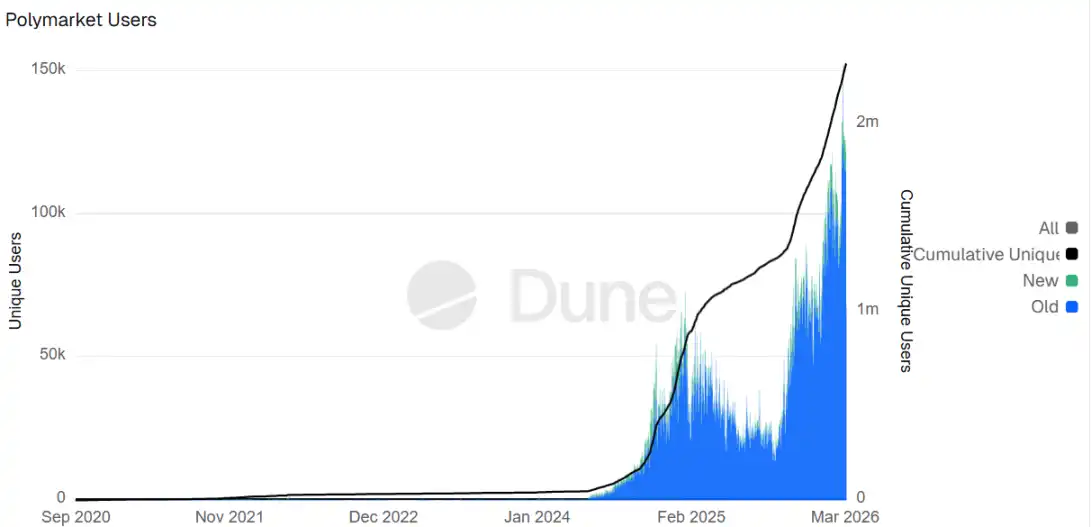
According to Dune data, its total number of users has soared from 40,000 in 2024 to the current 2.31 million.
It is worth noting that Polymarket still has an advantage in liquidity depth in political and crypto events, with some weekly transaction volumes accounting for up to 57%. However, its overall market share fell from 95% in 2025 to 35-40%, gradually stabilizing thereafter.

The divergence in the trading volume data of the two platforms fundamentally stems from the differences in business focus and user access models. As a CFTC-regulated entity, focusing on compliant USD transactions, covering over 42 U.S. states, Kalshi has the upper hand in sports dominance, while Polymarket maintains its lead in politics and crypto, jointly driving the entire market's weekly nominal trading volume to stabilize at billions of dollars.
In terms of ecosystem collaboration, the two major prediction markets have been very active, deeply integrating with mainstream institutions, media, and sports IP. Both have not only opened offline grocery stores but also expanded wildly online.
Kalshi, leveraging its compliance advantage, strategically partnered with Tradeweb and received a minority equity investment, embedding real-time probability data into its institutional trading platform. Robinhood emerged as the largest traffic source, contributing to over 50% of the trading volume in the second half of 2025. Simultaneously, exclusive media partnerships were established with CNBC and CNN, directly integrating data into programs and reports.
On the other hand, Polymarket focused on Wall Street data output and entertainment penetration. In June of last year, Polymarket partnered with X to become its official prediction partner. A strategic investment of up to $2 billion was secured from ICE, incorporating the data into financial product flows. In November, Polymarket signed a multi-year exclusive agreement with TKO Group, becoming the official prediction market partner for UFC and Zuffa Boxing, with data featured in broadcasts and live events.
In January 2026, Polymarket entered into an exclusive partnership with a Dow Jones-owned media outlet, providing prediction market data to media including Barron's and The Wall Street Journal.
Interestingly, both are official NHL prediction market partners, and Google has integrated data from both into its search and finance platforms.
Overall, looking at the trading volume and monthly active data from the past two years, they have collectively propelled the prediction markets from niche tools to mainstream information and risk management platforms. This trend has not only reshaped the valuation logic of the crypto industry but also provided real-time signal references for traditional finance. With potential upcoming financing rounds and the addition of hot geopolitical events (US-Iran conflict), World Cup matches, and the eve of the US presidential election, both platforms are expected to reach historic highs in data throughout 2026.
You may also like

AAVE founder issues a warning: DeFi must never become the exit liquidity for Wall Street private credit

How To Create A Frequency So Strong It Makes Reality Obey You
The first-ever WEEX AI Hackathon has concluded, with 10 winners emerging from over 200 global teams. Beyond its $1.8 million prize pool, the event marked a milestone—proving that the future of AI trading belongs to accessible, AI-powered innovation.

The cryptocurrency industry has waited for five and a half years, and what they got is half a ticket

The trend of Ethena reveals what information about the cryptocurrency market

I've been in the crypto industry for five and a half years, and all I got was half a ticket.

Crude Oil Surges 25%, Hyperliquid Unfolds On-Chain Showdown

Will Not Messing with OpenClaw Lead to Obsolescence in the AI Era? | Lobster Fuss Summit

Anticipating the Market's New Challenge to Political Elections

The Shadow Business Empire of Iran's New Supreme Leader: Oil, Real Estate, and Financial Intrigue

Next-Generation Software Built for Trillion-Agent Scale

Lessons From a Top 10 AI Trading Strategy in the WEEX AI Hackathon
A Top 10 finalist in the WEEX AI Hackathon shares how a market-neutral AI trading system competed against high-leverage strategies in live crypto markets.

From 27th to 4th: The AI Trading "Survivor Strategy" Behind a WEEX Hackathon Comeback
After a logic failure dropped him to 27th place, ClubW_9Kid rebuilt his AI trading framework and finished 4th in the WEEX AI Hackathon. In this interview, he explains the lessons behind disciplined AI execution, risk control, and why survival beats complexity in algorithmic trading.

TRON Industry Weekly Report: Non-Farm Payrolls "Surprise" Triggers Stagflation Concerns, Comprehensive Analysis of the Strategy Engine Bitway for Converting On-Chain Assets into Sustainable Income

WEEX Trade to Earn: Trade More, Earn More with Instant WXT Rebates
Join WEEX Trade to Earn event from March 9–31, 2026. Earn instant WXT rebates on every trade, invite friends for bonuses, and climb the leaderboard. Register now!

Key Market Information Discrepancy on March 9th - A Must-Read! | Alpha Morning Report

Claude skill documentation spam, Polymarket trading volume surpasses Kalshi, what is the English community talking about today?
Gulf Oil Crisis is Here

Oil Surges, What's the Next Target?
AAVE founder issues a warning: DeFi must never become the exit liquidity for Wall Street private credit
How To Create A Frequency So Strong It Makes Reality Obey You
The first-ever WEEX AI Hackathon has concluded, with 10 winners emerging from over 200 global teams. Beyond its $1.8 million prize pool, the event marked a milestone—proving that the future of AI trading belongs to accessible, AI-powered innovation.


 App
App