
 Buy Crypto
- Markets
 Futures
- Spot
- Copy Trade
- Earn
- More
After L2 Fraud, Ethereum Turns to ‘Economic Zone’ Self-Help

Original Title: "Ethereum to Establish an 'Economic Zone,' Ending the Era of Islands"
Original Author: David, Deep Tide TechFlow
Do you still care about Ethereum?
On February 3rd this year, Vitalik made a post on X.
Without much elaboration, just one sentence : The original vision of L2 and its role in Ethereum is no longer viable. We need a new path.
Over the past five years, Ethereum's entire scalability roadmap has been built on top of L2. The mainnet is responsible for security and settlement, with all the action happening on the execution layer delegated to L2. Rollups, bridges, cross-chain messages... the entire architecture was personally spearheaded by Vitalik.
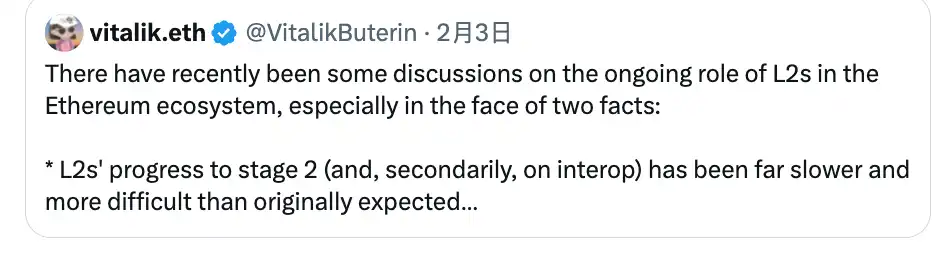
Now the designer himself says this path is no longer correct.
Less than two months later, at the EthCC Cannes conference on March 29th, Gnosis co-founder Friederike Ernst and zero-knowledge proof developer Jordi Baylina took the stage and released something called EEZ:
Full name Ethereum Economic Zone, Ethereum Economic Zone.
The Ethereum Foundation jointly funded it, and a group of protocols including Aave joined as founding members. The one-liner for what EEZ aims to do is to ensure that all L2 solutions are no longer isolated islands but become a connected continent.
The direction is certainly correct.
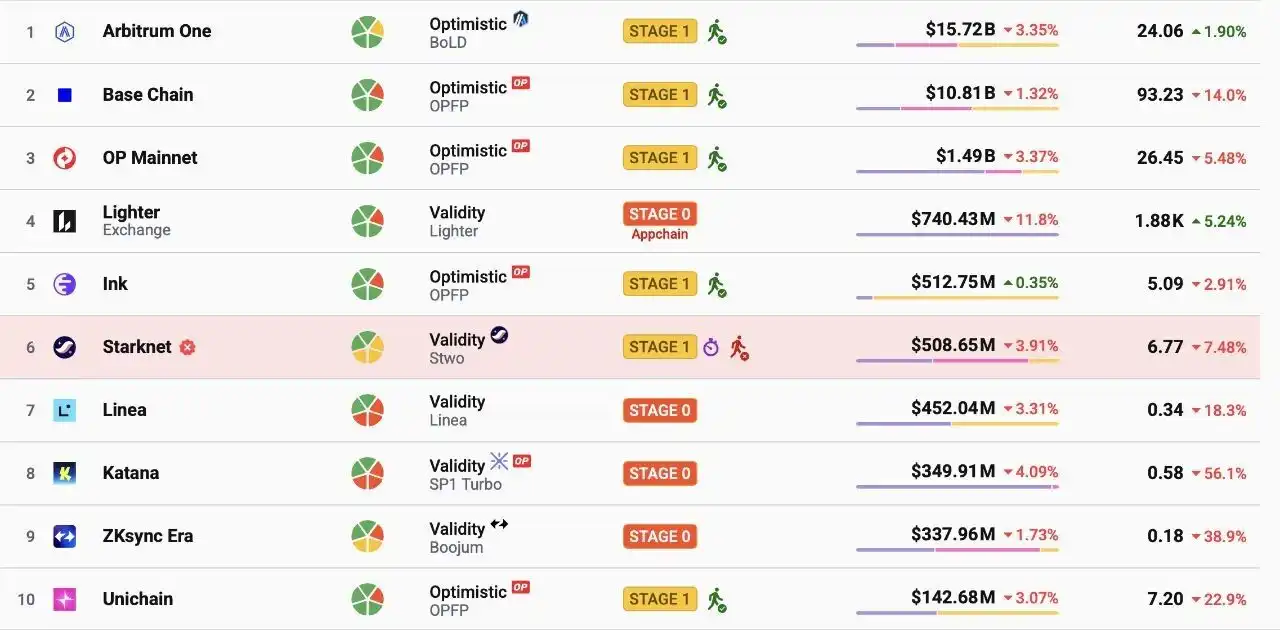
But the problem is, this archipelago has been built for five years... The island has also been extravagant, but now it's definitely deserted. Is it not too late to start digging tunnels now?
Is it worth trying to mend the fold after the sheep are lost?
From the name EEZ, you can actually see what Ethereum wants to do.
Everyone understands the logic of an Economic Zone, such as unified rules within the area, free movement of capital, and no barriers. The more than twenty L2 solutions in the past on Ethereum were like more than twenty small economies, each with its own customs, currency, and clearance procedures. A sum of money from Arbitrum to Base had to find a middleman to exchange and bridge.
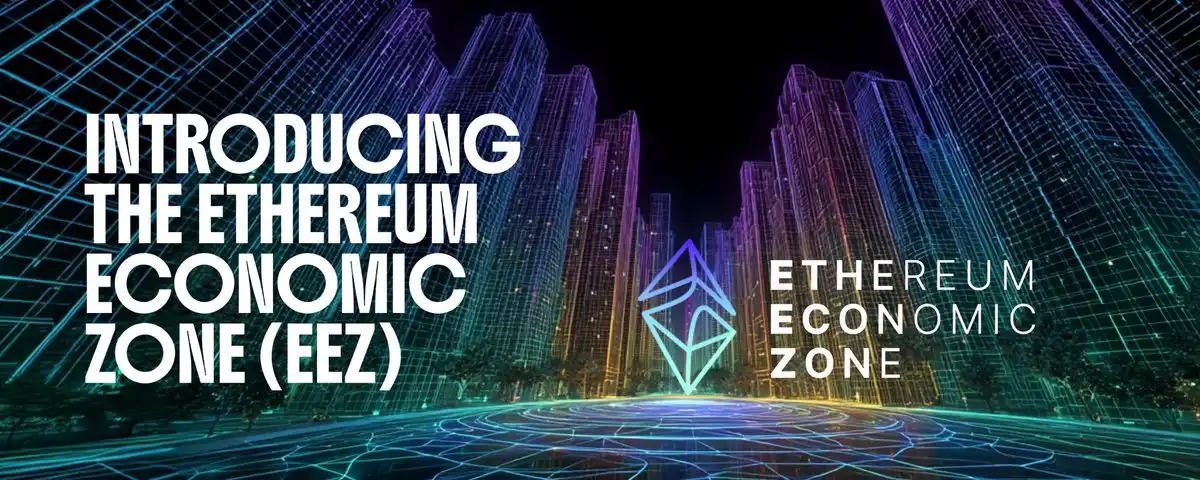
What EEZ needs to do is eliminate tariffs, adopt a common currency, and dismantle customs. Your operations on any chain can directly interact with contracts on another chain, settling back on the Ethereum mainnet with all Gas fees paid in ETH.
Does this sound familiar?
LayerZero and Wormhole told similar stories back in the day. Connecting all chains, enabling free asset movement... it's all old news.
The difference here is that those cross-chain protocols were asynchronous. For example, when you initiate an operation on Chain A, Chain B executes it after a while, introducing delays and failure risks, with the bridge itself being a prime target for hackers.
Now, this EEZ is synchronous. In a single transaction, contracts on both chains execute simultaneously, either both succeeding or both rolling back. The technical prerequisite for achieving this is real-time Ethereum block finality.
This was previously impossible. For two chains to operate synchronously, they must constantly reconcile each other's ledgers in real time. However, Ethereum produces a new block every 12 seconds, and the speed of reconciling the computations from the previous block has always lagged behind. Before the accounts are fully reconciled, the next block has already arrived.
This year, this speed limitation has been overcome technologically, turning synchronous operations from theory into engineering reality for the first time, giving rise to the EEZ proposal.
The direction is correct. But if you scroll through Twitter, who is still talking about Ethereum?
It's not just Ethereum that has cooled off; the entire industry has gone quiet. Last year saw the frenzy of meme coins, Solana's rise, and the trend of AI agents. From the beginning of this year until now, no narrative has emerged.
Ethereum has just cooled off more profoundly—ETH has plummeted from over $4800 at the end of 2025 to just over $2000 now, evaporating over 60%. Instead of significant anger in the community, there is more of a tired silence.
From Archipelago to Treasury Age
But if you look at on-chain data, you'll see a completely different picture.
According to AMBCrypto, the stablecoin supply on the Ethereum mainnet still stands at around $163.3 billion. Ethereum holds 58% of the $165 billion on-chain real asset market. Last year saw a net inflow of $9.9 billion into Ethereum spot ETFs. The DeFi TVL remains the highest in the industry, around $53 billion.
The people may be gone, but the money remains. And it's not retail money, it's institutional money.
The Ethereum Foundation's own moves also point in the same direction. Last year, it paused its public funding plans, reducing the burn rate to below 5% per year. However, just last week, it completed the largest single staking — 22,517 ETH, worth approximately $46.2 million, locked into the Beacon Chain.
While cutting the budget and locking funds in the treasury, it also funded one of the latest interoperability solutions.
All these actions combined point to one conclusion: the Ethereum archipelago era has indeed ended. But what replaces it is not a bustling continent.
It's a vault.
Quiet, sturdy, filled with institutional assets. Few reside there, but it holds the most money in the industry.
The Vault Doesn't Tax, Ethereum Doesn't Make Money
Ethereum's economic model has a simple cycle:
Users transact on the mainnet, transactions generate Gas fees, a portion of which ETH is permanently burned. The more people use it, the more is burned, and the ETH supply keeps decreasing.
When this mechanism started running in 2022, the community gave it a name: ultrasonic money. This means ETH is not only resistant to inflation, but also deflationary — harder than Bitcoin.
This narrative lasted for two years. Then L2 broke it apart.
After a large number of transactions moved from the mainnet to L2, mainnet Gas fee revenue plummeted. According to BitKE, Ethereum mainnet revenue has dropped by about 75% over the past two years. There was a week where the blob fees from L2 submitting data to the mainnet amounted to only 3.18 ETH.
3.18 ETH, at the time, was only about $5,000.
A network with $530 billion TVL, and a week's blob revenue enough to afford a decent dinner in Shanghai.
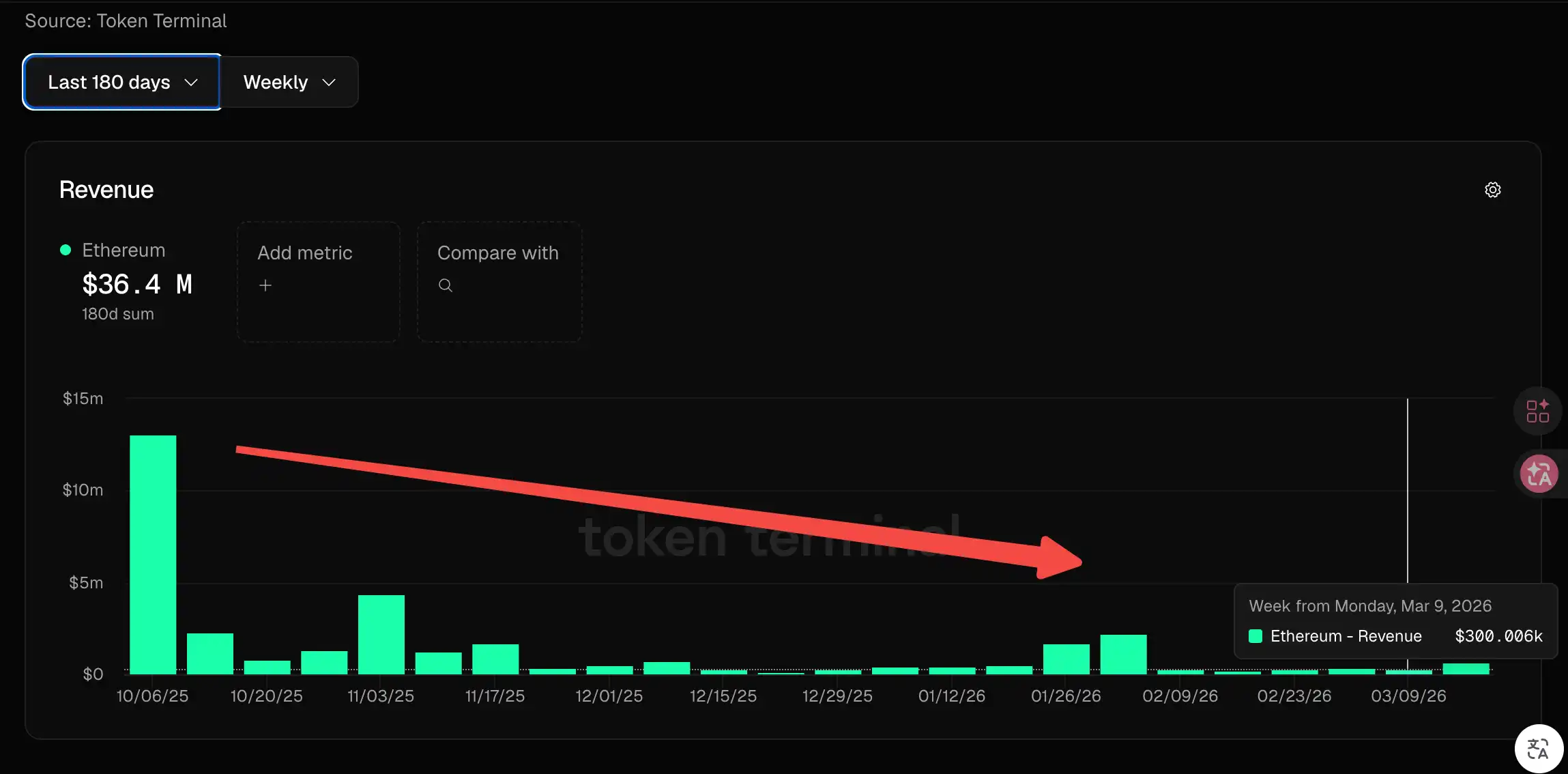
When the burns stop, the supply can't be constrained. In February this year, ETH's supply officially turned to net growth, with an annualized inflation rate of about 0.74%. The "ultrasonic money" has become an outdated marketing slogan.
This is the cost of the L2 roadmap. Users and transactions move to L2, L2 takes up the transaction fee revenue, and the mainnet is left with only settlement activity. Settlement is important, but settlement doesn't make money.
For example, Ethereum created an economic zone, relocating factories and shops into it, making the zone lively. However, tax revenue goes to the zone itself, and the central government's fiscal income keeps decreasing. The EEZ solution mentioned earlier aims to reconnect the zone to the center, but what reconnects is liquidity, not tax revenue.
Institutions' money is locked in the vault, very safe. But the vault itself, the asset that is ETH, is becoming increasingly hard to sell due to lack of income.
The price drops from 4800 to 2000 are not just emotional issues. When an asset's core narrative shifts from "deflation" to "actually inflation," the market will reprice.
The current situation Ethereum faces is:
The strongest industry-wide infrastructure, the most institutional capital industry-wide, but the economic model is leaking. EEZ fixes fragmentation, but it cannot fix this.
Is a house without residents valuable?
Back to the initial question: Do you still care about Ethereum?
Most people's honest answer might be not really. ETH is not appreciating, the narrative is outdated, it's cumbersome to use, and it's easier to use a neighboring protocol like Solana.
But rephrasing the question: Do you care about the water pipes under your home?
You don't care, as long as water comes out when you turn on the tap. You won't research what purification technology the water plant uses, you won't care what material the pipes are made of, and you certainly won't post on social media about the brand of water pipes.
Ethereum is turning into that water pipe.
530 billion TVL, 1633 billion stablecoins, 58% of the industry's real-world assets, nearly a hundred billion inflows into ETFs annually... These numbers indicate one thing, most of the global crypto finance's on-chain settlement still takes place on Ethereum.
It's not because users love Ethereum; it's because institutions can't find a second pipe of the same thickness.
What the EEZ economic zone is doing is essentially enlarging the diameter of this pipe—allowing institutional funds to flow faster between L2s, reducing settlement friction. This is useful, even necessary.
But pipes have one characteristic: No one is willing to pay a premium for pipes.
The water company is one of the most critical infrastructures in the city, but have you ever seen a water company with a higher P/E ratio than an internet company? The global clearing giant DTCC processes over $200 trillion in transactions annually, but hardly anyone talks about its stock price.
If Ethereum truly moves towards becoming a settlement layer, it will become extremely important yet extremely boring. Important in that all institutional money flows through it, boring in that no retail hodler is willing to hold ETH until it moons.
Yet, most ETH holders today are still pricing it based on the "city" narrative. User growth will happen, the ecosystem will thrive, L2 will benefit the mainnet, and the price will hit new all-time highs? This has been the story the Ethereum community has been telling itself for the past five years.
The reality is that Ethereum is turning into SWIFT, not into New York.
SWIFT processes $150 trillion in cross-border payments annually, and the global financial system relies on it. But no one speculates on SWIFT's stock because the valuation logic of infrastructure is stability.
ETH dropping from $4800 to $2000, it's not just emotions plummeting, it's the market reevaluating what this asset truly is.
If Ethereum's future is as a settlement layer, then the fair valuation of ETH should not be based on user count and ecosystem hype but on how much value it can capture annually as a settlement layer. At the current mainnet weekly $5000 blob income level, the answer doesn't look good.
The archipelago era is over. The EEZ is here, and institutional money is still in. But for those holding ETH, there is only one thing they really need to think about:
Did you buy a house in the city or just the right to use a pipeline?
You may also like
Global Crypto Tax Trends in 2026: From Bitcoin ETFs to DeFi Compliance
Bitcoin's 2025 peak of $126K is gone, but your tax bill isn't. New IRS Form 1099-DA means no hiding trades. Discover 3 legal strategies to reduce liabilities and use WEEX's free tax tool to automate reporting.

Airdrops cannot make you rich, edgeX does not need a community

Artificial intelligence agents are about to take away Visa's market share
2026 Crypto Tax Rules: How Bitcoin Price Changes Affect Your Filing
BTC trades around $67,500 today. If you sold near $126,000 last year, you still owe tax on those gains, regardless of where the price is now. Here's what every trader needs to know this tax season.

OpenClaw 3.28 Update: Potential Security Risks with Axios
Key Takeaways Recent findings suggest OpenClaw version 3.28 may contain a compromised version of the Axios library. Dependency…

Steakhouse Financial Experiences Phishing Attack: A Comprehensive Overview
Key Takeaways Steakhouse Financial’s domain experienced a phishing attack, prompting user safety advisories. Depositors’ funds and smart contracts…

DeFi Risk Management in Turmoil: Gauntlet’s Bold Move Amidst Resolv Exploit
Key Takeaways Gauntlet, a leading DeFi risk manager, is engaging in full recovery efforts after Resolv Labs’ exploit.…
FTX/Alameda Wallet Transfers Over $8 Million in ZRO Tokens to Wintermute
Key Takeaways An FTX/Alameda-associated wallet moved 4.126 million ZRO tokens to market maker Wintermute, with an approximate value…

Analysis of Recent Ethereum Short Position Activity on HyperLiquid
Key Takeaways Recently, a newly created wallet deposited $4.89 million into HyperLiquid, opening a short ETH position with…

Only 43% ROI on $1, why are 87% of Polymarket traders in the red?

AI has simultaneously created a shortage and surplus of memory

How Can the Average Person Win in the 2026 AI Boom?

When Wall Street Meets Crypto, Here's Your "Stock Market Beginner & Advanced Guide"
StandX Introduces SIP1 and SIP2: Holding Subsidy Mechanism Launched, Reshaping On-Chain Trading and Reward Structure
Decoding Aave V4: A Shift from Product to "Banking"

Huobi HTX Releases "2026 Digital Asset Trends Whitepaper": Global Liquidity Reconfiguration, Defining the New Era of "On-Chain Finance"

PUMP Valuation Breakdown: Debunking On-Chain Data “Wash Trading” Narrative, Where Does the Real Discount Come From?

StandX launches SIP1 and SIP2: Position subsidy mechanism goes live, reshaping on-chain trading and revenue structure
Global Crypto Tax Trends in 2026: From Bitcoin ETFs to DeFi Compliance
Bitcoin's 2025 peak of $126K is gone, but your tax bill isn't. New IRS Form 1099-DA means no hiding trades. Discover 3 legal strategies to reduce liabilities and use WEEX's free tax tool to automate reporting.
Airdrops cannot make you rich, edgeX does not need a community
Artificial intelligence agents are about to take away Visa's market share
2026 Crypto Tax Rules: How Bitcoin Price Changes Affect Your Filing
BTC trades around $67,500 today. If you sold near $126,000 last year, you still owe tax on those gains, regardless of where the price is now. Here's what every trader needs to know this tax season.
OpenClaw 3.28 Update: Potential Security Risks with Axios
Key Takeaways Recent findings suggest OpenClaw version 3.28 may contain a compromised version of the Axios library. Dependency…
Steakhouse Financial Experiences Phishing Attack: A Comprehensive Overview
Key Takeaways Steakhouse Financial’s domain experienced a phishing attack, prompting user safety advisories. Depositors’ funds and smart contracts…


 App
App