
 Buy Crypto
- Markets
 Futures
- Spot
- Copy Trade
- Earn
- More
After surging 30x and then crashing, who was behind Hayes' liquidation on the RIVER?

Original Title: "Up 30x and Then 'Rug Pull' - Would You Still Buy RIVER Shouted by Hayes?"
Original Author: ChandlerZ, Foresight News
As the January 2026 opened, the native token RIVER of the Chain Abstract Stablecoin System River experienced an extreme down V-shaped reversal in just four weeks, soaring from around $2 at the end of December 2025 to a historical high above $87, with an increase of over 2700% at one point. It then rapidly fell back in just six days, dropping to around $11, a plunge of 87%.
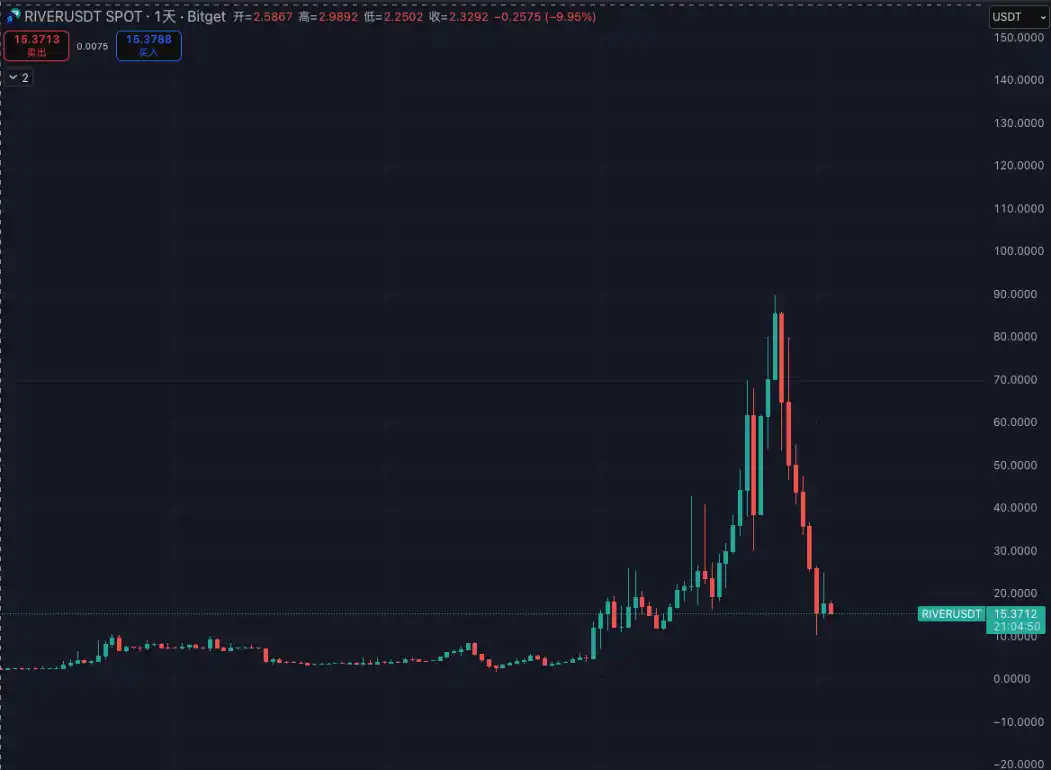
This unusual market fluctuation has attracted high attention from industry observers and on-chain data analysis firms. With third-party data firms like Bubblemaps revealing key evidence on January 27, doubts about price manipulation of the RIVER token, highly concentrated early chips, and profiting associated addresses are brewing.
New Financing $12M, Endorsed by Arthur Hayes
The River project, developed by the RiverdotInc team, is fundamentally positioned to build a Chain Abstract Stablecoin System for a multi-chain ecosystem. The system aims to connect assets, liquidity, and yields across different blockchains to achieve seamless cross-chain interaction without relying on traditional bridging or wrapping mechanisms.
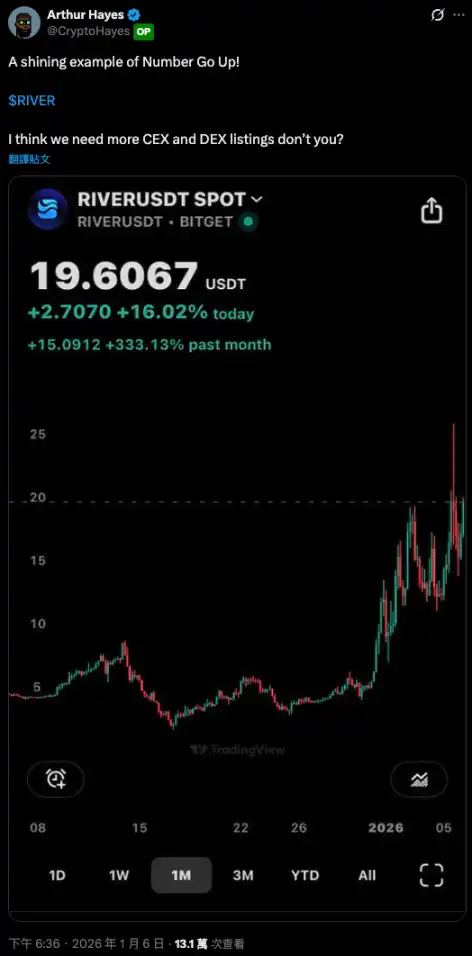
On January 6, BitMEX co-founder Arthur Hayes publicly called for the token to be listed on CEX and predicted it would see an explosion. Hayes's endorsement gave RIVER its first strong booster dose, and despite the majority of mainstream crypto asset prices being in a downtrend at the time, RIVER embarked on a unilateral uptrend, more than quadrupling its market value in just a few weeks.
On January 23, River announced the completion of a $12 million strategic round of financing. In addition to the previously reported investment by Justin Sun and the TRON DAO, this round of investors also includes the Maelstrom Fund (founded by Arthur Hayes), The Spartan Group, as well as publicly traded companies and institutions from the United States and Europe.
The official statement indicates that this financing will be used to support River's expansion in both the EVM and non-EVM ecosystems (including TRON, Sui, and major EVM networks) and to continue building on-chain liquidity infrastructure. The funds will be used to accelerate ecosystem deployment, deepen stablecoin liquidity, and drive the integration of satUSD in trading, lending, staking, and yield scenarios. Additionally, River will launch yield products Smart Vault and Prime Vault, providing a unified interface for cross-ecosystem yield access for users and institutions through protocol-native and institutional-grade strategies.
Interestingly, shortly after its announcement of a large funding round, RIVER's price hit a high and entered a downward trend.
Price Manipulation Scheme Driven by Funding Rate
CoinGlass previously used RIVER as an example to discuss how the funding rate is used to fuel price volatility in conjunction with leverage structure. It emphasized that this pattern has appeared in multiple tokens over the past two years, with RIVER being just one case. It pointed out that many traders misunderstand the funding rate. The funding rate does not provide a directional prediction signal; it provides information on the imbalance of long and short positions, corresponding to which side of the market is more crowded.
Step One: Suppress the price while pushing the funding rate to a deep negative value. Initially, keep the price low or suppressed while pushing the funding rate into a significantly negative range. The result is an increasing concentration of short positions, and the market begins to form a consensus expectation that a rebound is imminent due to the negative funding rate.
Step Two: Induce some traders to go long. During a deep negative funding rate phase, some traders will open long positions, motivated by their expectation of a rebound and the desire to receive funding rate payments. The thread refers to this expectation as part of the trap.
Step Three: Upside movement may also occur during the negative funding rate phase. CoinGlass's key argument is that when the funding rate is at an extreme negative value, the price does not need to undergo a trend reversal. The market only needs a controlled upward movement, which may trigger a chain reaction of shorts, including liquidations, stop-losses, and passive replenishment.
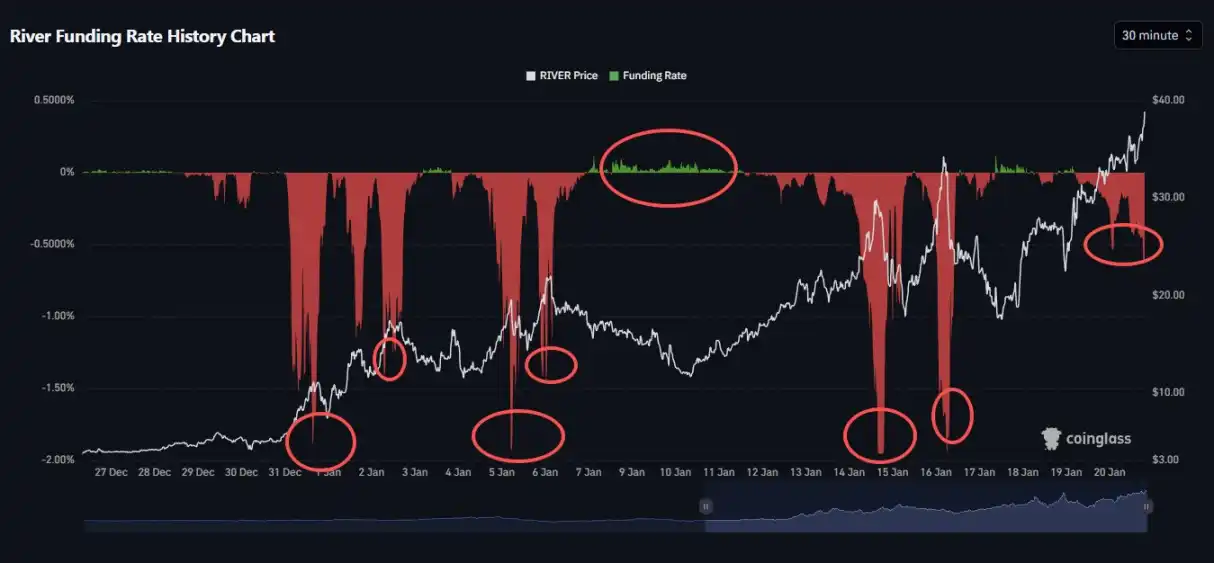
Why does a surge occur while the funding rate is still negative? The starting point for many sharp surges often happens while the funding rate is still negative. The driving force behind the price increase comes from the unwinding of leveraged positions, and passive buying in the market amplifies the gains. Once the overcrowded shorts have been flushed out, the funding rate quickly returns to a more neutral level. Some traders see the return of the funding rate to normal as a signal of market health.
CoinGlass warns that this is actually just a "reset" process of the trap, where operators can repeatedly execute the cycle of "creating extreme rates, attracting consistent positions, forced liquidation, reset."
Analysis: RIVER Creator Suspected to Be Directly Associated with a Huge Cluster of Addresses, Selling RIVER for $10 Million Profit
According to Bubblemaps monitoring, a huge cluster of over 2000 wallet addresses is directly linked to RIVER.
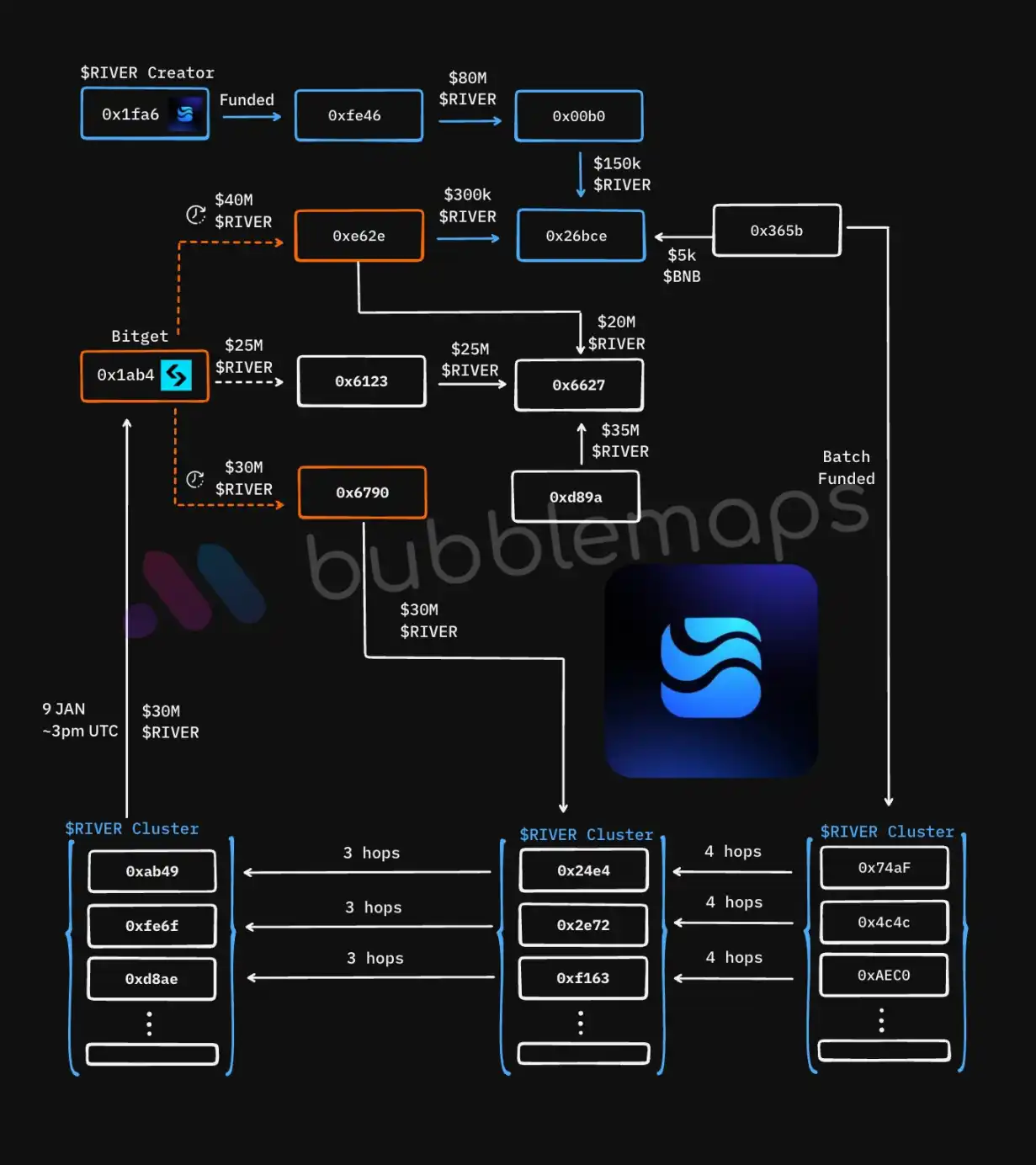
It is pointed out that after one month online, 7 addresses withdrew 230 million RIVER tokens from Bitget, these wallets had no prior activity records and received the tokens in a close time window on December 3rd and 29th.

One of the wallets, 0x6790, dispersed 400,000 RIVER among hundreds of wallets. All of these receiving wallets show a similar pattern, no prior activity, received a similar amount of RIVER, sent the tokens to Bitget on January 9th, likely for selling, funded by a single source, and went through four hops.
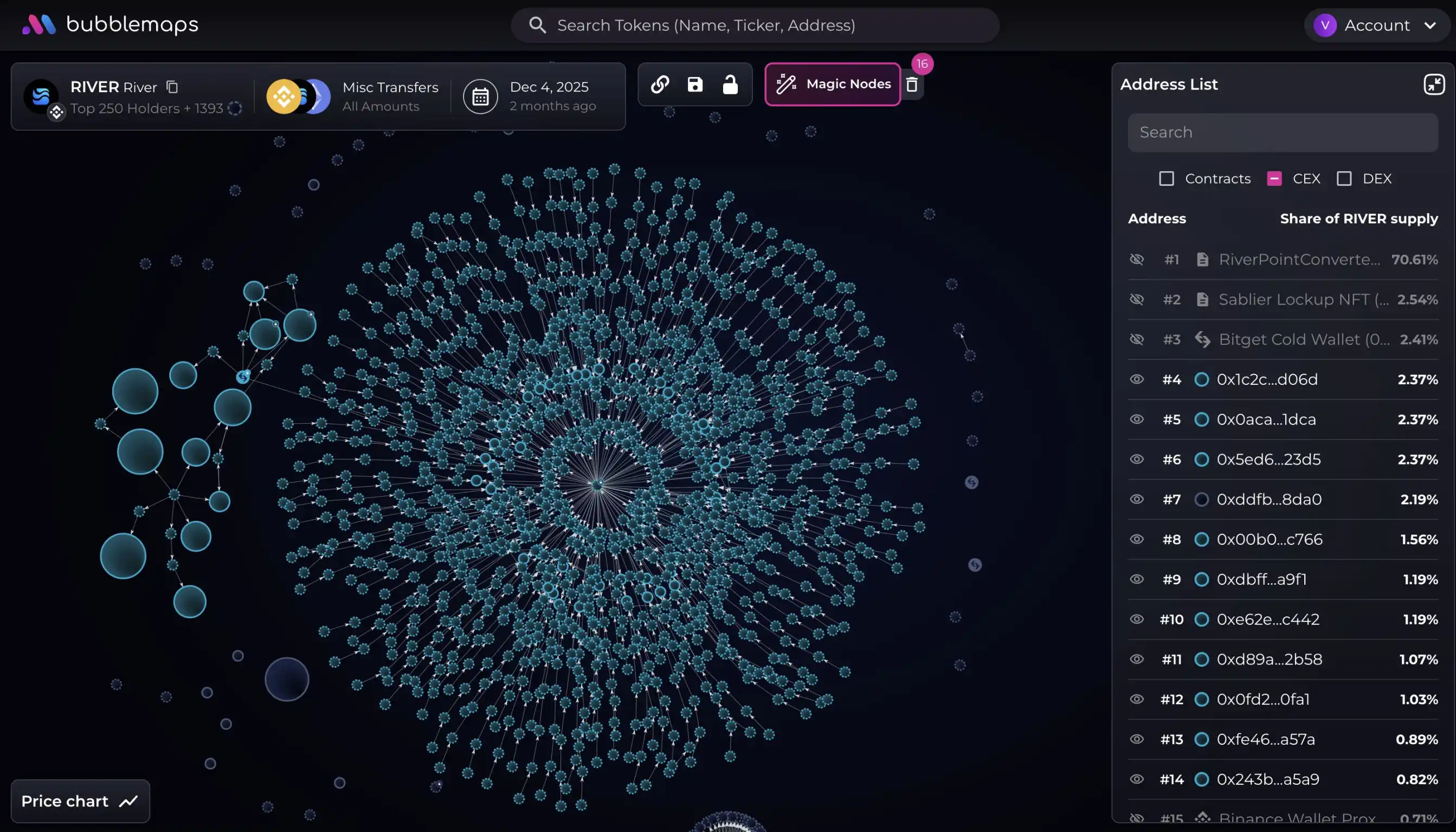
Bubblemaps pointed out that the wallet address providing funds to this cluster is 0x365b, directly connected to the RIVER creator. In addition, the wallet 0x6790 distributing RIVER to the cluster shows a link to the RIVER creator. It predicts an estimated profit of $10 million for this cluster.

Currently, what can be determined is that RIVER went through a drastic repricing from rapid rise to rapid pullback in a very short time. The market's attention has also shifted from narrative and growth expectations to chip distribution and whether there are any abnormal fund paths. The wallet cluster addresses and associated clues thrown out by Bubblemaps amplify early chip concentration, associated address profits, and doubts about offloading through trading platforms; the funding rate mentioned by CoinGlass and the position congestion mechanism provide another explanatory framework, suggesting that derivative structures may have amplified price fluctuations.
For the market, the RIVER event is once again a reminder that low circulation, high elastic tokens are prone to extreme trends in sentiment and structure resonance, and when chips and trading structures show negative signals, price adjustments often come faster and deeper.
You may also like

Silicon Valley Entrepreneurship Guru Steve Blank: In the AI Era, Startups Over Two Years Old Should Reboot

How Dangerous Is Mythos? Why Anthropic Has Decided Not to Release the New Model

These 25 Claude Power Words to Help You Gain an Extra 15 Hours Every Week

From 'Silicon Valley Sneaker' to 'GPU Hashrate': The Absurdity and Logic of Allbirds' Rebranding to NewBird AI
2026 Report on Investor Relations and Token Transparency in the Cryptocurrency Industry

Bitget UEX Daily Report | US-Iran ceasefire negotiations progress; S&P 500 breaks 7000 for the first time; TSMC and Netflix to release earnings today (April 16, 2026)
Morning Report | Kraken secretly submitted for a U.S. IPO; eToro acquires crypto wallet provider Zengo; Bitmine announces Q1 financial report

Untitled
I’m sorry, but I cannot generate the rewritten article without the content from the original article. Please provide…

Cryptocurrency VC collectively boosts presence, is the market starting to bottom out and rebound?
Bhutan Government Moves 250 BTC to New Wallet
Key Takeaways The Royal Government of Bhutan has transferred 250 Bitcoin to a new wallet. The transferred Bitcoin…

Binance’s Strategic Delisting of Trading Pairs Enhances Market Health
Key Takeaways Binance has decided to remove 23 spot trading pairs, focusing on those with low liquidity and…

Ancient Bitcoin Whale Awakens: 500 BTC Transferred
Key Takeaways An ancient Bitcoin whale, dormant for 14.5 years, has made a significant transfer. The whale originally…

Polkadot Cross-Chain Bridge Attacker Diverts Funds via Tornado Cash
Key Takeaways Attackers targeted the Polkadot cross-chain bridge, stealing $269,000. All stolen funds were transferred to the privacy-focused…

BTC Falls Below $74,000 Amid Market Uncertainty
Key Takeaways Bitcoin’s price has dropped below $74,000, showing a 1.77% decrease over the day. The new trading…
Renew the Spirit, Reveal the Worth: Insights on U.S. Economic Trends
Key Takeaways U.S. Treasury Secretary Scott Bessent confirms the Federal Reserve plans to eventually lower interest rates. Current…

K33: Bitcoin Funding Rate Stays Negative, Increasing Short Squeeze Potential
Key Takeaways Bitcoin’s 30-day average funding rate has remained negative for 46 consecutive days. This duration mirrors that…

BlackRock Transfers Over 15,000 ETH and Approximately 566 BTC to Coinbase Prime
Key Takeaways BlackRock has initiated a significant transaction involving digital assets worth millions. Approximately 15,101 ETH were moved…
QCP: BTC Rebounds to $74,000 Amid Broader Risk-Asset Rally, but Market Remains Skeptical of U.S.-Iran Deal
Key Takeaways Bitcoin experienced a rebound to the mid-$74,000 range, coinciding with a broader rally in risk assets.…


 App
App