
 Buy Crypto
- Markets
 Futures
- Spot
- Copy Trade
- Earn
- More
How to Automate Your Workflow with AI (No Code Required)

Original Title: how non-developers automate work like engineers (without writing code)...
Original Author: Damian Player
Translation: Peggy, BlockBeats
Editor's Note: While most people still see AI as a "more efficient search tool," Perplexity is starting to get work done.
This article revolves around a repeatedly overlooked difference—why do some people only get an answer when using AI, while others receive a deliverable outcome directly? The key is not in the model's capability, but in its usage: whether the tool is treated as a conversational window or as an executable system that can be commanded and scheduled.
Represented by Perplexity Computer, a new class of tools replaces "asking questions" with "tasks" as the core interaction method. From contract review, competitive analysis, to data cleansing and report generation, users no longer describe problems but directly define the final deliverable. Coupled with integration with enterprise tools, personal background hardening, and style examples, this capability further evolves from one-time output to a reusable, automatically executable workflow.
More importantly, the boundary of automation is being redefined. It is no longer just assisting in completing a step but can sustainably run, execute across tools, and even proactively propose additional tasks. This means that the relationship between humans and tools is shifting from "usage" to "management and delegation."
In this shift, the real watershed is no longer whether to use AI but whether you have already started using it to "deliver results."
The following is the original article:
Those who figure this out will gain an asymmetric advantage. Soon, everyone will learn how to do it. But before everything becomes obvious, here's how you can get ahead start.
Over the past year, developers have been running autonomous AI agents in the background (such as Claude Code, OpenClaw, etc.) that can conduct research, build products, and deliver complete results directly without requiring constant supervision or reminders. Yet, you've never been able to use this setup—unless you know how to use the terminal and write code.
Perplexity Computer changes that. This is the first time non-developers can access the same capabilities. All you need is a browser and a task to hand over to it for completion.
Most people open Perplexity, enter a question, get an answer, and then close the page. They miss the point. Perplexity Computer is not meant to answer questions; it is meant to perform tasks.
Stop asking questions and start delegating real work to it.

Why Most People Fail
Chief Financial Officers, Lawyers, Consultants... They open the tool, type in a question, get a decent answer, and think to themselves, "Oh, a fancier Google." Then they proceed to spend another 90 minutes cleaning up a spreadsheet they already cleaned up last Monday.
The issue is not with the tool but with the usage. They treat it like a chatbot.
Asking: "What risks are in this contract?"
Tasking: "Review this contract. Validate each statement against publicly available sources; highlight any vague wording, missing terms, or potentially litigious sections; list the top 5 key risk points with specific clause references; output a redline Word document."
Same contract. One approach gives you a list to read through yourself; the other approach directly gives you a client-ready deliverable.
Set Up This System in Just 10 Minutes
First, connect the tool. Click on the connectors in the sidebar. Perplexity can integrate with over 400 applications: Gmail, Google Drive, Slack, Salesforce, Notion, SharePoint... Connect the ones you actually use.
Then let it know who you are. Input once: "I am in a certain role, working in a specific type of company. I regularly produce X, Y, Z content. Please keep this background in mind for each session." It will retain this information long-term.
Tell it what "good" looks like. Find 2–3 of your most satisfactory outcomes, upload them, and input: "These are my best work examples. Please learn from their format and tone to use as a reference for future content generation."
This way, it's not guessing your style; it's reverse-engineering a successful path you have already validated.
10 minutes, start with this.
A Real Example: The 90-Minute Monday No More
Every Monday, a financial analyst would receive a data export: 150 rows of messy data with duplicate entries, three date formats, ratings in text instead of numeric form. She used to spend 90 minutes cleaning the data before she could even begin her analysis. The same issue, every week.
She entered just one command: clean the file, deduplicate, standardize date formats, convert text ratings to numbers; perform analysis on the cleaned data; generate an interactive dashboard with filtering capabilities and provide a sharing link; output a PDF report comparing pre- and post-cleaned data; save all files to the "Monday Report" folder on Drive.
4 minutes later: clean dataset, interactive dashboard, sharing link, PDF report—all appeared in her Drive.
Then she asked, "What improvement have I not yet asked for that would make this even more useful?"
The system suggested two things: first, automate this task to run every Monday morning at 7 a.m.; second, add a task to generate a Tuesday executive summary based on underperforming sectors.
She set up both tasks and closed the page.
Every Monday thereafter, it ran automatically—whether her computer was on or not.
This is the same set of capabilities developers have been using for the past year. Now, it's in your browser.
What People Have Been Using It For
@gregisenberg did a live test on @startupideaspod podcast.
He gave just one task: find companies advertising on competitive podcasts, identify the actual person responsible for sponsorship, and write a personalized email to each.
The system found Ramp's VP of Growth, grabbed a recent episode he was featured in, composed a cold email referencing his specific remarks on the show, and sent it off. Greg didn't say "send"; the system determined the task was complete and executed it on its own.
Then it proactively suggested: monitor competitive podcasts, immediately alert when a new brand starts advertising, and provide the corresponding contact—"reach out as soon as the budget starts rolling."
In the end, this process concurrently conducted research on 96 potential clients and scheduled follow-up emails on the 3rd and 7th days.
In the Marketing Against the Grain program, the team used Perplexity to audit the entire HubSpot product page: automatically crawling the entire site, scoring against custom criteria, sorting issues, and generating a shareable website report. What would have taken the team a week to accomplish was completed during the recording of the episode.
All of this was done live, not a demo, and not a scripted setup.
Specific Use Cases
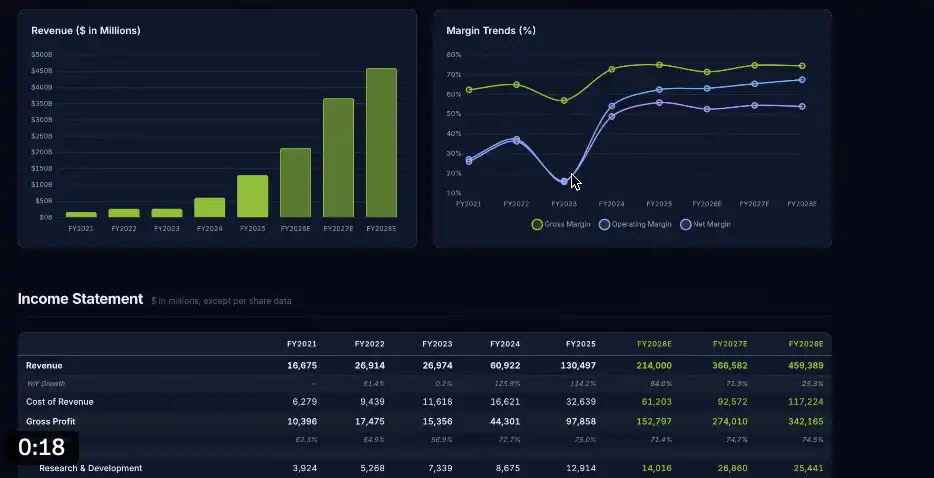
In the financial field, an investment portfolio analyst issued only one task before NVIDIA's earnings report.
The outcome was: a real-time interactive dashboard featuring $130.5 billion in revenue, 75% gross margin, 114.2% growth rate, full income statement, and profit margin trends forecasted from FY 2021 to FY 2028, all supporting filtering and sharing links.
No Excel, no manual data hunting, done in 5 minutes.
Perplexity can directly query SEC filings, FactSet, S&P Global, PitchBook, and other data sources—no API key needed, no additional authorization required, all built into the system.
Legal Scenario:
“Audit this contract. Review each provision for public reference support; highlight vague wording, missing standard clauses, and content that may create legal liability under [specific state] contract law; list the top 5 key risk points with specific clause references; output a Word document with tracked changes.”
An auditor once uploaded a proposal claiming a 43% year-over-year market growth. Perplexity Computer discovered the actual data was only 4%, flagging the issue before signing.
Marketing Scenario:
“Analyze the top-performing content of [Competitor 1], [Competitor 2], [Competitor 3] in the last 30 days; identify the most interactive content formats and topics; pinpoint content gaps; generate a 30-day content calendar based on these gaps and save it as a Google Doc.”
Set it as a recurring task. Auto-generate the latest competitor analysis every Monday without manual research.
Operations Scenario:
“Here is our Q1 CSV data. Please clean the data; analyze revenue by region and product line; identify the top three issues; create a one-page action plan; prepare a one-page presentation-ready PPT; save all files to the project folder.”
Five artifacts, one directive. It's done by the time you're in the meeting.
Model Council: Three judgments in 60 seconds
When faced with a decision that has real consequences, simply input your question once. Perplexity will simultaneously invoke Claude, ChatGPT, and Gemini, and a "Synthesizer" will summarize their consensus and discrepancies.
· Consistent Opinion: High-confidence conclusion
· Points of Divergence: Requires further judgment
Someone asked whether the product should be priced at $297 or $497. The three models provided different answers, but the Synthesizer found the only unanimous conclusion: do not go below $297. The decision is made.
Many companies spend money hiring consulting firms to lock analysts in a conference room to reach a conclusion.
Here, only one directive is needed.
The True Core Competency
To extract real value from the Perplexity Computer, 80% depends on one thing: can you clearly describe the "final output"?
Not the technical configuration. It's whether you are clear on what you are delivering. Do not describe the steps, describe the outcome.
After each task is completed, remember to ask, "Is there something I haven't asked that could make this output more useful?"
It almost always identifies blind spots. Every time, use it.
Start Here
Open Perplexity (pro version $20/month). Go to the Computer page, click on connectors, and first connect Gmail and Google Drive.
Input your three-sentence background (just once). Upload 2-3 of your best work samples to let it learn your style. Then select a task that took you over 2 hours last week and had similar outputs each time: describe it in terms of the "final deliverable," send it. Observe the execution process. If it's a recurring task, set it to run automatically before closing the page.
Developers have been using this system for a year. The gap between their output and others is real.
This is the way to bridge the gap.
You may also like

From "Kimchi Premium" to Bithumb's Rectification: An Interpretation of the Current Situation in the South Korean Crypto Market
Conversation with Pantera Founder: Bitcoin Has Reached Escape Velocity, Traditional Assets Are Being Left Behind

Is it still worth buying Circle on the callback?

BIT Launches Landmark "Same Name Virtual Account" Feature: Ushering in a New Era of OTC Trading that is Convenient, Efficient, and Compliant

Further Oracle Integration Reveals Polymarket's Ambitions

CoinGlass: 2026 Q1 Cryptocurrency Market Share Research Report

Tiger Research: Analysis of the Current Situation of Retail Investors in Nine Major Asian Markets

Forbes: Does quantum technology threaten the encryption industry? But it is more likely an opportunity

What Is Auto Earn? How To Claim Extra Free Crypto On Auto Earn 2026
What is Auto Earn and how do you use it? This guide explains how Auto Earn works and how balance increases and referrals may qualify for extra rewards during Auto Earn Boost Fest.
Auto Earn Compared 2026: Which Exchange Gives The Most Extra Bonus?
What is Auto Earn in crypto? Compare Kraken, OKX, Bybit, Binance, and WEEX Auto Earn features in 2026 and see which platforms provide additional promotional rewards beyond standard yield mechanisms.

Nearly $300M Targeting U.S. Midterm Elections, Tether Exec Leads Crypto Industry's Second-Largest Political Fund

Anthropic's Triple Moment: Code Leak, Government Standoff, and Weaponization
OpenAI and Anthropic both announced acquisitions on the same day, causing dual IPO anxiety.

Forbes: Quantum Technology Threatens the Crypto Industry? But It's More Likely an Opportunity

Rhythm X Zhihu Hong Kong Event Recruitment Skills, Register Now for a Chance to Showcase Live

CLARITY Act 2026 Update: Stablecoin Yield Ban, Senate Compromise, and What It Means for Crypto Markets
The CLARITY Act may reshape stablecoin yield rules, DeFi incentives, and crypto liquidity in 2026. Learn the latest Senate updates, timeline changes, and what the regulation could mean for crypto traders.
Bitcoin mining companies flee for the Nth time



 App
App