
- Buy Crypto
- Markets
 Futures
- Spot
- Copy Trade
- Earn
- More
IOSG: Power Flexibility Paradigm Shift: From Macro Assets to Distributed Intelligence Layer

Original Title: "IOSG Weekly Brief | Power Flexibility Paradigm Shift: From Macro Assets to Distributed Intelligence Layer #317"
Original Author: Benji Siem, IOSG Ventures
Introduction
This research began with a simple observation: the power system is being asked to perform a task it was never designed to do.
With the accelerating penetration of renewable energy, the comprehensive advancement of electrification, and the surge in AI-driven data center demand, the traditional mode of "building more generation and transmission facilities to meet peak loads" is eroding. Infrastructure construction cycles are too long, grid queues are heavily backlogged, and capital intensity remains high.
In this context, flexibility — the ability to dynamically adjust supply and demand in real-time — has evolved from a supporting function to a core pillar of grid reliability. What was once primarily reliant on the flexibility supply from large industrial loads and peaker plants is transforming into a complex multi-layered market, where distributed energy resources (DERs), software platforms, and aggregator consortia coordinate millions of assets to maintain system balance.
We are at a structural inflection point. The winners of this transformation will not be the players controlling generation assets but those building the connectivity and orchestration layers, unlocking flexibility at scale. Emerging crypto-native coordination models and token-based incentive mechanisms may further accelerate this shift by enabling decentralized participation, transparent settlement, and global liquidity of flexibility services.
As this article will delve into, flexibility is no longer just a technical capability; it is becoming an emerging economic infrastructure — creating new pools of value through revenue stacking across capacity markets, ancillary services, demand response, and local markets, reshaping how energy is transacted, managed, and monetized.
Key Points
The power flexibility market is at an inflection point. Rising penetration of renewable energy, growing data center demand, and regulatory impetus are creating a structural supply-demand imbalance for flexibility services.
The demand for powering AI and application development is quickly outstripping the grid's available supply capacity, key driving factors include:
Global data center electricity consumption is projected to double by 2030 to around 945 TWh, slightly higher than Japan's current total electricity consumption. AI is the key driver of this growth, while demand for other digital services continues to rise. It is worth noting that a lack of flexibility could also be a constraining factor in AI growth.
The power market urgently needs operational efficiency and flexibility to mitigate risks. In the context of lagging infrastructure development, the demand for and necessity of flexibility services have significantly increased.
· Many regions' grids are already under significant pressure: It is estimated that unless capacity risks are addressed, around 20% of planned data center projects may face delays.
· The United States currently has about 10,300 power projects queued for grid connection, with a total capacity of 2,300 GW—equivalent to twice the country's existing total installed generation capacity—due to grid operators' difficulty in addressing grid congestion.
An intermediary layer that aggregates and connects infrastructure will emerge as the biggest winner. It builds a critical bridge between the supply side (users with idle capacity) and the demand side (strained grid operators).
A platform that is software-centric, aggregates, and optimizes distributed energy resources (DERs) will gain a disproportionate share of value as the market expands from around $98.2 billion in 2025 to around $293.6 billion in 2034 (2025-2034 CAGR of 12.94%).
Flexibility Market Overview
What Is Flexibility in the Energy Market?
In the power system, flexibility = the ability to rapidly adjust generation and/or demand in response to signals (such as electricity prices, grid congestion, frequency, etc.) to maintain supply-demand balance and avoid blackouts.
Historically, flexibility has come almost entirely from flexible generation units (gas peaker plants, hydro). As the scale of renewable energy and electrification expands, system operators now also procure flexibility from the following sources:
· Demand Response: Load that can be curtailed or shifted in time
· Energy Storage: Batteries, electric vehicles, thermal storage
· Distributed Generation: Rooftop solar, small-scale cogeneration, etc.
The "Flexibility Market" is a market and contract aggregation where flexibility is bought and sold,
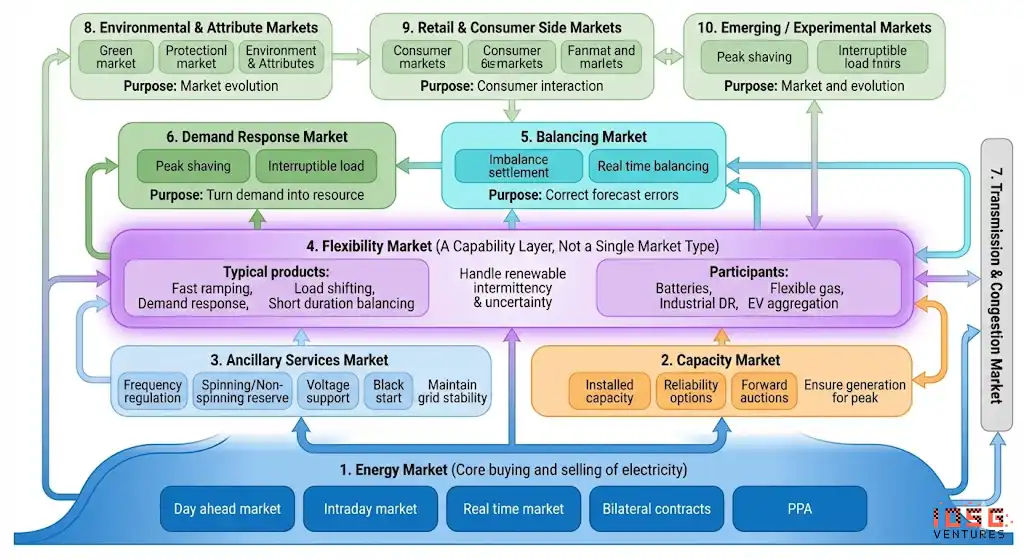
including wholesale markets, balancing/ancillary service products, capacity markets, and local distribution system operator (DSO) flexibility platforms. Aggregators act as intermediaries, providing a platform for grid operators to procure flexibility from end-users, forming a crucial infrastructure layer (see the "Flexibility Trading and Pricing" section for more details). Settlement is handled by the Transmission System Operator (TSO), with the TSO paying fees to the aggregator, who then pays customers after deducting a commission.
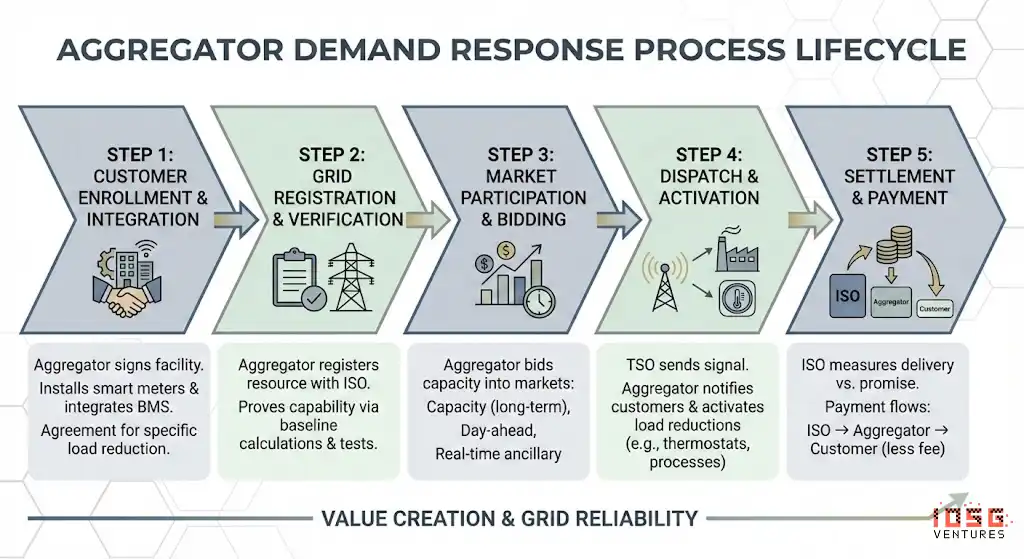
Flexibility delivery occurs in two ways:
· Implicit Flexibility: Automatically achieved through a static price signal, such as time-of-use electricity pricing. For example, a smart EV charger automatically delays charging to off-peak hours with lower prices. Price signals drive the behavior.
· Explicit Flexibility: Involves an active response to specific requests from grid operators. These actions are intentional and coordinated through a market platform for direct compensation.
Detailed Example
· Step 1: Customer Enrollment
An aggregator (e.g., CPower) contracts with a manufacturing company, installs monitoring equipment (smart meters, controllers), and integrates them into their building management system. The customer agrees to curtail a 2 MW load when called upon.
· Step 2: Enrollment with Grid Operator
The aggregator registers this 2 MW (along with thousands of other sites) as a "demand response resource" with the ISO. The aggregator must demonstrate that the resource can indeed deliver, including baseline calculations, metering agreements, and sometimes testing dispatch.
· Step 3: Market Participation
The aggregator bids the aggregated capacity into various markets:
· Capacity Market (annual/multi-year): "I commit to maintaining 500 MW available during the summer peak."
· Day-Ahead Energy Market: "I can curtail 200 MW of load tomorrow from 16:00-20:00."
· Real-time Support Service: "I can respond to frequency deviation within 10 minutes"
· Step Four: Scheduling
When the grid requires flexibility, the TSO sends a signal to the aggregator. The aggregator's software platform then takes action: notifies registered customers (via SMS, email, automated control signals); activates pre-programmed load reduction (such as raising temperature setpoints, dimming lighting, pausing industrial processes); monitors real-time performance.
· Step Five: Settlement
After the event concludes, the ISO measures the difference between actual delivery and committed capacity, and the fund flow is as follows: ISO → Aggregator → Customer (minus aggregator commission).
Key Players
Exchange — Market Platform
Flexible trading venues where these platforms match buyers (DSO/TSO) with sellers (aggregators, DER owners). Fast frequency reserve markets also provide another trading platform.
· Representative Projects
EPEX SPOT, Nord Pool, Piclo Flex, NODES, GOPACS, Enera
· Business Model
Cleared trade fees (typically 0.5-2% of transaction amount or €0.01-0.05/MWh)
Market access subscription/membership fees (participant annual fees)
Some platforms operate as regulated utility services (cost-recovered through grid tariffs), while others are commercially operated
· Pricing
· Platforms do not set prices but facilitate price discovery through auctions (payment by bid or uniform clearing)
· Congestion management prices on local flexibility platforms (Piclo, NODES) are typically €50-200/MWh
· Wholesale balancing market prices can soar to €1,000+/MWh during scarcity events
· Prices on classic wholesale markets (such as EPEX) may be negative, with the equivalent effect of actively procuring flexibility in a dedicated flexibility market
Aggregator / Virtual Power Plant (VPP)
A controller of a flexible asset pool whose revenue depends on winning contracts and dispatching load/storage correctly.
· Represented Companies
Enel X, CPower, Voltus, Next Kraftwerke, Flexitricity, Limejump
· Business Model
· Revenue share with asset owners: Aggregator retains 20-50% of market revenue, remaining paid to customers
· Upfront registration fee or monthly SaaS fee charged to asset owners
· Performance bonus possible for exceeding utility dispatch targets
· Pricing
· Capacity payment: $30-150/kW·year (varies by market and product)
· Energy payment: Pass-through of market price (minus aggregator profit)
· Typical customer benefits: Commercial & Industrial (C&I) load $50-200/kW·year, residential battery $100-400/year
· Distributed Energy Resource Management System (DERMS) / Optimization Software
· Software enabling forecasting, control, bidding, and compliance, serving as the intelligent layer of the entire system. Can be embedded within aggregator platforms.
· Represented Companies
AutoGrid (Uplight), Enbala (Generac), Opus One, Smarter Grid Solutions, GE GridOS, Siemens EnergyIP
· Business Model
· Enterprise-level SaaS license: Annual contract based on managed MWs or controlled asset quantity
· Implementation/Integration Costs: One-time project fee for utility deployments ($500K - $5M+)
· Managed Service: Performance-based ongoing optimization as a service
· Pricing
· Software licensing typically ranges from $2-10/kW·year (varies by functionality and scale)
· Total contract value for large utility DERMS deployments can reach $5-20 million+ (over 5 years)
· Some vendors offer revenue-sharing models (5-15% of incremental value)
Asset Owner
Physical suppliers: EVs, batteries, thermostats, heat pumps, industrial loads, etc.
Grid Buyer
Buyers: Procuring flexibility to manage congestion, balance, and peak load for utilities and system operators, including DSOs, TSOs, suppliers, and municipal utilities.
· Representative Entities
PJM, CAISO, National Grid ESO, TenneT, UK Power Networks, E.ON, Con Edison
· Business Models
· Regulated entities, costs recovered from users through grid tariffs or capacity charges
· Procurement when flexibility is cheaper than infrastructure alternative solutions ("non-wire alternatives")
· Some vertically integrated utilities operate internal DR projects, outsourcing the rest to aggregators
· Procurement Pricing
· Capacity Procurement: $20-330/MW·day (PJM 2026-27 auction reached $329/MW·day)
· Ancillary Services: $5-50/MW·hour (frequency response, spinning reserve)
· DSO Local Flexibility: €50-300/MWh (usually auctioned on a pay-as-bid basis)
· Rule of Thumb: Flexibility must be cheaper than grid reinforcement (aiming for around 30-40% savings)
· Figure 1: Mechanism Overview
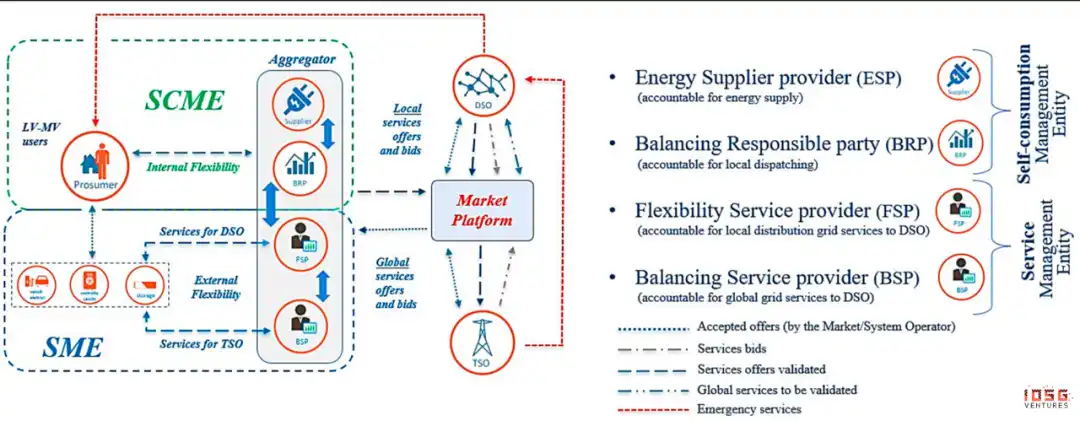
1. Distribution System Operator (DSO): A company that manages the local electricity grid (distribution lines, substations), responsible for delivering electricity from the main transmission lines to homes and businesses.
2. Transmission System Operator (TSO): A key entity that manages and maintains the high-voltage network (grid and gas pipelines), responsible for transporting energy from producers over long distances to local distribution companies or large users.
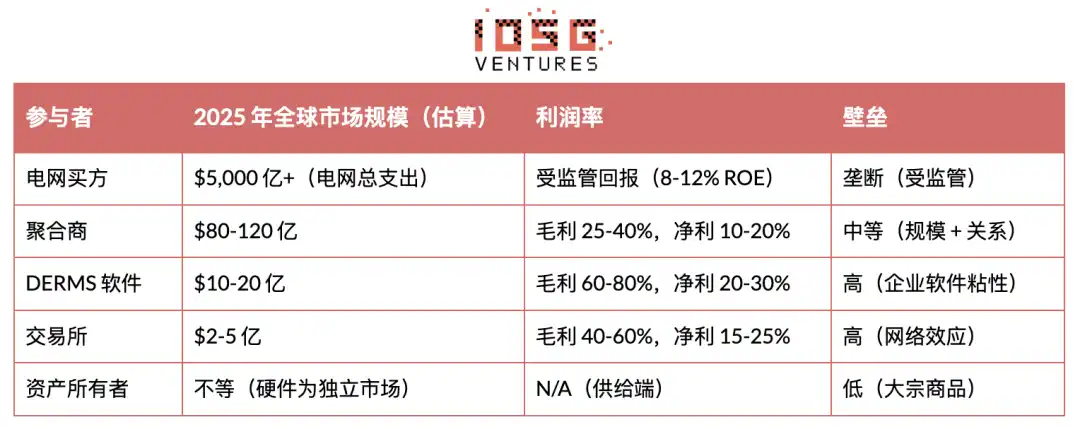
Participant Revenue Scale Estimation
Industry Status
The power system faces a structural supply-demand imbalance in generation capacity and grid infrastructure. This contradiction is reflected in two interrelated issues: an unprecedented backlog in grid interconnection queues and a surge in demand from electrification and data centers.
Grid Interconnection Queue Backlog
By the end of 2024, over 2,300 GW of generation and storage capacity in the U.S. alone are seeking grid interconnection—double the existing installed power capacity of 1,280 GW. This backlog has become a major bottleneck for clean energy deployment.
Demand-Side Pressures
· Data Centers: Global electricity demand is expected to double by 2030 to 1,000-1,200 TWh (equivalent to Japan's total electricity consumption).
· PJM Capacity Market: Prices surge from $28.92/MW·day (2024-25) to $329.17/MW·day (2026-27), a more than 10x increase, primarily driven by data center commitments.
A 5-year demand forecast by U.S. grid planners almost doubles; AI data centers require 99.999% uptime and massive power consumption.
· Grid Upgrade Costs: The EU requires €7.3 trillion in distribution investments + €4.77 trillion in transmission investments by 2040; flexibility can offer 30-40% cost savings compared to infrastructure buildout.
Flexibility Trading and Pricing
Grid operators (such as PJM, ERCOT, CAISO, etc., ISO/RTOs) need to balance supply and demand in real time, but they cannot communicate directly with millions of distributed assets (thermostats, batteries, industrial loads). Therefore, aggregators act as intermediaries.
The aggregation merchant we analyze (Enel X, CPower, Voltus) is situated between two parties:
1. Grid Operator/Utility needing flexible capacity
2. End-use customer with flexible load or assets
The aggregator bundles thousands of small distributed resources into a single "virtual power plant" to participate in wholesale markets bidding as if it were a traditional power plant.
Settlement Mechanism
Unlike generation (measured in MWh output), demand response is measured in MWh not consumed. This requires establishing a "baseline" — the amount of electricity a customer would have consumed in the absence of a DR event. Common baseline methodologies include:
· 10-of-10 Rule: Taking the average consumption over the past 10 similar days at the same time.
· Weather Normalization: Adjusting the baseline based on temperature differentials.
· Ex-ante/Intra-event Measurement: Comparing consumption before and during the event.
Settlement Example:
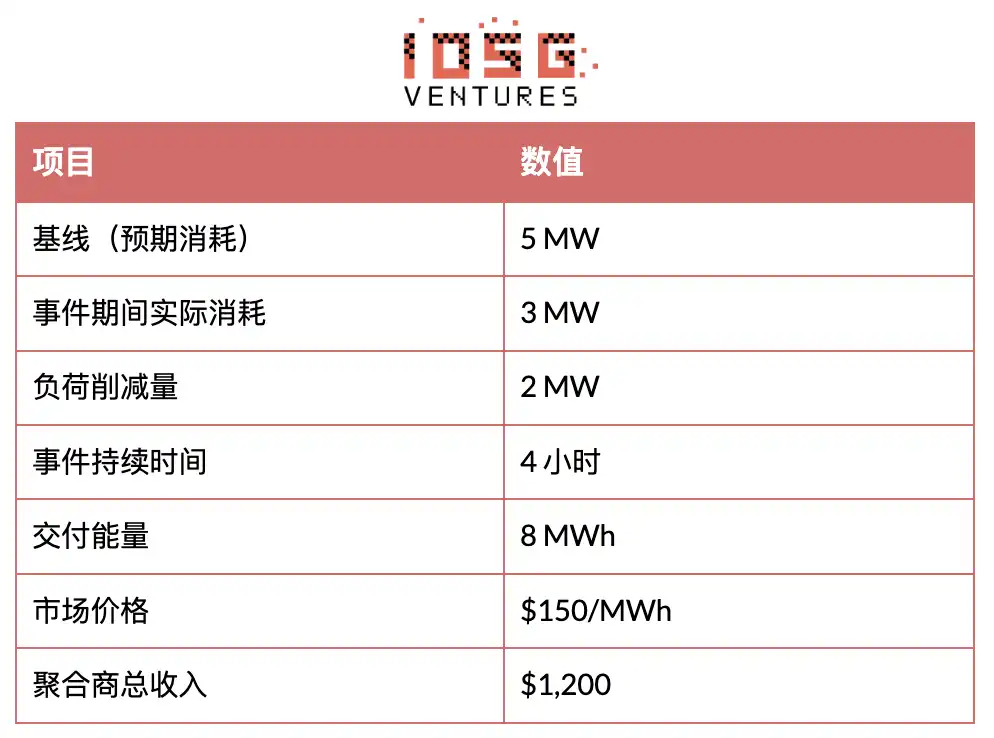
The aggregator then compensates the customer according to the contract (usually 50-80% of the total revenue), with the balance being the aggregator's revenue.
Flexibility is monetized through various market mechanisms, each with different timeframes, product types, and pricing structures. Suppliers can engage in "revenue stacking" across multiple markets to maximize asset returns.
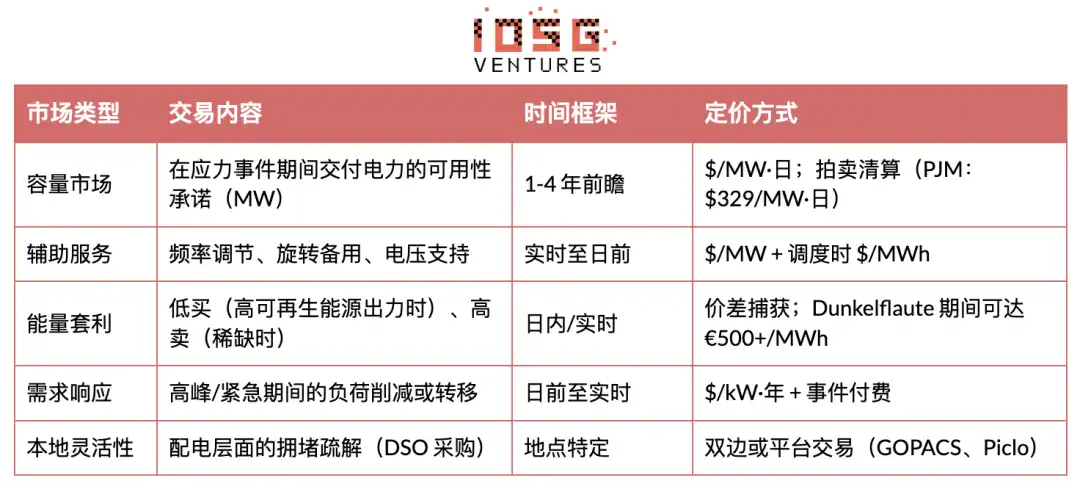
Additionally, Energy Communities — localized citizen and small business cooperatives empowered by EU policy — are becoming a significant force in flexibility aggregation. There are approximately 9,000 communities across the EU, representing around 1.5 million participants.
· By pooling behind-the-meter assets (such as PV, batteries, and controllable loads), these communities overcome the scale and coordination barriers that typically prevent individual households from accessing multiple revenue streams from flexibility.
· This aligns directly with research: Flexibility providers can "stack" value across capacity markets, ancillary services, energy arbitrage, demand response, and local DSO markets. Energy communities have created organizational and operational frameworks necessary for reliable cross-market participation, transforming dispersed DERs into a coordinated portfolio, democratizing flexibility revenue while supporting a decarbonized and resilient grid.
Why Flexibility Matters
Flexibility services provide a faster and cheaper alternative to building new generation and transmission facilities. The deployment speed of a Virtual Power Plant is equivalent to customer onboarding—no need to queue for grid connection. The Brattle Group estimates that VPP peak-shaving capacity is 40-60% cheaper than gas peaker plants or utility-scale batteries. ENTSO-E estimates that in the EU alone, flexibility can save €50 billion in annual generation costs.
For Grid Operators: Real-time supply-demand balancing; reducing reliance on expensive peaker plants and transmission upgrades; improving renewable energy integration; enhancing grid resilience during extreme weather events.
For Asset Owners: Unlocking new revenue streams from existing assets (batteries, EVs, HVAC, industrial loads); stacking multiple services can increase returns by 30-50%; minimal operational disruptions.
For Consumers: Lowering electricity bills through demand response incentives; avoiding costs associated with infrastructure investments through deferral; improving reliability and reducing outages.
For Energy Transition: Achieving higher renewable energy penetration rates without wind and solar curtailment; providing decarbonization grid services (replacing gas peaker plants); accelerating deployment compared to infrastructure-constrained alternatives.
Structural Tailwinds
1. Regulatory Drive: FERC Orders 2222/2223 (US), EU Demand Response Network Codes (2027), UK BSC P483 enabling 345,000 households participation. 45+ countries globally are introducing flexibility markets.
2. Grid Investment Wave: US utilities expect $1.1 trillion in grid investments by 2029. EU needs €7.3 trillion in distribution + €4.77 trillion in transmission upgrades by 2040. Flexibility presents a more cost-effective solution.
3. Data Center Demand: Global data center electricity consumption set to double by 2030 to 1,000-1,200 TWh. PJM capacity prices are forecasted to increase by 10x (2024→2027), driving both flexibility demand (grid stress) and supply.
4. DER Stacking: 4M+ US Residential PV Systems; 240K+ Home Batteries; 1M+ EV Sales by 2023. Critical mass reached, empowering aggregators and DER economics.
Key Risks to Watch
Oversupply post-2030: Large-scale battery storage investment may squeeze flexibility market margins. Pumped hydro revival in some markets.
Cybersecurity: Millions of distributed assets expand the attack surface. EU AI Act classifies grid operation as 'high risk.' NFPA 855 adds 15-25% cost to urban battery storage.
Aggregator Business Model
Revenue Streams
1. Capacity Payments ($/MW·year or $/MW·day): Largest and most predictable revenue stream. Customers compensated for availability, even if never dispatched. E.g., PJM capacity prices reached $329/MW·day in 2026-27 auctions.
2. Energy Payments ($/MWh): Payment for actual load reductions during events. More volatile, depending on dispatch frequency and market prices.
3. Ancillary Services ($/MW + $/MWh): Frequency regulation, spinning reserve, etc. Higher value but requiring faster response (seconds to minutes). Voltus pioneered access to these higher-profit-margin products.
Cost Structure
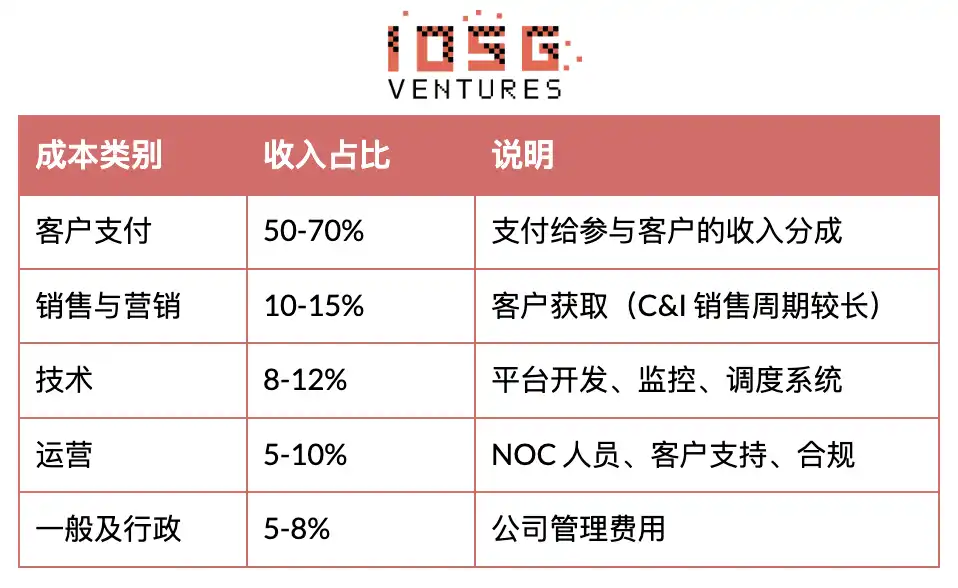
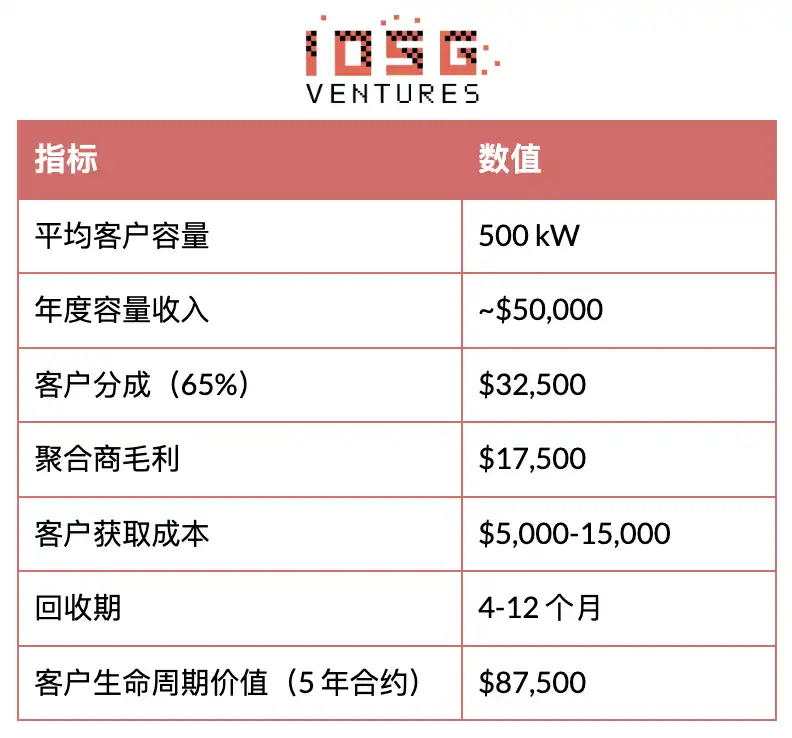
Unit Economics Model Example (C&I Customer)
Revenue Stacking: How Aggregators Maximize Value
The most mature aggregators 'stack' multiple revenue streams from the same asset:
Example: 10 MW industrial load in PJM
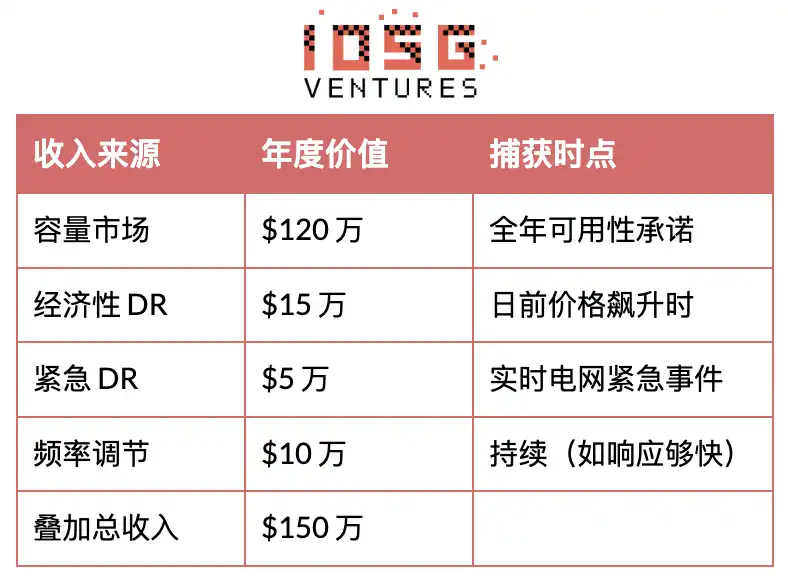
This is why Enel's DER.OS and Tesla's Autobidder emphasize 'coordinated optimization'—their AI determines at each moment which markets to participate in to maximize total returns.
Aggregator Layer Key Players Deep Dive
Enel X — Global Market Leader
· Company Overview
Enel X is the demand response and distributed energy business unit of Enel Group, one of the world's largest utility companies (with annual revenue exceeding €860 billion). The company traces its origins back to EnerNOC, a demand response pioneer founded in 2001 and acquired by Enel in 2017. Today, Enel X operates the world's largest commercial and industrial virtual power plant, with over 9 GW of demand response capacity in 18 countries and 110+ active projects.
· Scale and Coverage
· Global Capacity: 9+ GW under management (Q1 2025), aiming for 13 GW
· North America: ~5 GW, covering over 10,000 sites in 31 U.S. states and 2 Canadian provinces
· Projects: 80+ demand response projects, 30+ utility partnerships (11 exclusive bilateral agreements)
· Customer Payments: Nearly $20 billion allocated to DR participants since 2011
· Technology Investment: Over $200 million invested in platform development
· Strategic Partnerships
In September 2024, Enel X partnered with Google to aggregate 1 GW of flexible load from data centers — the world's largest enterprise VPP. This collaboration showcases the integration of data center demand growth with flexibility supply: enabling a major cloud services provider to drive grid stress while also serving as a key provider of demand-side flexibility through its UPS batteries and load-shifting capabilities.
· Technology Platform: DER.OS
Enel X's DER.OS platform employs machine learning-driven scheduling optimization, which, according to internal audits, can increase profitability by 12% compared to rule-based strategies. The platform streams data from over 16,000 corporate sites and operates a 24/7/365 network operations center for real-time dispatch management and monitoring.
· Core Customer: Commercial & Industrial (C&I) Facilities
These are large power consumers with interruptible loads—processes that can be temporarily reduced without significant disruption:
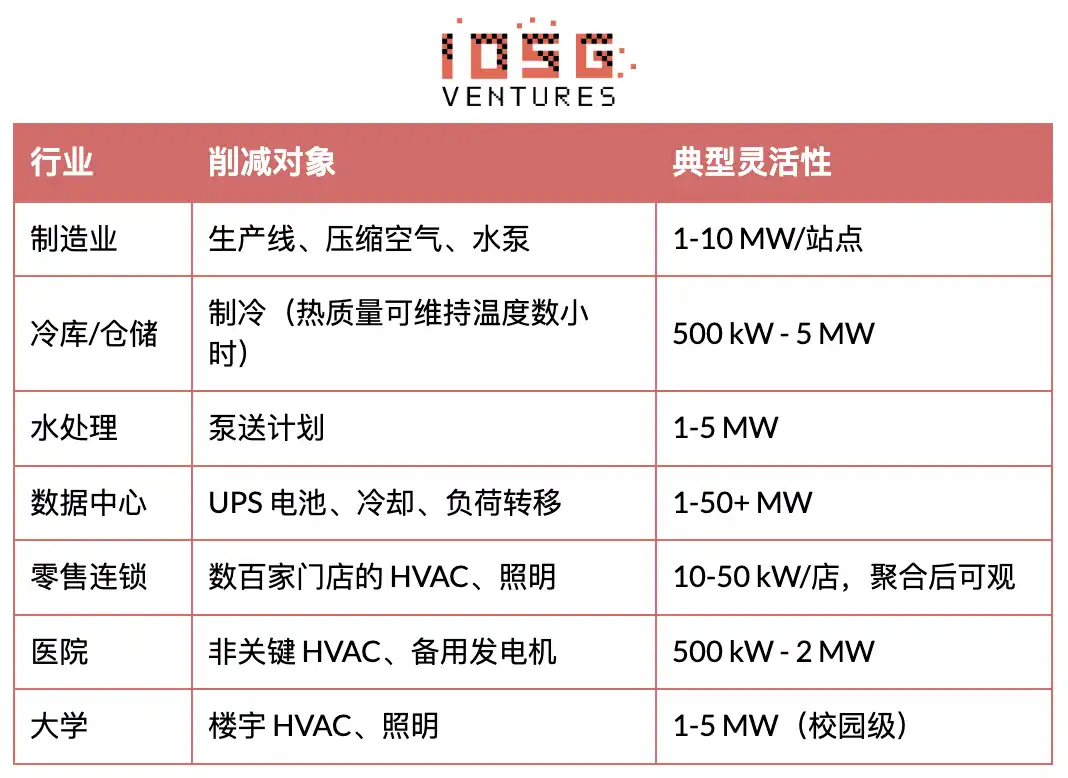
· Key Insights
These customers already own the "asset" (their power load). Enel X merely helps them monetize the flexibility they didn't know they had. Enel X is squarely positioned on the demand side and asset-light, not building or owning generation assets. Demand reduction on the grid is equivalent to supply addition.
· Deep Meaning of Google Partnership
The September 2024 Google deal is notable as it disrupts the traditional model:
· Traditional Model: Enel X recruits facilities → Aggregates into VPP → Sells to the grid
· Google Model: Google data centers become flexible asset → Enel X operates VPP → Grid operator buys flexibility
Google data centers have large-scale UPS battery arrays (typically used for backup), flexible cooling loads, and some workload scheduling flexibility. Google no longer consumes grid flexibility, but offers it—Enel X is the orchestration layer. This is a practical embodiment of the "Data Center as Grid Asset" argument.
· Revenue Model Breakdown
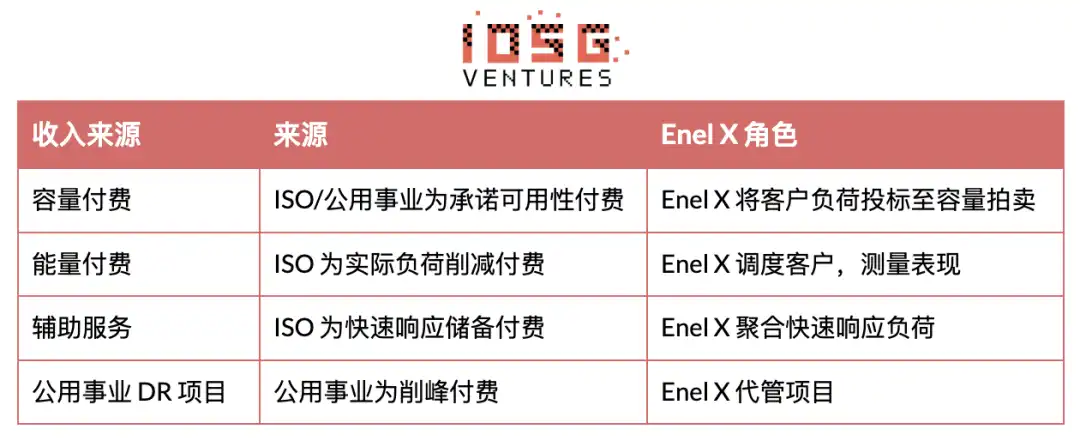
· Competitive Position
· Strengths: Largest global scale, deep utility relationships, integrated clean energy ecosystem (11 GW renewable + 1 GW storage), mature platform, financial backing from Enel Group
· Weaknesses: Traditional enterprise sales model, slower innovation cycle compared to pure startups, higher corporate overhead
· Strategy: Focus on C&I segment market, utility-scale renewable integration, data center flexibility partnerships
Voltus—Software-First Challenger
· Company Overview
Voltus was founded in 2016 by former EnerNOC executives Gregg Dixon and Matt Plante, positioning itself as a technology-first alternative to traditional demand response providers. The company's argument is that superior software and broader market coverage can overcome scale disadvantages. As of September 2025, Voltus has ranked first in managed GW capacity for the third consecutive year in Wood Mackenzie's North America VPP report.
· Scale and Financing
· Capacity: 7.5+ GW of managed capacity (as of September 2025), a significant increase from 2 GW in 2021
· Market Coverage: Active in all 9 U.S. wholesale electricity markets and Canada—geographically the broadest coverage among pure-play aggregators
· Financing: Total funding of $121 million (investors include Equinor Ventures, Activate Capital, Prelude Ventures)
· SPAC Attempt: Announced a $1.3 billion SPAC merger in December 2021 (valued at $1.3 billion), transaction not completed
· Differentiation Strategy
· Voltus differentiates itself on three dimensions:
(1) Pioneering Innovation—The company was a pioneer in gaining access to operational reserve projects across multiple grid operators;
(2) Widest Market Coverage—Active in projects that competitors avoid due to complexity;
(3) DER Partnerships—Not competing with equipment manufacturers but partnering with OEMs like Resideo and Carrier to aggregate their installation base into a VPP.
· Data Center Focus
In 2025, Voltus launched the Bring Your Own Capacity (BYOC) product, designed specifically for data centers and hyperscale cloud providers. BYOC allows data center developers to deploy VPP-driven grid flexibility alongside project development, offsetting capacity needs by procuring flexibility from Voltus's distributed network to shorten electrification timelines. Partners include Cloverleaf Infrastructure.
· Core Customer: C&I Facilities (similar to Enel X)
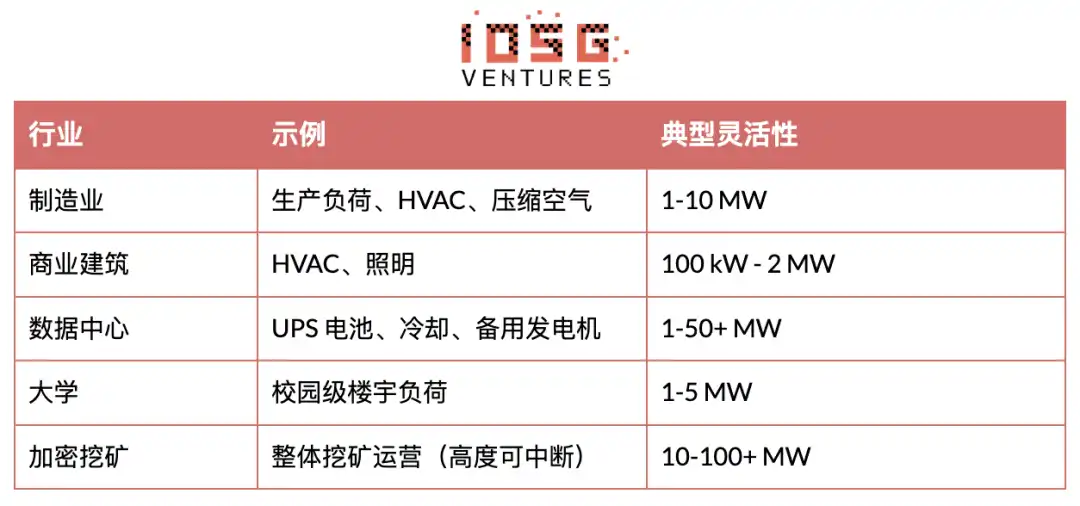
· OEM Partnership
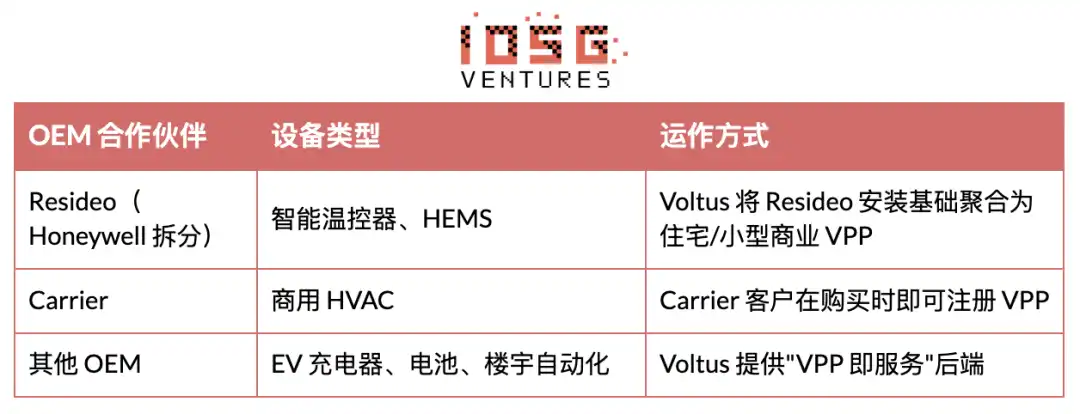
· Why OEM Model Matters
Customer Acquisition Cost (CAC) is the aggregator's largest expense. Through OEM partnership:
· OEM manages customer relationships
· Voltus provides software and market access
· Revenue is shared among OEM, Voltus, and end customers
· CAC is significantly lower than direct enterprise sales
Different Revenue Sources: Voltus vs Enel X
· Enel X: Primarily capacity market
· Predictable (annual auctions)
· Lower $/kW but at scale
· Requires large MW commitments
· Voltus: Actively pursuing ancillary service projects avoided by competitors
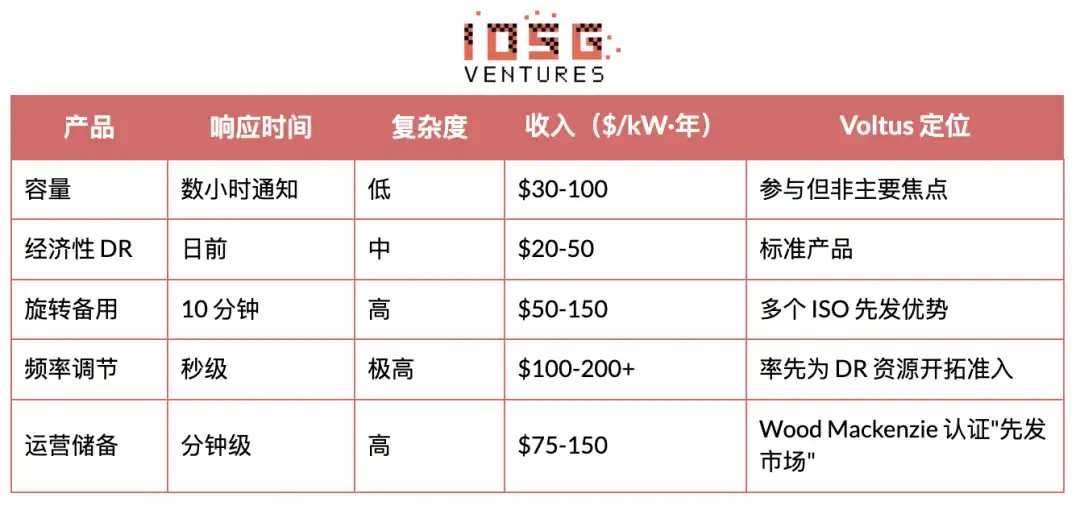
· Why Choose Ancillary Services?
Higher $/kW (2-3x capacity market); fewer competitors (complexity as a barrier); requires sophisticated software (Voltus's strength); but demands quicker asset response.
· Competitive Position
· Strengths: Technological sophistication, broadest market coverage, regulatory influence (former FERC Chairman Jon Wellinghoff serving as Chief Regulatory Officer), OEM partnership strategy, data center positioning
· Weaknesses: Smaller scale than Enel X, lack of utility-scale asset base, venture capital-backed burn rate, SPAC failure
· Strategy: Third-party DER Monetization, Ancillary Services First-Mover Advantage, Data Center Partnerships
VPP/Aggregator Investment Evaluation Criteria
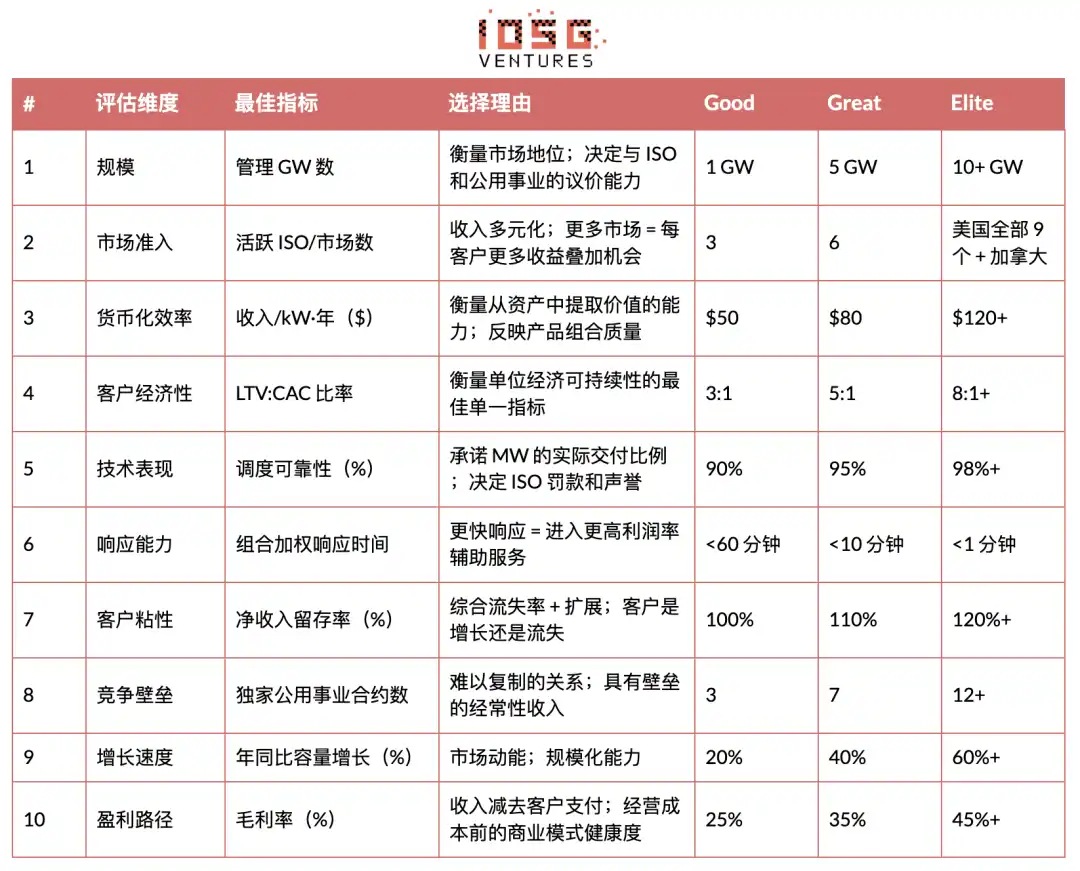
EU vs US Market
With robust supportive regulations and highly interconnected infrastructure, the EU has been leading the way in whole-system flexibility expansion compared to the US. Eurelectric notes that the liberalized EU market effectively incentivized collaborative participation of producers and consumers, continuously enhancing flexibility supply;
Meanwhile, the large-scale adoption of smart meters has driven the implementation of time-of-use pricing, laying the foundation for demand response.
· Market Design: Liberalized market mechanisms drive active participation from both supply and demand sides, with smart meters enabling time-of-use pricing for load shifting
· Interconnected Grids: The EU's robust cross-border interconnections have significantly reduced outage frequency and duration, providing industrial users with a stable and reliable power supply
The US harbors substantial untapped customer-side flexibility potential, with studies showing the ability to achieve large-scale load reductions (e.g., 100 GW) with minimal customer impact.
· Grid Edge Focus: The rapid proliferation of Distributed Energy Resources (DERs) has made flexible management at the "grid edge" increasingly critical for US utilities
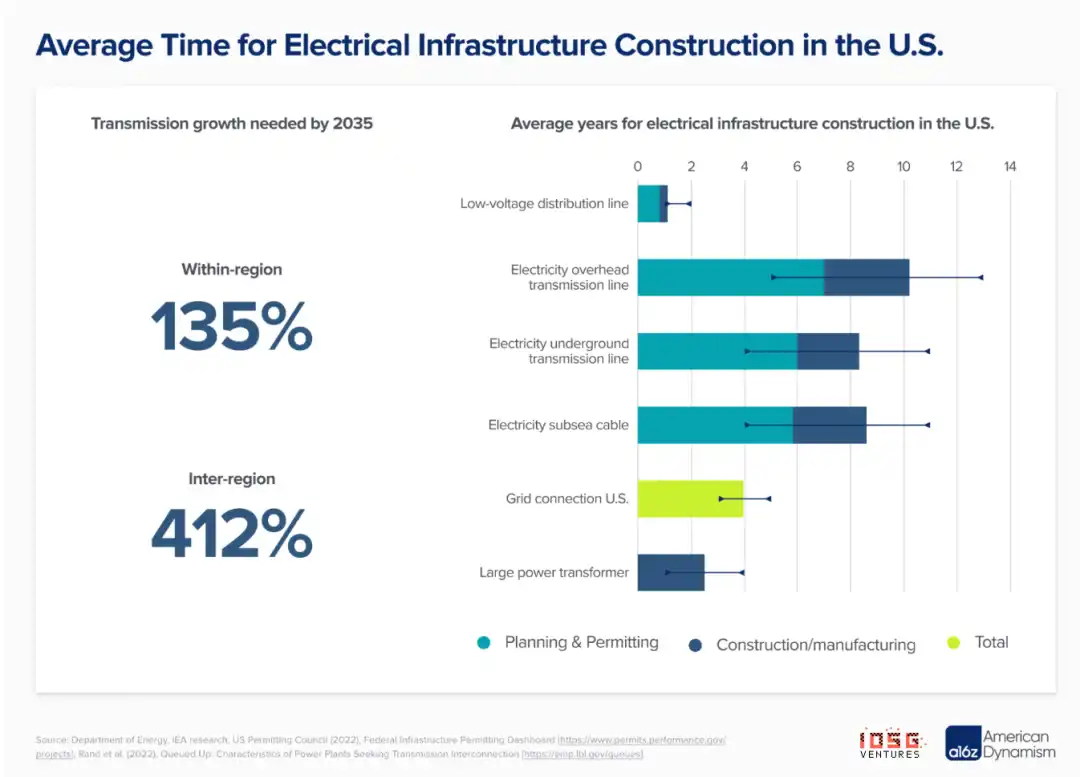
“The grid's inherent fragility demands that we treat every asset connection with caution to ensure reliable supply matches forecasted demand. The rapid growth of intermittent power sources (unstable supply) synchronized with the electrification wave (peaky demand) is posing severe challenges to the power system.” ——a16z
Conclusion
Thus far, flexibility has been predominantly driven by “Macro-Flexibilities” — large industrial-grade assets (>200 kW) connected at the transmission or high-voltage distribution level. These assets are attractive due to their ease of identification, contracting, and dispatch. However, this model is reaching a structural bottleneck.
Macro-Flexibilities are no longer sufficient, leading to power shortages and cascading issues such as grid connection delays. This increases system fragility and is becoming a critical bottleneck for AI-driven load growth.
Therefore, the next unavoidable frontier: Micro-Flexibilities. This refers to small behind-the-meter assets in the 1-10 kW range connected to the medium- and low-voltage grid, including EV chargers, heat pumps, HVAC systems, batteries, and household appliances. These assets, when aggregated, represent a capacity several orders of magnitude larger than macro sources but are significantly harder to access.
Current approaches to accessing this flexibility have largely left significant value uncaptured, creating an opportunity for flexibility owners to fill this gap and participate in the ecosystem. An aggregator that directly reaches critical mass, independent of suppliers or equipment brands, can create a powerful multiplier effect. Once users are horizontally aggregated, energy companies and OEMs will be economically incentivized to participate actively, rather than trying to control customer relationships from the outset.
At the core of all this, I believe DePIN has the greatest opportunity to disrupt this field and create long-term value through encrypted-native infrastructure and incentive mechanisms. By increasing capacity and opening up new pathways to access flexibility, this niche area will innovate the current power market, enabling AI to continuously reshape the world under unconstrained conditions.
You may also like
Best AI Crypto Trading Bot? Inside the AI Trading System That Ranked Top 3 on WEEX
Discover the best AI crypto trading bot on WEEX. Learn how AI trading works, how to trade automatically, and why this system stands out among top AI trading apps.
How to Trade Cryptocurrency Without App Store: Instant Browser Crypto Trading on WEEX
Trade crypto instantly without downloading an app. Use WEEX H5 to access spot and futures trading directly in your browser with fast execution, real-time risk control, and seamless experience across mobile, tablet, and desktop. Supports Bitcoin, Ethereum, and more.

From OKX to Bybit, exchanges are changing tires on the highway at high speed

A Brief History and Future of Perpetual Contracts
AI Agent Gets ID and Wallet on the Same Day | Rewire News Morning Brief

Murata 35% Price Increase Explained: A Capacitor that Gives AI Empire a Cold
MiniMax: A Henan County Youth and His 300 Billion

From Abandoned Project to Sky-High Target, Mastercorp Acquires BVNK for $1.8 Billion

Is Polymarket's Pricing Accurate? I Simulated a Crisis with 200 Agents to Find Out

A Decade of Regulation Finally Clarified, Victory for Crypto-Native Logic

The United States Establishes the "Five Categories Law" for Cryptographic Assets: A Summary to Understand the New Regulatory Framework

Morning Report | Mastercard plans to acquire BVNK for up to $1.8 billion; Solana Foundation launches aggregator Tokens on Solana; Bitcoin sees its first 8 consecutive rises in four years

Aster Chain officially launches: defining a new era of on-chain privacy and transparency

Stargate Debut Illustrated: The 1.4 Trillion Computing Power Empire Dream, Awakened
A Billion-Dollar Life Buy Threat Triggered by an Iranian Missile
BlackRock Launches ETHB: Ethereum ETF Enters 'Interest-Bearing Age'
Nvidia Starts Putting Chips in the Road | Rewire News Evening Update
RootData: February 2026 Cryptocurrency Exchange Transparency Research Report
Best AI Crypto Trading Bot? Inside the AI Trading System That Ranked Top 3 on WEEX
Discover the best AI crypto trading bot on WEEX. Learn how AI trading works, how to trade automatically, and why this system stands out among top AI trading apps.
How to Trade Cryptocurrency Without App Store: Instant Browser Crypto Trading on WEEX
Trade crypto instantly without downloading an app. Use WEEX H5 to access spot and futures trading directly in your browser with fast execution, real-time risk control, and seamless experience across mobile, tablet, and desktop. Supports Bitcoin, Ethereum, and more.


 App
App