
 Buy Crypto
- Markets
 Futures
- Spot
- Copy Trade
- Earn
- More
Myanmar in Turmoil: The Sanctity of the Dollar, Trapped Youth, and the Underground Financial System

Original Article Title: "Myanmar in Flames: The Dignity of the US Dollar, Trapped Youth, and the Underground Financial Market"
Original Article Author: Joe Zhou, Foresight News
During the 2026 Chinese New Year holiday, I traveled to Myanmar for a two-week on-the-ground research trip.
Passing through Yangon, Bagan, and Mandalay, I attempted to uncover the true colors of the country's economy, finance, and social fabric amid the shadows of war. As the first part of my journey, this article will showcase the real Myanmar I witnessed.
Just within the first week in Yangon, the overwhelming density of information far exceeded my imagination:
A 9-year-old child who dropped out of school to carry plates, middle-aged men who could be forcibly conscripted at any time, young people unable to obtain passports to leave the country, and foreigners who exploit the economic disparity to "buy wives" here...
In Yangon under warlord control, bars and KTVs still maintain a lively atmosphere; yet in many other cities in Myanmar, as soon as the 7 p.m. curfew sets in, the streets instantly fall silent, resembling a ghost town with no signs of life.
This is a vast, folded system. Amidst the flames of war and corruption, in the crevices, and as prices soar, ordinary people's lives are being pushed to the edge.
Myanmar's Folding
To understand this rift, one must first see the triple "folding" that exists in this country.
There are two Myanmars in this world: one under the Internet filter, and one in reality; one Myanmar embellished in official data tables, and one struggling in the black market.
The first fold is an unfathomable exchange rate rift. Upon arriving in Myanmar, I exchanged 2,500 RMB at a Chinese restaurant and received 1.38 million Myanmar Kyats. While the official rate boasts 1:300, the true black market exchange rate has plummeted to 1:550.
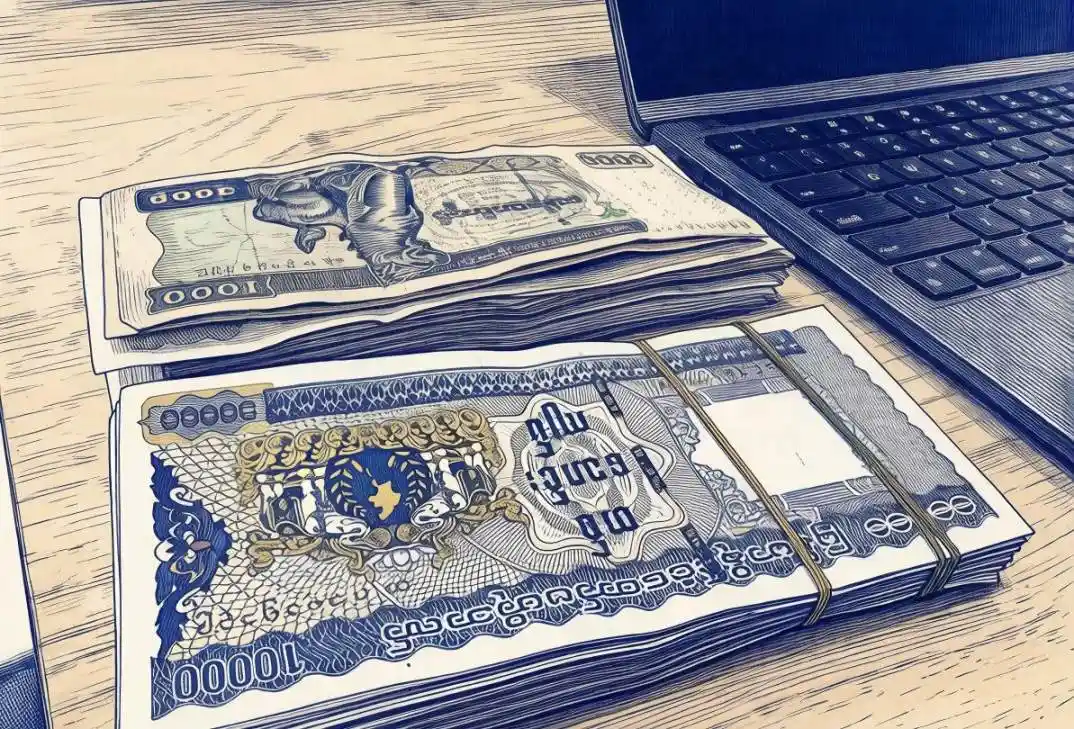
The 1.38 million Myanmar Kyats I exchanged
The country's official exchange rate is a facade, while the black market rate is the real deal.
The second fold is the cliff-like disparity in wages. A plate-carrying server in Hong Kong earns around 18,000 RMB per month, in Shanghai it's 8,000 RMB, but in Bagan, Myanmar, this number plunges dramatically to a suffocating 300 RMB.
Even within Myanmar, the urban-rural gap remains significant. A Chinese immigrant who has long lived in urban areas told me that the monthly salary of a service worker in a major city can reach 500 to 800 yuan—meaning that even for the highest-paid group in Myanmar, their income is only one-tenth of their counterparts in Shanghai.
The third fold is the demonized online labels versus the simple reality. On the Chinese internet, Myanmar is simplistically reduced to the synonym of "throat-slitting" and online fraud. But when you truly walk the streets of Yangon, Bagan, and Mandalay, you will find that the majority of people here still maintain extreme simplicity and peace. While indeed the northern part of Myanmar is dangerous, filled with conflicts and illicit economies, fundamentally, those evils have little to do with the vast majority of ordinary Myanmar people—in this grand geopolitical and interest-driven meat grinder, they are similarly the most helpless victims.
The "Dignity" of the US Dollar
This underlying economic crack and insecurity find their most absurd expression in currency.
In Myanmar's underground financial market, there is an ironclad rule: the US dollar must not be folded, rejecting any paper bill with marks or damage.
The common knowledge in economics that a "stepped-on $10 bill still holds value" is completely ineffective here. Even a very light crease on this bill will lead to merciless rejection by vendors. Every Myanmar person I have encountered who handles US dollars seems to be like a dealer examining precious antiques under a magnifying glass, holding their breath, carefully examining every inch of the bill's edges and every hidden line.
In stark contrast is the undignified local currency—the Myanmar Kyat can be crumpled into a ball, stuffed into a pocket, or even thrown into water for a bath, and still be spent afterward; but the US dollar must remain in perfect condition. In the locals' subconscious, a damaged dollar is equivalent to impure gold, facing a 10% to 20% discount penalty.
This almost pathological "cleanliness" vividly embodies the extreme fragility of this country's financial system. Prolonged sanctions and complete financial isolation have led to an extreme disparity between the official and black-market exchange rates. In this nation devoid of all senses of security, the dignity of a green paper note is greatly elevated, its prestige even surpassing that of a sweaty, toiling living being.
5 Bottles of Water, Equivalent to an Adult's Daily Wage
The collapse of currency credibility directly translates into runaway inflation. With years of conflict, Myanmar's prices have spiraled out of control.
In the memory of a local resident, Kosla, over these ten years, the prices of most goods in Myanmar have soared by about 5 times, while wages have barely managed to climb by 2 times. The specific numbers are stark: in 2019, a trip on JJ Express bus (JJ Express being Myanmar's most famous long-distance bus company) cost only 11,000 Kyats, but by 2026, the ticket price had risen to 50,000 Kyats; a bottle of mineral water, which used to cost 200 Kyats, has now increased to 800 to 1000 Kyats.
Prices have multiplied four or five times, but labor has become increasingly cheap. In Bagan, ten years ago, an ordinary adult waiter's daily wage was 2500 kyats, now it is 5000 kyats (less than 10 Chinese yuan). Kosla confirmed that this is the common daily wage for most restaurant waiters in Bagan. Veraswami, a service industry boss in Yangon, also revealed to me a harsh reality: the monthly salary of an ordinary person in Myanmar is usually only 200 to 300 Chinese yuan.
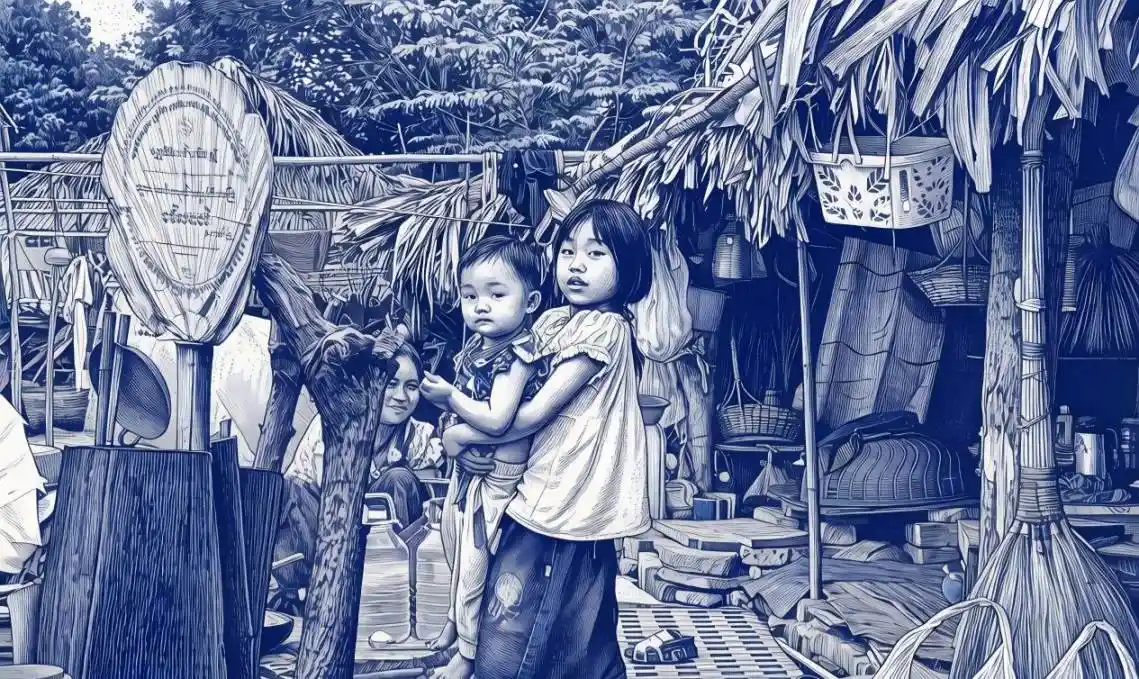
Only intense physical labor and being in big cities can bring a bit of breathing space. Near the famous pagodas in Mandalay, a construction worker toiling under the scorching sun told me that his daily wage is 30,000 kyats (less than 60 Chinese yuan).
The income of ordinary people has been firmly stuck in place. In Myanmar, locals generally cannot afford bottled water. This is because just 5 bottles of the most basic bottled water can instantly drain all the hard-earned daily wages of an adult.
Myanmar Children Reduced to the "Working Class"
As adults' meager salaries are squeezed by inflation, the heavy burden of survival inevitably falls on the next generation.
In Bagan, Kosla calmly recalled his childhood to me. To survive, he started working in a restaurant at the age of 9. From 8 in the morning until 5 in the afternoon, he earned a daily wage of 500 kyats. It wasn't until he was 16 that this wage laboriously climbed to 2500 kyats.
This is not just Kosla's personal tale of tears; it is the chilling backdrop of this country to this day.
Traveling from Yangon, Bagan all the way to the largest city in the north, Mandalay, "prematurely matured childhood" is the most common sight on the streets.
In the midst of Yangon's congested traffic, a boy under 15 holds his four or five-year-old brother, knocking on car windows to beg amidst exhaust fumes and danger;
In Bagan, children under 10 years old work in the restaurant kitchen, underage waiters skillfully serve food and water, and near those ancient pagodas, groups of teenagers can only earn small change by helping tourists take photos; outside Mandalay's temples, children around 10 years old are busy assisting their parents in the joss stick smoke.
Time seems to stand still here. Over a dozen years have passed, and whether in remote villages or core cities, the situation seems to have remained unchanged. In this country, childhood is a luxury. Children are thrown into a cruel survival game early on, and it remains Myanmar's heaviest and unsolvable daily reality.
The Lost Generation of Myanmar Youth
And as these prematurely matured children grow up, what awaits them is another daunting cage. For the average young person in Myanmar, leaving is a prohibitively expensive redemption.

The first and foremost shackle is economic. A meager salary is like a stagnant pool, barely enough to cover the soaring cost of living, depleting all their energy, turning "saving money to go abroad" into an unattainable luxury.
And the iron fist of power directly severs this generation's legitimate escape route. "If you are over 80, you can leave Myanmar at will; but if you are between 18 and 60, the country will never let you go," Veraswami, a boss in Yangon, revealed to me this cruel unwritten rule. The government tightly controls the emigration of youth, rendering passports meaningless.
When the normal channels are completely blocked, a perverse "way out" begins to grow in the dark.
"Nowadays, many people come to Myanmar specifically to 'buy a wife,'" Boss Veraswami shared with a bitter smile a recent incident he handled: to help a foreign man's Myanmar wife smoothly exit the country, he had to work top to bottom, spending a total of 3000 RMB in various fees. For a foreigner, 3000 RMB may just be a regular plane ticket; but for an ordinary Burmese, this is a lifetime of deprivation, hard work for 15 months without enough food or drink.
Even risking their lives to work illegally, the reality is equally despairing. A Burmese monk helplessly told me that many young people try to smuggle into Thailand by water. But with the spread of border conflicts, Thailand not only does not welcome Burmese refugees but also started severe inspections and crackdowns on hiring Burmese illegal workers.
Can't leave, can't stay. The national border here is no longer a dotted line on the map but an abyss co-constructed by absolute power and extreme poverty.
Final Thoughts
The camera focuses on a little boy quietly looking out of the train window.
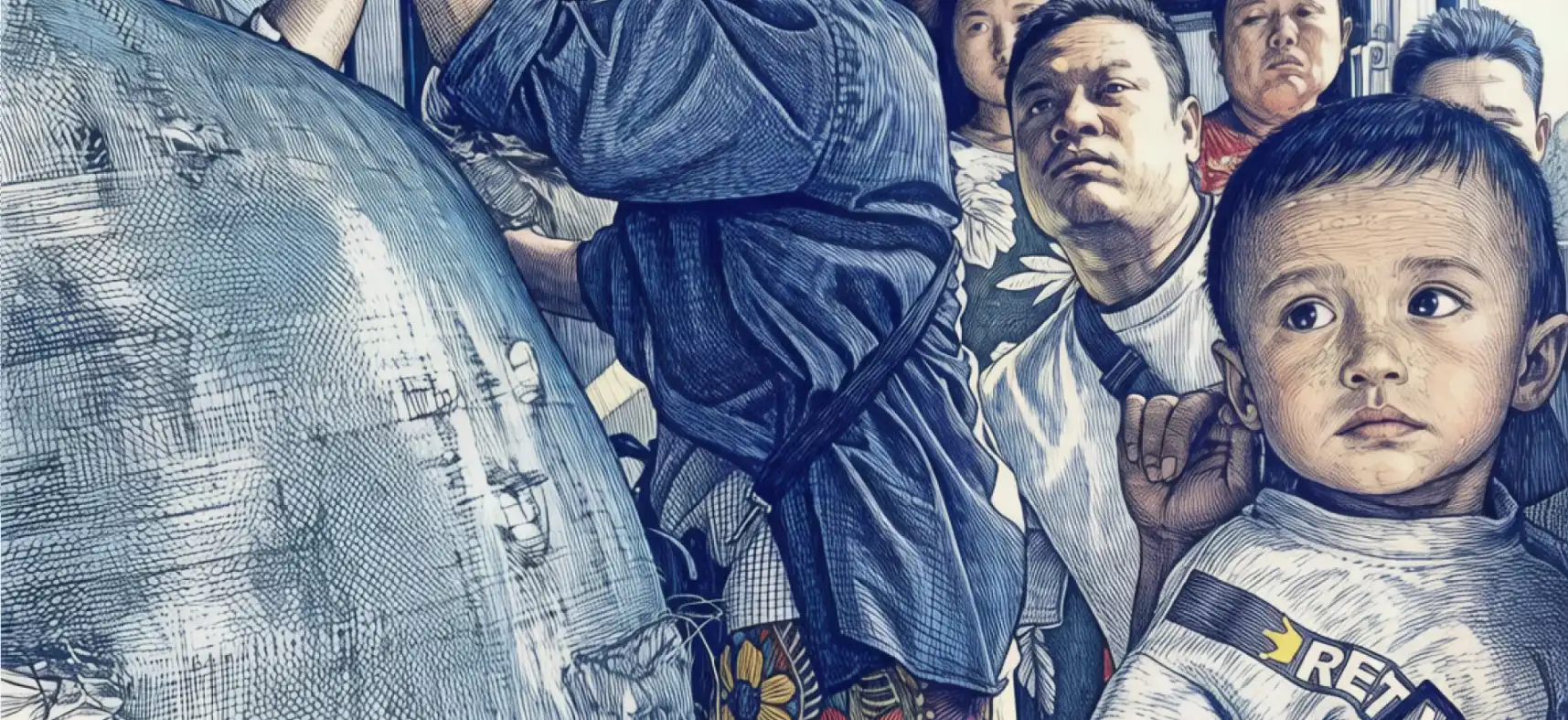
Myanmar Boy on the Train
He is a microcosm of the millions of ordinary boys in Myanmar. Time will inevitably push him forward, making him grow into a young man, turning into a man, and ultimately, unavoidably becoming someone like my guide Kosla.
I once asked this ordinary Burmese man, "Are you happy?" Kosla did not answer immediately. Upon my second inquiry, he simply deflected, saying, "We are too busy with making a living every day to even think about happiness."
It wasn't until much later, by the dusty roadside, that he answered this question for the third time, and most fully:
"I might die tomorrow. They could grab me anytime to join the military, to fight across the river. After 7 p.m., if a man is out on the streets of Pagan, he might just be thrown into prison, only to be sent to the battlefield for no reason. I have been working since I was 9 years old, but the rate of my wage increase can never keep up with inflation."
"A lifetime. No happiness," he said.
You may also like

The flow of stablecoins and the spillover effects in the foreign exchange market

After two years, Hong Kong's first batch of stablecoin licenses finally issued: HSBC, Standard Chartered make the cut
The person who helped TAO rise by 90% has now single-handedly crashed the price again today

3-Minute Guide to Participating in the SpaceX IPO on Bitget

Top 5 Cryptos to Buy in 2026 Q1: A ChatGPT Deep Dive Analysis
Explore the top 5 cryptos to buy in Q1 2026 including BTC, ETH, SOL, TAO, and ONDO. See price outlooks, key narratives, and institutional catalysts shaping the next market move.

How to Earn $15,000 with Idle USDT Before Altcoin Season 2026
Wondering if altcoin season is coming in 2026? Get the latest market update, and learn how to turn your idle stablecoins waiting for entry into extra rewards up to 15,000 USDT.
Can You Win Joker Returns Without Large Trading Volume? 5 Mistakes New Players Make In WEEX Joker Returns Season 2
Can small traders win WEEX Joker Returns 2026 without huge volume? Yes—if you avoid these 5 costly mistakes. Learn how to maximize card draws, use Jokers wisely, and turn small deposits into 15,000 USDT rewards.

Altcoin Season 2026: 4 Stages to Profit (Before the Crowd FOMO In)
Altcoin Season 2026 is starting — discover the 4 key stages of capital rotation (from ETH to PEPE) and how to position before the peak. Learn which tokens will lead each phase and avoid missing the rally.

Will Alt season come in 2026? 5 Tips to Spot the Next 100x Crypto Opportunities
Will altcoin season arrive in 2026? Discover 5 rotation stages, early signals smart traders watch, and the key crypto sectors where the next 100x altcoin opportunities may emerge.

The bear market has arrived, and cryptocurrency ETF issuers are also getting involved

The richest man had a quarrel with his former boss

BTC Firm Above 70K! Saylor’s "Institutional Logic" vs. Moon’s "Retail Faith": Who is Really Harvesting the Market?
Bitcoin is holding firm above the $70,000 support level following a massive short squeeze that liquidated $427 million. As the "Four-Year Cycle" narrative shifts, the market is split: Michael Saylor’s cold, institutional "indiscriminate stacking" vs. Carl Moon’s high-energy retail "hopium." This article decodes these two polar-opposite strategies for the 2026 bull run and reveals how WEEX’s institutional-grade liquidity and AI trading tools empower every type of investor to convert market volatility into profit.

The Girl Who Created the SBTI Test: A Story of a Doomed Cyber Love, an E-Widow Ratfolk

B.AI Officially Launched: Building AI Agent Financial Bedrock Platform, Driving AGI Era Business Underlying Logic

B.AI Officially Launched: Breaking Down A2A Collaboration Barriers to Unlock the Smart Body Economy's Full Potential
We helped Xu Mingxing write a book called "<OK Life>".

Rare APY of 400%, is TradeXYZ handing out money to oil bulls?
a16z: Perpetual Contracts are Rewriting Global Trading Rules
The flow of stablecoins and the spillover effects in the foreign exchange market
After two years, Hong Kong's first batch of stablecoin licenses finally issued: HSBC, Standard Chartered make the cut
The person who helped TAO rise by 90% has now single-handedly crashed the price again today
3-Minute Guide to Participating in the SpaceX IPO on Bitget
Top 5 Cryptos to Buy in 2026 Q1: A ChatGPT Deep Dive Analysis
Explore the top 5 cryptos to buy in Q1 2026 including BTC, ETH, SOL, TAO, and ONDO. See price outlooks, key narratives, and institutional catalysts shaping the next market move.
How to Earn $15,000 with Idle USDT Before Altcoin Season 2026
Wondering if altcoin season is coming in 2026? Get the latest market update, and learn how to turn your idle stablecoins waiting for entry into extra rewards up to 15,000 USDT.


 App
App