
 Buy Crypto
- Markets
 Futures
- Spot
- Copy Trade
- Earn
- More
Pantera Partner: Predicting the Market is No Longer a 'Betting Game,' But a Core Financial Asset Class

Original Title: State of Prediction Markets
Original Author: Paul Veradittakit, Partner at Pantera Capital
Original Translator: Saoirse, Foresight News
Abstract
· Prediction markets are not a new concept — they have now finally achieved decentralization. Humans have been betting on predictions since ancient times, but encryption technology has transformed this age-old behavior into a permissionless, transparent global market. In such markets, price aggregation reflects real-time collective intelligence rather than the results of opinion polls.
· Infrastructure and regulation are the dual drivers opening the market's doors. The clear regulatory stance of the U.S. Commodity Futures Trading Commission (CFTC), collaborations in the traditional finance (TradFi) sector, and multi-chain scalability have propelled prediction markets from niche experiments to a track with a weekly trading volume of $3.9 billion, with related platforms directly integrated into brokerage firms, media, and consumer applications.
· "Uncertainty" emerges as a new financial asset class. As prediction markets gradually evolve into core hedging, data, and forecasting infrastructure, platforms that combine liquidity, credibility, and coverage to "price" real-world outcomes globally will continue to accrue value.
For thousands of years, humans have been exploring methods to harness collective wisdom to predict the future. Ancient Greeks would receive specialized tokens to vote through a pipeline system; meanwhile, juries at the time would use solid or perforated stones to express their verdicts. It is safe to assume that the behavior of private betting in the ancient taverns called "kapeleia" was also very common.
In the 17th-century Amsterdam Stock Exchange, merchants would bet on the arrival time of cargo ships; in 19th-century America, political betting venues dominated during elections until they were banned in the 1940s. In addition, commodity futures trading on the Chicago Commodity Exchange falls into this category. It is evident that humans have long understood that investing in predicting outcomes can generate highly valuable informational signals.
Today, prediction markets driven by encryption technology represent a digital rebirth of this ancient practice — but with a key difference: the former is permissionless, transparent, open, and global.
Information Market Revolution: How Does Crypto Prediction Market Stand Out?
Traditional prediction markets require trusted intermediary institutions to hold funds, verify results, and distribute rewards, but encryption technology through blockchain has eliminated these middlemen. When you bet on issues in geopolitics, macroeconomics, or culture on the Polymarket platform — whether it's "Will the Fed cut rates in January?" or "Who will win the 2026 Oscar for Best Picture?" — your funds are held in a smart contract, result verification is fully transparent, and rewards are automatically distributed via USDC. The entire process does not require a bank account, has no geographical restrictions, and there are no intermediary fees or participant qualifications.
Another industry giant, Kalshi, focuses 90% of its business on the sports sector, covering topics such as "PGA Farmers Insurance Open champion attribution" and "Kent State University vs. Akron University basketball game result." The emerging prediction market platform, Novig, also has a strong emphasis on the sports sector.
Inflection Point: Why Now?
The current prediction market has seen explosive growth, with a 7-day trading volume reaching $3.9 billion, driven by three key factors: regulatory maturity, integration with traditional finance, and infrastructure breakthroughs.
From a regulatory standpoint, a significant development was the CFTC approval that cleared the way for platforms to operate in the U.S. For example, in July 2025, Polymarket acquired the CFTC-licensed derivatives trading platform, QCX LLC, and the clearinghouse, QC Clearing LLC. This acquisition enabled traders to confidently participate in prediction market contract trading on the Polymarket platform with clear and precise rules. In December 2025, Kalshi, with a valuation of $11 billion, completed a $1 billion financing round, reflecting institutional investors' confidence in the sector. Overall, regulatory clarity is unlocking institutional funding and retail participation through established brokerage channels.
Intercontinental Exchange (ICE), in addition to investing $2 billion in Polymarket, will also become the global distributor of Polymarket's event-driven data—highlighting the major trend of traditional finance merging with the prediction market.
This convergence has been further deepened through partnerships. Polymarket entered into a multi-year partnership with the TKO Group Holdings company, becoming the official exclusive partner of the Ultimate Fighting Championship (UFC) and Zuffa Boxing, achieving a direct integration of prediction market technology with live fan experiences.
In 2026, Kalshi will partner with Cable News Network (CNN) and Consumer News and Business Channel (CNBC), allowing viewers to see real-time prediction probabilities in the news ticker. Both Polymarket and Kalshi have partnered with Google, while companies like Robinhood, Fanatics, and Coinbase have entered the field through partnerships or native applications. In November 2025, Robinhood's prediction market saw a contract trading volume of 3 billion, a 20% increase month-over-month, confirming the significant retail participation.
Technological advancements have driven infrastructure breakthroughs, including: multi-chain scalability with Polygon, Solana, Base, Gnosis Chain; integration of AI oracles for permissionless instant settlement; and the use of hybrid Automated Market Maker (AMM) and order book models to reduce trading friction and enhance liquidity. In contrast, during its launch, the early platform Augur faced challenges with immature technology and regulatory environment.
Market Insights: Key Players and Challengers
While Polymarket currently holds a dominant position in the industry, its status may face challenges from competitors, providing users with more choices. In fact, in 2025, 12 institutions either submitted a Designated Contract Market (DCM) application or successfully obtained the qualification, representing a 500% increase from the previous year. Additionally, there are companies looking to collaborate with DCMs to offer prediction market services as "Futures Commission Merchants."
Here is a brief comparison between Polymarket and the Opinion platform (Data Period: Last 30 days as of December 3, 2025):
· Polymarket Key Data: Open Interest $2.471 billion; Nominal Trading Volume $43.9 billion; Market Share of 82% of the industry's Total Value Locked (TVL); adopting a historical zero-fee model to drive user growth.
· Opinion Key Data: TVL surged by 110% in the last 30 days (increasing from $30 million to $63 million); Estimated Monthly Trading Volume of $40 billion, posing a potential impact on the existing market share; achieving product-market fit on emerging Layer2 infrastructure.
Network effects and the market landscape of "Winner Takes All" are attracting significant growth capital—these platforms provide scalable diversification options for traditional derivatives and betting products. The revenue models have also transcended the single-fee structure, including: providing real-time probability data to news media, financial terminals, etc.; API integration with social platforms and apps; some companies (like Robinhood) also leverage this for cross-selling core financial services.
User Behavior Shift
Traders are gradually shifting towards prediction markets—these markets have a more sophisticated speculative structure, serving as both hedging tools and providing Alpha returns to decentralized finance (DeFi) portfolios. Due to the real-time predictive accuracy of political and economic forecasts surpassing traditional polling, this migration trend may also extend to more related event contract areas.
Although Polymarket initially gained media attention for political predictions, it is not limited to this area. Its largest open interest markets include:
· Non-Election Politics: $55 million
· Cryptocurrency: $52 million
· Business: $36 million
· Election Field: $22 million
· Pop Culture Field: $20 million
· Sports Field: $20 million
· Total: $242 million
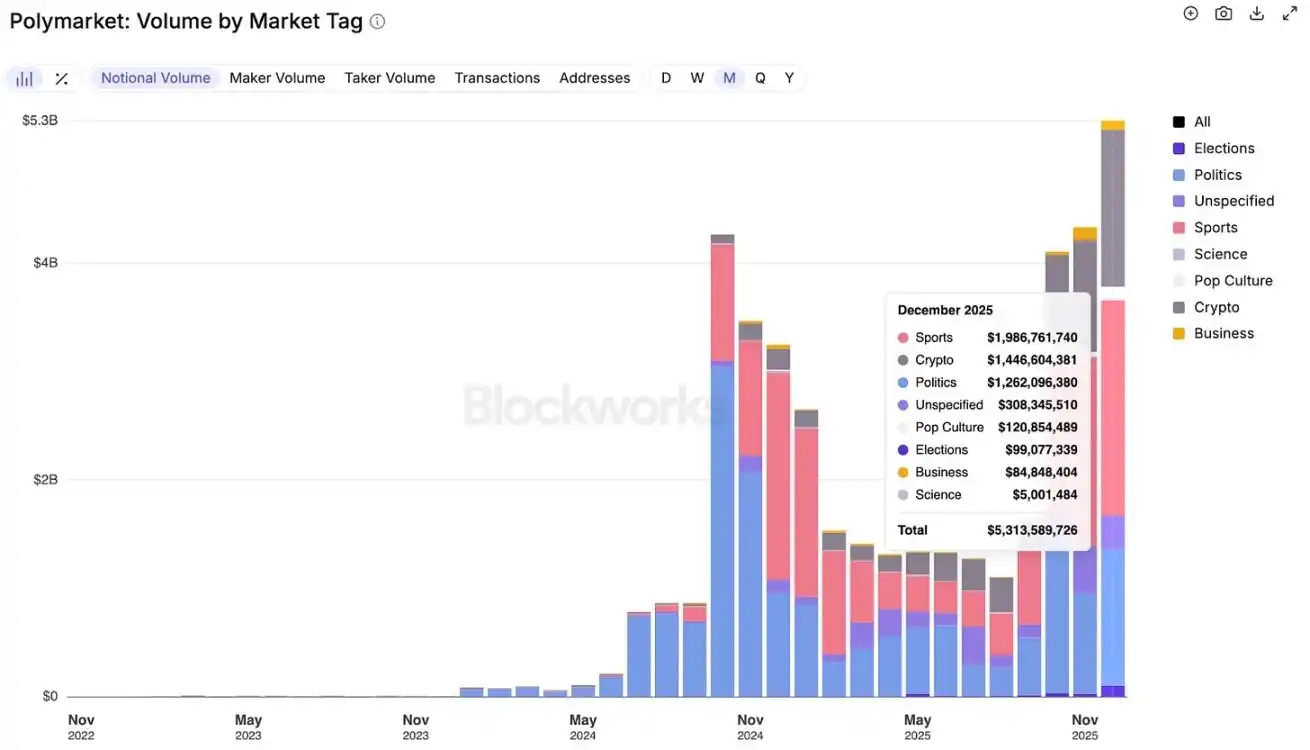
New entrants continue to emerge: Crypto.com partners with Hollywood.com to launch an entertainment-focused prediction market covering topics such as movies, TV shows, theater, actors, musicians, and award outcomes; Limitless focuses on a short-term prediction market for cryptocurrency and stock prices, originating from the X (formerly Twitter) project, with investment support from Coinbase and 1confirmation.
Controversies, Challenges, and Emerging Solutions
The prediction market still faces several pain points, including centralization risks, manipulation issues under traditional oracle models, and settlement delays due to manual reporting systems.
Regulatory gray areas still exist, including the classification dispute of sports betting. For example, in November 2025, a judge in Nevada ruled that Kalshi is a betting platform and cannot be exempt from the state's gambling regulations. However, Kalshi claims that its platform is a federally regulated financial trading platform offering legal derivative contracts (event-based contract swaps) rather than gambling bets. Following the ruling, Kalshi has initiated the appeals process, and similar disputes have arisen in Massachusetts.
Regardless of the case outcome, several issues still need to be addressed, including age restrictions, responsible gambling concerns, etc. Cross-border regulatory arbitrage may also pose a challenge to industry development.
Market manipulation risks also need to be controlled, such as: the influence of whales on low-liquidity markets, wash trading and price manipulation in a decentralized environment, and the balancing act between "permissionless trading" and "market credibility."
The current market structure is continuously evolving, including: the launch of perpetual prediction markets for "continuous outcomes," combinatorial markets to handle complex multivariable events, and binding curve mechanisms to enhance dynamic liquidity. Furthermore, there are multiple opportunities: using prediction market probabilities as inputs for DeFi protocol oracles; enabling secondary trading and leverage through tokenized positions; integrating prediction markets with yield strategies and portfolio hedging.
Emerging solutions focus on three main directions: providing AI-driven instant settlements for permissionless markets; integrating trading platform oracles to reduce frontrunning; developing application chains embedded with a consensus mechanism to ensure oracle credibility.
Future Outlook
From the current perspective, in the short term, three major factors will drive the wider adoption of prediction markets: U.S. platforms approved by the CFTC going live through established brokers; social media platform integrations (such as embedding prediction APIs in tweets); emerging banks embedding prediction markets to merge finance with speculative functions.
Furthermore, as prediction markets gradually evolve into a distinct financial market category, vertically specialized prediction markets for niche areas (such as sports, business, etc.) may emerge. For example, Novig, a sports-centric prediction market, is focusing on creating highly tailored markets and user experiences for sports betting users. As prediction markets become a more common consumer behavior, these specialized platforms may offer a better user experience than one-size-fits-all comprehensive platforms.
In the next 1-3 years, prediction markets focusing on privacy protection may adopt zero-knowledge proof technology; governance applications such as Futarchy and outcome-based decision-making may also gradually develop.
(Note: "Futarchy" is a new governance concept proposed by economist Robin Hanson around 2000. Its core idea is to use "predictions of future outcomes" to guide decision-making, rather than relying on traditional voting, expert judgment, or power hierarchies. Its name is a combination of "future" and "archy," translating directly to "prediction governance system" or "future-oriented governance.")
However, the industry may still face obstacles, including: regulatory tightening, restricting global access or product scope; if the market fails to improve prediction accuracy, it may lead to user fatigue; traditional platforms adopting blockchain technology may trigger intensified competition.
As the integration deepens, prediction markets will bring about various positive social impacts: providing collective wisdom support for resource allocation and policy decision-making; developing decentralized prediction markets into public infrastructure; shifting the media and governance sectors from a "polling model" to a "participatory probabilistic market model."
The current question is no longer "Can prediction markets scale," but "How many prediction markets will emerge in the future," and "Which models can capture this trillion-dollar opportunity—pricing uncertainty in the real world on-chain." These predictions will be a significant complement to human wisdom and forecasting capabilities.
You may also like

Found a "meme coin" that skyrocketed in just a few days. Any tips?

TAO is Elon Musk, who invested in OpenAI, and Subnet is Sam Altman

The era of "mass coin distribution" on public chains comes to an end

Soaring 50 times, with an FDV exceeding 10 billion USD, why RaveDAO?

1 billion DOTs were minted out of thin air, but the hacker only made 230,000 dollars

After the blockade of the Strait of Hormuz, when will the war end?

Before using Musk's "Western WeChat" X Chat, you need to understand these three questions
The X Chat will be available for download on the App Store this Friday. The media has already covered the feature list, including self-destructing messages, screenshot prevention, 481-person group chats, Grok integration, and registration without a phone number, positioning it as the "Western WeChat." However, there are three questions that have hardly been addressed in any reports.
There is a sentence on X's official help page that is still hanging there: "If malicious insiders or X itself cause encrypted conversations to be exposed through legal processes, both the sender and receiver will be completely unaware."
No. The difference lies in where the keys are stored.
In Signal's end-to-end encryption, the keys never leave your device. X, the court, or any external party does not hold your keys. Signal's servers have nothing to decrypt your messages; even if they were subpoenaed, they could only provide registration timestamps and last connection times, as evidenced by past subpoena records.
X Chat uses the Juicebox protocol. This solution divides the key into three parts, each stored on three servers operated by X. When recovering the key with a PIN code, the system retrieves these three shards from X's servers and recombines them. No matter how complex the PIN code is, X is the actual custodian of the key, not the user.
This is the technical background of the "help page sentence": because the key is on X's servers, X has the ability to respond to legal processes without the user's knowledge. Signal does not have this capability, not because of policy, but because it simply does not have the key.
The following illustration compares the security mechanisms of Signal, WhatsApp, Telegram, and X Chat along six dimensions. X Chat is the only one of the four where the platform holds the key and the only one without Forward Secrecy.
The significance of Forward Secrecy is that even if a key is compromised at a certain point in time, historical messages cannot be decrypted because each message has a unique key. Signal's Double Ratchet protocol automatically updates the key after each message, a mechanism lacking in X Chat.
After analyzing the X Chat architecture in June 2025, Johns Hopkins University cryptology professor Matthew Green commented, "If we judge XChat as an end-to-end encryption scheme, this seems like a pretty game-over type of vulnerability." He later added, "I would not trust this any more than I trust current unencrypted DMs."
From a September 2025 TechCrunch report to being live in April 2026, this architecture saw no changes.
In a February 9, 2026 tweet, Musk pledged to undergo rigorous security tests of X Chat before its launch on X Chat and to open source all the code.
As of the April 17 launch date, no independent third-party audit has been completed, there is no official code repository on GitHub, the App Store's privacy label reveals X Chat collects five or more categories of data including location, contact info, and search history, directly contradicting the marketing claim of "No Ads, No Trackers."
Not continuous monitoring, but a clear access point.
For every message on X Chat, users can long-press and select "Ask Grok." When this button is clicked, the message is delivered to Grok in plaintext, transitioning from encrypted to unencrypted at this stage.
This design is not a vulnerability but a feature. However, X Chat's privacy policy does not state whether this plaintext data will be used for Grok's model training or if Grok will store this conversation content. By actively clicking "Ask Grok," users are voluntarily removing the encryption protection of that message.
There is also a structural issue: How quickly will this button shift from an "optional feature" to a "default habit"? The higher the quality of Grok's replies, the more frequently users will rely on it, leading to an increase in the proportion of messages flowing out of encryption protection. The actual encryption strength of X Chat, in the long run, depends not only on the design of the Juicebox protocol but also on the frequency of user clicks on "Ask Grok."
X Chat's initial release only supports iOS, with the Android version simply stating "coming soon" without a timeline.
In the global smartphone market, Android holds about 73%, while iOS holds about 27% (IDC/Statista, 2025). Of WhatsApp's 3.14 billion monthly active users, 73% are on Android (according to Demand Sage). In India, WhatsApp covers 854 million users, with over 95% Android penetration. In Brazil, there are 148 million users, with 81% on Android, and in Indonesia, there are 112 million users, with 87% on Android.
WhatsApp's dominance in the global communication market is built on Android. Signal, with a monthly active user base of around 85 million, also relies mainly on privacy-conscious users in Android-dominant countries.
X Chat circumvented this battlefield, with two possible interpretations. One is technical debt; X Chat is built with Rust, and achieving cross-platform support is not easy, so prioritizing iOS may be an engineering constraint. The other is a strategic choice; with iOS holding a market share of nearly 55% in the U.S., X's core user base being in the U.S., prioritizing iOS means focusing on their core user base rather than engaging in direct competition with Android-dominated emerging markets and WhatsApp.
These two interpretations are not mutually exclusive, leading to the same result: X Chat's debut saw it willingly forfeit 73% of the global smartphone user base.
This matter has been described by some: X Chat, along with X Money and Grok, forms a trifecta creating a closed-loop data system parallel to the existing infrastructure, similar in concept to the WeChat ecosystem. This assessment is not new, but with X Chat's launch, it's worth revisiting the schematic.
X Chat generates communication metadata, including information on who is talking to whom, for how long, and how frequently. This data flows into X's identity system. Part of the message content goes through the Ask Grok feature and enters Grok's processing chain. Financial transactions are handled by X Money: external public testing was completed in March, opening to the public in April, enabling fiat peer-to-peer transfers via Visa Direct. A senior Fireblocks executive confirmed plans for cryptocurrency payments to go live by the end of the year, holding money transmitter licenses in over 40 U.S. states currently.
Every WeChat feature operates within China's regulatory framework. Musk's system operates within Western regulatory frameworks, but he also serves as the head of the Department of Government Efficiency (DOGE). This is not a WeChat replica; it is a reenactment of the same logic under different political conditions.
The difference is that WeChat has never explicitly claimed to be "end-to-end encrypted" on its main interface, whereas X Chat does. "End-to-end encryption" in user perception means that no one, not even the platform, can see your messages. X Chat's architectural design does not meet this user expectation, but it uses this term.
X Chat consolidates the three data lines of "who this person is, who they are talking to, and where their money comes from and goes to" in one company's hands.
The help page sentence has never been just technical instructions.
Parse Noise's newly launched Beta version, how to "on-chain" this heat?

Is Lobster a Thing of the Past? Unpacking the Hermes Agent Tools that Supercharge Your Throughput to 100x

Declare War on AI? The Doomsday Narrative Behind Ultraman's Residence in Flames
Crypto VCs Are Dead? The Market Extinction Cycle Has Begun
Claude's Journey to Foolishness in Diagrams: The Cost of Thriftiness, or How API Bill Increased 100-Fold

Edge Land Regress: A Rehash Around Maritime Power, Energy, and the Dollar
Arthur Hayes Latest Interview: How Should Retail Investors Navigate the Iran Conflict?
Just now, Sam Altman was attacked again, this time by gunfire

Straits Blockade, Stablecoin Recap | Rewire News Morning Edition
From High Expectations to Controversial Turnaround, Genius Airdrop Triggers Community Backlash


 App
App