
 Buy Crypto
- Markets
 Futures
- Spot
- Copy Trade
- Earn
- More
Q4 $667M Net Loss: Coinbase Earnings Report Foreshadows Challenging 2026 for Crypto Industry?

Original Title: "Q4 Huge Loss of 667 Million USD: Coinbase Financial Report Foreshadows a Tough Year for the Crypto Industry in 2026?"
Original Author: Mach, Foresight News
On February 13, the U.S. stock market experienced a sudden sharp decline, with the Dow Jones down 1.34%, the Nasdaq plummeting 2.03%, the S&P 500 falling 1.57%, gold dropping over 4%, and silver crashing 11%. Bitcoin price fell to $66,000, and Ethereum dropped to $1900.
Following the release of Coinbase, the largest U.S. cryptocurrency exchange, of its 2025 fourth-quarter and full-year financial report, the stock price plunged to around $140. Despite a strong performance for the full year, the net loss in Q4 and a slowdown in trading volume became the direct catalyst for investor sell-off.
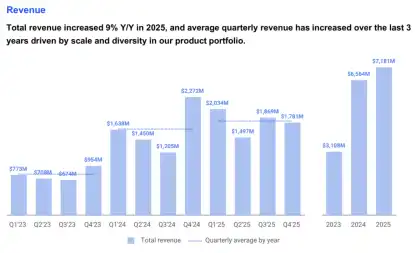
For the full year 2025, Coinbase's revenue was $7.181 billion, a growth of about 9% from $6.564 billion in 2024, with a net income of $6.883 billion. Despite a net loss of $667 million in Q4 due to unrealized losses on the crypto asset portfolio, a net profit of $1.26 billion was still achieved for the year.
Since Q4 2022, Coinbase has ceased direct disclosure of "total verified users" in its financial reports (which was 110 million at that time). According to the latest data from DemandSage, as of the end of 2025, Coinbase's global verified user count is estimated to have reached around 120 million.
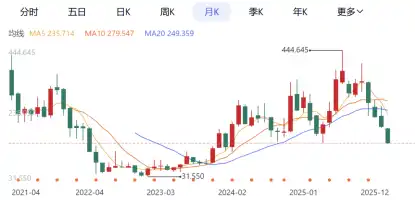
Furthermore, its stock performance has also been criticized, with the COIN price currently at a new low since March 2024.
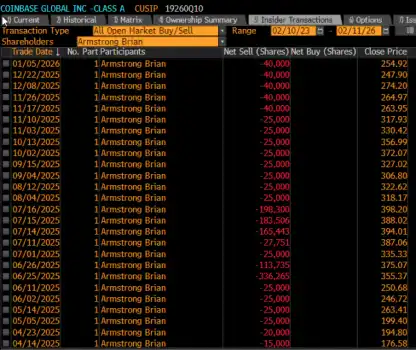
Meanwhile, Matthew Sigel, Director of Digital Asset Research at VanEck, stated that Coinbase CEO Brian Armstrong sold another 40,000 shares of COIN on January 5 for approximately $10.16 million based on the share price at that time. The VanEck chart supplement indicates that from April 2025 to January 2026, Brian Armstrong has sold over 1.5 million shares of Coinbase stock, cashing out approximately $550 million.
Q4 2025 Trading Volume at 18 Billion, But Slowing Down
On February 13, Coinbase's financial report detailed the full-year 2025 and Q4 financial data, presenting a mixed picture of growth and concerns.
Looking at the full year, Coinbase's total trading volume (including spot and derivatives) grew by 156% year-on-year, reaching $52 trillion, doubling its market share of crypto trading volume to 6.4% (up from 3.2% in 2024 and 1.8% in 2023).
Subscription and service revenue also hit a new high, reaching $2.328 billion for the full year, a 65% increase from 2024's $1.407 billion.
Notably, the stablecoin business stood out, with the USDC market cap rising to $760 billion (a significant increase from $380 billion in 2024 and $250 billion in 2023). The average USDC held within Coinbase's products reached $8 billion in Q4 (following a trend throughout the year from $3 billion in Q4'23 to $18 billion in Q4'24, and back to $8 billion in Q4'25, showing fluctuations but an overall upward trajectory).
The number of paid Coinbase One subscription users reached 971,000, a significant increase from 2024's 733,000 and 2023's 266,000, driven by adding new tiers and value-adding products like the Coinbase One Card.
Q4 Total Revenue at $1.8 Billion, $667 Million Loss Triggers Stock Plunge
The company revealed in the report that it has 12 products with annualized revenue exceeding $1 billion, with half surpassing $2.5 billion and two exceeding $10 billion.
Coinbase's transition from a simple trading platform to an "Everything Exchange" covering crypto, derivatives, stocks, prediction markets, and other areas. However, the Q4 specific data exposed short-term pressure, becoming a key driver of the stock price plunge.
Q4's total revenue was $1.8 billion, showing growth both year-on-year and quarter-on-quarter but falling short of Wall Street's expected $1.95 billion.
More striking is the net income: recording a $667 million loss, a reversal from profits in the same period last year and Q3. This loss was primarily due to unrealized losses from strategic investments, crypto asset price volatility (assets like Bitcoin retraced at the end of Q4), and rising operating expenses, including acquisition integration costs and regulatory compliance expenses.
If we exclude these non-core factors, the adjusted net income is $178 million, and adjusted EBITDA is $566 million, both positive but a 12% decrease from Q3, showing pressure on core profitability.
Transaction Fee Revenue was $1.05 billion, with the company's cash and equivalents at $11.3 billion as a traditional pillar of revenue, contributing approximately $1.05 billion in Q4 (about 55% for the full year). However, the transaction volume saw a slowdown compared to the previous period: while the total annual transaction volume reached $52 trillion, it was only about $12 trillion in Q4. Both retail and institutional trading were affected by market fluctuations, with a 15% decrease in average trade size per person. Spot trading volume fell by 10% year-on-year, and although the derivatives were boosted by the Deribit acquisition, it was not enough to offset the user loss due to bearish market sentiment—monthly active trading users decreased by 800,000 compared to the previous period, to 9.5 million.
Subscription and Service Revenue in Q4 was $730 million, an 18% year-on-year increase, but a slight 2% decrease from the previous period. In detail, benefiting from the Base Chain integration and developer tools, stablecoin revenue (mainly USDC) was $380 million, but staking rewards decreased to $120 million as the network yield rate declined by 18% compared to the previous period; interest and financial income were $65 million, and other service revenue was $165 million.
The balance sheet shows that the company's cash and cash equivalents reached $11.3 billion, an $800 million increase from Q3, benefiting from the full-year profit accumulation. However, loan issuance and crypto investments (such as Bitcoin holdings) in Q4 led to a net decrease of $300 million in dollar resources.
The company's Bitcoin holdings were not updated in Q4, but the annual trend shows a total holding of over 12,000 coins, with a total cost of about $800 million, an average price per coin of $66,000. The current value fluctuates with the Bitcoin price to about $1.1 billion (calculated based on a Bitcoin price of $90,000 at the time of the financial report). Calculated at the Bitcoin price on February 13, there is a slight unrealized loss.
While SEC regulation has slowed down, a new round of derivatives competition has intensified, with Binance's global expansion and Robinhood's cryptocurrency products eroding market share.
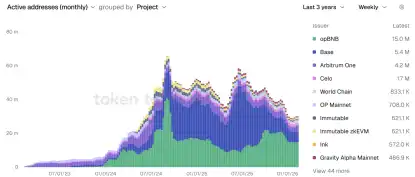
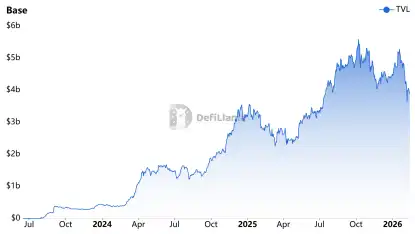
The financial report shows that Coinbase's 2026 priorities include expanding the Everything Exchange, extending stablecoin payments, and building on-chain finance. Base Chain's active addresses surpassed those of Optimism and Arbitrum, with a TVL of $3.5 billion.
According to the latest data from Token Terminal, Base's weekly active users are now second only to opBNB.
Latest data from DefiLlama shows that Base's TVL has risen to $39.05 billion.
Overall, Coinbase's financial report revealed the duality of the crypto giant: year-long innovation-driven diversification, but Q4 losses and trading softness exposed a reliance on asset prices. The sharp stock price decline is not just a sentiment reaction, but also a market questioning its sustainability. If there is no strong recovery or regulatory tailwinds by 2026, Coinbase will face a more severe test.
You may also like

The 17-Year Mystery Will Be Solved, Who is Satoshi Nakamoto?

5 Minutes to Make AI Your Second Brain

Uniswap is trapped in an innovation dilemma

What is the key to competition in crypto banking?

The flow of stablecoins and the spillover effects in the foreign exchange market

After two years, Hong Kong's first batch of stablecoin licenses finally issued: HSBC, Standard Chartered make the cut
The person who helped TAO rise by 90% has now single-handedly crashed the price again today

3-Minute Guide to Participating in the SpaceX IPO on Bitget

Top 5 Cryptos to Buy in 2026 Q1: A ChatGPT Deep Dive Analysis
Explore the top 5 cryptos to buy in Q1 2026 including BTC, ETH, SOL, TAO, and ONDO. See price outlooks, key narratives, and institutional catalysts shaping the next market move.

How to Earn $15,000 with Idle USDT Before Altcoin Season 2026
Wondering if altcoin season is coming in 2026? Get the latest market update, and learn how to turn your idle stablecoins waiting for entry into extra rewards up to 15,000 USDT.
Can You Win Joker Returns Without Large Trading Volume? 5 Mistakes New Players Make In WEEX Joker Returns Season 2
Can small traders win WEEX Joker Returns 2026 without huge volume? Yes—if you avoid these 5 costly mistakes. Learn how to maximize card draws, use Jokers wisely, and turn small deposits into 15,000 USDT rewards.

Altcoin Season 2026: 4 Stages to Profit (Before the Crowd FOMO In)
Altcoin Season 2026 is starting — discover the 4 key stages of capital rotation (from ETH to PEPE) and how to position before the peak. Learn which tokens will lead each phase and avoid missing the rally.

Will Alt season come in 2026? 5 Tips to Spot the Next 100x Crypto Opportunities
Will altcoin season arrive in 2026? Discover 5 rotation stages, early signals smart traders watch, and the key crypto sectors where the next 100x altcoin opportunities may emerge.

The bear market has arrived, and cryptocurrency ETF issuers are also getting involved

The richest man had a quarrel with his former boss

BTC Firm Above 70K! Saylor’s "Institutional Logic" vs. Moon’s "Retail Faith": Who is Really Harvesting the Market?
Bitcoin is holding firm above the $70,000 support level following a massive short squeeze that liquidated $427 million. As the "Four-Year Cycle" narrative shifts, the market is split: Michael Saylor’s cold, institutional "indiscriminate stacking" vs. Carl Moon’s high-energy retail "hopium." This article decodes these two polar-opposite strategies for the 2026 bull run and reveals how WEEX’s institutional-grade liquidity and AI trading tools empower every type of investor to convert market volatility into profit.

The Girl Who Created the SBTI Test: A Story of a Doomed Cyber Love, an E-Widow Ratfolk



 App
App