
 Buy Crypto
- Markets
 Futures
- Spot
- Copy Trade
- Earn
- More
Retrospect of the US-Iran Conflict: 5 Insiders Around Trump Explicitly Engaged in Insider Trading


The "insider" is perhaps a figure that retail investors both love and hate. They are loved because keeping up with their pace is like knowing the answer in advance; they are hated because the cards in their hands are forever invisible to you.
However, even the most well-informed insider has their limitations in the stock market. You may know that the U.S. is going to strike Iran, but the specific amount of increase in related defense stocks, the timing of the increase, and whether there will be a macro-sentiment hit in the middle are all uncontrollable variables.
Today, we are going to discuss five insiders who, without needing to consider the underlying asset, entry timing, or even worry about exposing their identity, made $1.3 million through a few trades by exploiting information asymmetry. Among them, someone was still trading half an hour before the start of the US-Iran conflict, and someone used two trades to make a 20x return.
Their "cash-out channel" comes from Polymarket, a prediction market platform based on the anonymity feature of blockchain. Unlike trading in stocks, commodities, and other assets, what is traded on the prediction market is "will this event happen or not."
Knowing full well that "Trump will negotiate with Iran next week," the lowest-risk way to profit is to predict with others that "the U.S. and Iran will definitely negotiate next week."
Today, we will delve into the profiles of these five accounts from a data perspective to see why they fit the characteristics of "insiders."
A $20,000 Principal, Two Trades, Twentyfold Compounding
Since 2026, there have been three particularly high-profile geopolitical trading events on Polymarket: Maduro's arrest, the US-Israel joint strike on Iran, and the US-Iran ceasefire announcement. These three trading events have contributed a total of $860 million in trading volume to the platform.
However, the five accounts we are discussing today, by continuously betting on these globally shocking geopolitical events, quickly filled their pockets. For example, Account 1 successfully predicted the timing of the US-Israel conflict with $20,000, then went all-in again on the US-Iran ceasefire, earning $400,000 and achieving a 20x profit.

What's even more intriguing is that the registration times of these accounts were in December 2025 and February of this year: one was before Maduro's arrest, and the other was on the eve of the current US-Iran conflict. Yet, the total number of markets they participated in on this platform is also very few, as if their purpose was solely to engage in a betting game they knew they would win.
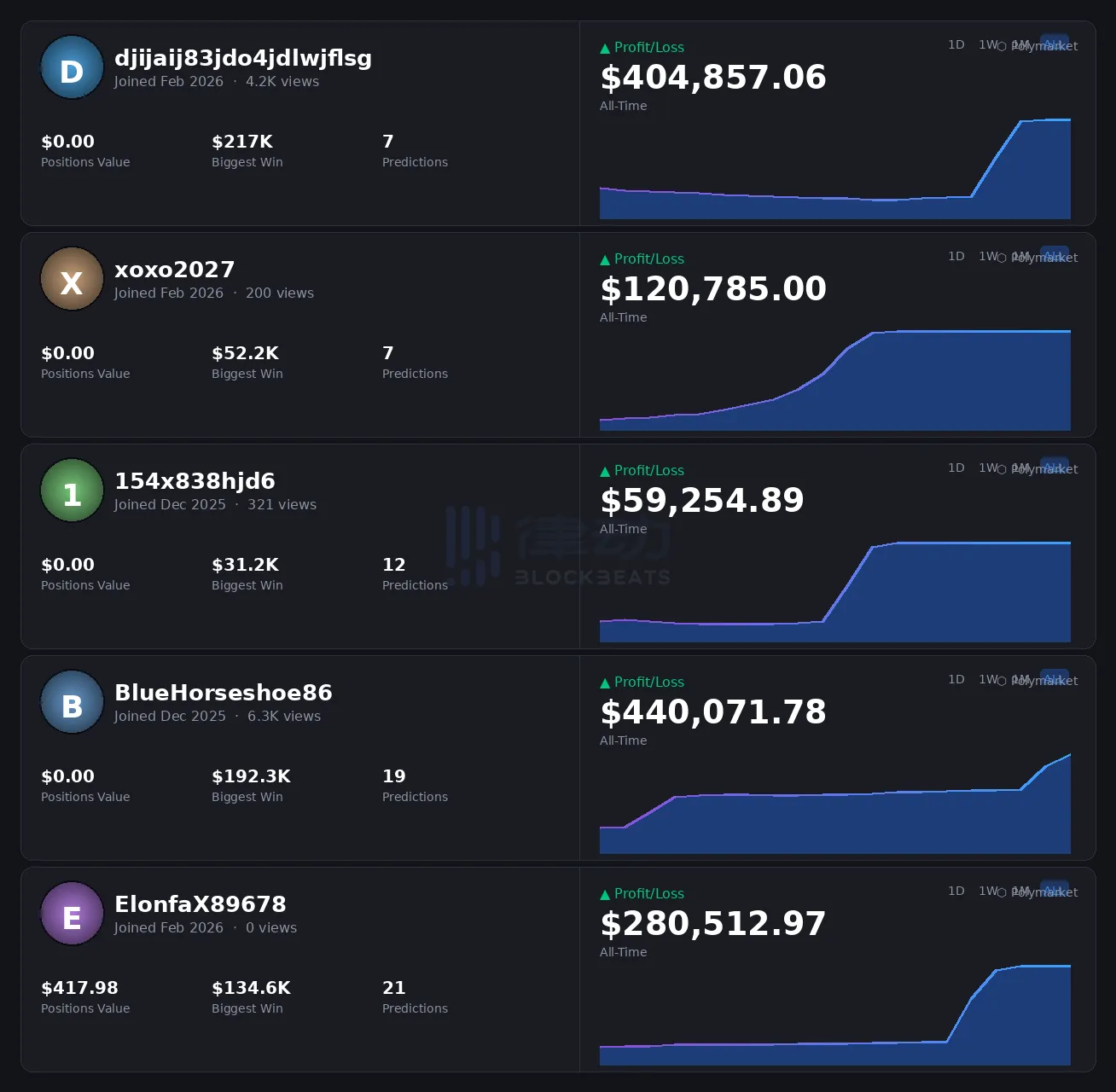
If the registration time, transaction count, and high profit are still not enough to prove their insider portrait, what is truly suspicious is the next two things.
“Small bets for enjoyment, big bets because I know I can't lose”
One of the biggest differences between a gambler and an insider is that the insider knows the outcome of the bet, so they dare to wager heavily on a sure opportunity. The characteristics displayed by these five accounts in this regard perfectly illustrate their difference from gamblers.
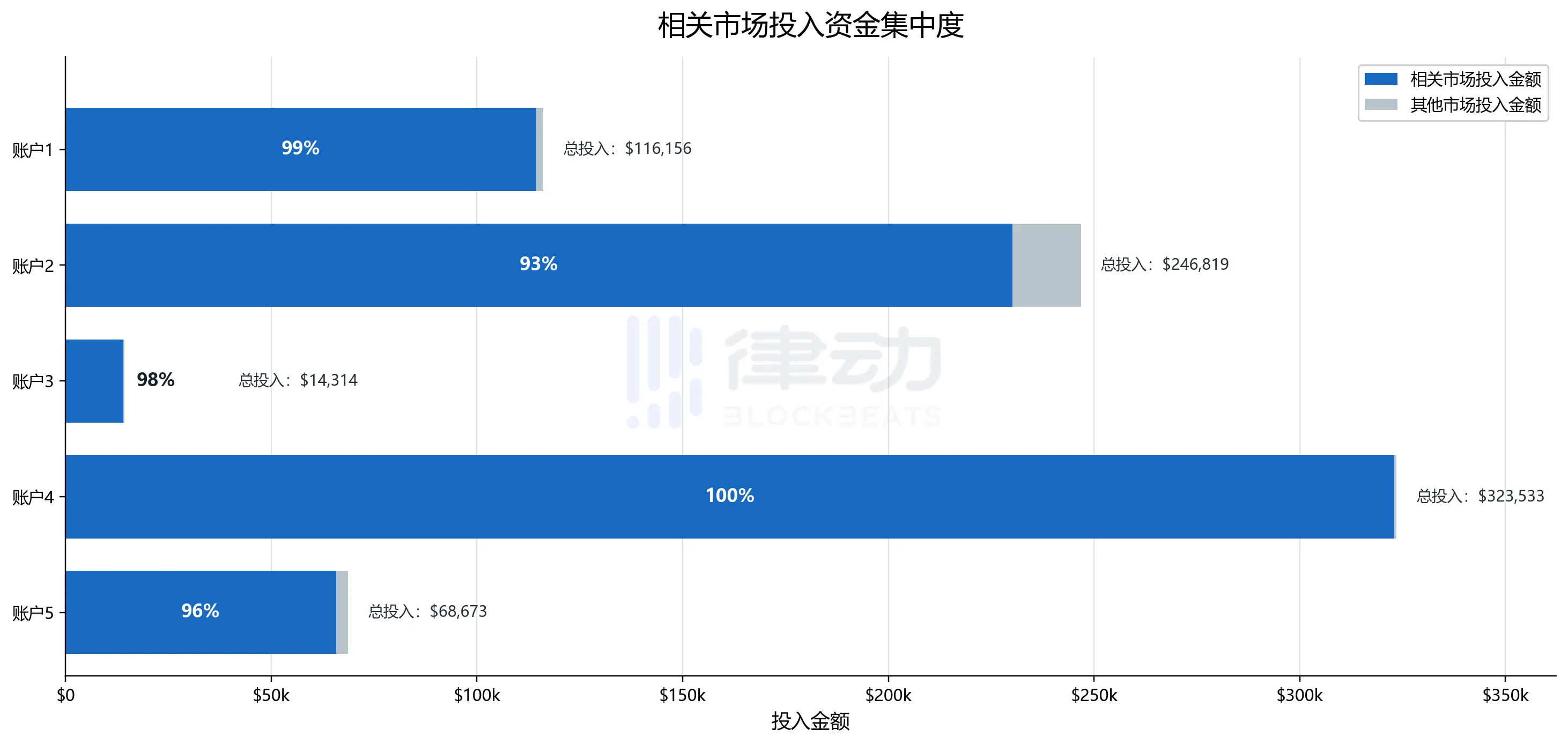
By calculating the percentage of each account's investment amount in these three events relative to their total investment amount, it can be seen that although the investment amounts of these five accounts vary, their percentage data is highly consistent. Even Account 2, which exhibits the most diversified behavior, has 93% of its funds wagered on the relevant market.
This level of concentration is statistically significant. Even analytical speculators focusing on geopolitics usually diversify their positions across a dozen markets to manage uncertainty. The choice of these five accounts is more like this: they identified a few targets, went all-in on almost all their chips, and other markets were not important.
Predicting the market 21 minutes before the match starts – Betting “Prepare for war”
If fund concentration is the outline of the portrait, then the timing of opening positions is the most direct evidence.
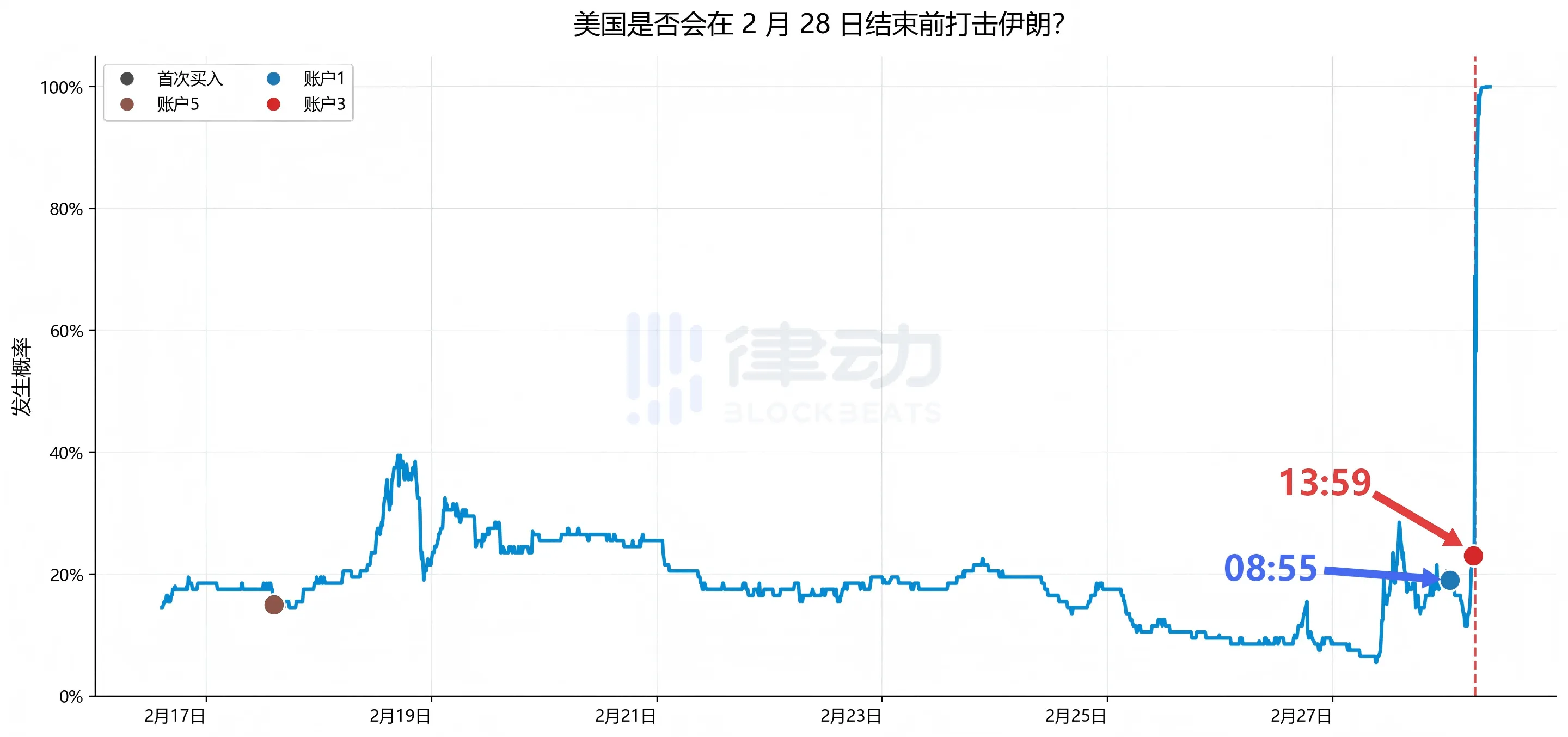
Around 2:20 PM Beijing time on February 28, explosions were heard in Tehran, the capital of Iran, and Israel announced an attack on Iran. At the same time, the probability of “Will the U.S. strike Iran before February 28” in this market skyrocketed from 20% to 99% in a short period of time, followed by settlement.
Of the three accounts participating in this market, two bet “yes” on the day of the strike, with Account 3 placing the first bet 21 minutes before the strike. This bet quadrupled half an hour later.
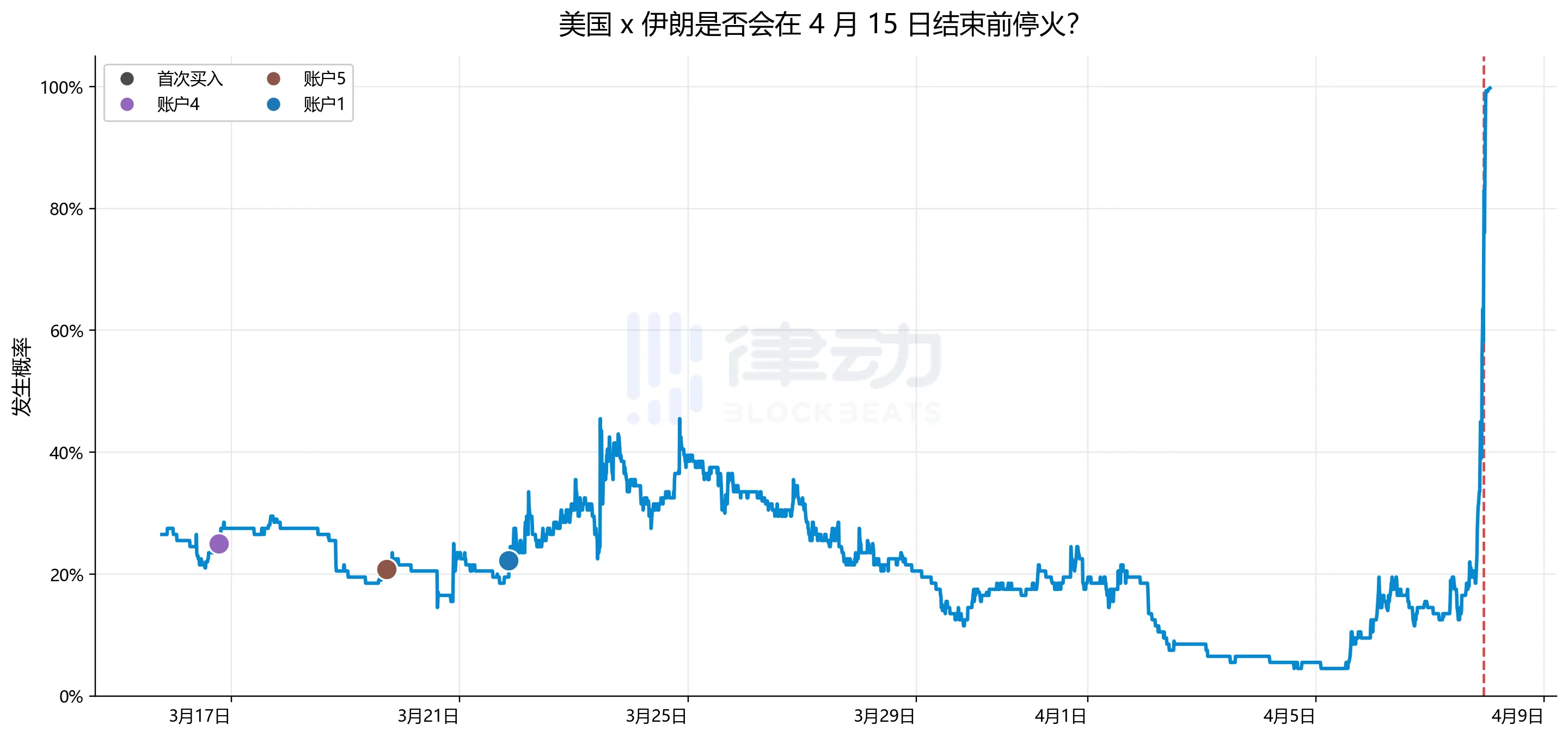
The scenario of the market “Will the U.S. and Iran have a ceasefire before April 15” is even more astounding. Three accounts participating in this market had already bought the “yes” option half a month before the ceasefire, and their positions shrank by over 80% in the following two weeks as the situation escalated.
In early April, while most macro analysts and think tanks were claiming that “the conflict was about to escalate into a ground war”, these three accounts were investing more funds, convinced that a ceasefire would be reached in the next two weeks.
At 06:32 on April 8th Beijing time, Trump posted on Truth Social announcing a ceasefire, causing the probability to surge from 20% to 100% in a straight line. These three accounts collectively made nearly $750,000 in profit from this ceasefire.
Loss, Further Confirming the Insider Portrait
These five accounts are not without flaws—Account 3 and Account 4 both lost money on the "Will Maduro step down by 2025" market. At first glance, this loss seemed enough to dispel their suspicion as insiders.
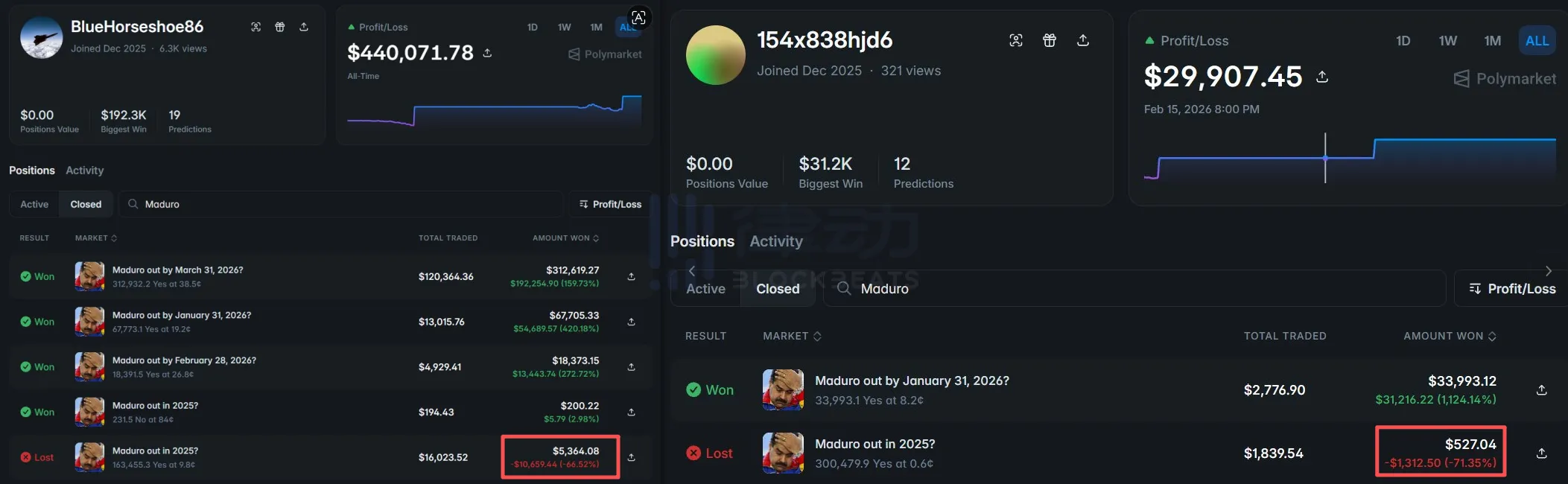
However, when we consider Trump's media interview on the day after Maduro's arrest, this loss actually solidified the insider portrait of the two.
On January 4, 2026, Trump revealed in an interview with Fox News that the U.S. military had initially planned to carry out a Venezuela operation on December 29, 2025, but had to wait for several days due to unfavorable weather conditions, eventually executing it on January 3.
In other words, if the weather had cooperated, Maduro would have been arrested in 2025, and the "Will Maduro step down by 2025" market would settle as "Yes." The $12,000 loss from these two accounts would have transformed into over $400,000 in profit.
They lost not because of a wrong judgment of the event itself, but due to the weather. Despite knowing that Maduro was still in jeopardy, they continued to bet on "Maduro stepping down by January 31, 2026," ultimately making nearly $300,000 in profit.
Precedent Exists: Someone Got Arrested for This
This is not the first time someone has used military insider information to profit on Polymarket.
In June 2025, Israel launched a 12-day military operation against Iran. Afterwards, Israeli authorities investigated and prosecuted two men: an Israeli Air Force reserve lieutenant colonel and his civilian accomplice.
According to the indictment, as Israeli warplanes were about to strike Iran, the lieutenant colonel informed his accomplice, who promptly bought relevant markets on Polymarket and made approximately $163,000 in profit from this bet.
The recent Congressional hearing incident has also caught the attention of U.S. law enforcement agencies. According to Fortune, several suspicious account transactions in the Congressional hearing incident have drawn the interest of the New York Southern District law enforcement, leading to a meeting with Polymarket representatives to discuss "potential misconduct."
Congressman Ritchie Torres subsequently proposed legislation to restrict government employees from participating in event-related contract trading. As of now, there have been no public prosecution outcomes, but the federal intervention in the investigation itself indicates that this is not a mere coincidence.
The Israeli arrest case has confirmed one thing: indeed, someone had military insider information when entering Polymarket, and indeed, someone is facing prosecution as a result. The analysis of these five accounts presented in this article, however, reveals a more systematic version—new accounts, highly concentrated funds, unusually precise timing of entry, and a swift exit after event settlement.
Instead of discussing the legal risks these insiders may face, as observers, there is another layer of potential opportunity in this matter: when insider funds flow into prediction markets, the market price itself becomes a signal, allowing us to glimpse into the future contours before the event actually occurs.
You may also like

Arthur Hayes New Post: It's "No Trade" Time Now

Claude Opus 4.7 Review: Is It Worthy of the Title of Strongest Model?

DWF In-Depth Report: AI Outperforms Humans in Yield Farming Optimization in DeFi, But Complex Transactions Still Lag Behind 5x
The financial tricks of the crypto giant Kraken

When proactive market makers start to take initiative

Massive Whale Movement: Unstaking $84.96 Million in HYPE Tokens
Key Takeaways A crypto whale, known as TechnoRevenant, has unstaked approximately $84.96 million in HYPE tokens. The tokens…

ListaDAO Addresses Third-Party Contract Vulnerability Concerns
Key Takeaways GoPlus Security revealed a vulnerability in a contract resembling those of ListaDAO. ListaDAO confirmed that their…

Security Risks of Fake Ledger Nano S+ Devices Emerging Through Chinese E-Commerce
Key Takeaways Counterfeit Ledger Nano S+ devices are being sold on Chinese e-commerce platforms, posing significant risks to…

Wave of Cyber Attacks Hits DeFi Protocols Post-Drift Hack
Key Takeaways A significant $280 million attack on Drift Protocol set off a chain of security breaches across…
Tom Lee Says ‘Mini Crypto Winter’ Is Over, Sees Ether Above $60K
Key Takeaways: Tom Lee predicts Ether’s resurgence, projecting it to surpass $60,000 in the coming years. Bitmine suffered…

French Government Tackles Rising Crypto Safety Concerns
Key Takeaways: France is intensifying measures to counter the surge in crypto kidnappings and wrench attacks. Since early…
Europe’s Bitcoin Treasury Playbook Unlikely to Mirror US Strategy: PBW 2026
Key Takeaways: European firms are adapting unique Bitcoin treasury strategies due to distinct financial regulations and market dynamics…
Circle Confronts Lawsuit Over $280M Drift Protocol Hack
Key Takeaways: Circle faces a lawsuit for allegedly aiding in the transfer of $230 million in stolen USDC.…
Bitcoin Faces ‘Near-Term Selling Pressure’ Following Surge to $76K: CryptoQuant
Key Takeaways: Bitcoin reaches a multi-month high of $76,000, prompting increased deposits to exchanges. CryptoQuant identifies a peak…

Ethereum Foundation Unveils North Korean Infiltration in Web3
Key Takeaways: The Ethereum Foundation’s ETH Rangers program exposed 100 North Korean operatives infiltrating Web3 companies. The Ketman…

Crypto in Sustained Winter as CEX Volumes Drop 39% in Q1
Key Takeaways: Centralized crypto exchange trading volume fell by 39% in Q1 2026 to $2.7 trillion. March saw…

Bitcoiners Should Prepare for Quantum Computing Now, Urges Adam Back
Key Takeaways: Adam Back emphasizes immediate steps toward quantum-resistant solutions for Bitcoin. Quantum computing may disrupt blockchain security…

Cybersecurity Alert: Counterfeit Ledger Devices on Chinese Market
Key Takeaways: Scammers distribute fake Ledger devices via Chinese marketplaces, risking user crypto assets. Victims of a related…
Arthur Hayes New Post: It's "No Trade" Time Now
Claude Opus 4.7 Review: Is It Worthy of the Title of Strongest Model?
DWF In-Depth Report: AI Outperforms Humans in Yield Farming Optimization in DeFi, But Complex Transactions Still Lag Behind 5x
The financial tricks of the crypto giant Kraken
When proactive market makers start to take initiative
Massive Whale Movement: Unstaking $84.96 Million in HYPE Tokens
Key Takeaways A crypto whale, known as TechnoRevenant, has unstaked approximately $84.96 million in HYPE tokens. The tokens…



 App
App