
 Buy Crypto
- Markets
 Futures
- Spot
- Copy Trade
- Earn
- More
Risk Asset Rollercoaster, the World Is on Edge Over the US vs. Iran




The U.S. fleet deployed to Iran is much larger in scale than the previous one to Venezuela, which also means that this time the asset's plummet is more brutal.
A few hours ago, Trump and the Iranian side began to speak harshly. Rumors are circulating in the community that the U.S. "Lincoln" aircraft carrier and its strike group deployed in the Middle East have entered a "comms blackout" state, indicating that action against Iran may be imminent.
All financial market investors are on edge.
Let's start with the U.S. stock market. The Nasdaq 100 quickly expanded its decline to 2%, the S&P 500 fell over 1%, and the Dow also couldn't escape, dropping 0.5%. The assets hit the hardest are those highly tied to risk appetite, with cryptocurrency-related stocks almost being ground to a halt. MSTR fell nearly 10% at one point, COIN dropped over 4%, and HOOD, SBET, BMNR, CRCL all experienced significant pullbacks.
The so-called safe-haven assets gold and silver are also falling. Spot gold plummeted through three $100 levels in just half an hour, dropping over $400 from its high to around $5155. Silver, on the other hand, was even more dramatic, plunging 8% intraday, plummeting from $121 directly to over $108.
The crypto market also couldn't evade the impact. As soon as the U.S. stock market opened, Bitcoin started to decline from $88,000 all the way down to around $83,000; Ethereum briefly dropped below $2800, SOL fell below $118, and BNB also dropped below $865.
This means that global funds have already assumed the worst-case scenario, that war is about to begin.
What Did the U.S. Prepare Before the Last "Showdown"
Lay your cards on the table first before deciding whether to flip it. This seems to be the consistent practice of the U.S. government.
If we look back at the recent action against Venezuela, we can see the series of signals the U.S. gave before the official attack: in the weeks before launching a series of attacks on Venezuelan ships, the U.S. had already stockpiled a large number of military assets in the Caribbean region. The official explanation at the time was that these ships were suspected of smuggling drugs into the U.S., but no clear evidence was presented. However, everyone knows the real facts: on January 3, the U.S. directly intervened and took away Venezuelan President Maduro from Caracas.
It is said that at that time the U.S. aircraft carrier was also in position. Usually, 5 to 7 days before the actual military action, the core U.S. strike force has already entered the designated area, leaving only the wait for a "suitable moment."
Before the attack on Iran in June 2025, the same pattern unfolded. A few days before the operation began, the media captured unusual movements of U.S. military equipment. On June 21, the U.S. suddenly deployed 6 B-2 stealth bombers to Guam, then casually explained that it was a feint to maintain the element of surprise. Those familiar with U.S. military logic understood that strategic assets of this level were never just for "practice." Meanwhile, two carrier strike groups led by the Carl Vinson and Lincoln aircraft carriers had already been deployed in the Arabian Sea. The Arleigh Burke-class guided-missile destroyer Thomas Hudner was also reassigned to the eastern Mediterranean.
Therefore, carrier deployments at sea, mobilization of strategic bombers and heavy strike capabilities, and air defense system deployments are the three key features of U.S. military pre-deployment before a conflict.
And now, similar signals are replaying step by step.
Is the Second Carrier on the Way?
"We have a very big fleet that's in that area. I don’t think we’ll need to use it." After Trump's statement, U.S. Central Command then confirmed on social platform X that a nuclear-powered aircraft carrier, the "Lincoln," had been sent to the Middle East.
The carrier left San Diego in November last year and had been on mission in the South China Sea. Now, it has a new combat purpose — Iran.
The Lincoln is one of the U.S. Navy's core assets and one of ten nuclear-powered aircraft carriers. It doesn't rely on diesel but is driven by a nuclear reactor, theoretically able to operate for decades without refueling. Equipped with highly advanced missile systems, radars, and sensors, it is itself a floating combat command center at sea.
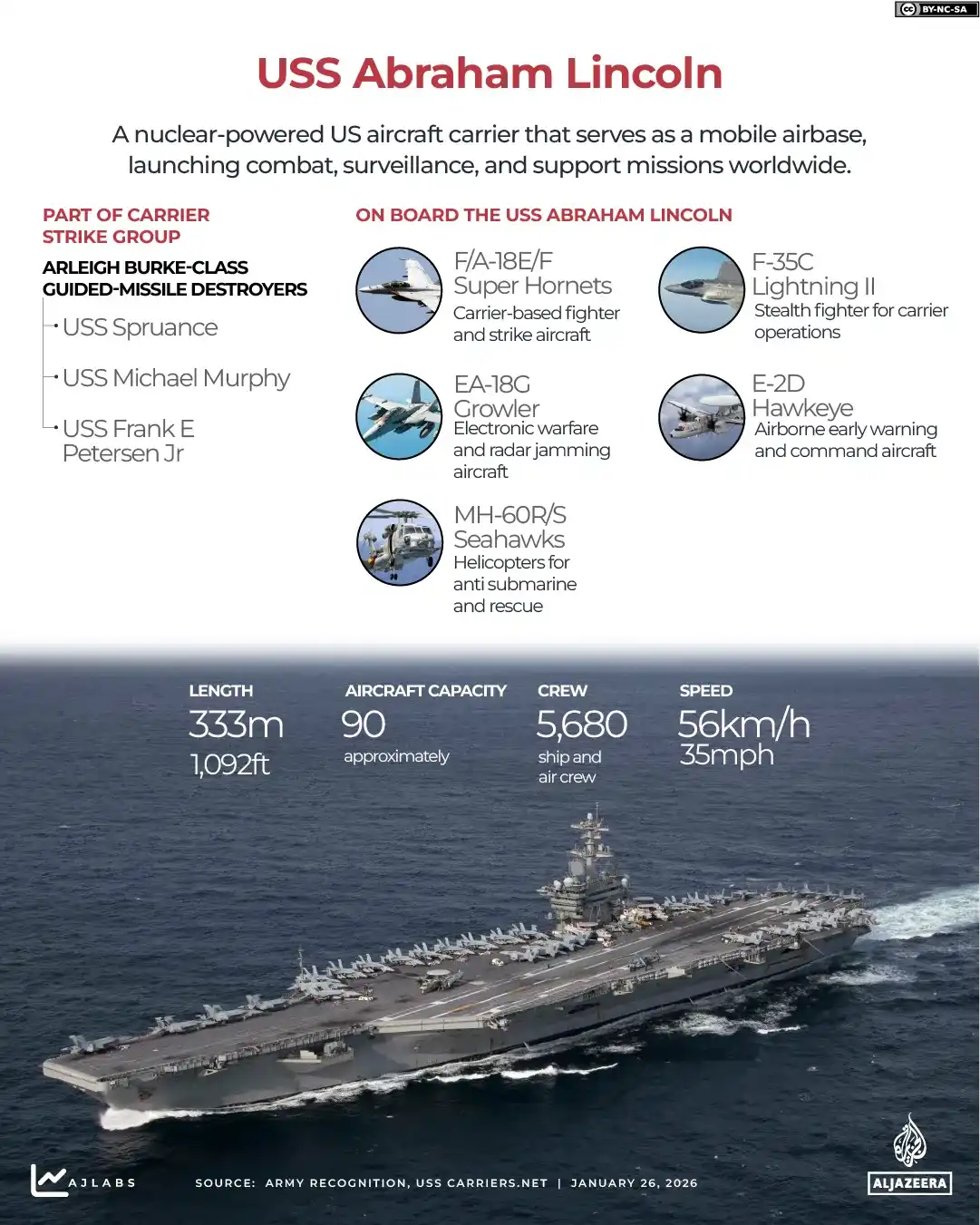
Lincoln Carrier Information
The Lincoln's trajectory was originally highly classified, but because it had to pass through the Strait of Malacca, one of the world's busiest waterways, it had to turn on its transponder to avoid collisions. It was this brief "lighting up" that confirmed to the outside world that it had crossed the Indian Ocean on January 23. Subsequently, the transponder was turned off, and its position disappeared again. But based on its speed, it has now essentially reached the vicinity of the combat zone and entered a state of readiness.
After passing through the Strait of Malacca, the transponder was turned off again, and the carrier disappeared from radar. The only option left is to rely on speed calculations. However, based on speed calculations, the current Lincoln has essentially reached the vicinity of the combat zone and is in position.
At the same time, it appears that a second aircraft carrier is also on the way.
The USS George H.W. Bush set sail from the U.S. East Coast on January 13, with the general belief being that it will likely cross the Atlantic, pass through the Strait of Gibraltar, and enter the Mediterranean. While the possibility of this being just a readiness exercise cannot be ruled out, at this moment, few truly believe it is a coincidence. Most military analysts speculate that the deployment of the George H.W. Bush is to "raise the stakes" in the Middle East situation.
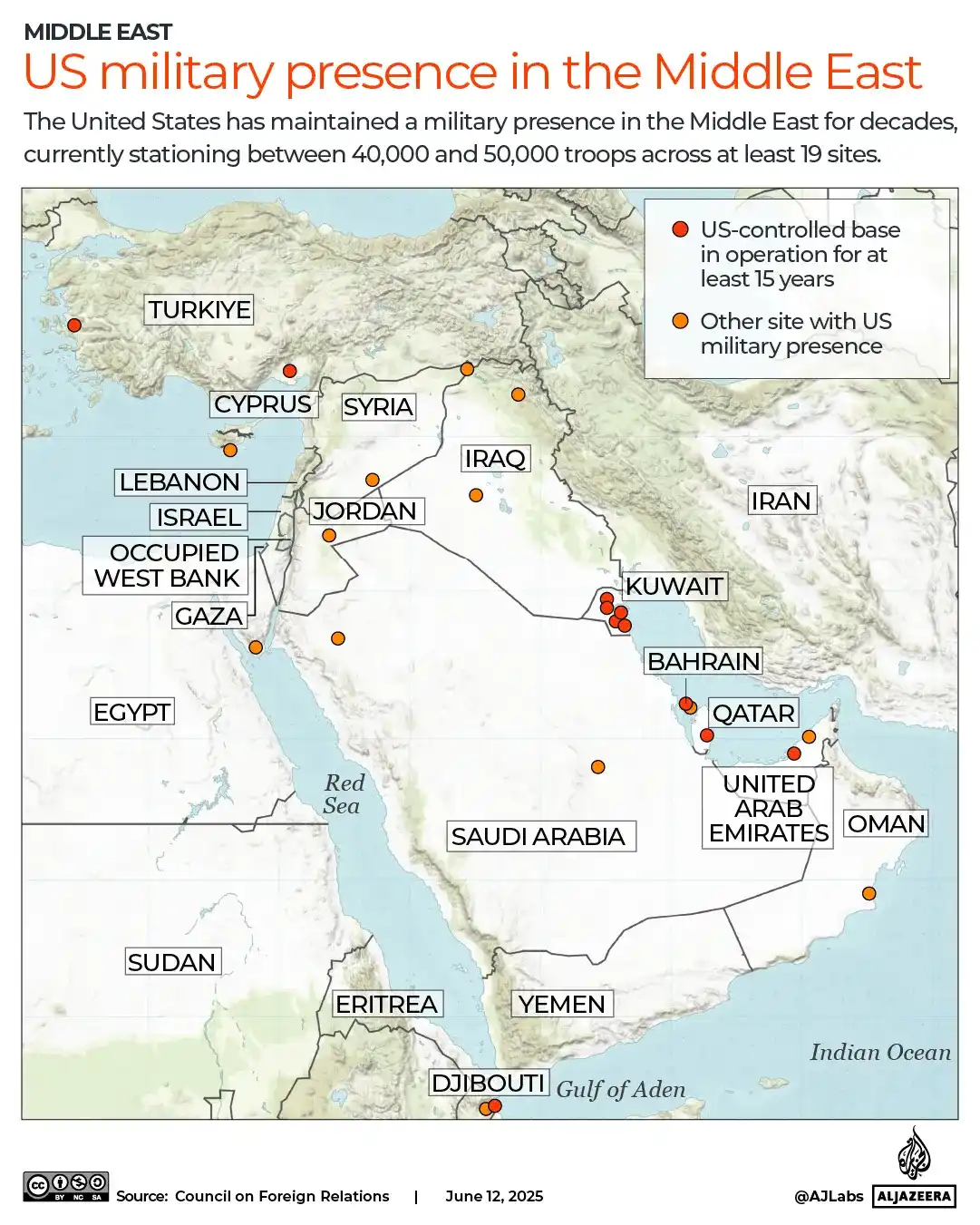
Middle East Terrain
Many military analysts also agree on a particular point: the truly "appropriate" time to strike is likely after the second aircraft carrier battle group is in place. While one aircraft carrier can certainly engage, having two means full air superiority, increased strike frequency, and fault tolerance all maxed out. Since the ideal window for an attack that Iran protested in early January has passed, the difference between waiting a day and waiting a week is not significant. Rather than rushing into action, it's better to wait for the second aircraft carrier battle group to be in place, consolidate the military power in the Middle East region to its highest, and then make a decisive move.
However, as of now, the Bush has not been seen crossing the critical strait, and based on its speed, it has not yet fully reached its preparedness position.
After discussing aircraft carrier deployments, the airspace side is also active. The U.S. Central Command has announced a multi-day readiness exercise in its area of responsibility, covering over 20 Middle Eastern, Asian, and African countries. The word "exercise" itself is very flexible.
Of course, with offense, there must be defense.
Especially, the U.S.' protection of Israel. According to The Wall Street Journal, the U.S. is also deploying Patriot and THAAD missile defense systems to the Middle East. Typically, the real war timetable only starts after the completion of the air defense system deployment. However, the specific timing is almost unknown to the outside world.
Some analyses even look further: Trump has always been fixated on Greenland, not just for its resources. There are crucial U.S. radar warning facilities there, which are essential nodes to prevent long-range ballistic missile attacks. Controlling these areas fundamentally establishes a depth of defense for larger-scale conflicts.
Israel has apparently also entered the same timeline. On January 25 local time, Israeli Defense Forces Northern Command chief Rafi Milo publicly stated that the IDF is preparing for a chain reaction after a potential U.S. military action against Iran. Earlier, The Jerusalem Post cited defense officials saying that the IDF has raised its alert level across the board to deal with "an attack the U.S. could launch within days."
In this context, the true goal of the United States is becoming increasingly clear. If action is taken, the target is likely not just a one-time limited strike, but a direct hit at the Iranian regime itself. It is for this reason that the United States emphasizes thorough preparation. A missed strike would result in long-term attrition, a political risk that any U.S. administration is unwilling to bear.
The U.S. Government's "Partial Shutdown" Woes
Beyond military risks, pressure is also building up domestically in the United States.
The Odaily editor believes that the "partial shutdown" of the U.S. government at the end of the month is one of the key reasons for today's decline.
Each fiscal year, the U.S. Congress must pass 12 appropriations bills. If they cannot agree, the government shuts down. The current temporary appropriations bill will expire on January 31, leaving only two working days for Congress. Informal tallies in the Senate have already shown that procedural votes to advance appropriations bills have failed, making a partial or complete government shutdown an almost certain event.
Now, with only 2 working days left, the fact of a partial government shutdown is essentially confirmed. Informal tallies in the U.S. Senate show that procedural votes held that day failed to advance government appropriations bills passed by the House of Representatives.
The main budget disagreement between the two parties is in the Department of Homeland Security. The key event was a major welfare fraud case, one of the largest in U.S. history, recently uncovered in Minnesota, a long-standing Democratic stronghold. The case involved as much as $9 billion. More information can be found in the related article: "U.S. Government Faces Another Shutdown, Will the Crypto Sphere Be Affected Again?." Here, we will briefly discuss the points of contention:
Many of the organizations involved in the case have close ties to the local Democratic political ecosystem. Evidence shows that much of the fraudulently obtained funds ended up in Democratic campaign donations.
Minnesota itself is highly immigrant-populated, with large immigrant communities such as the Somali community. The Minnesota Attorney General's Office stated that among the 92 defendants charged in the case, 82 are Somali-Americans. This intertwining of immigrant law enforcement, welfare distribution, and public safety issues precisely hits on core issues of contention between the Democratic and Republican parties, a focal point repeatedly emphasized in Trump's and the Republican Party's policy commitments during campaigns.
As a result, Trump has intensified immigration law enforcement in Minnesota. The sudden escalation of enforcement efforts quickly led to serious consequences, with two incidents where federal immigration officers mistakenly shot and killed local residents, sparking large-scale protests and riots, even necessitating the deployment of the National Guard to maintain order. The Democratic Party swiftly seized this opportunity, using the fatal ICE shootings in Minnesota as evidence of the agency's out-of-control enforcement tactics.
The Democratic Party's logic is very clear: ICE has caused two deaths in Minnesota, which proves that the agency's law enforcement has serious issues. Without substantial reforms to ICE and the addition of strict oversight measures, why should we continue to fund it? The Democratic Party is calling for a reduction in the size of ICE, or at least the addition of strict oversight measures.
The Republican position, on the other hand, is sharp: the Minnesota welfare fraud case involved $9 billion, with the majority of the defendants being of Somali descent, which precisely demonstrates the need to strengthen rather than weaken immigration enforcement. ICE is a key force in combating illegal immigration and welfare fraud and must be adequately funded.
The infighting is getting nowhere, while external risks are simultaneously escalating. Whether war will truly break out, no one can provide a definitive answer. But the Dunmo Editor hopes for world peace.
You may also like

Beta, meet cash flow

How do tokenized stocks work? A conversation with the head of digital assets at BlackRock
Is the rebound an illusion? The bond market has already provided the answer

The End of Crypto Premium? Observing the Market Logic Shift from the Dilemma After Gemini's Listing

The third round of repurchase and destruction by JST has been completed as scheduled, with a repurchase and destruction scale exceeding 21 million USD

Will Bitcoin ETF Increase Bitcoin Price in 2026?
Will Bitcoin ETF increase BTC price in 2026? See what ETF inflows signal about institutional demand, market momentum, and Bitcoin’s long-term outlook.

How to Track Bitcoin ETF Flows in 2026: Best Free Trackers Used by Analysts
Since 2024, Bitcoin ETFs have become one of the main channels through which institutional capital enters the crypto market. Unlike traditional crypto exchange volume data, ETF flow data reflects portfolio allocation decisions from large investors, which often influence long-term price direction rather than short-term speculation.
How to Invest in Bitcoin ETF in 2026: Beginner's Step-by-Step Guide
For users who want the simplest way to follow Bitcoin price movements, ETFs can be a convenient starting point.

What Is a Bitcoin ETF? Is Bitcoin ETF a Good Investment Entry for Crypto Beginners in 2026?
What is a Bitcoin ETF and why does it matter in 2026? Learn how Bitcoin ETFs work, why institutions use them, and how they changed crypto market access worldwide.

Bitcoin ETF vs Ethereum ETF: What's the Difference in 2026?
Bitcoin ETF vs Ethereum ETF: What’s the difference and which should you choose in 2026? Compare risk, adoption trends, and portfolio roles before investing.
The Bounce is a Illusion? The Bond Market Has Answered

The Flip Side of the Stock Market Rally: Energy Reconfiguration, Bitcoin Short Squeeze, and Market Dislocation

Claude's Request for Identity Verification Prompts Reflection from a Relay Operator
PinPet × VELA: Solana's First Atomic Swap Engine and Yield Hedging Protocol, Reframing the DeFi Financial Paradigm

From Coinbase to OpenAI: When lobbying experts start to flee crypto

Understanding the Key Issues of Tokenization in One Article

Silicon Valley Entrepreneurship Guru Steve Blank: In the AI Era, Startups Over Two Years Old Should Reboot
How Dangerous Is Mythos? Why Anthropic Has Decided Not to Release the New Model
Beta, meet cash flow
How do tokenized stocks work? A conversation with the head of digital assets at BlackRock
Is the rebound an illusion? The bond market has already provided the answer
The End of Crypto Premium? Observing the Market Logic Shift from the Dilemma After Gemini's Listing
The third round of repurchase and destruction by JST has been completed as scheduled, with a repurchase and destruction scale exceeding 21 million USD
Will Bitcoin ETF Increase Bitcoin Price in 2026?
Will Bitcoin ETF increase BTC price in 2026? See what ETF inflows signal about institutional demand, market momentum, and Bitcoin’s long-term outlook.



 App
App