
- Buy Crypto
- Markets
 Futures
- Spot
- Copy Trade
- Earn
- More
South Korea Sets 20% Ownership Cap for Major Shareholders of Cryptocurrency Exchanges

BlockBeats News, March 4th. According to Yonhap News Agency, the South Korean government and the ruling party have reached an agreement on the restriction of major shareholders of digital asset exchanges, setting the limit at 20%. This standard will be uniformly applied to all exchanges, with a grace period of 3 years after the law is implemented. However, for exchanges that have not reached a specific market share, the grace period will be extended by an additional 3 years.
The day before, the Digital Assets Special Task Force of the South Korean ruling party, the Democratic Party, discussed a key issue regarding digital assets with the Financial Services Commission – the limit on major shareholders of exchanges. It is reported that the Task Force and the Financial Services Commission reached a consensus at the meeting: the limit on major shareholder ownership is set at 20%, but based on exceptions determined by the Financial Services Commission in the enforcement decree, new companies can relax this limit to 34%. This 34% provision only applies to new market entrants, with the figure referencing the veto power threshold in the Corporate Law (33.3%).
The grace period for the enforcement of the major shareholder ownership limit is 3 years. However, exchanges that have not met specific criteria (estimated market share of 20%) can receive an additional 3-year extension. The two exchanges that hold about 90% of the market share, Upbit and Bithumb, must complete the adjustment of major shareholder ownership within 3 years after the law is implemented. Exchanges with relatively lower market shares such as Coinone, Korbit, Gopax, are expected to receive a grace period of up to 6 years.
You may also like

Particle Founder: The entrepreneurial insights I have gained the most from in the past year

Huang Renxun's latest podcast transcript: The future of Nvidia, the development of embodied intelligence and agents, the explosion of inference demand, and the public relations crisis of artificial intelligence

OKX Ventures Research Report: AI Agent Economic Infrastructure Research Report (Part 1)

The migration of settlement rights: B18 and the institutional starting point of on-chain banks

From Tencent and Circle: Looking at the Simple and Difficult Questions of Investment

The second half of stablecoins no longer belongs to the crypto circle

Cursor "Shell" Kimi Controversy Reversed: From Copyright Infringement Allegations to Authorized Collaboration, China's Open Source Model Once Again Becomes a Global AI Foundation

The Real Reason Tokens Don't Sell: 90% of Crypto Projects Overlook Investor Relations

Is the income of pump.fun real, earning a million dollars a day despite the market downturn?

The real reason why tokens are not selling: 90% of crypto projects neglect investor relations

Who is the true winner of the "Tokenization" narrative?

Moss: The Era of AI-Traded by Anyone | Project Introduction

Chip Smuggling Case Exposes Regulatory Loophole | Rewire News Evening Update

How a Structured AI Crypto Trading Bot Won at the WEEX Hackathon
Ritmex demonstrates how disciplined risk control and structured signals can make an AI crypto trading bot more stable and reliable on WEEX, highlighting the importance of combining execution discipline with scalable AI trading systems.

Old Indicator Fails, Three Major New Signals Emerge: BTC True Bottom May Still Be Below $60K

Meeting OpenClaw Founder at a Hackathon: What Else Can Lobsters Do?
Huang Renxun's Latest Podcast Transcript: NVIDIA's Future, Embodied Intelligence and Agent Development, Soaring Demand for Inferencing, and AI's PR Crisis
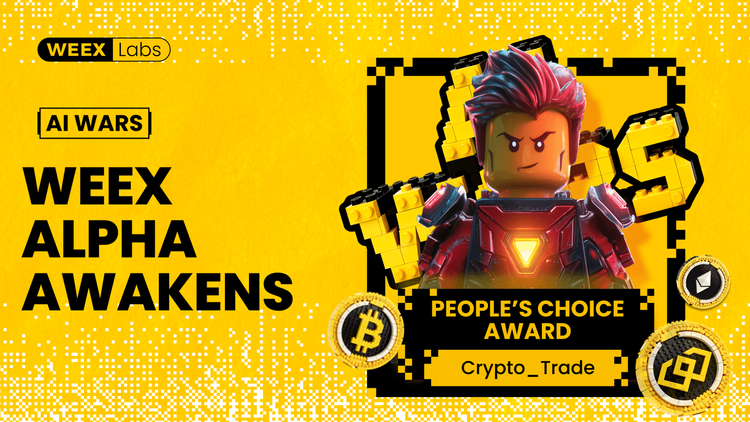
How a Structured AI Crypto Trading Bot Won at the WEEX Hackathon
Crypto_Trade shows how structured inputs and controlled adaptability can build a more stable and reliable AI crypto trading bot within the WEEX AI Trading Hackathon, highlighting a practical path toward scalable AI trading systems.


 App
App