
 Buy Crypto
- Markets
 Futures
- Spot
- Copy Trade
- Earn
- More
What Epstein Really Did to Bitcoin

The recently released Epstein files contain a lot of insider information about Bitcoin and the cryptocurrency industry. We provided a more comprehensive review in our previous article "Unpacking the Epstein Files, Revealing His Encounter with Satoshi Nakamoto."
Today, we are going to talk about the "Bitcoin Hijacking Theory," a theory that has regained attention due to the Epstein files.
What is the "Bitcoin Hijacking Theory"?
The "Bitcoin Hijacking Theory" comes from Roger Ver's book published in 2024, titled "Hijacking Bitcoin: The Hidden History of BTC." This was the first time he used a book title and the entire book to systematically expound the "Bitcoin Hijacking Theory."
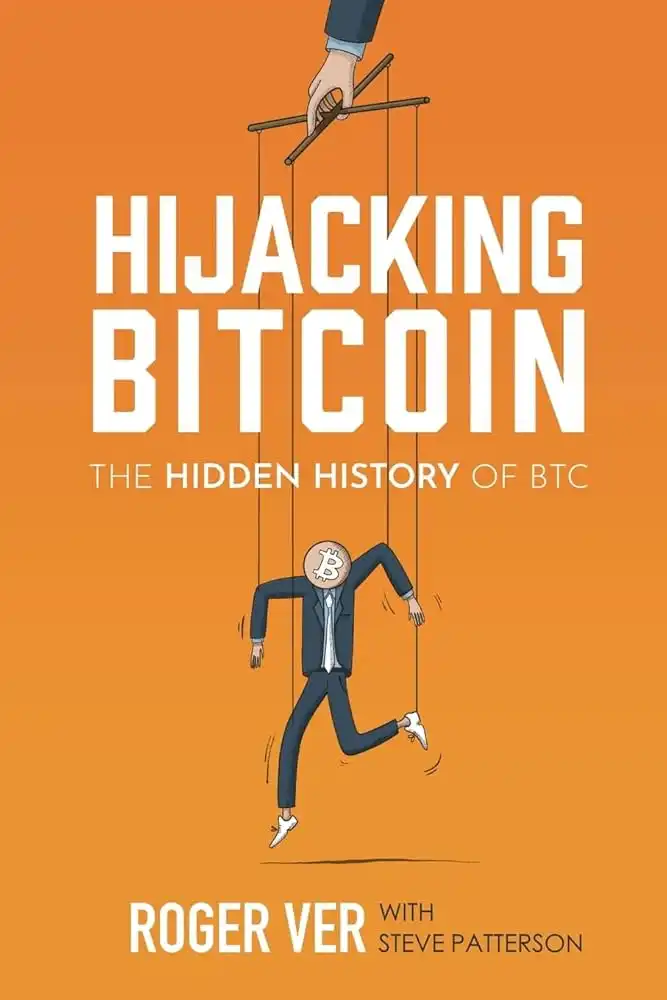
The "Bitcoin Hijacking Theory" believes that Bitcoin has transformed from a "peer-to-peer electronic cash" designed to combat fiat currency hegemony into a speculative asset, deviating from Satoshi Nakamoto's original vision for Bitcoin. It is seen as the deliberate result of various conspiracies (internal business interests, external funding such as Epstein's, and the U.S. government's desire to maintain dollar hegemony), indicating that "Bitcoin's development was not natural and organic. It was supposed to be a currency that people all over the world could finally choose to use freely, but it ended up being dominated by the digital gold narrative."
Roger Ver believes that Bitcoin Core developers' decisions are not independent but influenced by external funding. In 2014-2015, the collapse of the Bitcoin Foundation left Bitcoin Core developers without stable salaries. The Digital Currency Initiative (DCI) at the MIT Media Lab began paying several Bitcoin Core developers, leading Gavin Andresen, Wladimir van der Laan, and Cory Fields, three Bitcoin Core developers, to join the MIT Media Lab.
This information became a hot topic of discussion again due to the recent Epstein files disclosure. However, as early as 2019, when MIT admitted to accepting donations from Epstein, it was already known to the public. Therefore, Roger Ver introduced it into his book, considering it as evidence of external funding influencing Bitcoin's development, even though the developers funded by MIT were unaware that the donations came from Epstein.
He also mentioned another Bitcoin Core developer, Adam Back, leading Blockstream, accepting VC funding from a16z, among others. The mainnet congestion benefited the company's business, and commercial interests also led to Bitcoin being "co-opted," serving the narrative of sidechains/Bitcoin Layer 2.
During the "block size war," Bitcoin Core developers stuck to small blocks, rejecting various scaling proposals. They openly supported and pursued full blocks, high fees, and transaction congestion, considering this a "natural state of market competition," believing it could long-term replace block rewards for miner incentives to maintain network security.
On the other hand, Roger Ver believed this ultimately resulted in slow, expensive, and unreliable Bitcoin transactions, hindering Bitcoin's widespread adoption as a world currency and daily payment tool. He hoped Bitcoin could truly enter the lives of ordinary people, having coffee, buying clothes, watching sports...
"If blocks are always full, it's as absurd as Starbucks intentionally running out of coffee every day. Block space is a consumer good, and miners should meet Bitcoin's real usage needs."
He also pointed out that due to Bitcoin's small block limit, it had to turn to solutions like custodial wallets or the Lightning Network. Bitcoin has become a settlement layer rather than electronic cash. Meanwhile, whether it's custodial wallets or sidechains/Bitcoin Layer 2, ultimately it still forces users to rely on centralized services.
The big block advocates lost the "block size war," and Roger Ver turned to BCH, which later split into BSV and XEC. However, did the small block advocates really "win"? At the time, they believed that large blocks would skyrocket the cost of running a full node, making it increasingly unaffordable for ordinary people to run full nodes, leading to government, mining pool, big company, and data center control over Bitcoin validation rights.
However, many years later, government influence on Bitcoin continues to grow. The envisioned path of "decentralization first, with payments coming later" has not developed ideally. Companies like Valve, Stripe, Dell, Expedia once supported direct Bitcoin payments (without converting to fiat settlement), but eventually withdrew support due to long transaction times, high fees, or low user willingness to use.
Nowadays, hardly anyone is talking about Bitcoin's world currency attributes, and the digital gold narrative has become mainstream.
Then, he went further to mention U.S. government intervention, pointing out that U.S. intelligence agencies were interested in similar technology even before Bitcoin's birth, using NSA's 1996 paper "How to Make a Mint: The Cryptography of Anonymous Electronic Cash" as evidence. The paper describes an anonymous digital currency system similar to Bitcoin, indicating that the U.S. government may have been monitoring or trying to influence Bitcoin's development early on to prevent it from truly threatening the national currency system.
In an interview in 2024, he further stated:
「As early as 2011, we knew that the CIA was interested in Bitcoin because they had reached out to Bitcoin developers for information. When most people hadn't even heard of Bitcoin, the CIA had already started researching it.
But around 2012, a person claiming to be 'John Dylan' alleged to be a member of an intelligence agency and spent over $10,000 (a significant amount) creating propaganda trying to deceive people into believing that keeping the Bitcoin block small would make it more decentralized. This was completely contrary to the truth and to the original design intentions of Bitcoin's creator, Satoshi Nakamoto. The design philosophy and use of Bitcoin were not like that at the beginning. Initially, no one believed this propaganda.
Later on, the Bitcoin community went through a massive censorship wave. Some anonymous individuals took control of all major Bitcoin discussion platforms, and overnight, any advocacy for using Bitcoin as a currency was banned. They censored anyone trying to promote Bitcoin for payments. Initially, people could see through these operations, but as new users joined, they were indoctrinated with these censored ideas.」
Credibility of the 'Bitcoin Hijacking Theory'
Roger Ver, an early influential figure in the crypto industry, began investing in Bitcoin in early 2011. He is the founder of Bitcoin.com, a co-founder of Ripple and Blockchain.com, and an early investor in Kraken. He actively promoted Bitcoin and cryptocurrency-related startups in the early days and was already a millionaire before investing in Bitcoin, yet he still sold his Lamborghini to buy more Bitcoin. Thus, he was dubbed 'Bitcoin Jesus.'
However, since the 'Block Size War,' he has long criticized small block advocates, Bitcoin Core developers, and Blockstream, and has been a staunch supporter of BCH. Therefore, the Bitcoin community's reactions to his statements have almost always been mockery, such as 'Roger is still making excuses for the lost war of 2017; BCH is the real hijacking of Bitcoin.'
It wasn't until 2024 when he published a new book that he first integrated various elements such as the 'Block Size War,' Epstein's funding of Bitcoin Core developers, NSA papers, and potential U.S. government censorship of pro-big block speech into a comprehensive 'Bitcoin Hijacking Theory.'
Approximately 3 weeks after the book was published, he was arrested in Spain for tax evasion, with the U.S. subsequently requesting extradition. The U.S. Department of Justice charged him with selling approximately $240 million in Bitcoin in 2017 without reporting taxes (resulting in at least $48 million in losses to the IRS) and undervaluing Bitcoin assets when renouncing his U.S. citizenship in 2014, including charges of mail fraud, tax evasion, false tax returns, and 8 total charges, facing up to 109 years in prison.
In a subsequent interview, Roger Ver claimed that he was retaliated against only after he exposed the "truth about Bitcoin's hijacking" and the U.S. government's involvement. However, the charges against him were made months before the publication of his book, and the arrest was executed only after the book was released.
In October 2025, he reached a deferred prosecution agreement with the U.S. Department of Justice, paying approximately $49.9 million (taxes + fines + interest), after which the case was dismissed.
In conclusion, he has a stance (supporting big blocks and BCH), and his arrest did not have direct evidence that it was because he "exposed the U.S. government's deliberate effort to turn Bitcoin from a currency into a speculative asset to uphold the dollar's dominance." However, he still perseveres in expressing his views amid the Bitcoin community's lack of understanding and even hostility, unable to erase his contributions in the early days of Bitcoin. More importantly, his view that "Bitcoin deviated from its original positioning, thereby diminishing its own value," has actually gained considerable recognition.
PayPal co-founder Peter Thiel explicitly stated in a recent interview that Bitcoin has deviated from its decentralized and anti-establishment origins. It is no longer a revolutionary tool against the old system but has been "co-opted" by the old system, becoming part of it. Peter Thiel pointed out that FBI agents once told him that they would prefer criminals to use Bitcoin instead of the dollar, indicating that Bitcoin has not achieved its intended anonymity and resistance to censorship but has become a more traceable tool. While Bitcoin ETFs have introduced incremental changes to the market, it does not signify that traditional finance has bowed to cryptocurrency; on the contrary, Bitcoin has been "co-opted" by traditional finance. The liberating technology that aimed to subvert fiat currency has ultimately become a mainstream financial product.
The recent massive disclosures from the Epstein files have caused cognitive and perceptual shocks. These pieces of information were previously inaccessible and unimaginable, so when they are finally unveiled, people shocked and impacted will "retaliate" by expanding their imaginative space.
Roger Ver's "Bitcoin hijacking theory" has started to receive renewed attention and is considered "correct." @miyaspokeofthis even combined Nikolai Mushegian (MakerDAO co-founder, WETH development lead)'s death with Epstein, Tether co-founder Brock Pierce, and the "Bitcoin hijacking theory," crafting a comprehensive article.
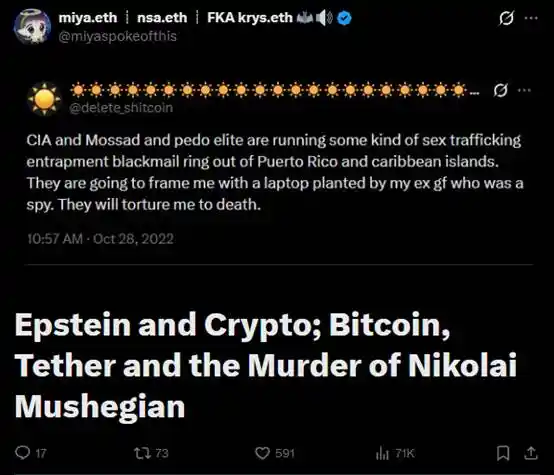
I am unwilling to label all of this as a "conspiracy theory" because when a corner of the iceberg of evil is suddenly exposed to the sunlight, no one can convince themselves, "Human nature is inherently good, and I should not have more doubts."
You may also like

Found a "meme coin" that skyrocketed in just a few days. Any tips?

TAO is Elon Musk, who invested in OpenAI, and Subnet is Sam Altman

The era of "mass coin distribution" on public chains comes to an end

Soaring 50 times, with an FDV exceeding 10 billion USD, why RaveDAO?

1 billion DOTs were minted out of thin air, but the hacker only made 230,000 dollars

After the blockade of the Strait of Hormuz, when will the war end?

Before using Musk's "Western WeChat" X Chat, you need to understand these three questions
The X Chat will be available for download on the App Store this Friday. The media has already covered the feature list, including self-destructing messages, screenshot prevention, 481-person group chats, Grok integration, and registration without a phone number, positioning it as the "Western WeChat." However, there are three questions that have hardly been addressed in any reports.
There is a sentence on X's official help page that is still hanging there: "If malicious insiders or X itself cause encrypted conversations to be exposed through legal processes, both the sender and receiver will be completely unaware."
No. The difference lies in where the keys are stored.
In Signal's end-to-end encryption, the keys never leave your device. X, the court, or any external party does not hold your keys. Signal's servers have nothing to decrypt your messages; even if they were subpoenaed, they could only provide registration timestamps and last connection times, as evidenced by past subpoena records.
X Chat uses the Juicebox protocol. This solution divides the key into three parts, each stored on three servers operated by X. When recovering the key with a PIN code, the system retrieves these three shards from X's servers and recombines them. No matter how complex the PIN code is, X is the actual custodian of the key, not the user.
This is the technical background of the "help page sentence": because the key is on X's servers, X has the ability to respond to legal processes without the user's knowledge. Signal does not have this capability, not because of policy, but because it simply does not have the key.
The following illustration compares the security mechanisms of Signal, WhatsApp, Telegram, and X Chat along six dimensions. X Chat is the only one of the four where the platform holds the key and the only one without Forward Secrecy.
The significance of Forward Secrecy is that even if a key is compromised at a certain point in time, historical messages cannot be decrypted because each message has a unique key. Signal's Double Ratchet protocol automatically updates the key after each message, a mechanism lacking in X Chat.
After analyzing the X Chat architecture in June 2025, Johns Hopkins University cryptology professor Matthew Green commented, "If we judge XChat as an end-to-end encryption scheme, this seems like a pretty game-over type of vulnerability." He later added, "I would not trust this any more than I trust current unencrypted DMs."
From a September 2025 TechCrunch report to being live in April 2026, this architecture saw no changes.
In a February 9, 2026 tweet, Musk pledged to undergo rigorous security tests of X Chat before its launch on X Chat and to open source all the code.
As of the April 17 launch date, no independent third-party audit has been completed, there is no official code repository on GitHub, the App Store's privacy label reveals X Chat collects five or more categories of data including location, contact info, and search history, directly contradicting the marketing claim of "No Ads, No Trackers."
Not continuous monitoring, but a clear access point.
For every message on X Chat, users can long-press and select "Ask Grok." When this button is clicked, the message is delivered to Grok in plaintext, transitioning from encrypted to unencrypted at this stage.
This design is not a vulnerability but a feature. However, X Chat's privacy policy does not state whether this plaintext data will be used for Grok's model training or if Grok will store this conversation content. By actively clicking "Ask Grok," users are voluntarily removing the encryption protection of that message.
There is also a structural issue: How quickly will this button shift from an "optional feature" to a "default habit"? The higher the quality of Grok's replies, the more frequently users will rely on it, leading to an increase in the proportion of messages flowing out of encryption protection. The actual encryption strength of X Chat, in the long run, depends not only on the design of the Juicebox protocol but also on the frequency of user clicks on "Ask Grok."
X Chat's initial release only supports iOS, with the Android version simply stating "coming soon" without a timeline.
In the global smartphone market, Android holds about 73%, while iOS holds about 27% (IDC/Statista, 2025). Of WhatsApp's 3.14 billion monthly active users, 73% are on Android (according to Demand Sage). In India, WhatsApp covers 854 million users, with over 95% Android penetration. In Brazil, there are 148 million users, with 81% on Android, and in Indonesia, there are 112 million users, with 87% on Android.
WhatsApp's dominance in the global communication market is built on Android. Signal, with a monthly active user base of around 85 million, also relies mainly on privacy-conscious users in Android-dominant countries.
X Chat circumvented this battlefield, with two possible interpretations. One is technical debt; X Chat is built with Rust, and achieving cross-platform support is not easy, so prioritizing iOS may be an engineering constraint. The other is a strategic choice; with iOS holding a market share of nearly 55% in the U.S., X's core user base being in the U.S., prioritizing iOS means focusing on their core user base rather than engaging in direct competition with Android-dominated emerging markets and WhatsApp.
These two interpretations are not mutually exclusive, leading to the same result: X Chat's debut saw it willingly forfeit 73% of the global smartphone user base.
This matter has been described by some: X Chat, along with X Money and Grok, forms a trifecta creating a closed-loop data system parallel to the existing infrastructure, similar in concept to the WeChat ecosystem. This assessment is not new, but with X Chat's launch, it's worth revisiting the schematic.
X Chat generates communication metadata, including information on who is talking to whom, for how long, and how frequently. This data flows into X's identity system. Part of the message content goes through the Ask Grok feature and enters Grok's processing chain. Financial transactions are handled by X Money: external public testing was completed in March, opening to the public in April, enabling fiat peer-to-peer transfers via Visa Direct. A senior Fireblocks executive confirmed plans for cryptocurrency payments to go live by the end of the year, holding money transmitter licenses in over 40 U.S. states currently.
Every WeChat feature operates within China's regulatory framework. Musk's system operates within Western regulatory frameworks, but he also serves as the head of the Department of Government Efficiency (DOGE). This is not a WeChat replica; it is a reenactment of the same logic under different political conditions.
The difference is that WeChat has never explicitly claimed to be "end-to-end encrypted" on its main interface, whereas X Chat does. "End-to-end encryption" in user perception means that no one, not even the platform, can see your messages. X Chat's architectural design does not meet this user expectation, but it uses this term.
X Chat consolidates the three data lines of "who this person is, who they are talking to, and where their money comes from and goes to" in one company's hands.
The help page sentence has never been just technical instructions.
Parse Noise's newly launched Beta version, how to "on-chain" this heat?

Is Lobster a Thing of the Past? Unpacking the Hermes Agent Tools that Supercharge Your Throughput to 100x

Declare War on AI? The Doomsday Narrative Behind Ultraman's Residence in Flames
Crypto VCs Are Dead? The Market Extinction Cycle Has Begun
Claude's Journey to Foolishness in Diagrams: The Cost of Thriftiness, or How API Bill Increased 100-Fold

Edge Land Regress: A Rehash Around Maritime Power, Energy, and the Dollar
Arthur Hayes Latest Interview: How Should Retail Investors Navigate the Iran Conflict?
Just now, Sam Altman was attacked again, this time by gunfire

Straits Blockade, Stablecoin Recap | Rewire News Morning Edition
From High Expectations to Controversial Turnaround, Genius Airdrop Triggers Community Backlash


 App
App