
Jensen Huang's reinstatement ignites stock rally: Is the crisis really over?

 Prefer us on Google
Introduction
On Nov. 23, NVDA's board announced Jensen Huang's reinstatement as president, chief executive officer and director. The board said the decision was unanimous and effective immediately. Colette Kress remains chief financial officer, while Harvey C. Jones remains chair.
Markets responded immediately: NVDA closed the regular session at $165.05, up 31.48% for the day. More important than the headline gain is what investors were actually pricing in—Huang's return to the helm, improving expectations for AI demand, or a concentrated reversal of previously bearish positioning?
The answer may involve all three. Reinstatement addresses leadership uncertainty, but it does not automatically end internal investigations, accounting inquiries, export-control reviews, or congressional hearings. The one-day surge removed part of the risk premium, but it cannot be read as an all-clear on every risk.
Trade now
Spot: NVDA
Futures: NVDA
Contents
- From resignation to reinstatement: NVDA's 11-day governance shock
- What did the 31.48% rebound actually recover?
- Why can Huang's departure or return move the entire AI sector?
- Why did markets sell off despite strong earnings?
- Reinstatement does not end investigations: Four risks still in play
- Outlook
From resignation to reinstatement: NVDA's 11-day governance shock
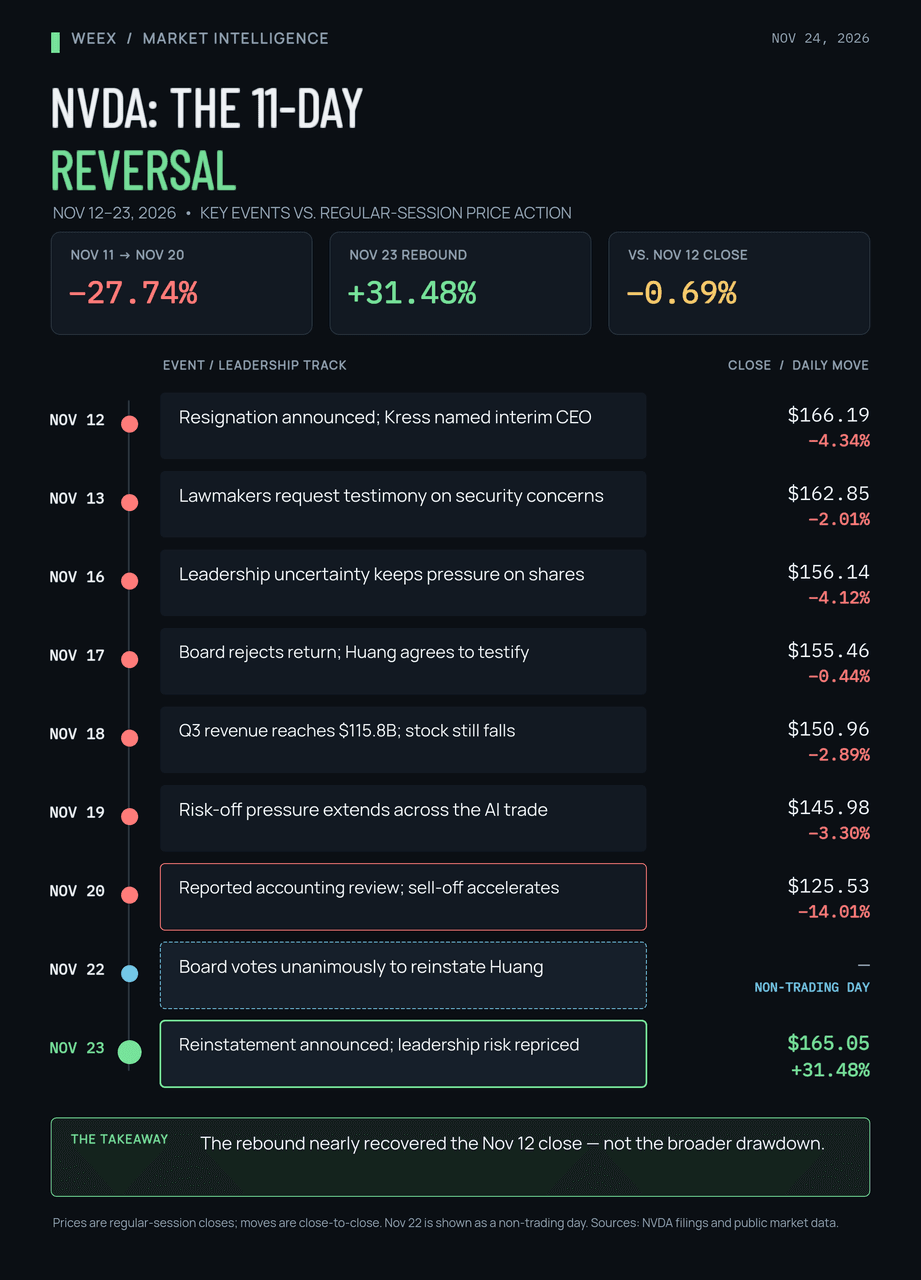
According to NVDA's regulatory filing, the board accepted Jensen Huang's resignation as president, chief executive officer and director on Nov. 11, with the decision announced on Nov. 12. Colette Kress subsequently became interim CEO while Harvey C. Jones was appointed chair. The board also initiated a formal search for a permanent successor.
At this stage, investors were facing more than a simple CEO change. Three uncertainties emerged simultaneously:
- Strategic continuity: Would NVDA's AI product roadmap, supply-chain coordination and capital allocation change?
- Governance stability: How long would the interim leadership team remain in place, and where would a permanent successor come from?
- Regulatory tail risk: Could internal investigations and external inquiries further affect operations and disclosure?
On Nov. 22, the board voted to reinstate Huang, announcing the decision publicly on Nov. 23. The regulatory filing confirmed that the reinstatement took immediate effect and that Kress would remain CFO.
In hindsight, the market did not undergo a lengthy management rebuild. Instead, it experienced an 11-day "leadership stress test." The interim arrangement ended quickly, and the succession search ceased to be the focus of short-term pricing—the first uncertainty repaired by the rebound.
-- Price
Over 30% stock rebound: How much of the decline was recovered?
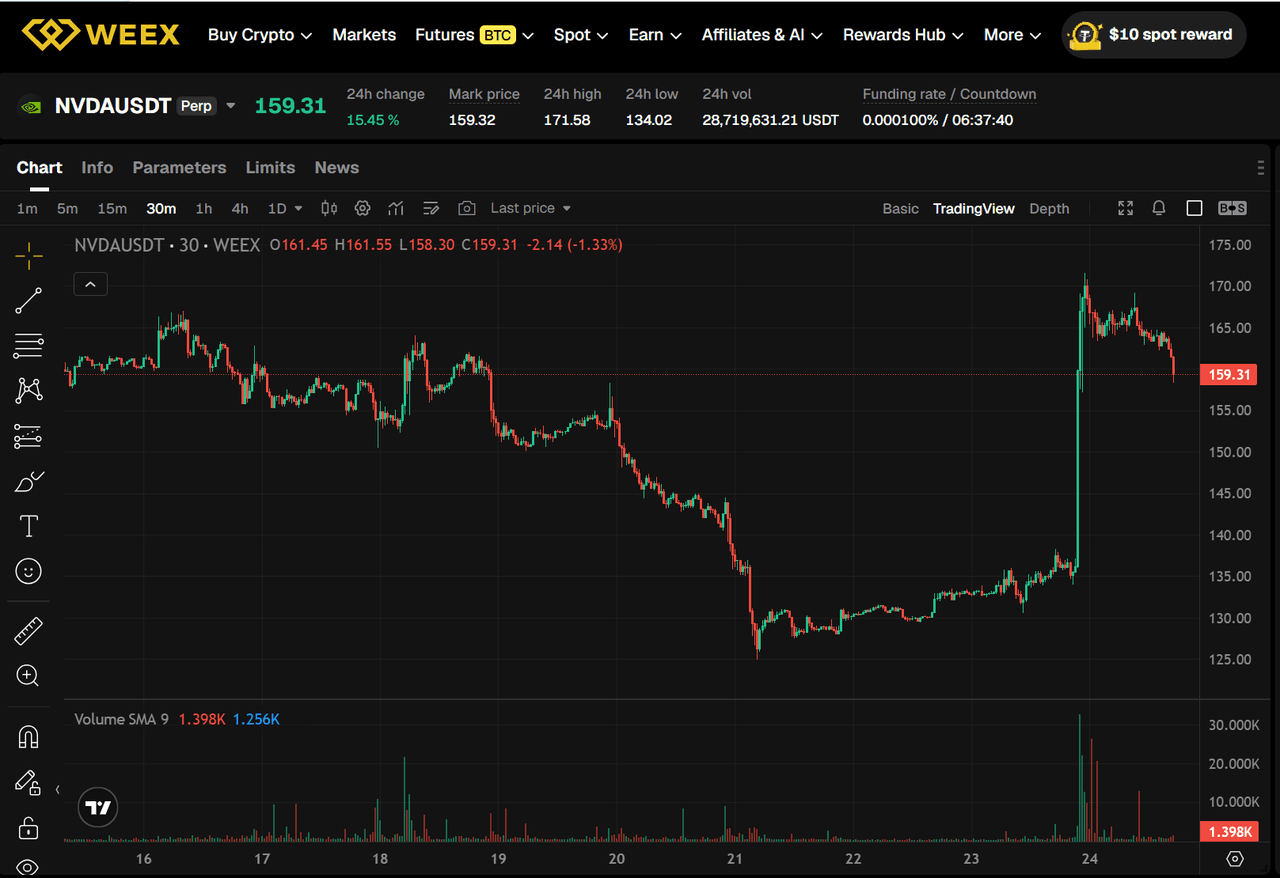
On Nov. 23, NVDA rose above $170 intraday, gaining about $45 on the day, or more than 30%. The rebound quickly spread to major indices and the AI supply chain:
Asset or index | Nov. 23 regular-session performance |
NVDA | +31.48% |
Nasdaq Composite | +6.51% |
S&P 500 | +4.73% |
Dow Jones Industrial Average | +3.01% |
The Nasdaq Composite closed at 24,089.56, the S&P 500 at 7,237.17 and the Dow Jones Industrial Average at 49,595.31. AMD, ARM, CRWV and MU also advanced, showing that the day's trading had expanded from a single-company event into a collective repricing of AI risk assets. But over a longer observation window, the picture is less upbeat than a "31.48% surge" suggests.
Based on consistent closing-price comparisons, NVDA fell from $239.24 on Oct. 6 to $125.53 on Nov. 20, a cumulative drawdown of approximately 47.53%. Even after the Nov. 23 rebound, the $165.05 close remained about 31.01% below its Oct. 6 level and approximately 0.69% below the $166.19 close on Nov. 12, when the resignation was announced.
https://www.weex.com/futures/NVDA-USDT
The asymmetry of percentage moves matters here: after a 47.53% decline, a stock must gain approximately 90.6% to return to its starting point — not 47.53%. The 31.48% one-day rebound was therefore powerful, but recovered only part of the earlier decline.
A more precise interpretation is that NVDA largely repaired the leadership discount imposed after the resignation announcement, but has not yet recovered the losses from the broader AI-sector correction.
Why can Huang's departure or return move the entire AI sector?
For most mature companies, a CEO change does not necessarily alter intrinsic value overnight. NVDA is different because Huang's role extends well beyond conventional executive management.
First, he is the central decision-maker behind product roadmaps and long-term capital allocation. Competition in AI accelerators depends not only on individual chip performance, but also on whether networking, software, systems, supply capacity and the developer ecosystem can advance together. Investors trust Huang to maintain a coherent pace across these areas, and that confidence itself carries valuation value.
Second, he serves as an interface of credibility for customers and the supply chain. Major cloud providers, model developers and server manufacturers make multi-year investments and need confidence that NVDA's product roadmap will remain stable over the coming years. A sudden CEO departure can make some long-term commitments appear less certain, even if current orders are not immediately cancelled.
Third, Huang is a central symbol of NVDA's external communication. Against a backdrop of evolving export restrictions, supply-chain security and AI infrastructure policy, investors often view continued founder leadership as a way to reduce communication risk.
Huang's departure was therefore more than a management headline: it led markets to demand greater risk compensation. His reinstatement reduced that required compensation. But the episode also reveals the opposite problem: if one CEO's departure or return can generate such a large market-capitalization swing, NVDA carries both a substantial leadership premium and significant key-person dependence. Reinstatement restored short-term certainty, but it is no substitute for long-term succession planning.
Why did markets sell off despite strong earnings?
Operationally, NVDA's fundamentals did not suddenly stall because of the leadership change. Revenue in the latest quarter reached approximately $115.84 billion, showing that AI infrastructure demand continues to provide a strong operating foundation.
This explains why capital was willing to return quickly once the board reinstated Huang. Investors did not need to assume that "AI demand had disappeared"; they only needed to reduce concerns about strategic loss of control, execution disruption and governance disorder.
But strong earnings have two limitations: On one hand, quarterly results mainly reflect shipments, deliveries and revenue recognition already completed; they cannot independently prove that the leadership episode will not affect future quarters. On the other, rapid revenue growth does not mean markets can ignore changes in valuations, financing conditions or customer capital expenditure.
The earlier decline should therefore not be read simply as "markets rejecting AI demand." It was more like multiple risks compressing valuations at once: The AI-sector correction set the backdrop, the leadership change amplified volatility, and regulatory and accounting reports further increased the risk discount.
Reinstatement does not end investigations: Four risks still in play
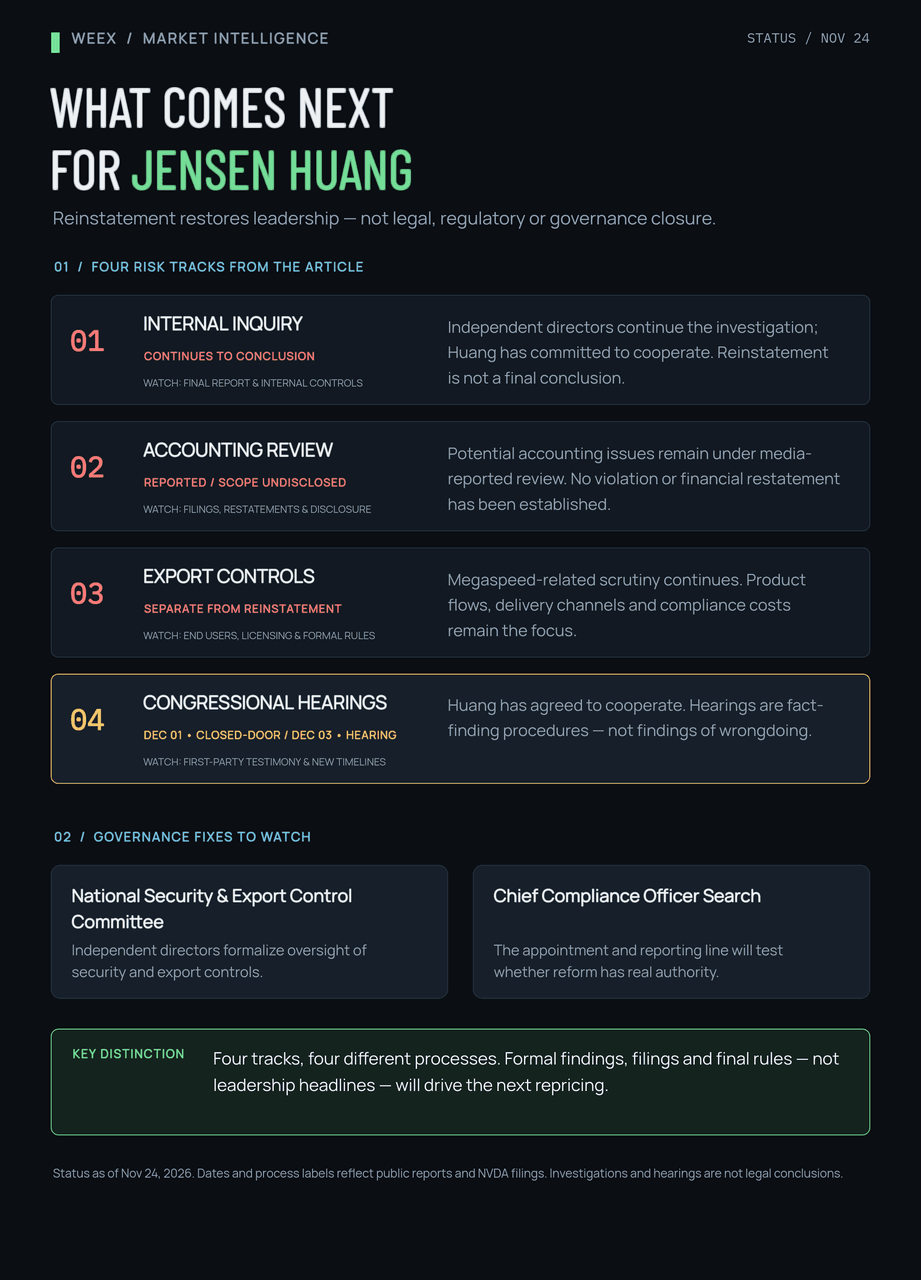
1. The independent internal investigation continues: NVDA stated clearly in its reinstatement announcement that a committee of independent directors will continue the investigation through to its conclusion and that Huang will cooperate. The board's decision to restore him to office therefore does not mean the investigation has reached a final conclusion. The key issue is not whether an investigation exists, but whether the final report introduces new disclosures, internal-control adjustments or findings of responsibility.
2. Accounting issues remain a reported investigation: Selected media coverage securities regulators are examining potential accounting issues at NVDA, but the specific accounting practices involved have not been disclosed, and the relevant authorities have not provided substantive comment. At this stage, a strict distinction must be maintained between an "ongoing investigation," the "discovery of irregularities" and a "formal finding of violations." Unless formal enforcement documents, a financial restatement or a company announcement subsequently emerges, media reports cannot be treated as proof of accounting fraud.
3. Export controls are a legal issue independent of the CEO's reinstatement: The Megaspeed-related export-control review involves product flows, end users, licensing requirements and compliance procedures. It will not automatically disappear because the board replaced or reinstated a CEO. The valuation impact of this risk is particularly complex; it may not immediately change global AI demand, but it could affect who can buy certain products, which delivery channels can be used and how much compliance will cost.
4. Hearings remain key information events: Public reports indicate that Huang has agreed to cooperate with congressional hearings. The closed-door questioning scheduled for Dec. 1 and the hearing on Dec. 3 will be important opportunities for markets to hear first-hand accounts. Hearings are oversight and fact-finding procedures, not findings of wrongdoing. But if previously undisclosed documents, timelines or regulatory requirements emerge, markets may reassess the risks.
Outlook
In the short term, Huang's reinstatement materially reduces the risk of a leadership vacuum and abrupt strategic change at NVDA, providing a reasonable basis for a rapid share-price recovery. After a 31.48% one-day gain, however, markets will need new information to support further valuation expansion—including a clear conclusion to the internal investigation, the scope of accounting inquiries, formal export-control documents and management's explanation of the operating outlook.
The medium-term trajectory will depend on whether two forces can reinforce each other: continued strength in AI demand, product deliveries and profitability on one side, and governance and compliance reforms that persuade investors similar episodes will not repeatedly disrupt the company on the other. Only when fundamentals and institutional trust recover together can NVDA move from an event-driven rebound toward a more stable valuation recovery.
If subsequent investigations produce no material operating impact, NVDA may still regain capital allocations on the strength of its industry position. Conversely, if hearings, accounting reviews or export controls produce substantive new information, the risk premium previously thought to have faded could return quickly.
Nov. 23 should therefore be understood as the removal of leadership uncertainty, not the end of every risk. Markets bought back Huang and a measure of confidence, but they have not received comprehensive proof that all risks have been cleared.
Trade now
Spot: NVDA
Futures: NVDA
Risk Disclosure
This article is based on public information and market data and does not constitute investment advice.
This content is provided for general informational purposes only and doesn't constitute financial, investment, legal, or tax advice. Any events, rewards, online promotions, or related information mentioned herein should not be considered a recommendation, solicitation, or invitation to purchase, sell, trade, or otherwise deal in any crypto assets. Crypto assets are highly volatile and may result in loss. The availability of WEEX services, products, and related events may vary by region. You are responsible for ensuring that your participation is in accordance with applicable local laws and regulations.

Alawn focuses on blockchain data and algorithmic research, examining on-chain activity, market structure, and evolving risk. The work explores how data-driven methods can deepen understanding of crypto markets and the broader Web3 ecosystem.


