
Historical FIFA World Cup Evaluations: Where Does Spain 2026 Rank Among the Greatest Champions?

 Prefer us on Google
Historical FIFA World Cup evaluations are among the most contested discussions in football precisely because no two tournaments are played under the same conditions, against the same quality of opposition, or with the same rules and format. Historical FIFA World Cup evaluations require a framework that accounts for era differences, tournament format changes, and the fundamental incomparability of teams separated by decades of football evolution. Historical FIFA World Cup evaluations of Spain 2026 specifically require the additional honesty of acknowledging that proximity to a recent triumph creates a recency bias that tends to inflate assessments of the team just crowned champion before the longer view of history provides the perspective that enduring greatness requires.
The framework this guide applies has four components: defensive dominance relative to historical peers, the quality of opposition defeated on the path to the title, individual brilliance that transcended the team context, and the style of play that defined the campaign. Each component produces a ranking that situates Spain 2026 within the historical conversation rather than simply asserting it belongs there.
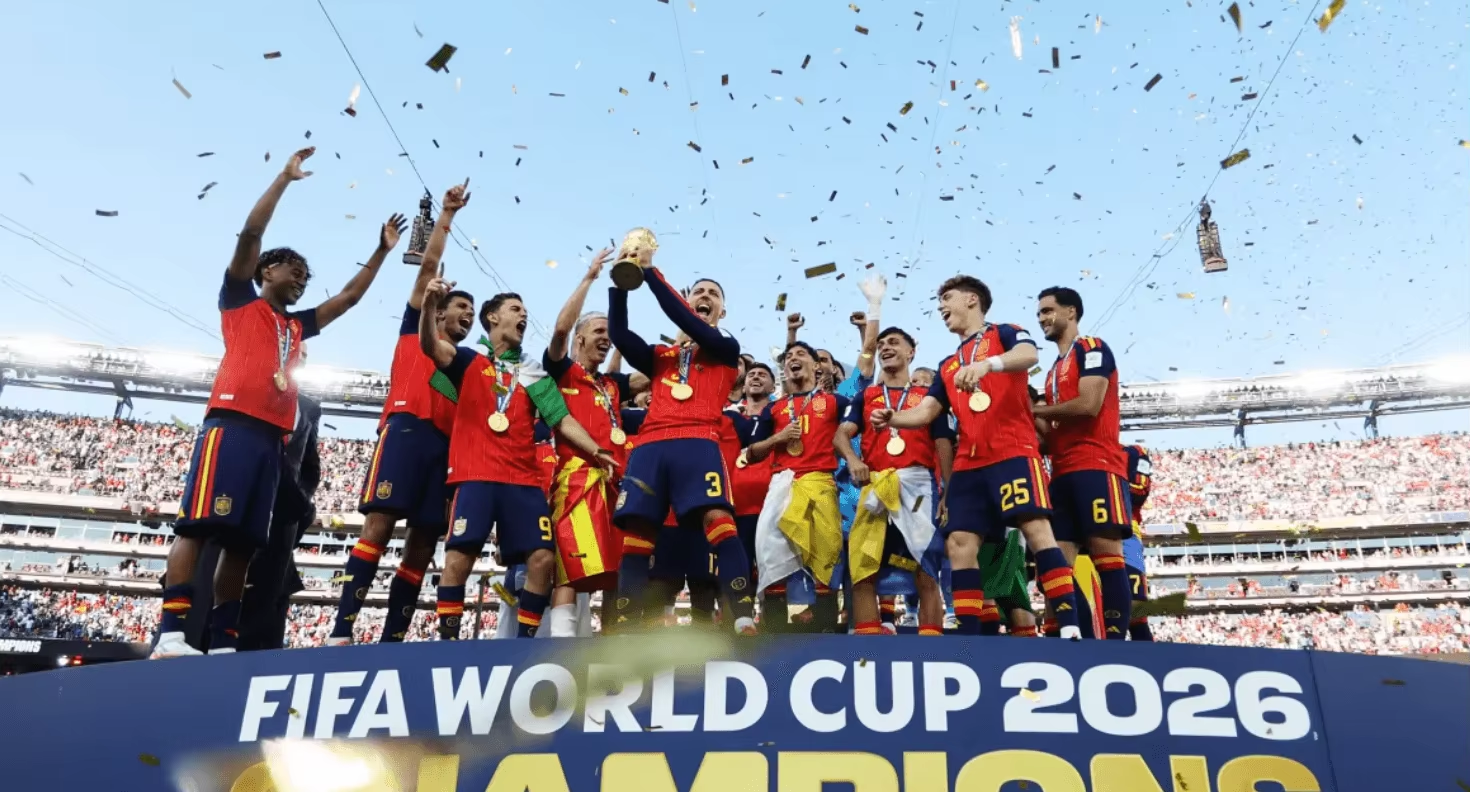
The Framework for Evaluating World Cup Champions Across Eras
Before applying any evaluation to Spain 2026, establishing what makes a World Cup champion historically great rather than merely successful is the necessary foundation. Winning is the minimum requirement, not the distinguishing criterion. Every entry in the historical ranking has won. The question is how they won and against whom.
Defensive dominance is the first evaluative component because it is the most objectively measurable across eras. Goals conceded per match, clean sheets maintained, and the defensive record against the strongest opponents in the tournament provide a statistical baseline that can be compared across decades despite the tactical evolution that separates the 1950s from the 2020s.
Opposition quality is the second component and the most contested. A team that defeats mediocre opponents on the way to the title demonstrates less than a team that defeats the world's best. The 48-team format that 2026 introduced for the first time creates a specific evaluation challenge because a 48-team tournament includes more mismatches in the group stage than a 32-team tournament, which affects how the early round results should be weighted relative to the knockout stage performances.
Individual brilliance is the third component because the greatest World Cup campaigns have typically combined exceptional collective performance with individual moments that defined the tournament in the cultural memory rather than only in the statistical record. Pelé in 1970, Maradona in 1986, Ronaldo in 2002, and Zidane in 1998 each provided the individual dimension that elevated their teams' campaigns beyond what the collective alone would have achieved.
Style of play is the fourth component because historically great World Cup winners have typically demonstrated a coherent and dominant approach to the game rather than surviving through fortune or opponents' misfortune. The most celebrated World Cup champions won in ways that changed how football was subsequently played, which is the ultimate historical compliment.
The Benchmark: The Three Campaigns That Define Historical Greatness
Three World Cup winning campaigns consistently appear at the top of serious historical evaluations and serve as the benchmark against which Spain 2026 must be assessed.
Brazil 1970 is the universal reference point for the greatest World Cup winning campaign in history. The squad that Pelé, Jairzinho, Tostão, Rivelino, and Carlos Alberto led through Mexico did not simply win the tournament. They won it while producing football of a quality that contemporaries and historians alike have struggled to match in description. Jairzinho scored in every single match of the tournament, a feat that has never been replicated. Brazil conceded only seven goals in six matches while scoring nineteen, a goal difference that reflects both extraordinary attacking ambition and sufficient defensive solidity. The opposition they defeated included England, which was considered the world's best team entering the tournament, and Italy in the final. The 4-1 final scoreline against a defensive Italy team that had reached the final without conceding a goal in the knockout stages remains one of the most emphatic championship victories in football history.
Argentina 1986 is the second benchmark. Maradona's performance across the tournament in Mexico was the most dominant individual World Cup campaign in the history of the competition. Five goals and five assists in seven matches would be extraordinary for any player. In the context of a Maradona who was simultaneously the most creative, most dangerous, and most audacious player in the world operating at the absolute peak of his powers, the statistics undersell the reality. The quarter-final against England produced both the Hand of God goal and the Goal of the Century in the same match, which is a symbolic concentration of everything that made the 1986 campaign historically unique. Argentina defeated quality opposition including England and Belgium on the way to the final, where they beat West Germany despite conceding twice in the second half before Burruchaga's winner.
Germany 1974 represents the third benchmark, chosen over other strong candidates because of the specific quality of the opposition defeated and the tactical sophistication of the campaign. West Germany defeated the Netherlands in the final, ending the tournament of Total Football with a triumph that required matching tactical ambition with greater competitive composure. Defeating a Netherlands side containing Cruyff, Neeskens, and Rep at the peak of their powers is the quality of opposition that makes the 1974 triumph historically significant beyond the trophy itself.
Spain 2026 Against the Defensive Benchmark
On defensive dominance, Spain 2026 sets a standard that is historically unprecedented and that no serious evaluation can dismiss as coincidental.
Conceding one goal across eight matches in a 48 team World Cup is a defensive achievement without precedent in the tournament's history. The single goal conceded came from Belgium in the quarterfinals. Every other opponent across the group stage, round of 16, quarterfinals, semifinals, and final failed to score against Unai Simón and Spain's defensive structure. Argentina, the defending champion with Messi orchestrating, managed zero goals against Spain despite reaching the final and creating chances that Simón saved with extraordinary consistency.
The historical comparison is stark. Brazil 1970 conceded seven goals in six matches. Argentina 1986 conceded five goals in seven matches. Germany 1974 conceded four goals in seven matches. Spain 2026 conceded one goal in eight matches, including the expansion to the 48-team format that required an additional knockout round compared to previous tournaments.
The honest qualification is that the 48-team format includes weaker opposition in the early rounds than a 32 team tournament. Spain's group stage opponents were not the same quality tier as the knockout stage opponents that defined the historical benchmarks. But Spain also faced Cape Verde, who drew with them before conceding, and then defeated Austria, Portugal, Belgium, France, and Argentina in sequence. The knockout stage opponents represent a genuinely elite collection that makes the defensive record more impressive rather than less.
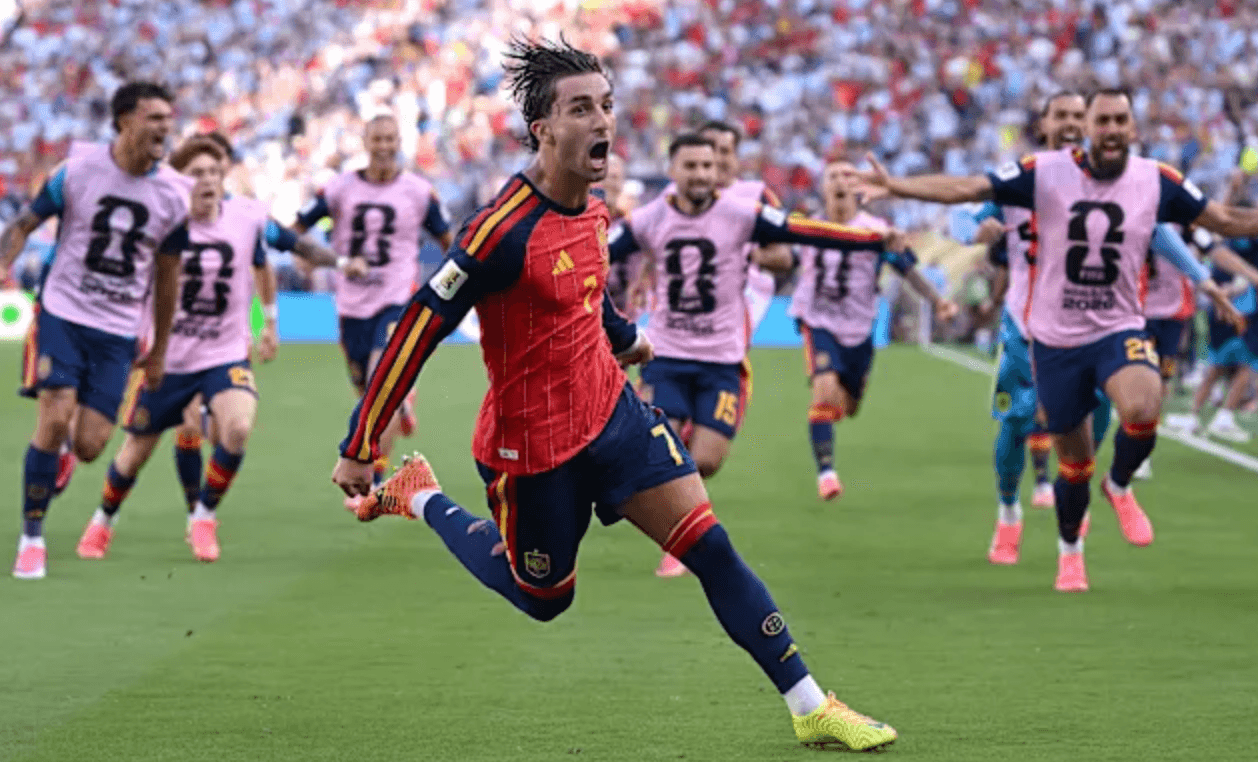
Spain 2026 Against the Opposition Quality Benchmark
The quality of opponents defeated by Spain 2026 on the path to the title compares favorably with historical benchmarks when the knockout stage is isolated from the group stage mismatches.
France in the semifinal was the most specific test of opposition quality. Mbappé, who had scored in every tournament he had ever participated in at the highest level, was entirely neutralized. France had been scoring freely throughout the tournament and arrived at the semifinal as many observers' pick for the likeliest threat to Spain's dominance. The 2-0 victory without conceding and without Mbappé managing a single shot on target represents the most complete defensive performance against a world-class attacking team that any World Cup campaign has produced in the statistical era.
Argentina in the final was the second elite test. The defending champion with a 38-year-old Messi still capable of orchestrating late comebacks, as he demonstrated against England in the semifinal, represents the kind of opponent whose defeat in a final carries historical weight. Spain's 1-0 victory in extra time after a goalless 90 minutes is the kind of narrow final that historical evaluators weigh carefully because it prevents the comfortable assessment of dominance that a 4-1 win provides.
The honest limitation is that Spain did not face a team of Brazil 1970's England caliber or Argentina 1986's Germany caliber in their knockout opponents. Portugal, who Spain defeated in the round of 16, was a strong team but not the 1974 Netherlands. France was a genuine elite opponent. Argentina was a genuine elite opponent. The opposition quality argument for Spain 2026 is strong but not unambiguously superior to the benchmarks.
Individual Brilliance and the Lamine Yamal Question
The individual brilliance component is where Spain 2026 most clearly falls short of the Brazil 1970 and Argentina 1986 benchmarks, and acknowledging this is essential to an honest historical evaluation.
Lamine Yamal at 19 was the tournament's most electric individual performer and the youngest player ever to appear in a World Cup Final. His directness, creativity, and composure under tournament pressure were extraordinary for a player of his age. He is the player around whom Spain's attacking philosophy was organized and without whom the campaign's most dangerous moments would not have materialized.
But Lamine Yamal is not the 1970 Pelé or the 1986 Maradona in the specific sense that matters for historical evaluation. Those players did not simply contribute to their teams' success. They defined eras of the sport in ways that changed how football was played globally in the years that followed. Yamal's 2026 campaign announced the arrival of a potentially generational talent. It did not yet demonstrate the generational impact that Pelé's 1970 or Maradona's 1986 achieved in the historical record.
Ferran Torres, who scored the winning goal in extra time from the bench, represents a different kind of individual brilliance. The substitute who becomes the champion's defining scorer is a football archetype that carries its own historical resonance. Andrés Iniesta in 2010 performed the same role for the previous generation of Spanish champions. But Torres's goal, decisive as it was, does not elevate the individual brilliance component of Spain 2026's evaluation to the level of the historical benchmarks.
Style of Play and Historical Legacy
Spain's style of play in 2026 represents the most sophisticated expression of organized defensive football that any World Cup champion has demonstrated, combined with enough attacking quality to score when opportunities were created rather than only to prevent the opposition from scoring.
The tiki-taka that defined Spain 2010 has evolved into something more direct and more physically intense in the 2026 version. Lamine Yamal's running with the ball, Nico Williams's width, and the midfield's ability to press and recover as well as possess produced a style that is harder to categorize than 2010's possession dominance but that is no less coherent in its organizational principles.
The style legacy question for Spain 2026 will be answered by what happens in European club football and in international football over the next four years as coaches and analysts study how Spain eliminated five elite opponents without conceding. A defensive organization that maintains the attacking threat Spain demonstrated is not purely reactive but rather the most complete expression of what modern football's best teams aspire to. Whether that style is subsequently widely adopted, as tiki-taka was after 2010, will determine how historically significant the 2026 campaign appears in retrospect.
The Historical Ranking That the Framework Produces
Applying the four components honestly to Spain 2026 alongside the historical benchmarks produces a ranking that is respectful of the achievement without overstating it relative to the greatest campaigns in the tournament's history.
Brazil 1970 remains the historical standard against which all World Cup winning campaigns are measured. The combination of attacking brilliance, sufficient defensive solidity, the quality of opponents defeated, and the individual transcendence that Pelé and Jairzinho provided places the 1970 campaign in a category that Spain 2026 does not challenge.
Argentina 1986 sits in the second position historically, primarily because Maradona's individual campaign is the single most dominant individual performance in World Cup history and because the quality of opponents defeated, particularly England and West Germany, is not matched by Spain 2026's knockout schedule.
Spain 2026 occupies a position in the historical ranking that is genuinely elite but not yet at the summit. The defensive record is historically unprecedented and earns the campaign a place in the conversation about the greatest World Cup winning performances. The opposition quality in the knockout stage is genuinely world class. The individual brilliance, while extraordinary for Yamal's age, does not yet carry the historical weight of the 1970 or 1986 individual contributions.
A defensible historical ranking places Spain 2026 in the tier that includes Germany 1974, France 1998, and Spain 2010, meaning among the five or six greatest World Cup winning campaigns in the tournament's history rather than at the absolute summit that Brazil 1970 and Argentina 1986 occupy through universal consensus.
That is a remarkable achievement. It is also an honest one.
Conclusion
Historical FIFA World Cup evaluations of Spain 2026 must balance the unprecedented defensive record that conceding one goal across eight matches represents against the honest acknowledgment that individual brilliance at the Pelé or Maradona level was not present and that the 48-team format's group stage mismatches limit the opposition quality argument relative to the historical benchmarks.
Spain 2026 is an elite World Cup winning campaign by any serious historical measure. The defensive record alone earns it a place in the top five or six campaigns in the tournament's 96-year history. The knockout stage quality, particularly the neutralization of Mbappé's France and the defeat of Messi's Argentina, provides the opposition credential that separates great World Cup winners from merely successful ones.
It is not Brazil 1970. It is not Argentina 1986. It is something different and perhaps equally worth celebrating: the most complete defensive World Cup winning campaign in history, achieved by the youngest and most tactically coherent Spanish squad since the generation that won in 2010 and beyond.
Where Spain 2026 ultimately ranks in the historical consensus will be determined not by what observers say in the days after the final but by what the campaign means to the game a decade from now.
FAQ
1. How does Spain 2026 compare to the greatest World Cup champions in history?
Spain 2026 ranks among the five or six greatest World Cup winning campaigns in the tournament's history based on a four-component framework of defensive dominance, opposition quality, individual brilliance, and style of play. The unprecedented defensive record of conceding one goal across eight matches is the campaign's most historically significant achievement. The individual brilliance component, while outstanding for Lamine Yamal's age, does not yet match the Brazil 1970 or Argentina 1986 level that defines the historical summit.
2. Is Spain 2026 the most defensively dominant World Cup champion in history?
Yes on the statistical record. Conceding one goal in eight matches is a defensive achievement without precedent in World Cup history. Brazil 1970 conceded seven goals in six matches. Argentina 1986 conceded five in seven. Germany 1974 conceded four in seven. The honest qualification is that the 48-team format's group stage includes weaker opposition than previous 32-team tournaments, but the knockout stage opponents including France and Argentina represent genuine elite tests that the defensive record withstood completely.
3. Why is Brazil 1970 still considered the greatest World Cup winning campaign?
Brazil 1970 combines attacking brilliance at a level that has never been matched, sufficient defensive solidity, the quality of opponents defeated including England and Italy, and Pelé's individual transcendence in what most historians consider his greatest tournament performance. Jairzinho scoring in every match and the 4-1 final victory against a defensively organized Italy represent a completeness across all components of the evaluation framework that no subsequent champion has matched.
4. How did the 48 team format affect Spain 2026's historical evaluation?
The 48-team format required Spain to play an additional knockout round compared to previous 32-team tournaments, which adds to the achievement by requiring one more elite level performance. However, the group stage included weaker opposition than a 32 team tournament would have produced, which means the early round results carry less historical weight than the knockout stage performances. Evaluators who focus on the knockout stage give Spain 2026 full credit for the opposition quality argument. Those who weight the full tournament more uniformly note the group stage limitations.
5. Where does Lamine Yamal rank among World Cup individual performances?
Lamine Yamal's 2026 performance is the most impressive World Cup campaign by a teenager in the tournament's history and ranks among the greatest individual performances by any player in recent World Cup history. It does not yet rank alongside Pelé 1970 or Maradona 1986 in the all-time individual performance ranking because those campaigns changed football globally in the years that followed. Yamal's 2026 campaign announced the arrival of a potentially generational talent. Whether it is remembered as the beginning of a Pelé or Maradona-level career will determin
Disclaimer: This content is provided for general branding and informational purposes only and doesn't constitute financial, investment, legal, or tax advice. Any events, rewards, online events, or related information mentioned herein should not be considered a recommendation, solicitation, or invitation to purchase, sell, trade, or otherwise deal in any crypto assets or to use any services. Crypto assets are highly volatile and may result in loss. WEEX services and online events may not be available in all regions and are subject to applicable laws, regulations, and eligibility requirements. You are responsible for ensuring that your use of WEEX services complies with local laws and for carefully assessing the risks before participating in any crypto-related activities.
You may also like

Do You Need a Crypto Broker? What They Are and Who Should Use One in 2026

What Is the Difference Between a Broker and a Market Maker? A Complete Guide
Argentina World Cup Final Controversy: What the On-Field Incidents Mean for the Team's Global Brand
Argentina World Cup 2030: Who Replaces Messi and Can They Ever Win Again?
Oil Falls 7% as US Pauses Iran Strikes: Which Stocks Win and Which Lose Now

US Pauses Iran Strikes: What the Ceasefire Signal Means for Oil Prices and Stock Markets
Samsung Stock vs Samsung ETF: Which Is the Better Way for International Investors?
Samsung Stock Is 30% Below Its Peak: What Getting Back to Record Highs Actually Requires

Samsung Stock and the $200 Billion Broadcom Deal: What the Memory and Foundry MOU Means for Investors

SK Hynix Stock Before July 29 Earnings: What Investors Should Watch
New SK Hynix 2X ETFs Launch: Who Should Use Them and Who Should Not
SK Hynix Stock and Nvidia's $500 Billion SK Group Deal: What the 2027 Timeline Means for Investors
CXMT Stock Debut: 471% Pop and the Crypto Market That Called It
Tesla Stock After the 16% Crash: Price, Targets, and How to Trade It
WEEX Poker Party Series 4: Your First 24 Hours, Step by Step
Is XST Coin a Scam? XSolut Risks, Dump Concerns & Price Analysis

What Is XSolut (XST) Coin? Exploring AI Infrastructure and RWA Tokenization
WEEX TradFi Trading Fest: Trade Stock Futures and Share 50,000 USDT Rewards
STABLE Crypto Airdrop Guide: How to Claim 50,000 USDT Rewards on WEEX
What Is a Broker? The Complete Guide to Understanding Financial and Crypto Brokers
How to Compare Crypto Brokers: What the Rankings Don't Tell You and What Actually Matters
Oracle Stock Price Prediction 2026-2027: Can ORCL Reach $250 After the Pentagon Deal?
Is Oracle Stock a Buy After the $7 Billion Pentagon Deal? What the Defense Contract Changes
SPCX Stock Price Is Down $1 Trillion From Its Peak: Is Now the Time to Buy?
Is Tesla Stock a Buy at $320 After the Q2 Earnings Crash?
SPCX Stock Price and Starship Flight 13: What Tonight's Launch Needs to Deliver
Why Tesla Stock Crashed 14% on Record Revenue: What the 1.4% Operating Margin Actually Means
Tesla Stock Is Betting Everything on Robotaxi and Optimus: What Investors Are Actually Paying For
Intel Stock vs AMD Stock: Which Chip Giant Is the Better Buy After Q2?
Intel Stock Price Prediction 2026-2027: Can INTC Reach $150 After the Foundry Turnaround?
Do You Need a Crypto Broker? What They Are and Who Should Use One in 2026
What Is the Difference Between a Broker and a Market Maker? A Complete Guide
Argentina World Cup Final Controversy: What the On-Field Incidents Mean for the Team's Global Brand
Argentina World Cup 2030: Who Replaces Messi and Can They Ever Win Again?
Oil Falls 7% as US Pauses Iran Strikes: Which Stocks Win and Which Lose Now
US Pauses Iran Strikes: What the Ceasefire Signal Means for Oil Prices and Stock Markets


