
XLM Price Drops 2.48% Before Stellar's Bell Vote: Can Protocol 30 Change the Trend?

 Prefer us on Google

Key Takeaways
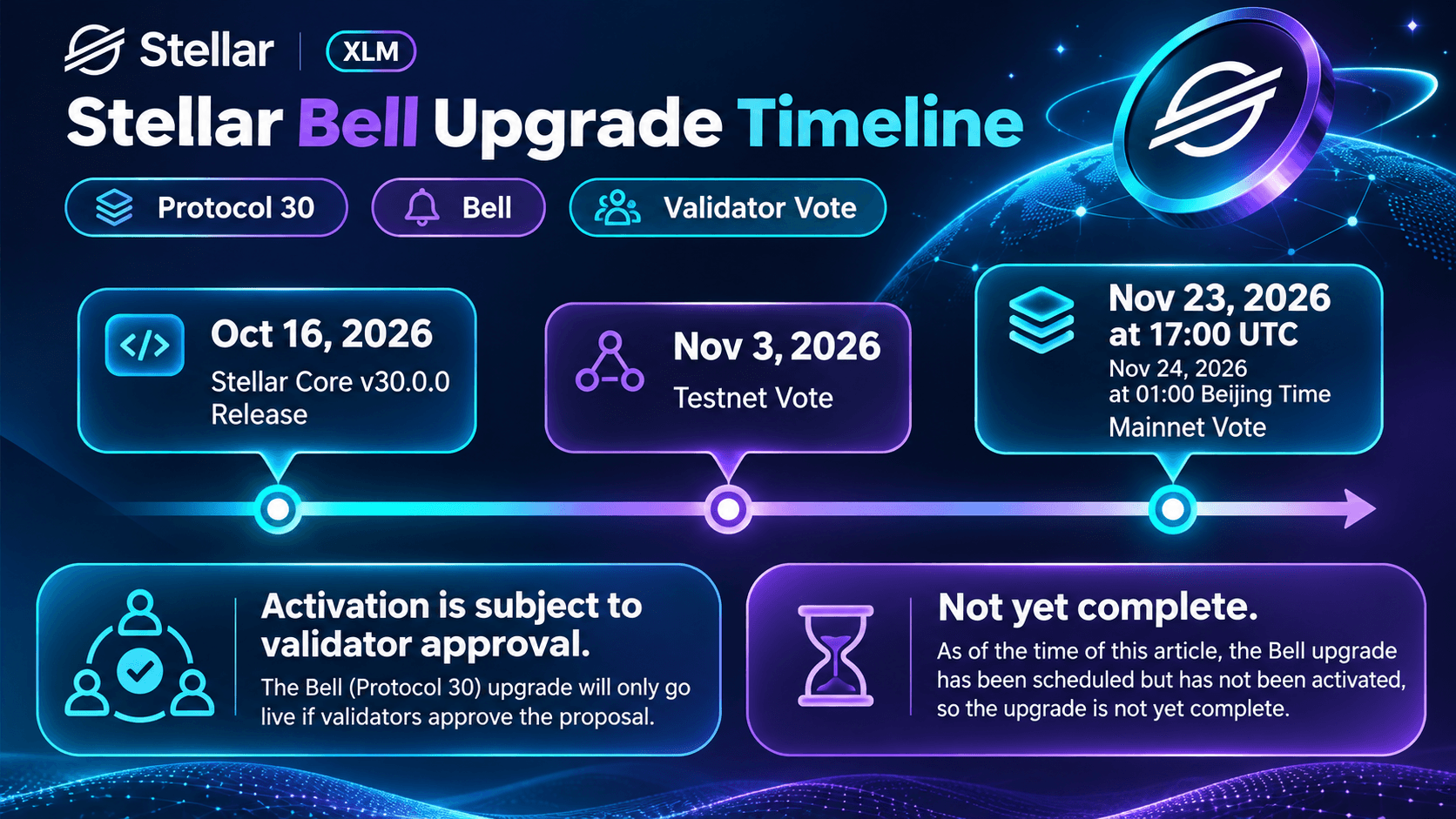
- Stellar validators are scheduled to vote on Protocol 30, known as Bell, on November 23, 2026, at 17:00 UTC, following its November 3 testnet vote.
- The proposed upgrade introduces muxed smart-contract addresses, ML-DSA post-quantum signature verification for smart contracts and millisecond-precision ledger timestamps.
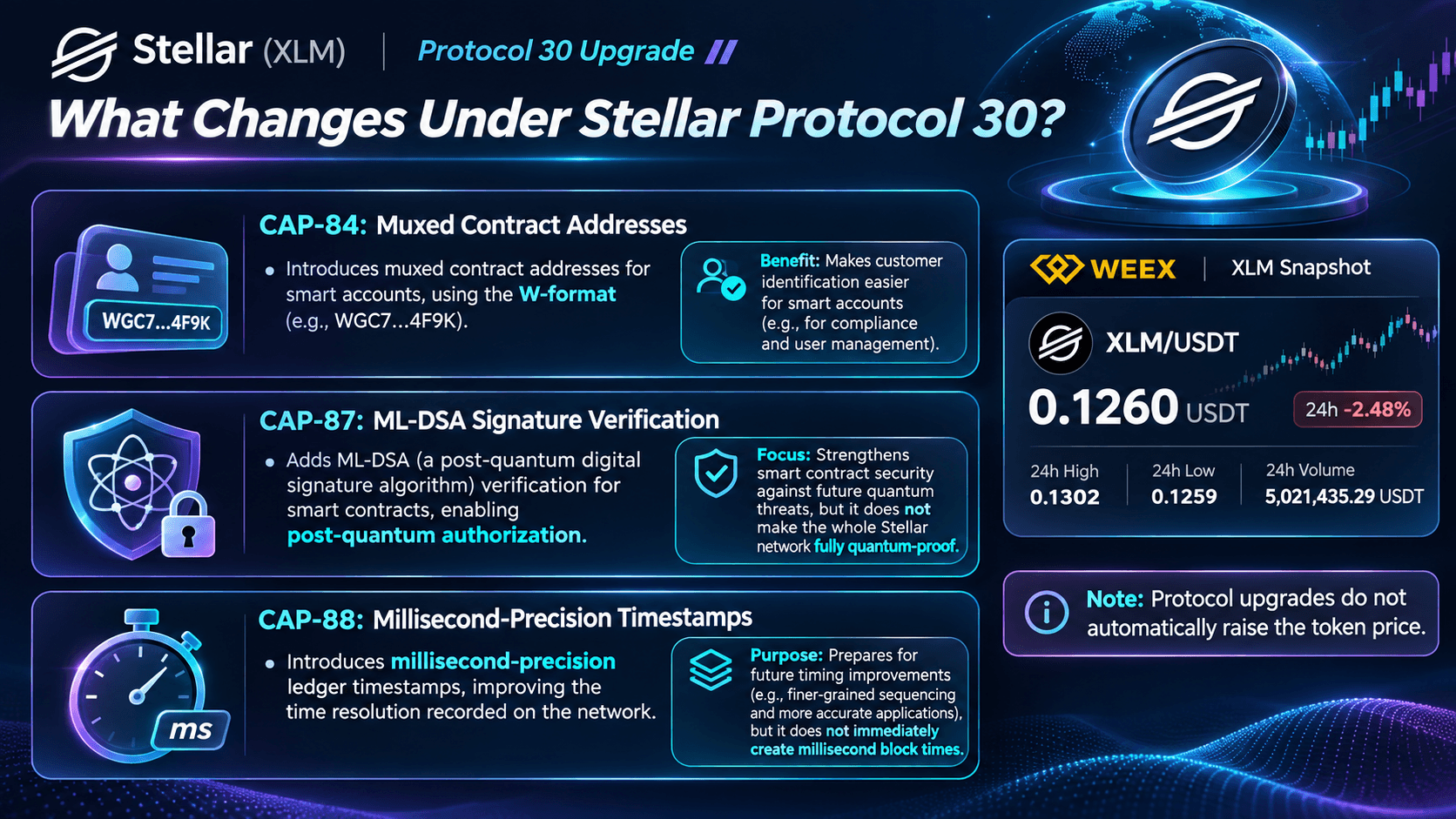
- A November 23 WEEX market snapshot showed XLM trading around 0.1260 USDT, down 2.48% over 24 hours despite anticipation surrounding the upgrade.
- Bell does not directly change XLM supply or guarantee faster ledger closes, so its technical benefits should not be confused with an immediate bullish price catalyst.
XLM price fell 2.48% in a November 23 WEEX market snapshot as Stellar approached its scheduled Bell (Protocol 30) mainnet vote. The XLM price weakness contrasts with expectations surrounding new smart-contract addresses, post-quantum signature verification and ledger-timing improvements. This article examines the Bell upgrade, explains why the XLM price has not automatically benefited and identifies the developments traders should monitor.
When Is the Stellar Protocol 30 Mainnet Vote?
The Stellar Development Foundation has scheduled the mainnet validator vote for Bell, Protocol 30, on November 23, 2026, at 17:00 UTC. This corresponds to November 24 at 01:00 Beijing Time.
The vote follows the November 3 testnet upgrade vote, providing developers and infrastructure operators with a period to prepare for the proposed changes.
Importantly, the scheduled mainnet vote does not mean that Protocol 30 has already been activated. The upgrade takes effect only if Stellar validators approve it through the network's established coordination process.
This distinction matters for both developers and traders. The official schedule identifies when the decision is expected to take place, but the outcome must be confirmed through Stellar's subsequent network announcements.
Stellar Bell Upgrade: Key Dates and Details
| Event | Confirmed Information |
|---|---|
| Blockchain | Stellar |
| Native Token | XLM |
| Upgrade Name | Bell |
| Protocol Version | Protocol 30 |
| Stellar Core v30.0.0 Release | October 16, 2026 |
| Testnet Upgrade Vote | November 3, 2026 |
| Mainnet Vote | November 23, 2026, 17:00 UTC |
| Beijing Time | November 24, 2026, 01:00 |
| CAP-84 | Muxed contract addresses |
| CAP-87 | ML-DSA signature verification for smart contracts |
| CAP-88 | Millisecond ledger timestamps |
| Mainnet Activation Status | Subject to validator approval |
Sources: Stellar Development Foundation — Introducing Bell and Official Protocol 30 Upgrade Guide.
The Bell release represents an infrastructure-focused upgrade rather than a direct redesign of XLM's monetary policy.
Its improvements are intended to help businesses manage smart accounts more efficiently, expand the cryptographic capabilities available to developers and prepare the network for further performance optimization.
What Will Stellar's Bell Upgrade Actually Change?
Protocol 30 includes three major technical changes, each addressing a different part of the Stellar ecosystem.
These changes are particularly relevant to exchanges, custodians, payment services and applications built using Stellar smart contracts.
Understanding their specific functions is essential because references to quantum security or faster blockchain processing can otherwise create misleading expectations.
CAP-84: Muxed Contract Addresses
CAP-84 introduces a new muxed contract address type beginning with the letter W.
This allows a smart contract address to carry an additional 64-bit identifier that applications can use to distinguish different customers or payment destinations.
For example, an institutional payment service may need to process transactions for many users through shared infrastructure. Muxed contract addresses can help the service identify which customer a transfer relates to without deploying a separate contract for every user.
The change is especially relevant to payment providers, exchanges and custodians that handle large numbers of customer transactions.
However, applications must update their address-handling logic to recognize the new format. Existing integrations that assume all contract addresses use the previous structure may need software changes.
CAP-87: Post-Quantum Signature Verification
CAP-87 introduces support for verifying Module-Lattice-Based Digital Signature Algorithm (ML-DSA) signatures within Stellar smart contracts.
ML-DSA is a post-quantum digital signature standard designed to provide security against attacks involving sufficiently advanced quantum computers.
The upgrade gives developers a mechanism for building smart-contract authorization systems that can verify these signatures.
This is an important step in Stellar's longer-term quantum preparedness strategy.
However, Bell does not immediately make every Stellar transaction quantum-resistant. Standard network transaction signatures continue to use the existing Ed25519 system, while native post-quantum signing for classic accounts is intended for future development.
Therefore, describing Protocol 30 as making the entire network fully quantum-proof would overstate what the upgrade delivers.
CAP-88: Millisecond-Precision Ledger Timing
CAP-88 changes the way Stellar records ledger close times.
Previously, the network recorded ledger timestamps using whole seconds. Protocol 30 introduces millisecond-level precision, creating a more flexible foundation for future changes to ledger timing.
This is a technical prerequisite for potentially faster ledger processing in future protocol versions.
It does not mean that the Bell upgrade immediately reduces Stellar's ledger close time to milliseconds.
The existing target remains approximately five seconds, and further performance improvements would require additional development and validation.
What Changes Under Stellar Protocol 30?
| Proposal | Technical Change | Potential Benefit | Important Limitation |
|---|---|---|---|
| CAP-84 | New W-format muxed contract addresses | More efficient customer identification for smart accounts | Applications must support the new address type |
| CAP-87 | ML-DSA signature verification | Enables post-quantum authorization in smart contracts | Does not replace all network signatures |
| CAP-88 | Millisecond-precision ledger timestamps | Prepares for future ledger timing improvements | Does not immediately create millisecond block times |
Source: Stellar Development Foundation's official Bell technical announcement.
These proposals are designed to improve infrastructure capabilities. Their practical impact will depend on software compatibility, application adoption and successful implementation.
-- Price
Why Did XLM Price Fall Ahead of the Bell Vote?
A protocol upgrade can generate positive attention without immediately increasing demand for the associated cryptocurrency.
At approximately 10:30 Beijing Time on November 23, WEEX displayed an XLM/USDT spot quotation of 0.1260 USDT, with a rolling 24-hour decline of 2.48%.
The reported 24-hour trading volume was approximately 5.02 million USDT, while the price range extended from 0.1259 to 0.1302 USDT.
These figures provide a timestamped view of XLM trading activity before the scheduled mainnet vote. They do not establish that the upgrade caused the price decline.
XLM Market Data — November 23, 2026
| Market Metric | WEEX Snapshot |
|---|---|
| Trading Pair | XLM/USDT |
| Observation Time | Approximately 10:30 UTC+8 |
| Displayed Price | 0.1260 USDT |
| 24-Hour Change | -2.48% |
| 24-Hour High | 0.1302 USDT |
| 24-Hour Low | 0.1259 USDT |
| Best Ask | 0.1261 USDT |
| Best Bid | 0.1259 USDT |
| 24-Hour Trading Volume | 5,021,435.29 USDT |
Source: WEEX XLM/USDT spot market snapshot provided on November 23, 2026. Values are historical observations rather than live quotations.
The snapshot indicates that XLM was trading near the lower end of its reported daily range despite anticipation surrounding the upcoming vote.
However, price performance reflects a combination of market forces, including broader cryptocurrency sentiment, available liquidity, token demand and investor expectations.
Why Doesn't a Major Network Upgrade Automatically Increase Token Demand?
One explanation is that the upgrade may already be anticipated by the market. Stellar announced the Bell roadmap before the scheduled vote, allowing traders and developers to incorporate expected developments into their decisions.
A second consideration is the nature of the upgrade itself.
Bell focuses on improving smart-contract functionality, cryptographic capabilities and ledger infrastructure. It does not announce a direct reduction in circulating XLM supply or an immediate increase in token consumption.
The third factor is uncertainty about adoption. New technical capabilities become economically meaningful when applications and businesses use them in ways that increase network activity.
A successful protocol vote can enable future development, but it cannot independently guarantee additional users, transactions or token demand.
Will Stellar's Bell Upgrade Make the Network Quantum-Safe?
Protocol 30 introduces an important post-quantum security capability, but the scope of the improvement needs to be understood accurately.
CAP-87 allows Stellar smart contracts to verify ML-DSA signatures. This can support more advanced authorization models, including smart accounts that require quantum-resistant signatures for particular operations.
For payment services and institutional custodians, the ability to use alternative cryptographic authorization methods may become increasingly relevant over time.
However, the feature is not equivalent to a complete network-wide migration to post-quantum cryptography.
What Remains Unchanged After Bell?
Standard Stellar account transaction signatures continue to use Ed25519 under the current protocol design.
The Bell upgrade does not automatically convert existing wallets to a new signature system, nor does it require ordinary XLM holders to migrate their balances to new addresses.
Developers wishing to use post-quantum authorization in smart contracts must implement the relevant functionality.
For further discussion of the blockchain industry's approach to quantum security, see Blockchain Prepares for the Era of Quantum Computers: Ethereum, Stellar, and Tron Adopt Different Survival Strategies.
The practical implication is that Stellar is introducing tools for future quantum-resistant applications, rather than declaring its existing network completely protected against every possible quantum threat.
What Does Protocol 30 Mean for Stellar Developers and Exchanges?
While ordinary XLM holders generally do not need to perform a token migration, infrastructure operators have more substantial preparation requirements.
The Stellar Development Foundation advises developers to upgrade their software development kits and infrastructure components before the mainnet vote.
One reason is the new W-format contract address. Wallets, exchanges and payment applications need to recognize the updated address type when validating, displaying or processing transfers.
Another reason is the change to ledger header data under CAP-88. Applications relying on outdated data definitions may be unable to decode new ledger information correctly.
Who Needs to Prepare for the Bell Upgrade?
| Participant | Recommended Action |
|---|---|
| Validators | Install the compatible Stellar Core release |
| Exchanges | Update SDKs and support relevant new address formats |
| Custodians | Review transfer and withdrawal handling |
| Wallet Developers | Add support for W-format addresses |
| Infrastructure Operators | Update ledger data definitions and compatible software |
| Smart-Contract Developers | Test new capabilities before adoption |
| Ordinary XLM Holders | No automatic token migration required |
Source: Stellar Protocol 30 Upgrade Guide, updated October 23, 2026.
The distinction between infrastructure preparation and ordinary token ownership is important.
Users should not assume that a scheduled network upgrade requires them to transfer assets to unfamiliar wallets, reveal recovery phrases or interact with unverified websites.
Official software and wallet instructions should be obtained from Stellar's published documentation and the relevant service provider.
Could the Protocol 30 Vote Trigger an XLM Price Rebound?
The vote may influence market sentiment, but its outcome is only one of several variables affecting XLM.
If validators approve Protocol 30, traders may interpret the result as a successful technical milestone. However, positive sentiment does not necessarily translate into sustained price appreciation.
A delayed or unsuccessful vote could create uncertainty regarding the implementation schedule, although any price reaction would also depend on broader market conditions.
For a lasting change in token demand, investors may need evidence that the upgraded network is attracting more real economic activity.
Possible XLM Market Scenarios
| Scenario | What Happens | Potential Market Interpretation |
|---|---|---|
| Upgrade Approved | Validators approve Bell | Technical milestone confirmed |
| Vote Delayed | Mainnet upgrade requires more preparation | Short-term uncertainty may increase |
| Strong Adoption | Wallets, exchanges and applications implement new features | Longer-term utility may improve |
| Limited Adoption | New functionality sees relatively little use | Immediate economic impact may remain small |
| Broader Market Weakness | Cryptocurrency selling pressure persists | Upgrade news may have limited influence |
Source: Scenario analysis based on Stellar's official upgrade process. These are possible outcomes, not price predictions.
A more useful approach is to monitor both the vote result and subsequent network activity.
Investors can evaluate whether new address formats are adopted, whether developers deploy applications using the updated cryptographic features and whether demand for Stellar-based financial services increases.
For earlier context on XLM's market performance and Bell expectations, see XLM Token Price Today: Why Stellar's Nov. 23 Bell Vote Matters.
How to Buy or Trade Stellar (XLM) on WEEX
WEEX provides XLM/USDT spot trading, allowing eligible users to access Stellar's native cryptocurrency.
The Bell upgrade does not automatically change the standard spot trading process, although users should monitor official platform notices for any network-related service adjustments.
Step 1: Access the XLM/USDT Spot Market
Visit the WEEX XLM/USDT Spot Trading Page and review the current price, available liquidity and supported order types.
Users can also consult the WEEX Stellar Token Information Page for additional background on the asset.
Step 2: Prepare USDT and Review the Order
Sign in to WEEX, complete any applicable account verification requirements and ensure sufficient USDT is available.
Review the chosen order type, intended XLM quantity and trading fees before placing an order.
Step 3: Confirm the Transaction and Monitor Network Status
After reviewing the order details, submit the trade when the market is available.
For deposits and withdrawals, users should check the supported network, recipient address and any service notices related to the Protocol 30 upgrade.
A scheduled protocol vote can create market attention, but it does not eliminate volatility or guarantee positive price performance.
Conclusion
The November 23 mainnet vote has placed XLM price attention on a major technical milestone for Stellar. Bell proposes new muxed contract addresses, post-quantum signature verification for smart contracts and more precise ledger timestamps, but activation remains subject to validator approval.
For XLM price, the latest WEEX snapshot demonstrates the difference between technological progress and immediate market demand. Protocol 30 does not directly change token supply, and its proposed features require adoption before their longer-term economic effects can be assessed.
Traders monitoring XLM price should distinguish the scheduled vote from confirmed activation, follow official network announcements and evaluate liquidity and actual network activity rather than assuming that an upgrade automatically produces a rally.
FAQ
1. When is the Stellar Protocol 30 mainnet vote?
Stellar's Bell upgrade vote is scheduled for November 23, 2026, at 17:00 UTC, equivalent to November 24 at 01:00 Beijing Time. The upgrade takes effect only if validators approve it.
2. What new features does the Stellar Bell upgrade introduce?
Protocol 30 proposes three main capabilities: muxed smart-contract addresses under CAP-84, ML-DSA post-quantum signature verification under CAP-87 and millisecond-precision ledger timestamps under CAP-88.
3. Will Protocol 30 make Stellar fully quantum-resistant?
No. Bell enables ML-DSA signature verification inside smart contracts but does not immediately replace the standard network transaction signature system. Broader post-quantum migration remains a longer-term development objective.
4. Why did XLM fall despite the upcoming network upgrade?
XLM traded around 0.1260 USDT with a 2.48% daily decline in the November 23 WEEX snapshot. Network upgrades do not necessarily produce immediate buying demand, and token prices also reflect liquidity, expectations and broader cryptocurrency conditions. The screenshot alone cannot establish the cause of the decline.
5. Can users buy XLM on WEEX before the Bell upgrade?
WEEX provides XLM/USDT spot trading, subject to trading availability and applicable account requirements. Users should monitor official service notices when transferring assets around the network upgrade.
This content is provided for general informational purposes only and doesn't constitute financial, investment, legal, or tax advice. Any events, rewards, online promotions, or related information mentioned herein should not be considered a recommendation, solicitation, or invitation to purchase, sell, trade, or otherwise deal in any crypto assets. Crypto assets are highly volatile and may result in loss. The availability of WEEX services, products, and related events may vary by region. You are responsible for ensuring that your participation is in accordance with applicable local laws and regulations.
You may also like
View moreNVIDIA Rehires Jensen Huang Just 11 Days Later: What Changed Behind the Scenes?
Beginner7 minWEEX Product GuideEthereum Glamsterdam Delayed: Could 15,000 Smart Contracts Be at Risk?
Beginner9 minWEEX Product GuideTether Backs SCRYPT: Could USDT Become the New Rail for Global Payments?
Beginner6 minWEEX Product GuidePolygon's Purley Hard Fork Is Live: What Changes for POL and Network Security?
Beginner7 minWEEX Product GuideCoherent and Lumentum Stocks Rise: Why Optical Stocks Are Rallying
Beginner7 minWEEX Product GuideNVIDIA Q3 2027 Earnings: Revenue Hits $115.8B as Leadership Questions Persist
Beginner5 minWEEX Product Guide




