
Signal Partners with United Airlines and Several Banks to Limit AI Agents Due to Customer Risk Issues

 Prefer us on Google


Key Points
Privacy-focused messaging app Signal has stated that AI agents embedded in mobile operating systems can scan users' screen information, potentially collecting and storing Signal's data, which falls outside of Signal's control. Signal is calling on Apple, Google, and Microsoft to provide simple technical tools and supporting documentation to enable developers to prevent AI agents from accessing sensitive data within applications. Prior to this, companies like United Airlines, JPMorgan Chase, and Charles Schwab have already implemented restrictions or bans on AI agents for security and customer protection reasons.{#quote_JPM}
The privacy-focused instant messaging application Signal is strengthening its defenses against AI agents that can read user screen content, with concerns centered around privacy and security.
Signal claims that AI agents embedded in mobile operating systems (such as Google's Gemini and Apple's Siri, which have screen awareness capabilities) can "scan" the information displayed on users' screens, potentially collecting and retaining Signal's data, a process that is not under Signal's control.
Yat Siu, co-founder of Animoca Brands, stated, "People tend to adopt a one-size-fits-all approach to the risks posed by AI agents, rather than matching the corresponding security levels based on the actual tasks."
Signal announced that it will block screenshot functionality on its iOS client; on Android, if an AI assistant attempts to read the screen, a screen security protection mechanism will be activated.
The Signal Foundation is a nonprofit organization that serves as the parent company of this messaging application. Its president, Meredith Whittaker, wrote in an official blog, "We want to make it clear: Signal and other app developers lack reliable tools to prevent AI agents from compromising privacy at the application level, which is a very serious issue."
Last year, Signal had already implemented similar restrictions against Microsoft's Recall AI for Windows 11. Now, Signal's latest move is part of a broader trend among companies—United Airlines, JPMorgan Chase, Charles Schwab, and others are restricting or blocking AI agents for security and customer protection purposes.
Whittaker stated that this new protective measure does not cover all avenues through which AI agents can obtain data, as agents can still read content already stored on users' devices.
Signal also warns that third-party AI agents like Meta's Muse can read private content within applications by leveraging permissions granted during user installation.
Tianyi Jiang, CEO of data security software company AvePoint, pointed out, "Application-level protections will always have vulnerabilities. Therefore, data classification, permission control, and support for data revocation must be completed before AI agents access data."
AvePoint's "2026 AI Status Report" surveyed 750 IT leaders globally, revealing that 88.4% of responding companies experienced at least one security breach related to AI agents in the past year.
Whittaker stated, "We continue to call on mainstream consumer operating system vendors like Apple, Google, and Microsoft to provide simple and user-friendly technical tools and comprehensive documentation to enable developers like Signal to prevent AI agents from touching sensitive data within applications."
Control Actions Continue to Be Implemented
Major banks are also beginning to restrict third-party AI agents from accessing customer accounts.
JPMorgan Chase CEO Jamie Dimon stated in October that the bank has prohibited external AI agents from accessing bank and customer accounts; Morgan Stanley has also banned third-party AI agents on its platform.{#quote_MS}
Meanwhile, Charles Schwab CEO Richard Worcester stated that the company will intercept unauthorized AI agents to protect customer and corporate security.
Singapore's OCBC Bank has stated that it does not allow third-party AI agents to perform automated transfer operations on behalf of the bank, while reminding customers to exercise caution when using such AI agents for banking transactions.
United Airlines issued a notice on November 11, restricting unauthorized AI agents from handling ticket bookings and management, citing concerns that such agents could leak customer information, generate unintended expenses, and potentially violate aviation regulations.
Mik Malyshev, an AI expert at identity verification compliance platform Sumsub, stated, "To book a flight or purchase daily necessities, AI agents need your email, account, and payment information." He explained that once such high access permissions are granted, it poses a risk of account hijacking—because retailers and banks may mistakenly interpret actions performed by AI agents as authorized by the user.
In contrast, Singapore Airlines is an early partner of Meta Muse. Meta stated that users can use this AI agent to inquire about travel plans, tickets, and booking services.
Yat Siu, co-founder and executive chairman of Animoca Brands, reiterated, "People tend to handle AI agent risks with a one-size-fits-all approach, without matching security levels according to the task itself." He believes that AI agents can help consumers fulfill their needs and assist businesses in directly reaching customers, but the risks associated with different tasks can vary significantly. "Allowing AI agents to operate large sums of money or access highly sensitive personal information is completely different from asking them to help you make a restaurant reservation; the risks are not on the same level. The reality is that, like past internet applications, AI agents must have a tiered protection mechanism.
-- Price
This content is provided for general informational purposes only and doesn't constitute financial, investment, legal, or tax advice. Any events, rewards, online promotions, or related information mentioned herein should not be considered a recommendation, solicitation, or invitation to purchase, sell, trade, or otherwise deal in any crypto assets. Crypto assets are highly volatile and may result in loss. The availability of WEEX services, products, and related events may vary by region. You are responsible for ensuring that your participation is in accordance with applicable local laws and regulations.
You may also like

Kimball Plans to Move Main Listing Location to New York

MSCI Confirms No Change in Indonesia Market Consultation Process

Amazon Supports Media AI Monetization with Article Access Fees in USDC

Submission of Supplementary Reports by 28 Virtual Asset Operators Completed

White House reviews final CFTC prediction market rule
Suiyuan Technology Expects High Sales Proportion from Tencent in the Future

UBS and Chainlink Build New System to Automate Issuance and Management of Structured Bonds

Bitcoin’s smallest miners face a decade-old payout problem that may require middlemen
Crypto PNL vs Trading Volume: How WEEX WWFC 2026 Leaderboards Work
Compare crypto PNL, trading volume, and ROI with worked examples, and learn how to read the four planned WEEX WWFC 2026 leaderboards accurately.
WEEX WWFC 2026: Check Dates, $5 Million Prize Pool and How to Join
Explore WEEX WWFC 2026 dates, the announced $5 million prize pool, individual and team leaderboards, mystery boxes, and how to prepare to join.

South Korean Education Minister Resigns, Citing Age as a Barrier to Addressing AI Exam Cheating Issues
Digital Asset Basic Law Government Proposal to be Released Tomorrow... Four Key Points to Watch

Compass Group Plans to Relocate Main Listing to New York

Gold and silver lose $15 trillion, Bitcoin holds up better

Parliament: Pre-sale of Babak Zanjani's cryptocurrency is illegal; DotOne lacks exchange license

White House Plans to Reduce Use of Special Government Employee Status, Involving Musk and David Sacks
Bitcoin Turns 18: Only 1.5% of the Cryptocurrency is Actively Used and It is Shaping Up as a Credit Source

JPMorgan: El Niño Effects May Last Until 2027

France urges tougher EU crypto rules on staking, ads and investor safety
Explosive Insider: Since Returning to NVIDIA is Not an Option, Jensen Huang May Plan to Start Anew!

Chainlink Partners with UBS to Advance Ethereum Tokenized Note Management

Ledger Hardware Wallets Identify Tampered Devices Outside Southeast Asia

Real-Life Theranos: New Blood Testing Startup Claims to Predict Health Risks
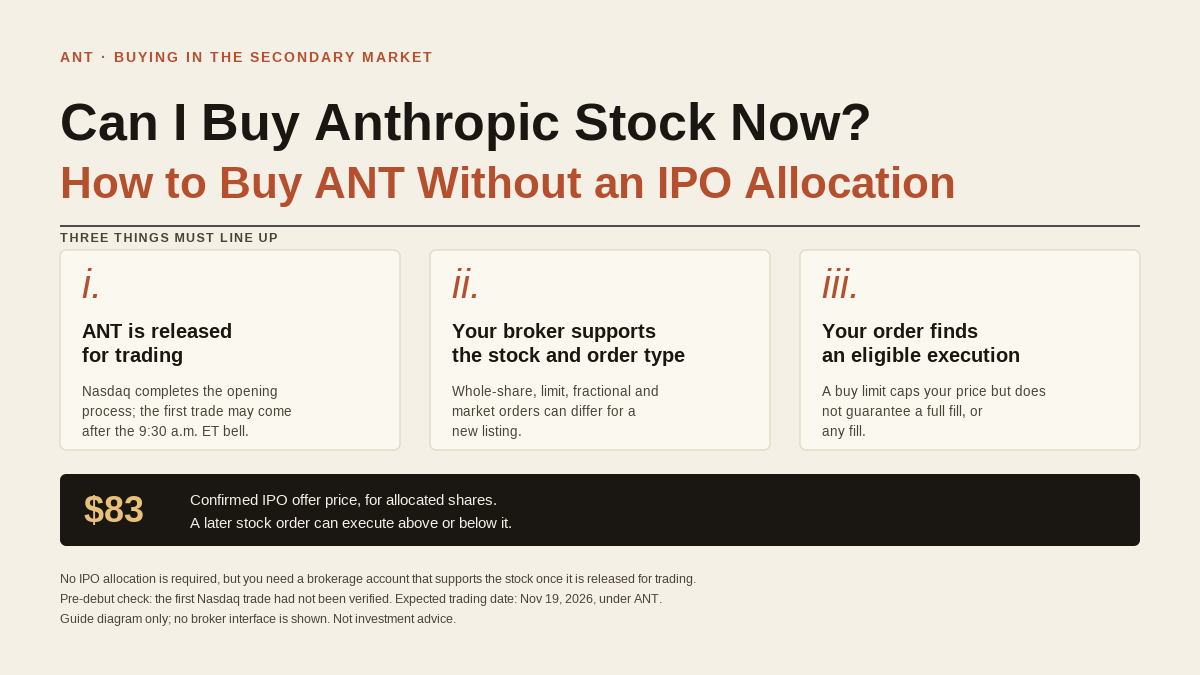
Can I Buy Anthropic Stock Now? How to Buy ANT Without an IPO Allocation
Can you buy Anthropic stock without an IPO allocation? Learn when ANT orders can fill, what $83 means, and how to handle zero or partial allocations.
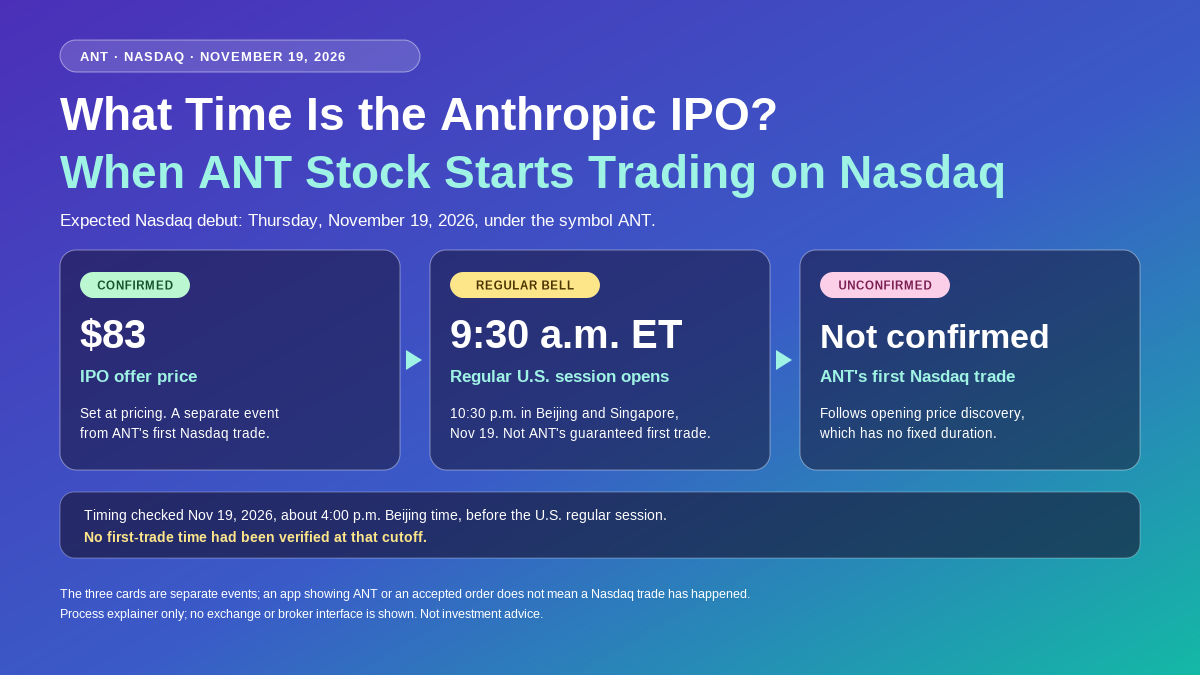
What Time Is the Anthropic IPO? When ANT Stock Starts Trading on Nasdaq
What time is the Anthropic IPO? Check ANT’s November 19 Nasdaq debut, global opening-bell times, the $83 offer price, and why orders may stay pending.
Samsung SDS Unveils Technology for Controlling KRW Stablecoin Issuance and Remittance Qualifications

UniCredit and German Government Reach Agreement on Acquisition of Commerzbank

Analysts Warn That Gold Prices Falling Below $3,800 Reflects Capitulation Selling

Moody's: US Economy Expected to Grow 2.3%, Q3 GDP Annual Growth Rate at 3.4%
Western Australia Exempted from New Gas Reserve Regulations
Kimball Plans to Move Main Listing Location to New York
MSCI Confirms No Change in Indonesia Market Consultation Process
Amazon Supports Media AI Monetization with Article Access Fees in USDC
Submission of Supplementary Reports by 28 Virtual Asset Operators Completed
White House reviews final CFTC prediction market rule
Suiyuan Technology Expects High Sales Proportion from Tencent in the Future
Latest articles


Latest coin listings on WEEX


