
Apple Stock Fell 6.6% on a Record Quarter: What Traders Missed

 Prefer us on Google
Apple stock closed the July 30 session at $333.43, reported the best June quarter in company history two hours later, and was trading at $311.25 before most of the world woke up. A 6.65% after-hours drop on roughly $4.96 trillion of market value works out to about $330 billion changing hands in sentiment terms — and it happened entirely outside Nasdaq trading hours.
That gap is the part of the Apple stock story that quote pages do not cover. If you held AAPL through the print, you could not act on it. If you held tokenized Apple exposure on a crypto venue, you could — and that difference is now the most practical question in trading Apple around earnings.
What Apple's Q3 FY2026 numbers actually showed
Apple reported fiscal Q3 2026 results on July 30, 2026, for the quarter ended June 27. Revenue came in at $109.42 billion, up 16% year over year, with net income of $29.79 billion and diluted EPS of $2.02, a 29% increase. Both revenue and EPS set June-quarter records, as did iPhone, Mac and Services individually.
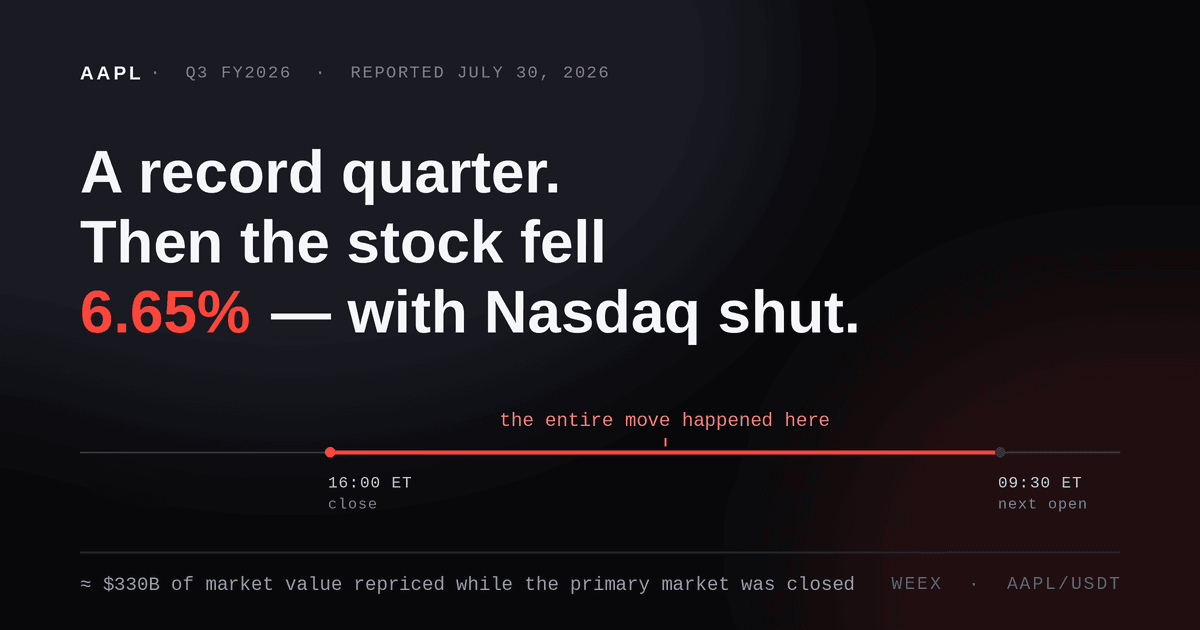
The beat was real. The reaction was not about the beat.
| Metric (Q3 FY2026) | Reported | Consensus | Read |
|---|---|---|---|
| Revenue | $109.42B | $108.86B | Beat |
| Diluted EPS | $2.02 | $1.89 | Beat, +29% YoY |
| Services revenue | $30.74B | $31.22B | Miss |
| Greater China | $18.8B | $19.5B | Miss (up from $15.4B YoY) |
| Net income | $29.79B | — | June-quarter record |
| R&D spend | $11.7B | — | +32% YoY from $8.9B |
Reported figures from Apple's July 30, 2026 release; consensus figures as compiled by sell-side coverage on the same date.
Two lines did the damage. Services missed by roughly $480 million, and Services is the segment that carries Apple's margin story. Greater China grew hard off a weak base but still landed about $700 million light. Then management guided fiscal Q4 gross margin to 47–48% — with roughly a full point of that coming from tariff refunds rather than operations — flagged supply constraints, and put a 2.5 percentage point FX headwind on the quarter. It was also Tim Cook's final earnings call as CEO, which removed the one variable the market usually treats as constant.
The more useful reading: the market did not reprice this quarter, it repriced the next four. A 39.5x trailing P/E near an 18-year high leaves no room for a guidance wobble, and the after-hours tape said so immediately.
Why Apple stock fell after hours instead of during the day
Apple reports after the closing bell, as almost all large caps do. That is a deliberate choice — it gives the market time to digest a 10-Q's worth of detail without intraday chaos. The side effect is that the single most information-dense moment of the quarter lands when the primary market is shut.
For a holder of ordinary Apple stock, the sequence on July 30–31, 2026 looked like this: regular session closes at 4:00 p.m. ET, results drop at ~4:30 p.m., the call runs to ~6:00 p.m., and the next chance to transact at a real, deep, protected price is 9:30 a.m. the following morning. Extended-hours sessions exist through most retail brokers, but spreads widen, size disappears, and many brokers restrict order types to limit-only.
Roughly 17 hours pass between the last liquid print and the next one. This quarter, the entire move happened inside that window.
Apple stock trades 24/7 now — as a token, not a share
A tokenized version of Apple stock has existed since mid-2025. AAPLX, issued by Backed Finance as part of the xStocks range, is a token backed 1:1 by an Apple share held with a regulated custodian. Similar wrappers exist from Dinari, Ondo and others, and Apple is one of the handful of marquee tickers where this actually has liquidity.
The category stopped being a curiosity this year. Tokenized equities went from about $2.23 billion in market value at the start of 2026 to roughly $5.5 billion by mid-June 2026 — a ~147% move in under six months, making it the fastest-growing real-world asset segment. Freely tradable on-chain RWA value excluding stablecoins sat near $33.5 billion in early July 2026. In May 2026, the DTCC ran a tokenized securities pilot with more than 50 institutions including BlackRock, Goldman Sachs and JPMorgan, which is the sort of thing that tends to precede infrastructure rather than follow it.
Here is what that changes in practice around an event like July 30:
| Instrument | Trading window | Who sets the price off-hours | What you own |
|---|---|---|---|
| AAPL shares (Nasdaq) | 9:30–16:00 ET, weekdays | Nobody — market closed | Equity, votes, dividends |
| AAPL extended hours | ~04:00–20:00 ET, weekdays | Thin broker order flow | Equity, votes, dividends |
| AAPLX and similar tokens | 24/7, including weekends | Crypto-side supply and demand | Custodial claim on a share |
| AAPL-settled perpetuals | 24/7, including weekends | Funding-anchored index | A derivative, no share |
The crossover matters most for weekends and after-hours. During Nasdaq hours, arbitrage between the token and the real share keeps the peg tight — authorised participants create and redeem 1:1 and any gap gets closed. Outside those hours there is nothing to arbitrage against, so the token floats on pure crypto order flow. Pegs hold when the underlying market is open and drift when it is not. That is the whole mechanism, and it cuts both ways.
-- Price
How to trade Apple stock exposure with a crypto account
If the reason you are reading about Apple stock is that you hold USDT rather than a brokerage balance, there are two routes, and they are not the same trade.
Route one — spot tokenized shares. You buy AAPLX or an equivalent on a venue that lists it. You are long a custodial claim on a real Apple share. No leverage, no funding, no liquidation. Your risks are issuer solvency, custodian conduct, and off-hours price drift.
Route two — a USDT-margined perpetual. WEEX lists AAPL/USDT perpetual futures, part of its TradFi lineup alongside TSLA, MSFT and AMZN. You are not buying a share at all — you are taking a leveraged position on an index price, settled in USDT, with a funding rate that periodically pays longs or shorts depending on which side is crowded. This is the instrument people actually use to trade an earnings gap, because you can be short.
The practical workflow on a perp is: fund a USDT balance, open the AAPL/USDT contract, set leverage deliberately low for an event trade, and place the stop before the position, not after. Then check the funding rate. Around a heavily anticipated print, funding on equity perps skews toward whichever direction the crowd expects, which means you can be directionally right and still bleed on carry if you sized the holding period wrong.
What traders usually miss: the perp does not stop moving when Nasdaq does, but its index does thin out. A stop placed at a level that looks reasonable against Nasdaq's 4:00 p.m. close can be swept at 3:00 a.m. by a fraction of the size it would have taken during the session. Every post-earnings blowup story in tokenized equities is some version of that sentence. If you intend to hold through a print, either widen the stop to reflect off-hours liquidity or size down so you can survive being wrong overnight — do not use daytime stop distances on an overnight book.
Is Apple stock a good buy at 39x earnings?
The sell side is broadly constructive and narrowly cautious, which is a familiar combination for a company this large.
| Signal (as of July 30, 2026) | Level |
|---|---|
| Consensus rating | Buy (24 of 49 analysts at buy or better) |
| Average 1-year target range | $311 – $327 across major polls |
| Highest target | $400 |
| Lowest target | $250 |
| Trailing P/E | ~39.5, near an 18-year high |
| Post-earnings price | $311.25 (after hours, July 30, 2026) |
Read the table honestly and the average target sits roughly at the post-drop price. That is not a bullish setup; it is a market that had already priced the good news. The bull case rests on AI monetisation eventually flowing through Services — one widely-cited estimate puts that at $75–$100 per share over several years — and on China stabilising, which this quarter genuinely supports at $18.8 billion versus $15.4 billion a year ago. The bear case is that Apple is spending 32% more on R&D while guiding margins down, in a year when global smartphone demand is expected to soften, with a CEO transition underway.
Nothing here is a recommendation. The point for anyone trading Apple stock through a crypto venue is narrower and more actionable: at a 39x multiple with a compressed target spread, the asset is priced for execution, and execution risk shows up on earnings dates — after the close.
What can go wrong with tokenized Apple stock
The wrapper introduces risks that the underlying share does not have. They are worth naming precisely rather than gesturing at.
- Issuer and custodian risk. Your claim is on the issuer's custodial arrangement, not on Apple. If the issuer fails, an Apple share existing somewhere does not automatically become yours.
- No shareholder standing. Voting rights do not pass through. Dividend treatment varies by issuer and is not equivalent to holding the share directly — check the specific product's terms before assuming anything.
- Off-hours dislocation. Premiums and discounts open when the underlying market is closed. In the long tail of tokenized tickers, discounts of 20%+ to the underlying have persisted despite 1:1 redemption rights.
- Concentrated liquidity. Depth clusters in a few names. Apple is one of the better ones, which makes it the exception rather than the rule.
- Leverage mechanics. On a perpetual, funding and liquidation are separate ways to lose money from the same position, and both run overnight.
- Regulatory availability. Tokenized equity access is restricted in several jurisdictions and the product set changes. What is listed today may not be listed for your account tomorrow.
The bottom line on Apple stock right now
Apple stock delivered a record June quarter and lost 6.65% for it, because the market cared about a soft Services line, a light China print, a 47–48% margin guide propped up by tariff refunds, and a CEO handover — not about the $109.4 billion headline. At roughly 39x trailing earnings with analyst targets clustered around the post-drop price, Apple stock is priced with very little slack.
For crypto-native traders, the operational takeaway matters more than the valuation debate: the move happened when the stock market was shut. Tokenized wrappers and USDT-margined perpetuals are the two instruments that let you act in that window, and each carries costs the underlying share does not. If you plan to trade Apple stock through the next print, decide now which instrument you are using and what your overnight stop distance is. Explore the AAPL/USDT perpetual contract on WEEX to see the current funding rate and depth before you commit size.
FAQ
1. Why did Apple stock drop after beating earnings on July 30, 2026?
Services revenue came in at $30.74 billion against about $31.22 billion expected, Greater China landed at $18.8 billion versus roughly $19.5 billion expected, and fiscal Q4 gross margin guidance of 47–48% included about a percentage point from tariff refunds rather than operations. Management also flagged supply constraints and a 2.5 percentage point FX headwind. The beat was on the quarter just ended; the selling was about the quarters ahead.
2. Can I buy Apple stock with crypto?
Not the share itself. You can buy a tokenized claim on an Apple share, such as AAPLX from Backed Finance, or take a USDT-margined derivative position such as an AAPL perpetual future. The first gives you custodial exposure to the share price; the second gives you a leveraged derivative with no share behind it.
3. Does tokenized Apple stock track the real AAPL price?
Closely during Nasdaq hours, when arbitrage against the underlying share keeps the peg tight. Less closely overnight and on weekends, when the underlying market is closed and the token trades on crypto supply and demand alone. Premiums and discounts open in that window.
4. What is the price target for Apple stock in 2026?
Analyst averages as of July 30, 2026 cluster between roughly $311 and $327, with a high of $400 and a low of $250 across the major polls. The consensus rating is Buy, though the average target sits close to the post-earnings price, which limits the implied upside.
5. Do I get Apple dividends if I hold a tokenized Apple stock?
Treatment depends entirely on the issuer, and it is not equivalent to direct ownership. Some structures reflect distributions in the token value; others do not pass them through at all. Voting rights do not transfer in any of the current wrappers. Read the specific product documentation rather than assuming brokerage-equivalent treatment.
6. Is it safer to trade Apple stock on a broker or a crypto exchange?
They fail differently. A broker gives you direct share ownership, investor protections and market-hours liquidity, but no access when the market is closed. A crypto venue gives you 24/7 access and the ability to be short with leverage, but adds issuer, custodian and off-hours liquidity risk. The right answer depends on whether your edge is holding the asset or trading the event.
Risk Warning
Trading Apple stock exposure through tokenized assets or derivatives carries substantial risk, and losses can exceed the amount you expect to lose — including total loss of the position. Prices are volatile and, in the case of leveraged perpetual contracts, adverse moves can trigger liquidation without further notice.
Specific risks in this article's subject matter include: counterparty and custodial risk on tokenized equity issuers, whose solvency stands between you and the underlying share; off-hours liquidity risk, where thin overnight and weekend books produce wide spreads, slippage and stop-outs at prices that would not occur during Nasdaq hours; peg and dislocation risk, where a tokenized share trades at a persistent premium or discount to the underlying; funding and leverage risk on perpetual contracts, which accrue costs independently of price direction; and regulatory risk, as tokenized equity products remain restricted or unavailable in a number of jurisdictions and rules continue to change. Tokenized Apple stock does not confer shareholder rights, and dividend treatment varies by issuer.
Nothing here is investment advice. Market data and analyst figures are current as of July 30–31, 2026 and change continuously. Assess your own objectives, jurisdiction and risk tolerance, and never commit capital you cannot afford to lose entirely.
This content is provided for general informational purposes only and doesn't constitute financial, investment, legal, or tax advice. Any events, rewards, online promotions, or related information mentioned herein should not be considered a recommendation, solicitation, or invitation to purchase, sell, trade, or otherwise deal in any crypto assets. Crypto assets are highly volatile and may result in loss. The availability of WEEX services, products, and related events may vary by region. You are responsible for ensuring that your participation is in accordance with applicable local laws and regulations.
You may also like

Nike Stock and the China Sales Collapse: What a 30% Revenue Drop and Cutting Thousands of Distributors Actually Signals

BTC to MYR: Why the Ringgit Price of Bitcoin Has Two Legs
Logista Stock (LOG): The August 2026 Interim Dividend, the Four Dates That Decide Who Is Paid and What the Company Is
Manta Network (MANTA) Token Unlock: Supply Details, Allocation Breakdown and Price Risks
ETHFI Price Today: Why Ether.fi Is in Focus Ahead of Its Token Unlock
Santander Reveals a $4.3 Million Bitcoin Investment: What Europe's Biggest Bank Buying IBIT Actually Signals
SNDK Stock and the $93.9 Billion NBM Agreements: What SanDisk's New Business Model Actually Changes
Is Reddit Stock a Buy After Falling From Its Highs? What the S&P 500 Inclusion Actually Changes
Reddit Stock Jumps 11% After S&P 500 Inclusion: What Joining the Index on August 18 Actually Changes
Santander Stock and the Webster Acquisition: What the Federal Reserve Approval Actually Changes
What Is IREN? How the AI Data Center Company Behind Microsoft's $9.7 Billion Contract Actually Works
IREN Stock and the Microsoft Delivery: What Completing Horizon 1 and Getting Nvidia's Exemplar Status Actually Mean
MU Stock After the 28% Drop: What Micron's HBM Backlog Says
Is OpenAI Publicly Traded? The Foundation That Controls It, and the Ticker That Isn't Theirs
Is HIMS Stock a Buy After the Earnings Selloff? What the Full-Year Guidance Raise Actually Implies
CRWV Stock After Q2: Demand Is Fine, the Interest Bill Isn't
Is Bitcoin Preparing for a Bullish Breakout? Key Technical Indicators and On-Chain Data
MSFT Stock and the 30 Million Copilot Seats Milestone: What Growing From 20 Million Actually Changes
RKLB Stock After Q2: Record Revenue, Wider Loss, Narrower Window
Strategic Petroleum Reserve 2026: What's Left and What It Can Do
Apple Stock and CXMT: What Testing Chinese Memory Chips for iPhone Actually Means for AAPL
Jensen Huang Stock Advice: What He Said and What It Returned
Metaplanet (3350): What the Japanese Retail Boards Argue About — and How to Check Each Claim

KGHM Stock Forum: Copper, Silver, and the Argument the Thread Keeps Getting Backwards
JSW Stock Forum: What the Threads Are Actually Arguing About — and What They Cannot Tell You
What Is Phantom Wallet? How to Install the Official Version Safely and Use It
How Zero Knowledge Proofs Are Used in Blockchain Today
What Is Zero Knowledge Proof? A Beginner's Guide
PGP vs End-to-End Encryption: What's the Difference?
Roblox Stock Price Prediction 2026-2027: Can RBLX Recover After Pulling Full-Year Guidance?
Nike Stock and the China Sales Collapse: What a 30% Revenue Drop and Cutting Thousands of Distributors Actually Signals
BTC to MYR: Why the Ringgit Price of Bitcoin Has Two Legs
Logista Stock (LOG): The August 2026 Interim Dividend, the Four Dates That Decide Who Is Paid and What the Company Is
Manta Network (MANTA) Token Unlock: Supply Details, Allocation Breakdown and Price Risks
ETHFI Price Today: Why Ether.fi Is in Focus Ahead of Its Token Unlock
Santander Reveals a $4.3 Million Bitcoin Investment: What Europe's Biggest Bank Buying IBIT Actually Signals
Contents
Popular coins
Latest articles


