Argentina World Cup Final Controversy: What the On-Field Incidents Mean for the Team's Global Brand

 Prefer us on Google


Argentina World Cup exits have historically generated as much global conversation as Argentina World Cup victories, and the 2026 final produced the kind of post match narrative that will follow the team into the post Messi era with consequences that extend well beyond the result itself.
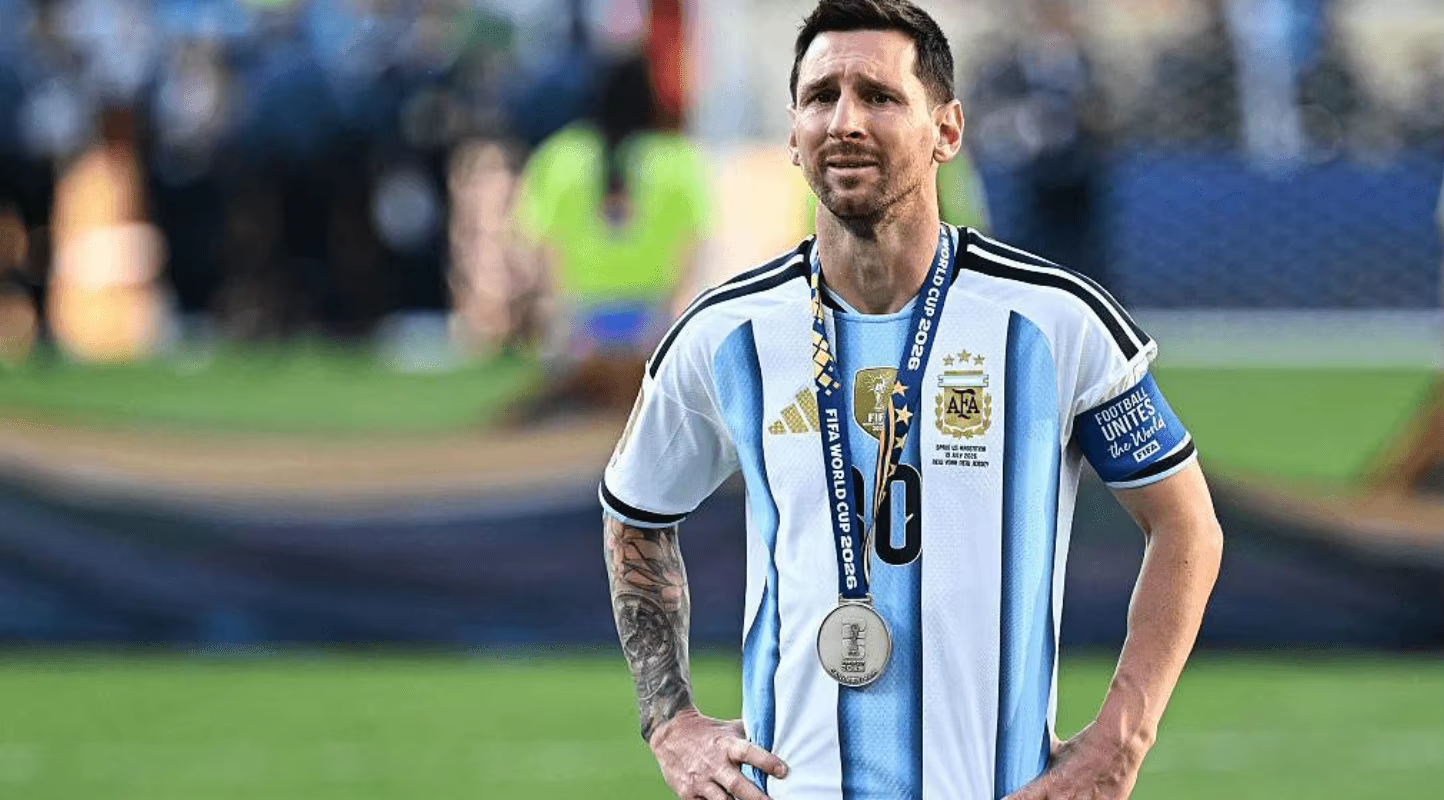
The Argentina World Cup final of 2026 will be remembered for two distinct stories that are difficult to separate in the historical record: the remarkable journey of a 38 year old Messi orchestrating consecutive World Cup final appearances through sheer force of will, and the behavior of the players around him that produced images and incidents that no commercial partner or global football governing body can easily ignore. The Argentina World Cup brand that Messi built through a decade of grace, brilliance, and goodwill is the specific asset that the 2026 final's incidents have damaged in ways that matter commercially and institutionally rather than merely symbolically.
What Actually Happened on the Field
Before evaluating the commercial and reputational implications, establishing what specifically occurred during and after the 2026 World Cup final is necessary because the incidents have been described with varying levels of precision across different coverage.
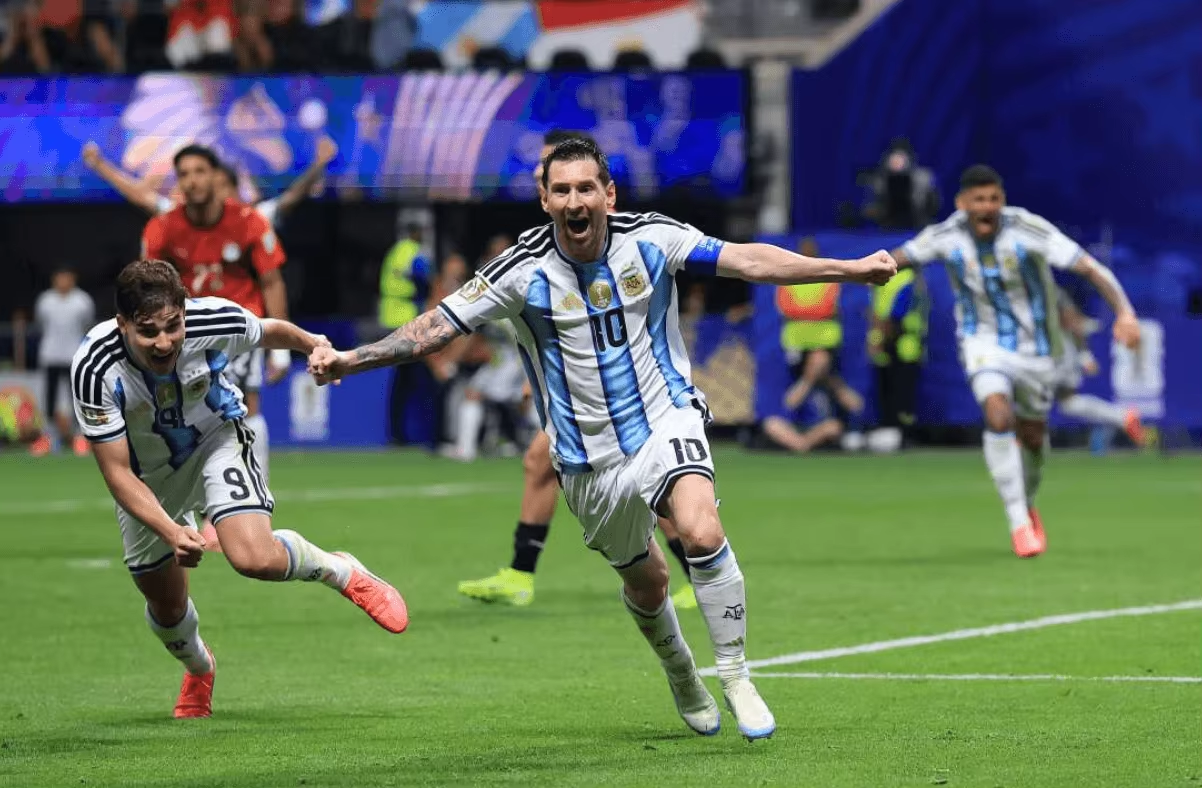
Leandro Paredes grabbed a Spanish player by the throat and threw two or three haymakers into someone's face, per Alan Shearer's assessment. Enzo Fernandez received a red card in stoppage time of the second half, leaving Argentina with ten men for the entirety of extra time, which directly contributed to the conditions that produced Ferran Torres' winning goal six minutes into the additional period. Nahuel Molina reportedly took a swing at Rodri. And in the image that has circulated most widely in the week since the final, eleven Argentine players stood with their backs to the Spanish squad during the trophy presentation rather than facing the ceremony as football tradition and basic sportsmanship require.
Each incident carries different severity. Fernandez's red card was a disciplinary decision that resulted from on-field behavior during play and that had direct tactical consequences for the match outcome. The Paredes and Molina incidents, if confirmed to the severity described, represent behavior that FIFA's disciplinary processes are equipped to address through retrospective sanctions. The trophy presentation image is the most symbolically damaging rather than the most practically severe, because it captures the team's collective attitude in a moment that global television audiences witnessed simultaneously.
What the Messi Halo Effect Had Been Protecting
Understanding what the 2026 final incidents have damaged requires understanding what Messi's presence had been providing to Argentina's global brand beyond his obvious footballing contribution.
For the past decade, Lionel Messi's immense popularity provided a halo effect, making the team widely beloved and often forgiven despite their actions. However, with Messi's impending retirement, this protective shield is gone.
The halo effect is a well-documented commercial and perceptual phenomenon where a single figure's extraordinary positive reputation extends protective credibility to the broader entity they represent. Argentina's national football team has not been universally beloved throughout its history. The team's reputation has included episodes of physical play, controversial conduct, and nationalistic intensity that have generated negative coverage in various markets across multiple World Cup cycles.
Messi's specific contribution to the halo effect was not simply that he was likeable. It was that he was globally likeable across markets that do not traditionally have strong affinity for Argentine football. In Southeast Asia, the Middle East, and across sub Saharan Africa, Messi's popularity created Argentina supporters who had no historical connection to Argentine football culture but who followed the team because of their relationship with a single player whose on-field character and off-field conduct represented an accessible and positive football identity.
Those markets are precisely the ones where Argentina's commercial value in terms of jersey sales, sponsorship activation, and broadcasting appeal had grown most dramatically during the Messi era. And those are the markets where the 2026 final's incidents, amplified by social media, will do the most damage to a commercial brand that was built on Messi's foundation rather than on the team's independent identity.
The Commercial Implications That Will Take Time to Materialize
The damage to Argentina's global brand from the 2026 final incidents will not appear immediately in any financial statement or sponsorship renewal announcement. It will materialize over the twelve to eighteen months following the final as commercial conversations that had assumed the continuation of Messi-era brand value encounter a different reality.
National football team commercial value operates through several distinct channels. Jersey sales are the most visible and most easily tracked. Argentina jerseys bearing Messi's number 10 have been among the best selling football jerseys globally for the past decade, and the commercial partners who license reproduction rights and manufacture those jerseys had been pricing the Messi association into their arrangements. Post retirement, the jersey commercial value compresses regardless of the 2026 incidents. The incidents accelerate and amplify that compression in markets where the brand had been built on positive association rather than on competitive loyalty.
Sponsorship renewal conversations are the less visible but more commercially significant channel. Argentina's commercial partners in global categories including sportswear, financial services, and consumer goods had been paying premiums that reflected the Messi halo effect's reach into non-traditional football markets. Those premiums will be renegotiated in the post Messi cycle, and the 2026 final's incidents give commercial partners who were already planning to reduce their Argentina exposure an additional justification that they can articulate to internal stakeholders when explaining why the renewal rate should be lower than the previous cycle.
Broadcasting rights valuations in markets outside South America will face similar pressure. Broadcasters who had been paying for Argentina matches in non-traditional markets based on Messi audience draw will reassess the market size for Argentine football without the Messi premium, and the 2026 final's coverage of the incidents will have provided additional justification for audiences in those markets to disengage from Argentina as a product proposition.
Why Argentina's Behavior Pattern Creates a Specific Problem Without Messi
The 2026 final incidents are not isolated events in Argentina's recent international football history, and their specific timing relative to Messi's apparent retirement makes the pattern more commercially damaging than any single incident would be independently.
Argentina's recent World Cup final was marred by unsportsmanlike conduct, including on field altercations and players turning their backs during the trophy presentation. This incident highlights a pattern of controversial behavior, from racist chants to taunting opponents.
A pattern of behavior that was previously overlooked or forgiven because of Messi's protective presence becomes the team's defining characteristic when that presence is removed. The commercial partners, broadcasters, and global football governance bodies that had extended benefit of the doubt to Argentina because of their association with the world's most beloved player face a different calculus when that player is no longer active.
The specific risk for Argentina's football federation is that the pattern becomes self- reinforcing in the post Messi period. Commercial partners who reduce their Argentina exposure because of post-Messi brand value compression cite the incidents as justification. Reduced commercial value limits the federation's ability to invest in facilities, coaching, and talent development that would produce a team whose on field conduct and competitive quality could independently rebuild the global brand. The cycle creates a period of commercial and competitive difficulty that is harder to escape than the original incident alone would produce.
What Messi's Own Conduct Contrasted With the Incidents
One of the most striking dimensions of the 2026 final's aftermath is the specific contrast between Messi's personal conduct and the behavior that surrounded him.
Messi posted an emotional message after Argentina's defeat: "The pain is immense, and this wound will take time to heal. But I also hold onto all the good things. The matches we turned around by giving it our all, moments that will remain in our memories forever."
Although the ending of the 2026 FIFA World Cup was heartbreaking for Argentina, Messi wanted to say goodbye to his teammates with a very special gift, personally giving a present to every member of the national team.
The gesture of personally gifting every squad member amplifies the contrast between Messi's character and the conduct that surrounded him in the final's most visible moments. A player who responds to his most painful professional disappointment by ensuring every colleague receives a personal acknowledgment is demonstrating the specific human qualities that created the halo effect in the first place. The players whose behavior generated the most negative global coverage were simultaneously benefiting from Messi's generosity while providing evidence that the conduct norms Messi embodied were not shared across the squad.
For Argentina's federation, Messi's conduct in the aftermath of the defeat is both the most heartening element of the 2026 story and the clearest illustration of the gap between what the team's global brand was built on and what the team's actual character, as expressed by multiple players in the final, appears to be.
The Path to Rebuilding Without Messi
Argentina's football federation faces a specific and identifiable challenge in the post-2026 period that goes beyond finding a replacement for Messi's on-field contribution.
The commercial brand rebuild requires a player or group of players who can generate the kind of positive global affinity that Messi created through individual conduct and character rather than only through competitive excellence. Talent of Messi's level does not emerge on any predictable schedule and cannot be manufactured through any federation intervention. But conduct can be shaped through cultural norms that the coaching staff and federation establish and enforce consistently rather than protecting commercial relationships by avoiding difficult internal conversations.
The 2026 final incidents, and Argentina's federation's response to them, will tell observers more about the team's capacity for self reflection than the incidents themselves. A federation that publicly acknowledges the conduct concerns, implements specific consequences for the identified behavior, and communicates those actions to commercial partners demonstrates an institutional seriousness that can partially offset the brand damage. A federation that minimizes the incidents or treats them as a media narrative rather than as a genuine institutional concern accelerates the commercial decline that the post-Messi transition was already going to produce.
The next competitive cycle for Argentina, including the 2027 Copa America and eventually the 2030 World Cup in Spain, Portugal, and Morocco, represents the timeline across which the post-Messi brand either rebuilds on independent foundations or confirms that the Messi-era commercial value was entirely dependent on a single player whose departure removes the rationale for the premiums that commercial partners had been paying.
Conclusion
Argentina's World Cup final incidents have damaged a global brand that was built on Messi's foundation rather than on the team's independent commercial identity, and the damage is most acute in precisely the markets where Messi's halo effect had extended Argentina's commercial reach beyond the traditional South American football audience.
The commercial implications will materialize over twelve to eighteen months as sponsorship renewals, jersey licensing, and broadcasting rights valuations in non-traditional markets reflect a post-Messi reality that the 2026 final's incidents have made more difficult rather than less. A team that had been forgiven repeated conduct concerns because of a single player's extraordinary global goodwill must now demonstrate that it can build a commercial identity and a conduct standard that are independent of that player.
Messi's personal response to the defeat, the emotional Instagram post and the individual gifts to every squad member, provides the clearest available illustration of the gap between what Argentina's global brand was built on and what the 2026 final revealed about the team's actual character without him. That gap is the specific challenge Argentina's federation must address if the post-Messi era is to be commercially and institutionally coherent rather than simply a period of managed decline from the peak that a single generational player made possible.
FAQ
1. What happened during and after the 2026 World Cup final involving Argentina players?
Enzo Fernandez received a red card in stoppage time leaving Argentina with ten men for extra time. Leandro Paredes grabbed a Spanish player by the throat and reportedly struck someone during the match. Nahuel Molina reportedly struck Rodri. Eleven Argentine players stood with their backs to the Spanish squad during the trophy presentation rather than facing the ceremony. The incidents generated significant global coverage and a Forbes analysis describing Argentina's brand as damaged.
2. What was the Messi halo effect and why does its loss matter commercially?
The halo effect describes how Messi's extraordinary global popularity extended positive credibility to the Argentine national team across markets that had no traditional connection to Argentine football. In Southeast Asia, the Middle East, and sub-Saharan Africa, Argentina attracted commercial interest, jersey sales, and broadcasting audiences because of their association with Messi rather than because of the team's independent identity. Those commercial premiums compress in the post-Messi period and the 2026 final incidents give commercial partners additional justification for reducing exposure.
3. How will the 2026 final incidents affect Argentina's commercial value over time?
Jersey sales in non-traditional markets will compress as the Messi number 10 association fades. Sponsorship renewal conversations over the next twelve to eighteen months will reflect reduced brand value as commercial partners renegotiate arrangements that had priced in the Messi halo effect. Broadcasting rights valuations in markets outside South America will reassess the audience size for Argentine football without the Messi premium. The incidents accelerate and amplify a compression that post-retirement transition was already going to produce.
4. How did Messi's personal conduct contrast with the incidents around him?
Messi posted an emotional and gracious Instagram message acknowledging the pain of defeat while congratulating Spain and expressing pride in the team's achievement of reaching consecutive World Cup finals. He personally gifted every squad member a present following the defeat. The conduct that generated the most negative global coverage came from the players surrounding him rather than from Messi himself, creating a specific contrast between the character that built Argentina's global brand and the conduct that the 2026 final revealed in his teammates.
5. What does Argentina need to do to rebuild its global brand in the post-Messi era?
Argentina's federation needs to publicly acknowledge the conduct concerns rather than minimizing them, implement specific consequences for the identified behavior, and communicate those actions to commercial partners to demonstrate institutional seriousness. The commercial brand rebuild over the 2027 Copa America and 2030 World Cup cycle requires either a player who can generate independent global affinity through character as well as talent, or a team whose collective conduct and competitive quality can independently sustain the commercial interest that Messi's individual presence previously guaranteed.
Disclaimer: This content is provided for general branding and informational purposes only and doesn't constitute financial, investment, legal, or tax advice. Any events, rewards, online events, or related information mentioned herein should not be considered a recommendation, solicitation, or invitation to purchase, sell, trade, or otherwise deal in any crypto assets or to use any services. Crypto assets are highly volatile and may result in loss. WEEX services and online events may not be available in all regions and are subject to applicable laws, regulations, and eligibility requirements. You are responsible for ensuring that your use of WEEX services complies with local laws and for carefully assessing the risks before participating in any crypto-related activities.
You may also like

Do You Need a Crypto Broker? What They Are and Who Should Use One in 2026

What Is the Difference Between a Broker and a Market Maker? A Complete Guide
Argentina World Cup 2030: Who Replaces Messi and Can They Ever Win Again?

Historical FIFA World Cup Evaluations: Where Does Spain 2026 Rank Among the Greatest Champions?
Oil Falls 7% as US Pauses Iran Strikes: Which Stocks Win and Which Lose Now

US Pauses Iran Strikes: What the Ceasefire Signal Means for Oil Prices and Stock Markets

Samsung Stock vs Samsung ETF: Which Is the Better Way for International Investors?
Samsung Stock Is 30% Below Its Peak: What Getting Back to Record Highs Actually Requires
Samsung Stock and the $200 Billion Broadcom Deal: What the Memory and Foundry MOU Means for Investors

SK Hynix Stock Before July 29 Earnings: What Investors Should Watch
New SK Hynix 2X ETFs Launch: Who Should Use Them and Who Should Not
SK Hynix Stock and Nvidia's $500 Billion SK Group Deal: What the 2027 Timeline Means for Investors
CXMT Stock Debut: 471% Pop and the Crypto Market That Called It
Tesla Stock After the 16% Crash: Price, Targets, and How to Trade It
WEEX Poker Party Series 4: Your First 24 Hours, Step by Step
Is XST Coin a Scam? XSolut Risks, Dump Concerns & Price Analysis

What Is XSolut (XST) Coin? Exploring AI Infrastructure and RWA Tokenization
WEEX TradFi Trading Fest: Trade Stock Futures and Share 50,000 USDT Rewards
STABLE Crypto Airdrop Guide: How to Claim 50,000 USDT Rewards on WEEX
What Is a Broker? The Complete Guide to Understanding Financial and Crypto Brokers
How to Compare Crypto Brokers: What the Rankings Don't Tell You and What Actually Matters
Oracle Stock Price Prediction 2026-2027: Can ORCL Reach $250 After the Pentagon Deal?
Is Oracle Stock a Buy After the $7 Billion Pentagon Deal? What the Defense Contract Changes
SPCX Stock Price Is Down $1 Trillion From Its Peak: Is Now the Time to Buy?
Is Tesla Stock a Buy at $320 After the Q2 Earnings Crash?
SPCX Stock Price and Starship Flight 13: What Tonight's Launch Needs to Deliver
Why Tesla Stock Crashed 14% on Record Revenue: What the 1.4% Operating Margin Actually Means
Tesla Stock Is Betting Everything on Robotaxi and Optimus: What Investors Are Actually Paying For
Intel Stock vs AMD Stock: Which Chip Giant Is the Better Buy After Q2?
Intel Stock Price Prediction 2026-2027: Can INTC Reach $150 After the Foundry Turnaround?
Do You Need a Crypto Broker? What They Are and Who Should Use One in 2026
What Is the Difference Between a Broker and a Market Maker? A Complete Guide
Argentina World Cup 2030: Who Replaces Messi and Can They Ever Win Again?
Historical FIFA World Cup Evaluations: Where Does Spain 2026 Rank Among the Greatest Champions?
Oil Falls 7% as US Pauses Iran Strikes: Which Stocks Win and Which Lose Now
US Pauses Iran Strikes: What the Ceasefire Signal Means for Oil Prices and Stock Markets