
Binance Hack: Can the DOJ Recover $1.1B in Frozen USDC?

 Prefer us on Google

Key Takeaways
- The U.S. Department of Justice filed a civil forfeiture complaint on November 23, 2026, seeking more than $1.1 billion in USDC connected to the October Binance hack.
- Federal investigators attributed the theft of more than $6 billion in cryptocurrency to North Korean cyber actors associated with Lazarus Group/APT38.
- The forfeiture case targets USDC associated with 36 cryptocurrency addresses across 18 blockchains, with Circle assisting authorities in restricting access to the funds.
- U.S. authorities have helped freeze, seize or return more than $2.9 billion in assets, but frozen cryptocurrency should not be mistaken for funds already recovered by victims.
The Binance hack entered a new legal phase on November 23, 2026, when U.S. prosecutors sought forfeiture of more than $1.1 billion in frozen USDC. The Binance hack involved over $6 billion in stolen cryptocurrency, but freezing assets does not automatically return them to victims. This article examines the Binance hack, Circle's role in restricting stolen funds and the legal challenges surrounding cryptocurrency recovery.
Why Is the DOJ Seeking $1.1 Billion From the Binance Hack?
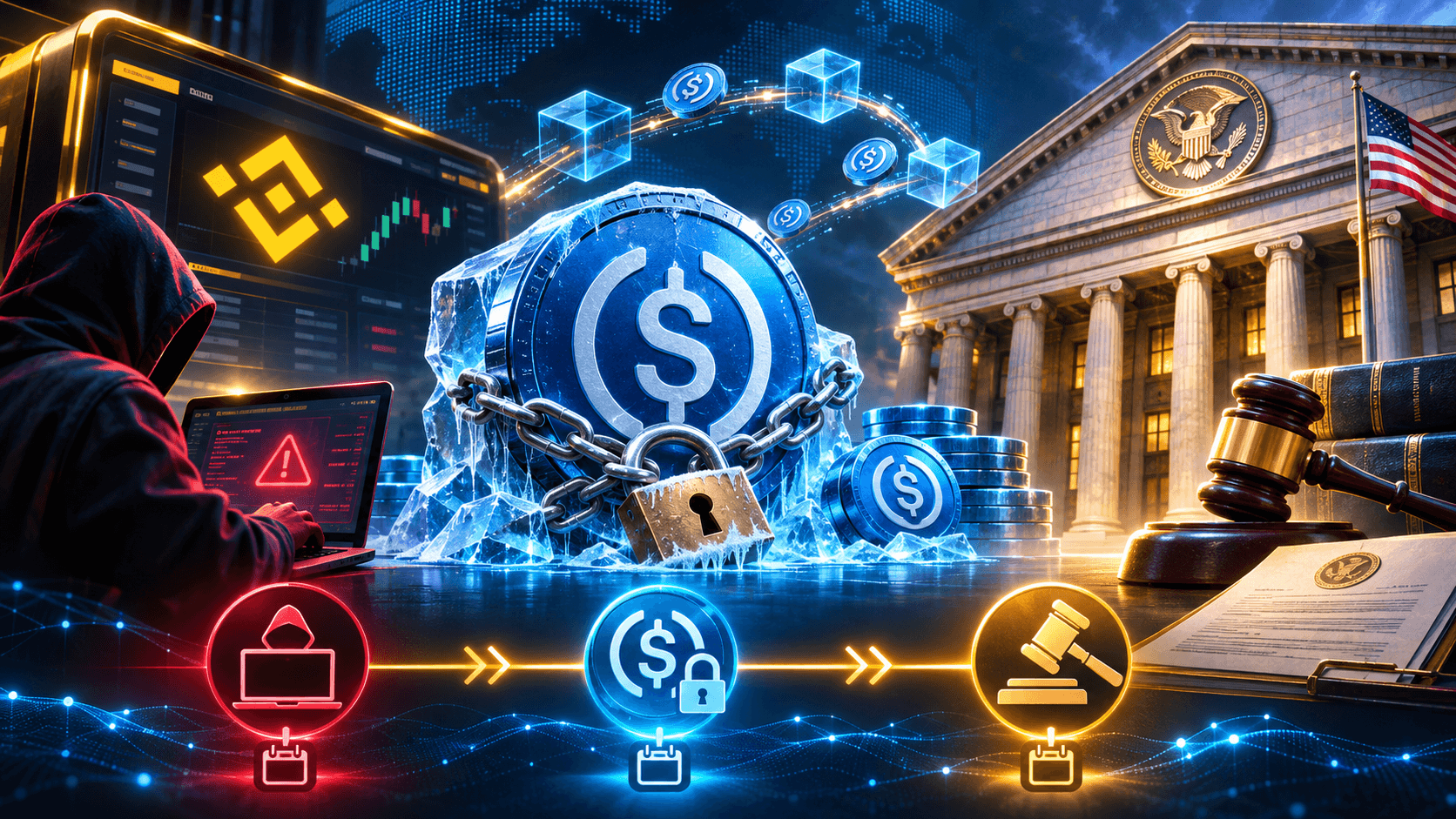
The U.S. Department of Justice announced on November 23 that it had filed a civil forfeiture complaint seeking control of more than $1.1 billion in USDC allegedly obtained through the October 29 Binance cryptocurrency theft.
The action was filed in the U.S. District Court for the District of Columbia under case number 1:26-cv-04150. It identifies USDC associated with 36 cryptocurrency addresses across 18 blockchain networks as the property subject to forfeiture.
The filing represents a significant development in the government's efforts to recover cryptocurrency linked to the attack, which investigators estimate involved more than $6 billion in stolen assets.
However, the legal status of the funds is essential to understanding the announcement. The government is seeking judicial forfeiture of assets already subject to restrictions. The complaint does not establish that the full $1.1 billion has been permanently forfeited or returned to Binance.
Binance Hack Recovery: Key Figures
| Metric | Confirmed Information |
|---|---|
| Original Hack Date | October 29, 2026 |
| Affected Platform | Binance |
| Estimated Cryptocurrency Stolen | More than $6 billion |
| DOJ Announcement Date | November 23, 2026 |
| Assets Targeted in Forfeiture Complaint | More than $1.1 billion in USDC |
| Stablecoin Issuer | Circle Internet Financial |
| Blockchain Networks Involved in Complaint | 18 |
| Cryptocurrency Addresses Listed | 36 |
| Suspected Attackers | North Korean cyber actors |
| Attribution in Court Filing | Lazarus Group / APT38 |
| Combined Assets Frozen, Seized or Returned With U.S. Assistance | More than $2.9 billion |
| Court Case | 1:26-cv-04150 |
| Final Forfeiture and Victim Repayment | Not confirmed |
Sources: U.S. DOJ November 23 Announcement and Official Civil Forfeiture Complaint.
The distinction between the figures matters. The $1.1 billion targeted in the latest lawsuit forms part of the wider asset-recovery effort. It should not be added separately to the government's more than $2.9 billion combined figure, because the categories may overlap.
The latest case also demonstrates how blockchain investigations can move beyond identifying suspicious transactions toward taking legal action against assets connected to those transactions.
For readers following earlier developments, WEEX previously covered the Binance Hack's $6.3 Billion Laundering Trail and Recovery Progress.
How Did North Korean Hackers Steal More Than $6 Billion From Binance?
The October 29 incident involved unauthorized access to Binance's computer network and cryptocurrency wallets.
According to the Justice Department's court filing, investigators determined that attackers accessed protected systems and transferred approximately $6 billion in virtual assets from Binance-controlled addresses to wallets controlled by the criminal actors.
The FBI, U.S. Secret Service and IRS Criminal Investigation attributed the attack to members of North Korean military hacking organizations associated with Lazarus Group and Advanced Persistent Threat 38, or APT38.
The investigators based their assessment on technical indicators related to the intrusion and patterns observed in subsequent efforts to launder the stolen cryptocurrency.
Who Are Lazarus Group and APT38?
Lazarus Group and APT38 are names used in cybersecurity investigations to describe North Korean-linked cyber operations.
These actors have previously been associated with sophisticated intrusion campaigns, including attacks against financial institutions and cryptocurrency businesses.
The broader concern is that cryptocurrency theft can provide criminal organizations with access to transferable digital assets that may be moved across multiple blockchain networks and financial intermediaries.
In the Binance case, the DOJ alleged that stolen assets were subsequently transferred and laundered through different virtual currencies, service providers and wallet addresses.
However, investigative attribution should be distinguished from a completed criminal prosecution. The November 23 civil forfeiture case concerns specified assets and does not itself constitute a criminal conviction of every individual suspected of participating in the attack.
Binance Hack: Timeline of Major Developments
| Date | Event | Significance |
|---|---|---|
| October 29, 2026 | Attackers gain unauthorized access to Binance | More than $6B in cryptocurrency stolen |
| Early November | Investigators and industry participants trace affected assets | Wallets and transactions identified |
| November 6 | U.S. government seeks a temporary restraining order | Legal restrictions requested for USDC |
| November 12 | DOJ announces broader disruption and recovery efforts | More than $2.7B reported frozen through combined efforts at that time |
| November 23 | DOJ files civil forfeiture complaint | More than $1.1B in USDC targeted |
| November 23 | DOJ updates combined recovery-related total | More than $2.9B frozen, seized or returned with U.S. assistance |
| Future Proceedings | Court considers forfeiture and related claims | Final ownership and distribution remain unresolved |
Sources: DOJ November 12 Cybercrime Announcement, November 23 Forfeiture Announcement and Court Restraining Order Filing.
The timeline shows that investigators moved from identifying and restricting assets toward pursuing a formal legal mechanism for forfeiture.
These actions are closely related, but they are not interchangeable. In particular, an asset can remain frozen while ownership and repayment questions are still being considered.
-- Price
How Did Circle Help Freeze More Than $1.1 Billion in USDC?
Circle's involvement is one of the most important aspects of the recovery effort.
USDC is a U.S. dollar-referenced stablecoin issued by Circle. Unlike Bitcoin, which has no centralized token issuer, USDC incorporates issuer-controlled mechanisms that can restrict transfers associated with specific blockchain addresses under applicable circumstances.
According to Circle's public explanation of the Binance incident, the company froze approximately $1.1 billion in USDC in coordination with law enforcement.
Circle also emphasized that its role was to assist with enforcing restrictions, not to independently determine criminal liability or final ownership of the assets.
How Does USDC Address Freezing Work?
USDC transactions are recorded on blockchain networks, but the token's issuer can block specific addresses from sending or receiving USDC under its access-denial policy.
When a wallet address is blocked, associated USDC can become inaccessible while the restriction remains in effect.
This does not mean Circle can reverse every completed blockchain transaction or retrieve all cryptocurrency moved by an attacker.
The freezing mechanism affects USDC under the relevant token contract controls. Assets converted into other cryptocurrencies may be subject to entirely different technical and legal restrictions.
For example, an attacker who converts USDC into ETH may subsequently control an asset that cannot be frozen using Circle's USDC-specific address restrictions.
USDC vs. Bitcoin and Ethereum: Recovery Differences
| Feature | USDC | Bitcoin (BTC) | Ethereum (ETH) |
|---|---|---|---|
| Centralized Token Issuer | Yes, Circle | No | No |
| Issuer-Level Address Blocking | Available under defined conditions | Not available | Not available for native ETH |
| Public Blockchain Transaction History | Yes | Yes | Yes |
| Completed Transfers Automatically Reversible | No | No | No |
| Recovery Through Exchange Cooperation | Possible | Possible | Possible |
| Recovery Through Legal Proceedings | Possible | Possible | Possible |
| Main Challenge | Legal control, blocklisting and asset disposition | Wallet control and cooperation | Wallet control, smart contracts and cooperation |
Sources: Circle's Official USDC Blocklisting Explanation and Circle's Binance Incident Response.
These differences help explain why certain stolen stablecoins can be immobilized more quickly than assets without comparable issuer controls.
However, centralized restrictions introduce their own concerns. Users rely on the issuer's compliance with legal processes, its operational controls and its ability to apply restrictions accurately.
The Binance case therefore illustrates both the practical advantages and governance trade-offs of issuer-managed stablecoins.
Does Freezing USDC Mean Binance Has Recovered the Money?
No. Freezing, seizure, forfeiture and restitution represent different stages of the asset-recovery process.
The DOJ's November 23 announcement concerns a civil action seeking forfeiture of identified USDC. While the assets had already been subject to restrictions, the filing does not establish that they have been permanently transferred to the government or distributed to victims.
This distinction is particularly important when interpreting headlines about billions of dollars being recovered after a cryptocurrency hack.
Crypto Asset Recovery: Four Different Stages
| Stage | Meaning | Does It Guarantee Repayment? |
|---|---|---|
| Tracing | Investigators identify suspicious transactions and wallets | No |
| Freezing or Restraint | Transfers or use of identified assets are restricted | No |
| Seizure or Forfeiture | Assets become subject to government control or a final legal forfeiture process | No |
| Return or Restitution | Assets are distributed to eligible owners or victims | Repayment occurs only to the extent actually distributed |
Source: DOJ court filings and general distinctions within U.S. asset-forfeiture procedures.
The latest complaint moves the recovery effort forward because it provides a formal basis for seeking a judicial determination concerning the targeted property.
Nevertheless, legal proceedings can involve ownership claims, evidentiary requirements and procedural challenges.
Even when courts authorize forfeiture, additional steps may be necessary before assets can be returned to their rightful owners.
Why Does the $2.9 Billion Figure Require Careful Interpretation?
The DOJ stated that the United States had assisted in freezing, seizing or returning more than $2.9 billion in cryptocurrency from multiple sources since the Binance theft.
The phrase covers several different forms of intervention.
Some assets may be temporarily immobilized, others may be subject to seizure or restraint, and some may already have been returned.
The statement does not provide a breakdown establishing that the entire amount has reached Binance or its users.
Therefore, describing all $2.9 billion as fully recovered and repaid would misrepresent the announcement.
For earlier context on frozen assets and legal proceedings, see Binance Hack Update: $2.85B of $6.3B Frozen, December 1 Court Test.
Can the U.S. Recover All $6 Billion in Stolen Cryptocurrency?
Recovering the entire amount remains uncertain.
The DOJ's latest case demonstrates that substantial assets can be identified and restricted when investigators coordinate with stablecoin issuers, cryptocurrency exchanges and other financial service providers.
However, the original theft involved multiple cryptocurrencies and a network of addresses used to move the proceeds.
Assets that have been transferred through different blockchains, converted into other cryptocurrencies or moved beyond cooperating service providers may be significantly harder to recover.
Three Factors That Could Determine the Outcome
1. Continued blockchain tracing
Investigators must follow transactions through different wallets and blockchain networks. Public transaction records can provide valuable evidence, but interpreting complex transaction paths may require additional information from exchanges, custodians and analytics providers.
2. International cooperation
Cryptocurrency can move across borders without following traditional banking channels. Recovery may depend on cooperation among governments, exchanges and other organizations operating under different legal frameworks.
3. Court decisions and asset ownership
The government must pursue the relevant legal processes before restricted funds can be permanently forfeited or distributed. Ownership disputes and procedural requirements could affect the timing and outcome.
What Happens Next in the Recovery Process?
The next major developments will involve the court's consideration of the forfeiture complaint, potential claims involving the targeted property and further announcements about identified assets.
Investigators may also continue tracing cryptocurrency outside the funds covered by the November 23 complaint.
A larger future recovery is possible, but the DOJ has not announced a guaranteed timetable or confirmed that the full amount stolen in October will be returned.

What Does the Binance Hack Mean for Crypto Exchange Security?
The incident highlights the importance of security controls beyond blockchain technology itself.
Public blockchains can operate as designed while attackers exploit weaknesses in an exchange's internal systems, employee access or wallet infrastructure.
The ability to trace stolen funds after an attack is valuable, but preventing unauthorized transactions remains the more important objective.
For centralized exchanges, effective risk management depends on secure wallet architecture, internal authorization controls, employee security procedures and the ability to respond quickly to suspicious activity.
What Should Cryptocurrency Users Check?
Users should evaluate how an exchange protects digital assets, whether it publishes reserve information and how it communicates during security incidents.
Account-level protections such as two-factor authentication, anti-phishing measures and withdrawal address verification can reduce certain user-specific risks.
However, these protections do not independently prevent an exchange-level infrastructure compromise.
Proof-of-reserves information can help users understand certain asset holdings, but it does not replace a comprehensive assessment of financial liabilities, operational security and governance.
For additional guidance, see Binance Hack Explained: What the $6.3B Theft Means for Users.
The broader lesson is that stolen-fund recovery and exchange security are related but separate issues. Effective asset tracing can limit losses after an attack, while sound operational controls aim to prevent the attack from succeeding in the first place.
How to Buy or Trade USDC on WEEX
WEEX provides a USDC/USDT spot trading market where eligible users can exchange supported dollar-referenced stablecoins.
This market is separate from the DOJ's Binance asset-recovery case. Trading USDC on WEEX does not provide an entitlement to the frozen assets or to any proceeds from the forfeiture proceedings.
Step 1: Access the USDC/USDT Spot Market
Visit the WEEX USDC/USDT Spot Trading Page and review the displayed quotation, order book, available trading functions and market status.
USDC and USDT are separate stablecoins issued by different organizations. Both are designed to reference the U.S. dollar, but their issuer arrangements, reserve structures and operational risks are not identical.
Step 2: Prepare Funds and Review the Order
Sign in to WEEX, complete applicable account verification and ensure sufficient supported funds are available.
Select an available order type and review the intended USDC quantity, execution price and trading fees.
Because stablecoins are designed to maintain a relatively stable reference value, users should also consider market liquidity and temporary deviations from the intended peg.
Step 3: Confirm the Trade and Manage Transfer Risks
After reviewing the order details, submit the trade when the relevant market is available.
When depositing or withdrawing USDC, verify the supported blockchain network and recipient address.
Incorrect networks or addresses can result in loss of funds. Users should also recognize that issuer-level restrictions may affect certain addresses under legal or compliance circumstances.
USDC spot trading does not involve a leveraged futures position, and the Binance recovery announcement does not imply any expected appreciation in USDC's dollar-referenced price.
Conclusion
The Binance hack has reached a significant legal milestone as U.S. prosecutors seek forfeiture of more than $1.1 billion in USDC linked to the October 29 theft. However, the complaint is a request for judicial action, not confirmation that the assets have already been returned.
The Binance hack also demonstrates the difference between tracing stolen cryptocurrency, restricting transfers and completing legal recovery. Circle's cooperation highlights how issuer-managed stablecoins can assist enforcement, while raising questions about centralized control.
For users following the Binance hack, the next meaningful developments will be court decisions, documented asset transfers and verified repayment arrangements. Recovery announcements should be evaluated according to what has actually been returned, rather than headline totals alone.
FAQ
1. How much cryptocurrency was stolen in the Binance hack?
According to the U.S. Department of Justice, North Korean cyber actors stole more than $6 billion in cryptocurrency from Binance on or about October 29, 2026. The theft affected cryptocurrency held through the exchange's infrastructure and is the subject of ongoing investigations and asset-recovery proceedings.
2. Has the U.S. government recovered $1.1 billion in stolen USDC?
The DOJ filed a civil forfeiture complaint on November 23 seeking more than $1.1 billion in USDC. The assets had already been restricted through coordinated legal and issuer actions, but the filing does not establish that all the funds have been permanently forfeited or returned to victims.
3. Who was responsible for the Binance hack?
U.S. investigators attributed the attack to North Korean cyber actors associated with Lazarus Group and APT38. The assessment is based on technical evidence and laundering patterns described in the government's court filings. Attribution in an investigation is distinct from a completed criminal conviction.
4. Can Circle freeze stolen USDC?
Yes. Circle can restrict specified addresses from transferring USDC under its published policies and applicable legal requirements. However, blocklisting does not reverse completed blockchain transactions, and Circle does not independently determine who should ultimately receive assets involved in legal proceedings.
5. Will all stolen Binance funds eventually be returned?
There is no confirmed guarantee that all the stolen cryptocurrency will be recovered. The outcome depends on continued asset tracing, cooperation among industry participants, legal proceedings and the ability to gain control of additional funds. Frozen or restrained assets are not automatically equivalent to money already repaid.
This content is provided for general informational purposes only and doesn't constitute financial, investment, legal, or tax advice. Any events, rewards, online promotions, or related information mentioned herein should not be considered a recommendation, solicitation, or invitation to purchase, sell, trade, or otherwise deal in any crypto assets. Crypto assets are highly volatile and may result in loss. The availability of WEEX services, products, and related events may vary by region. You are responsible for ensuring that your participation is in accordance with applicable local laws and regulations.
You may also like
View moreNVIDIA Rehires Jensen Huang Just 11 Days Later: What Changed Behind the Scenes?
Beginner7 minWEEX Product GuideEthereum Glamsterdam Delayed: Could 15,000 Smart Contracts Be at Risk?
Beginner9 minWEEX Product GuideXLM Price Drops 2.48% Before Stellar's Bell Vote: Can Protocol 30 Change the Trend?
Beginner8 minWEEX Product GuideTether Backs SCRYPT: Could USDT Become the New Rail for Global Payments?
Beginner6 minWEEX Product GuidePolygon's Purley Hard Fork Is Live: What Changes for POL and Network Security?
Beginner7 minWEEX Product GuideCoherent and Lumentum Stocks Rise: Why Optical Stocks Are Rallying
Beginner7 minWEEX Product Guide





