
SK Hynix Stock and Nvidia's $500 Billion SK Group Deal: What the 2027 Timeline Means for Investors

 Prefer us on Google
SK Hynix stock receiving a long-term supply lock in from Nvidia as part of a partnership the companies have valued at more than $500 billion is the kind of development that changes the investment narrative rather than simply adding to it. SK Hynix stock had been building the HBM market leadership case since before its Nasdaq listing in June, but that case was always subject to the question of whether the demand that justified the 57% HBM market share would persist long enough to validate the extraordinary capex required to sustain it.
SK Hynix stock's Nvidia supply agreement answers that question with a commitment that extends the demand visibility well beyond what any quarterly earnings report could provide. The 2027 timeline that TipRanks specifically flagged as the dimension investors should watch is the most analytically important element of the deal rather than the headline $500 billion figure.
What the Deal Actually Consists Of
Nvidia and SK Group signed letters of intent for a partnership worth more than $500 billion covering AI data centers, memory chip supply, and next generation computing infrastructure. The partnership has three distinct components that carry different implications for SK Hynix stock specifically.
SK Telecom will build a 2 gigawatt AI data center powered by Nvidia's Vera Rubin platform, with the first phase targeted for operation in 2027. Nvidia and SK Hynix will deepen a long-term collaboration to co-develop HBM4, the next generation of high-bandwidth memory that AI training workloads depend on.
Nvidia also said it would invest $1 billion into Korean cloud provider Naver to support data center expansion.
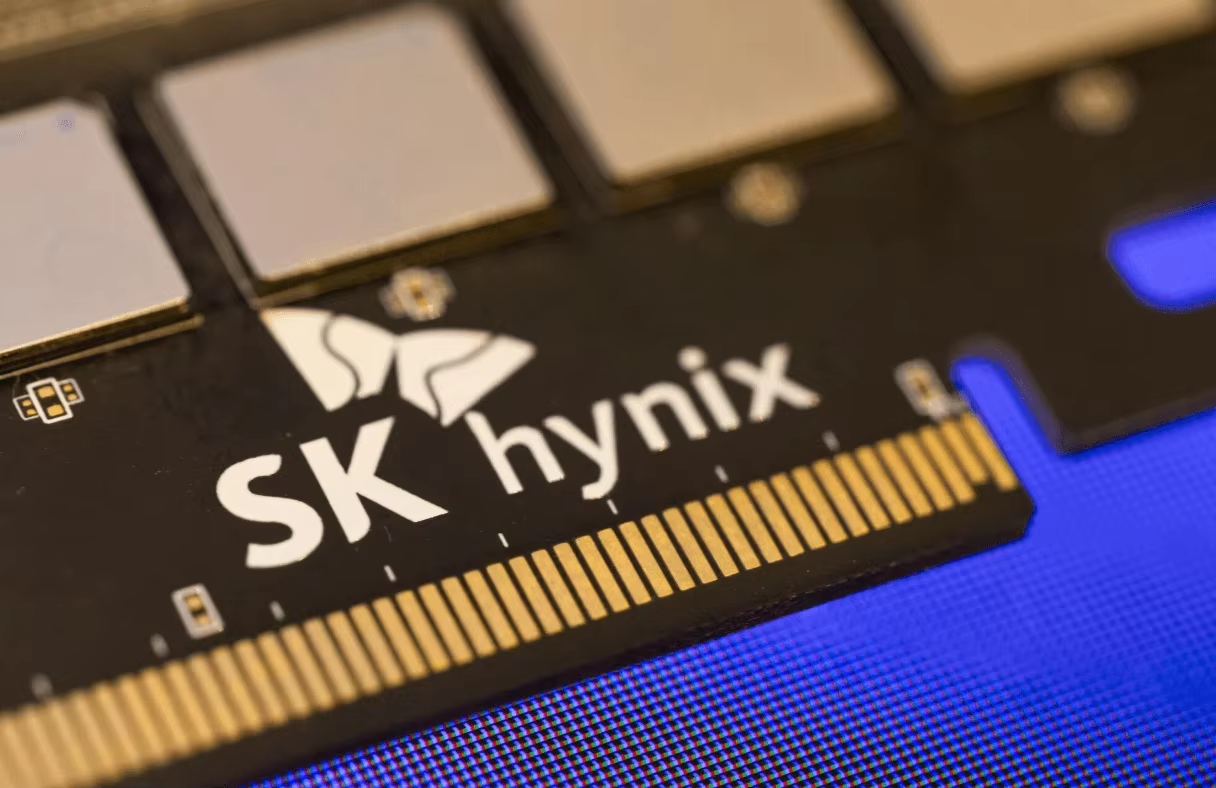
The memory supply component is what directly affects SK Hynix stock's investment case. SK Hynix, which currently controls roughly 60 percent of the global HBM market, will enter a long-term supply arrangement with Nvidia and co-develop next generation high bandwidth memory covering applications from large language model training to physical AI.
The co-development dimension is as significant as the supply agreement itself. A supplier that co-develops the next generation of memory with its largest customer is not a commodity vendor that can be replaced when a cheaper alternative emerges. It is a technology partner whose roadmap is intertwined with the customer's hardware platform in ways that create switching costs on both sides of the relationship.
Why the 2027 Timeline Is What Investors Should Actually Watch
Investors will watch for firm orders, as the first major facility is not expected until 2027. This observation from TipRanks is the most analytically precise available assessment of what the $500 billion headline requires to become financial reality for SK Hynix stock.
Letters of intent are not purchase orders. They are commitments to pursue a defined course of action subject to the specific terms being negotiated and the conditions that both parties determine must be met before binding commitments are made. The $500 billion figure represents the total potential value of the partnership over a multi-year period rather than contracted revenue that SK Hynix can begin recognizing in its next quarterly report.
The 2027 first facility online timeline is the specific date around which the letters of intent begin converting to financial reality. Before 2027, the deal's contribution to SK Hynix stock's financial statements consists primarily of the HBM4 co-development work that generates engineering collaboration rather than large scale production revenue. After 2027, the 2 gigawatt facility begins consuming the HBM4 production that the supply agreement commits SK Hynix to provide.
For investors evaluating SK Hynix stock before the July 29 earnings report, the 2027 timeline matters in a specific way. The Q2 results that arrive in five days will not yet reflect the $500 billion partnership in recognized revenue because the facilities that generate that revenue are not yet built. What Q2 may reflect is the HBM co-development work and any advance production commitments associated with securing supply for the 2027 facility timeline. Management commentary on the partnership's near-term financial impact rather than its total potential value is the more useful disclosure for the quarterly earnings context.
What a 2-Gigawatt AI Factory Actually Means
Two gigawatts of compute capacity exceeds what most national power grids allocate to any single industrial tenant. The scale of the SK Telecom facility deserves specific treatment because it changes the context for evaluating how much HBM SK Hynix needs to supply for this single customer commitment.
Most hyperscale data centers that have defined the AI infrastructure buildout operate in the hundreds of megawatts range. A 2 gigawatt facility is ten times larger than a large conventional data center and represents a category of AI infrastructure commitment that has very few precedents globally. The power requirement alone makes this facility a national infrastructure project rather than a corporate investment decision, which is why the deal was announced at an AI summit attended by South Korean President Lee Jae Myung rather than through a standard corporate press release.
The centerpiece of the expanded infrastructure deal is SK Telecom, which will construct a massive 2 gigawatt AI cloud facility in South Korea, built on Nvidia's full stack DSX AI factory architecture, deploying Nvidia's next-generation Vera Rubin platforms running on SK Hynix's HBM4 memory modules.
The HBM4 requirement for a 2 gigawatt Vera Rubin facility is the financial connection to SK Hynix stock that the headline $500 billion does not directly specify. Each Vera Rubin accelerator requires HBM4 memory to function, and a 2 gigawatt facility operating hundreds of thousands of GPUs creates sustained HBM demand that extends beyond the initial build out into the ongoing supply relationship required to maintain and expand the facility over its operational life.
-- Price
The Supply Security Argument That Benefits Both Sides
Raj Mirpuri, Nvidia enterprise vice president, said the expansion will include a co-develop opportunity on the next generation SK Hynix AI memory, and this will help Nvidia secure a stable supply of HBM memory.
Nvidia's articulation of supply security as a primary deal motivation is the specific signal that tells investors most about why this partnership matters beyond the financial scale. Nvidia is not primarily buying HBM. It is buying supply certainty in a market where supply uncertainty has been one of the primary constraints on AI accelerator delivery throughout the current boom.
HBM supply has been constrained not because SK Hynix, Micron, and Samsung lack the will to produce more but because the manufacturing complexity of HBM, particularly the packaging step that integrates memory dies with GPU dies, has limited how quickly production capacity can be expanded. High-bandwidth memory has been a key supply constraint for advanced AI systems, and a long-term partnership with SK Hynix could help Nvidia secure enough HBM4 capacity as Vera Rubin production expands.
For SK Hynix stock investors, Nvidia's supply security motivation creates a specific and durable competitive advantage. A customer that is motivated primarily by supply certainty rather than by price is a customer whose relationship cannot be disrupted by a competitor offering lower prices. If Samsung or Micron offered Nvidia HBM4 at a lower price per unit, Nvidia's response would be to consider allocating some volume to those suppliers while maintaining the SK Hynix relationship rather than switching entirely. The supply security motivation creates a floor under the SK Hynix-Nvidia relationship that price competition alone cannot undermine.
What the Deal Means for July 29 Earnings
The timing of the Nvidia partnership announcement five days before SK Hynix's Q2 earnings creates a specific context for interpreting whatever management says about the partnership on the July 29 call.
Management's characterization of the partnership's near-term versus long-term financial contribution is the most important earnings call disclosure related to the Nvidia deal. If management indicates that HBM4 co-development work has already begun generating engineering revenue and that advance production commitments have been made ahead of the 2027 facility timeline, the deal's financial contribution to fiscal 2026 and early fiscal 2027 is larger than the letters of intent structure would suggest.
If management indicates that the financial impact is primarily a 2027 event tied to the facility coming online, the deal confirms the long-term thesis without changing the near-term financial trajectory that Q2's $56.79 billion revenue estimate and $4.87 EPS estimate already reflect.
The Q2 earnings call is also where management will address whether the Nvidia partnership affects the memory shortage assessment that has been one of the most discussed aspects of SK Hynix's public communications. SK Hynix's CEO has previously stated that the memory shortage may last past 2030. The Nvidia partnership, which commits to new HBM4 production capacity through 2027 and beyond, is consistent with that shortage assessment and gives management a specific contracted customer to point to when supporting the shortage duration claim.
The Samsung $200 Billion Broadcom Deal
In a separate deal, Samsung signed a $200 billion memorandum of understanding with Broadcom covering memory and foundry technologies.
The simultaneous announcement of Samsung's Broadcom deal alongside the SK Hynix Nvidia deal at the same San Francisco AI summit is the broader market context that gives both deals meaning beyond their individual terms. Two of the world's most important AI chip designers have simultaneously locked in long-term supply relationships with South Korea's two dominant memory manufacturers, which tells investors something specific about where the AI infrastructure industry believes its supply constraints lie.
The $500 billion SK Hynix Nvidia deal and the $200 billion Samsung Broadcom deal arriving simultaneously signal that supply constraint, not demand constraint, is the binding factor in AI infrastructure scaling. Companies that are willing to commit hundreds of billions of dollars to long-term supply agreements are expressing the view that without those commitments, supply will be insufficient to meet the demand they can see in their own customer pipelines.
For SK Hynix stock investors, the Samsung Broadcom deal is context rather than competition. Broadcom's AI chip designs are in a different market segment from Nvidia's accelerator platform. The two deals are not substitutes but complements in a market where the total addressable demand for advanced memory exceeds what either SK Hynix or Samsung can supply independently.
What Changes and What Does Not Change for SK Hynix Stock
The Nvidia partnership changes specific things about SK Hynix stock's investment case while leaving others intact, and the distinction matters for evaluating the stock before July 29 earnings.
What changes is the demand visibility timeline. Before the Nvidia deal, SK Hynix's HBM demand case rested on the current shortage, management commentary about its duration, and the general trajectory of AI infrastructure spending. After the Nvidia deal, the demand case has a specific and named customer committed to a specific and named facility that requires SK Hynix HBM4 on a specific timeline extending through 2027 and beyond.
What does not change is the 51% premium that SKHY trades at over the Korean-listed shares, which remains the most specific near-term risk to SKHY's performance relative to the underlying business. The Nvidia deal validates the business. It does not change the ADR premium mechanics that determine how SKHY performs relative to the Korean shares regardless of how the underlying business performs.
What also does not change is the July 29 earnings binary that the market has been anticipating. The Nvidia deal is positive context for the earnings call rather than a substitute for the financial results that will determine whether the current SKHY price is fairly valued or requires further adjustment.
For those looking to participate in global financial markets, having access to the right trading platform matters. WEEX offers crypto and stock trading products, covering major global markets including US stocks and digital assets.
Conclusion
SK Hynix stock's Nvidia partnership is the most consequential single development in the company's brief public history because it converts the HBM demand narrative from an industry trend into a named customer commitment on a specific timeline. The letters of intent structure means the financial impact is primarily a 2027 event rather than a near-term earnings driver, but the co-development relationship that the partnership establishes creates a competitive position that quarterly earnings cannot capture.
The 2027 timeline that TipRanks flagged as the critical watch point is the appropriate frame for evaluating the deal's financial significance. Before 2027, the partnership contributes to SK Hynix stock's investment case through demand visibility and competitive moat rather than through recognized revenue. After 2027, the 2-gigawatt facility's HBM4 consumption begins converting the letters of intent into the financial reality that the $500 billion headline implies.
July 29 earnings will reveal how management characterizes the partnership's near-term financial contribution and whether the advance production commitments associated with the 2027 timeline have already begun affecting the revenue trajectory. That characterization will determine whether the Nvidia deal accelerates or simply validates the investment case that SK Hynix stock has been building since its Nasdaq listing.
FAQ
1. What is the Nvidia SK Group $500 billion deal and what does it mean for SK Hynix stock?
Nvidia and SK Group signed letters of intent for a partnership worth more than $500 billion covering AI data center construction and long-term HBM memory supply. SK Hynix will co-develop HBM4 with Nvidia and supply memory for a 2 gigawatt AI factory that SK Telecom is building using Nvidia's Vera Rubin platform, expected online in 2027. For SK Hynix stock, the deal converts the HBM demand narrative from an industry trend into a named customer commitment on a specific timeline.
2. Why does the 2027 timeline matter most for SK Hynix stock investors?
The partnership was formalized through letters of intent rather than purchase orders, meaning the $500 billion in total potential value converts to financial reality primarily when the 2027 facility comes online and begins consuming the HBM4 production the supply agreement commits SK Hynix to provide. Before 2027, the deal contributes demand visibility and competitive moat rather than large scale recognized revenue.
3. What is HBM4 and why does the co-development aspect matter?
HBM4 is the next generation of high bandwidth memory that AI training workloads will depend on as Nvidia's Vera Rubin platform succeeds the current Blackwell generation. The co-development relationship means SK Hynix and Nvidia are aligning their memory and accelerator roadmaps rather than operating as independent supplier and customer. A co-development partner cannot be replaced by a cheaper alternative because the intertwined roadmaps create switching costs on both sides of the relationship.
4. What does the 2 gigawatt AI factory scale mean for HBM demand?
Two gigawatts of compute capacity exceeds what most national power grids allocate to any single industrial tenant. A facility of this scale operating hundreds of thousands of Vera Rubin GPUs creates sustained HBM demand extending beyond the initial build out into the ongoing supply required to maintain and expand the facility over its operational life. The HBM4 requirement for a 2-gigawatt Vera Rubin facility is the financial connection to SK Hynix stock that the $500 billion headline does not directly specify.
5. How does the deal affect SK Hynix stock's July 29 earnings?
The Q2 earnings arriving July 29 will not yet reflect the $500 billion partnership in recognized revenue because the facilities are not yet built. The most important earnings call disclosure related to the deal is management's characterization of whether HBM4 co-development work has already begun generating engineering revenue and whether advance production commitments have been made ahead of the 2027 facility timeline. That characterization determines whether the deal's financial contribution to fiscal 2026 is larger than the letters of intent structure would suggest.
This content is provided for general informational purposes only and doesn't constitute financial, investment, legal, or tax advice. Any events, rewards, online promotions, or related information mentioned herein should not be considered a recommendation, solicitation, or invitation to purchase, sell, trade, or otherwise deal in any crypto assets. Crypto assets are highly volatile and may result in loss. The availability of WEEX services, products, and related events may vary by region. You are responsible for ensuring that your participation is in accordance with applicable local laws and regulations.
You may also like

RST vs RAINI: Which Raini Studios Token Is Still Supported?
Intel Stock Is Up Over 170% in 2026: What the AI Foundry Turnaround Actually Required

RKLB Stock Price Targets Range From $64 to $150: What the Analyst Disagreement Actually Reveals
MU Stock and the Apple CXMT Test: What Replacing Micron With Chinese Memory Actually Means
Is Nvidia Stock Price a Buy Before August 26 Earnings? What the SpaceX Deal and 46% Upside Imply
Samsung Stock and the 99.7% Problem: When One Business Unit Drives Everything

Samsung and SK Hynix Are Half the KOSPI: Why That Concentration Is Now the Market's Biggest Problem

AEON Crypto Explained: AI Agent Payments, OKX Listing and Price Outlook
PONS vs CASHCAT: Price Prediction and Robinhood Chain Growth Analysis
New SK Hynix 2X ETFs Launch: Who Should Use Them and Who Should Not
Intel Stock Price Prediction 2026-2027: Can INTC Reach $150 After the Foundry Turnaround?
Intel Stock Forecast: Can AI and 18A Foundry Drive INTC Growth?

How to Set a Stop-Loss Order on WEEX: Full Guide 2026
Is Gold Still a Good Investment in 2026? Everything You Need to Know
What is PULSE WORLD (XPL) Coin? A 2025 Guide for Crypto Investors
WEEX Security Alert – SMS Spoofing
How Can I Safely Buy Cryptocurrency on WEEX?
6 Steps to Create Your WEEX Exchange Account
RST vs RAINI: Which Raini Studios Token Is Still Supported?
Intel Stock Is Up Over 170% in 2026: What the AI Foundry Turnaround Actually Required
RKLB Stock Price Targets Range From $64 to $150: What the Analyst Disagreement Actually Reveals
MU Stock and the Apple CXMT Test: What Replacing Micron With Chinese Memory Actually Means
Is Nvidia Stock Price a Buy Before August 26 Earnings? What the SpaceX Deal and 46% Upside Imply
Samsung Stock and the 99.7% Problem: When One Business Unit Drives Everything


