
SK Hynix Stock Before July 29 Earnings: What Investors Should Watch

 Prefer us on Google


SK Hynix stock heading into July 29 earnings carries more positive context than at any previous earnings event in the company's brief public history, and the specific analytical challenge that creates is separating what is already priced from what could genuinely surprise. SK Hynix stock has recovered from its $145.57 post-IPO low to trade near $172, meaning the combination of the Barclays Overweight initiation, the Nvidia $500 billion partnership announcement, and the broader memory sector recovery from KOSPI bear market lows has already restored a meaningful portion of the enthusiasm that the IPO attracted.
SK Hynix stock heading into July 29 is not asking investors whether the HBM thesis is valid. The Nvidia deal answered that. It is asking whether the financial results confirm that the thesis is converting to revenue at the pace the current price requires.
Why This Earnings Report Is Different From Any Previous SK Hynix Report
Every previous SK Hynix earnings report was evaluated primarily by Korean institutional investors and the small number of international funds that maintained direct Korean market access. July 29 is the first earnings report since the Nasdaq listing that will be scrutinized by the full population of global investors who bought SKHY during the IPO and who are now evaluating their position for the first time against audited financial results rather than pre-IPO prospectus projections.
That expanded investor base changes the context for interpreting the results in specific ways. Korean institutional investors who have followed SK Hynix through multiple memory cycles have a framework for interpreting HBM revenue trajectories, DRAM pricing dynamics, and NAND market conditions that includes historical context from years of following the company. Global investors who bought SKHY at $149 or above based on the HBM market leadership narrative may be evaluating their first quarterly report from a memory company without that historical framework.
The difference matters for the stock price reaction because it affects how much positive or negative surprise is required to produce meaningful price movement. A quarterly result that Korean institutional investors interpret as broadly in line with expectations may produce a larger reaction from global investors who are applying different reference points to the same numbers.
The Revenue Figure That Sets the Context
The consensus revenue estimate of approximately $56.79 billion for Q2 is the most important single number to understand before the July 29 report arrives, because it establishes what the market has already priced rather than what SK Hynix is likely to report.
Sequential growth from Q1's $35.55 billion to the Q2 estimate implies roughly 60% quarter-over-quarter growth, which is an extraordinary rate of sequential acceleration for a company of SK Hynix's scale. The magnitude of that implied sequential growth reflects two simultaneous forces. HBM revenue continuing to expand as Nvidia's Blackwell production ramp demands more HBM3E than Q1 capacity could deliver, and conventional DRAM pricing recovering alongside the broader memory market improvement that the industry has been experiencing.
A Q2 revenue figure that meets or modestly exceeds the consensus establishes that the sequential acceleration is real rather than a prospectus projection. A significant beat above consensus produces analyst estimate revisions for Q3 and Q4 that are more important for the forward stock price than the Q2 beat itself. A miss below consensus is the scenario that no current SKHY analysis has adequately incorporated into positioning, because the post-IPO narrative has been almost uniformly positive about the revenue trajectory.
HBM Revenue Mix That Actually Matters More Than Total Revenue
One specific disclosure that matters more for SK Hynix stock's forward valuation than the total Q2 revenue figure is the HBM revenue composition within the broader DRAM segment.
HBM revenue carries substantially higher margins than conventional DRAM revenue, which means the same total revenue figure can produce very different gross margins depending on how much of the revenue came from HBM versus conventional DRAM. A Q2 result where total revenue meets consensus but HBM mix is lower than expected produces a gross margin miss that is more negative for the stock than a simple revenue miss because it indicates the highest-margin segment is converting at a slower pace than the total revenue number implies.
The specific HBM disclosure investors should watch on July 29 is the percentage of DRAM revenue derived from HBM and whether management provides any color on HBM4 qualification progress with Nvidia customers. The Nvidia $500 billion partnership announced last week was specifically tied to HBM4 co-development for the Vera Rubin platform expected in 2027. Any disclosure on HBM4 timeline, yield rates, or customer qualification status on July 29 provides the earliest available financial statement context for evaluating whether the 2027 Nvidia facility timeline is tracking toward delivery.
-- Price
The Nvidia Partnership Disclosure That July 29 Needs to Address
The $500 billion Nvidia SK Group partnership announced on July 25 creates a specific and previously absent disclosure obligation for SK Hynix on the July 29 earnings call.
Management will face analyst questions about the financial structure of the partnership that the letters of intent announcement did not specify. The most important questions center on whether any advance production commitments associated with HBM4 development have already generated revenue in Q2, whether the co-development timeline implies upfront engineering costs that affected Q2 operating expenses, and whether the partnership changes the guidance trajectory for fiscal 2026 and 2027 in ways that analyst models built before the announcement could not incorporate.
Any quantification of the Nvidia partnership's near-term financial contribution is the most valuable new information July 29 can provide because it converts the $500 billion headline into a specific revenue recognition schedule that analysts can model rather than a total potential value figure that requires multiple assumptions to translate into earnings estimates.
Management may choose to provide limited quantification of the Nvidia partnership's near-term financial impact on the grounds that the letters of intent have not yet been converted to binding purchase orders. That caution would be legally and commercially appropriate. The market is likely to interpret limited quantification as a near-term financial contribution that is smaller than the headline suggests rather than as a standard disclosure limitation, which creates a specific communication challenge for management on the July 29 call.
Q3 Guidance That Matters More Than Q2 Results
For SK Hynix stock at current levels, the Q3 guidance management provides on July 29 is more consequential for the stock price reaction than the Q2 results themselves, because the current price reflects forward expectations rather than historical performance.
Q3 guidance that implies continued sequential growth from Q2's already extraordinary level confirms that the HBM supercycle the CEO has described as potentially lasting past 2030 is visible in contracted demand rather than only in management commentary. A Q3 guidance range that implies sequential growth would be particularly significant because it would mean SK Hynix is guiding for continued acceleration into the second half of 2026 at a time when most semiconductor companies are managing investor expectations around cyclical normalization.
Q3 guidance that implies sequential deceleration from Q2 levels, even if the Q2 results themselves beat consensus, is the specific scenario that would produce the most negative SK Hynix stock reaction on July 29. Deceleration guidance would suggest that the HBM demand that drove Q2's extraordinary sequential growth is not sustaining at the same pace, which would require analysts to revise their H2 2026 and 2027 estimates downward from the trajectory that the current $172 stock price reflects.
The 51% US Premium That Earnings Will Test
One dimension of SK Hynix stock's July 29 earnings that has no equivalent in most other earnings events is the specific question of whether the 51% premium that SKHY trades at over the Korean-listed shares can sustain through a result that the Korean market processes simultaneously.
SK Hynix will release Q2 results on July 29 during Korean market hours, which means Korean investors will react to the results before US markets open for the day. By the time SKHY begins trading in the US, the Korean shares will have already partially priced whatever reaction the results produce. If Q2 results are strongly positive, the Korean shares will open higher before the US session, narrowing the premium that US buyers have been paying simply by the Korean price rising faster than SKHY can move in pre-market trading. If Q2 results disappoint, the Korean shares will fall before the US open, putting immediate pressure on SKHY to gap down to the implied premium level.
The premium dynamics mean that SKHY's earnings reaction is partially determined by the Korean market's reaction before US investors can respond. An investor holding SKHY through July 29 is accepting not just the binary of a beat or miss but also the premium compression or expansion that the Korean market's reaction determines before the US session opens.
Three Scenarios and What Each Means
In a strong scenario, Q2 revenue significantly exceeds the consensus estimate driven by HBM mix above expectations, gross margin expands beyond analyst models as HBM's superior margin profile dominates the DRAM segment mix, Q3 guidance implies continued sequential growth, and management provides specific near-term financial contribution from the Nvidia HBM4 co-development work. SK Hynix stock recovers from current levels toward the $180 to $190 range as analysts revise H2 2026 estimates upward and as the Nvidia partnership's near-term contribution becomes visible in the guidance rather than remaining as a 2027 story.
In a moderate scenario, Q2 revenue meets or modestly beats consensus, gross margin tracks analyst estimates without a significant HBM mix surprise, Q3 guidance implies modest sequential growth rather than acceleration, and the Nvidia partnership disclosure provides qualitative context without specific revenue contribution quantification. SK Hynix stock holds near current levels or moves modestly in either direction as the results confirm the thesis without providing the acceleration signal that drives analyst estimate revisions above current projections.
In a cautious scenario, Q2 revenue meets consensus but HBM mix disappoints, gross margins come in below expectations as conventional DRAM pricing softness affects blended margins more than the HBM strength can offset, Q3 guidance implies sequential deceleration from Q2 levels, and management's Nvidia partnership comments are limited to qualitative enthusiasm without financial specificity. SK Hynix stock tests support near the $155 to $160 range as the premium compression and guidance deceleration combine to pressure a stock that has recovered substantially from its post-IPO low.
What to Watch in the Hours Before the Report
The July 29 earnings release timing during Korean market hours means that investors monitoring SK Hynix stock's pre-earnings setup should pay attention to the Korean market session that precedes the US open rather than waiting for the US pre-market to signal direction.
Any unusual movement in the Korean 000660.KS shares before the earnings release suggests that information is circulating in Korean institutional circles that US investors do not yet have access to. A Korean share rally before the release historically correlates with results that meet or exceed expectations. A Korean share decline before the release has the opposite historical pattern.
The leveraged ETF ecosystem including SKHA launching on July 28, the day before earnings, creates a specific dynamic in the options and derivatives market that can produce amplified pre-earnings volatility as traders position in SKHA or the existing SKHL for the earnings event. Higher than normal trading volume in the leveraged ETFs on July 28 signals elevated institutional positioning around the earnings binary rather than routine trading activity.
For those looking to participate in global financial markets, having access to the right trading platform matters. WEEX offers crypto and stock trading products, covering major global markets including US stocks and digital assets.
Conclusion
SK Hynix stock's July 29 earnings report is the most consequential single event in the company's public history because it is the first opportunity for the audited financial results to confirm or challenge the HBM market leadership narrative that drove the IPO, the Barclays Overweight initiation, the Nvidia $500 billion partnership, and the recovery from the $145.57 post-IPO low.
The five specific things to watch are the HBM revenue mix within the DRAM segment that determines whether the highest-margin product is converting at expected rates, the Nvidia partnership near-term financial contribution that converts the letters of intent into a revenue recognition schedule, the Q3 guidance that shows whether the sequential acceleration from Q1 to Q2 is continuing or moderating, the gross margin trajectory that reveals whether HBM's superior margin is dominating the blended rate, and the Korean market's pre-release reaction that provides early signal before US markets open.
What the report needs to show is not that the HBM thesis is valid. The Nvidia deal answered that before July 29. What it needs to show is that the thesis is converting to revenue at a pace that justifies the current price after the recovery from the post-IPO low.
FAQ
1. What is the most important metric to watch in SK Hynix's July 29 earnings?
HBM revenue mix within the DRAM segment is more important than total revenue because the margin difference between HBM and conventional DRAM means the same total revenue figure can produce very different gross margins depending on composition. Q3 guidance is the second most important disclosure because the current stock price reflects forward expectations rather than historical performance. The Nvidia partnership near-term financial contribution quantification is the third because it converts the $500 billion headline into a modelable revenue recognition schedule.
2. Why does the Korean market reaction matter for SKHY on July 29?
SK Hynix releases Q2 results during Korean market hours before the US session opens. Korean investors react to the results while SKHY is not yet trading, meaning the Korean shares will have partially priced the earnings reaction before US investors can respond. This produces gap movements at the SKHY US open that reflect the Korean market's assessment rather than being determined by US pre-market trading alone.
3. What does the Nvidia $500 billion partnership mean for July 29 earnings?
The partnership announced on July 25 creates a specific disclosure obligation for management on the July 29 call. The most important questions are whether HBM4 co-development work has already generated Q2 revenue, whether the partnership changes H2 2026 and 2027 guidance, and whether management can provide a specific revenue recognition schedule rather than total potential value. Limited quantification is likely to be interpreted negatively regardless of the legal and commercial reasons for the limitation.
4. What would cause SK Hynix stock to fall on July 29 despite the positive recent developments?
Q3 guidance implying sequential deceleration from Q2's extraordinary growth rate is the specific scenario most likely to produce a negative stock reaction despite the results being broadly positive. Deceleration guidance suggests the HBM demand that drove Q2 is not sustaining at the same pace, which requires analyst estimates for H2 2026 and 2027 to be revised downward from the trajectory the current stock price reflects. A gross margin miss driven by HBM mix disappointment would compound a guidance deceleration into a more significant negative reaction.
5. How does the SKHA leveraged ETF launching July 28 affect the earnings setup?
SKHA launching the day before earnings creates elevated trading activity in leveraged products on July 28 as traders position for the earnings binary. Higher than normal SKHA and SKHL trading volume on July 28 signals institutional positioning around July 29 rather than routine activity. Investors holding SKHA through the July 29 overnight earnings release face specific gap risk because the Korean market's reaction to the results will produce a SKHY opening gap that SKHA amplifies by approximately 200% before US investors can exit.
This content is provided for general informational purposes only and doesn't constitute financial, investment, legal, or tax advice. Any events, rewards, online promotions, or related information mentioned herein should not be considered a recommendation, solicitation, or invitation to purchase, sell, trade, or otherwise deal in any crypto assets. Crypto assets are highly volatile and may result in loss. The availability of WEEX services, products, and related events may vary by region. You are responsible for ensuring that your participation is in accordance with applicable local laws and regulations.
You may also like

Who Is Attending TOKEN2049 Singapore 2026? Top Speakers, Exchanges and Exhibitors to Watch
USDC on Arc: What Circle's Mainnet Launch Changes for Holders
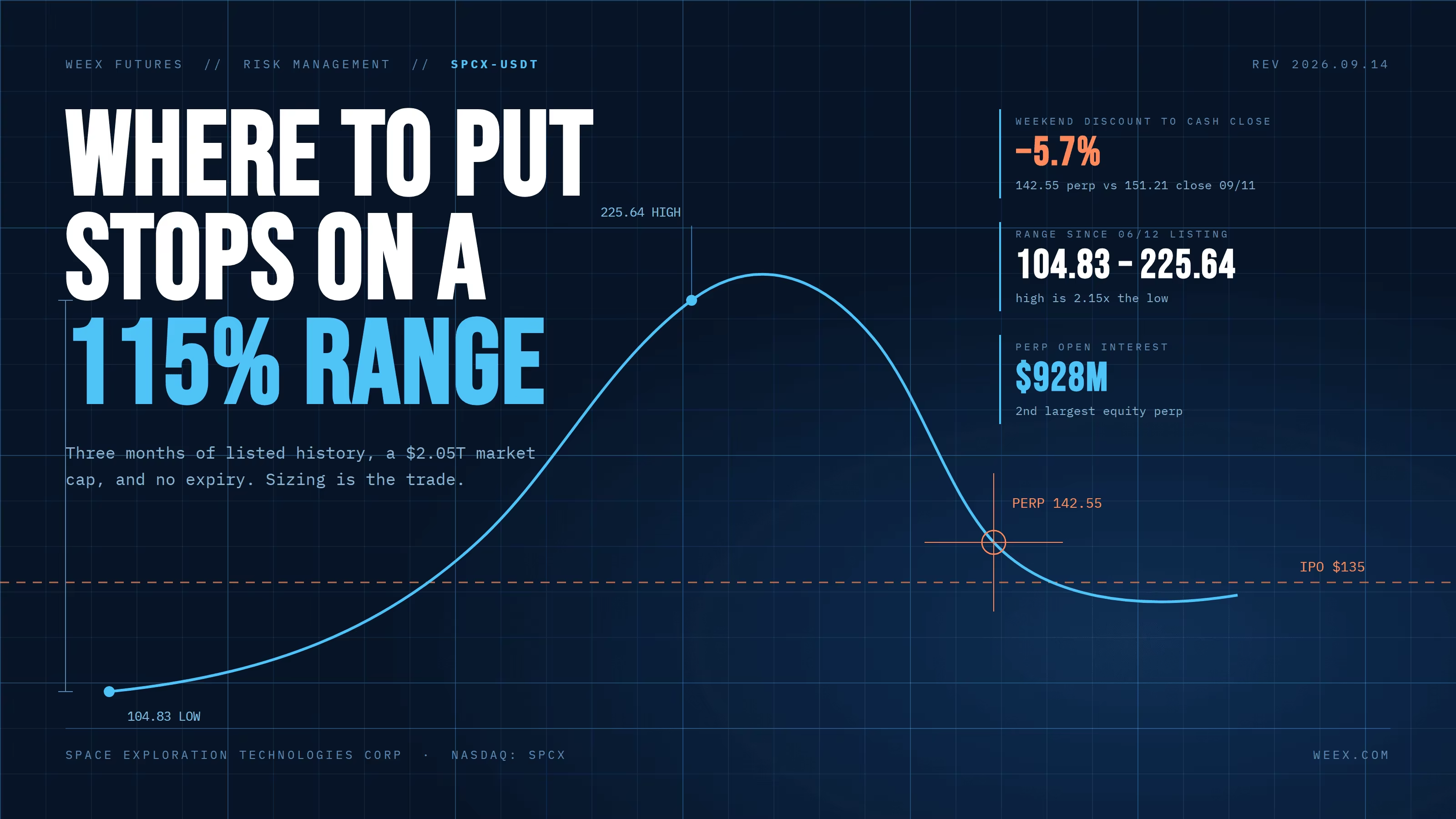
SpaceX Stock Futures: Where to Put Stops on a 115% Range
How to Trade Microsoft (MSFT) Stock Token with USDT on WEEX
How to Trade Apple (AAPL) Stock Token with USDT on WEEX
Crypto Futures Trading Explained: Leverage, Funding, Liquidation
Crypto Futures Trading: Leverage, Funding and Apple Perps
How to Trade Tesla (TSLA) Stock Token with USDT on WEEX: A Trading Guide for Beginers in 2026
How to Trade NVIDIA (NVDA) Stock Token with USDT on WEEX
How to Trade U.S. Stocks Without a Brokerage Account Using USDT

Nike Stock Price Prediction 2026: What the $50 Target Actually Requires to Happen

CLARITY Act Enters a Critical Window: What the September 15 Senate Vote Actually Means

What Are Spot Stock Tokens? How Synthetic Stock Trading Works

XST Coin Price Bounced 19% Off a New Low in Hours: Is This the Bottom or Just Noise?

What to Do After Buying USDT in Pakistan: Spot, Futures or Hold?

What Is the WEEX Mini App? A Lightweight Way to Trade Inside Telegram
XST Coin Price Crosses Into Deep Capitulation Territory: What a 90%+ Decline Actually Signals

CyberLeek Is Trending—but Why Are People Searching for CYBERLINK?
Nvidia After-Hours Stock Price: What Moved NVDA After the Earnings Report?

Crypto Futures Liquidation in Pakistan: How It Works and How to Manage Risk
Bank Account Freeze Risk for Crypto Traders in Pakistan 2026
Crypto Tax in Pakistan: What FBR Rules Mean for PKR Traders
Humanity Protocol Unlocked 266 Million H Tokens Today—Where Did They Go?
DGAI Has Trading Volume but No Reported Circulating Supply—So What Is Its Real Market Cap?
MORTY After Viral Meme Rally: Overvalued or Growth Story?
Best Futures Exchange in Pakistan for 2026? What Leverage, Liquidity, and Liquidation Risk Actually Require
XST Coin Liquidity Risk: What Low DEX Depth Actually Means for Buyers Who Want to Exit
MSTR Stock Surges 12% in a Single Session: What Strategy Inc's Bitcoin Treasury Model Actually Amplifies
Is SOXL a Good Investment? What 3x Leverage Actually Does to Your Returns in Both Directions
XST Coin and Stargate: What XSolut's AI Infrastructure Narrative Has to Do With the $500 Billion OpenAI Project
Who Is Attending TOKEN2049 Singapore 2026? Top Speakers, Exchanges and Exhibitors to Watch
USDC on Arc: What Circle's Mainnet Launch Changes for Holders
SpaceX Stock Futures: Where to Put Stops on a 115% Range
How to Trade Microsoft (MSFT) Stock Token with USDT on WEEX
How to Trade Apple (AAPL) Stock Token with USDT on WEEX
Crypto Futures Trading Explained: Leverage, Funding, Liquidation





