
SNDK Stock Price: Why SanDisk Trades at 43x Trailing and 7x Forward Earnings

 Prefer us on Google
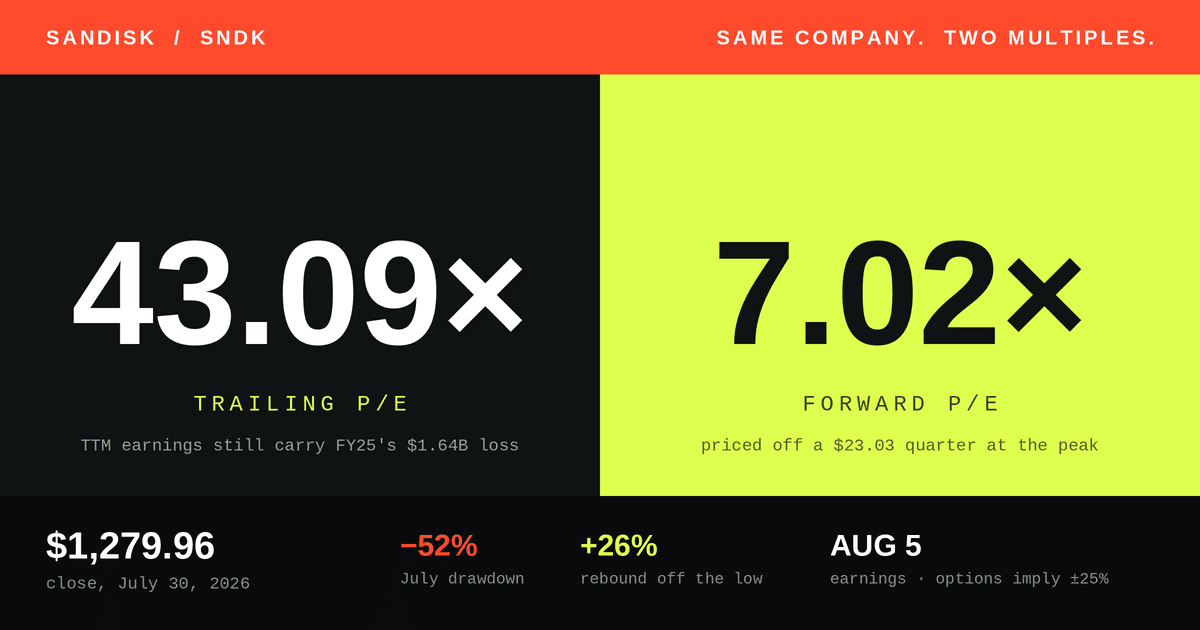
SanDisk closed at $1,279.96 on July 30, 2026, up 25.99% ($264.07) in a single session — its best day since January and the top gain in the S&P 500 that day. It traded up again after hours, at $1,354.03.
That number means very little on its own. The context is what matters: SNDK closed at $2,335 on June 25, hit an intraday high of $2,354.39, then lost 52% of its value in July, including three consecutive double-digit percentage down days. The 52-week range is $40.10 to $2,354.39. Very few large-cap names have printed a range like that.
The stock is a $189.55 billion company that trades like a small cap. Understanding the price requires understanding two things the quote pages don't show you: what actually broke in July, and why the trailing and forward earnings multiples are telling completely different stories.
SNDK stock price today and the key numbers
| Metric | Value | As of |
|---|---|---|
| Last close | $1,279.96 (+25.99%) | Jul 30, 2026 |
| After-hours | $1,354.03 (+5.79%) | Jul 30, 2026, 7:59 PM EDT |
| Previous close | $1,015.89 | Jul 29, 2026 |
| 52-week range | $40.10 – $2,354.39 | Jul 30, 2026 |
| Market cap | $189.55B | Jul 30, 2026 |
| Shares outstanding | 148.09M | Jul 30, 2026 |
| Revenue (TTM) | $13.18B (+82.8%) | Jul 30, 2026 |
| EPS (TTM) | $29.71 | Jul 30, 2026 |
| Trailing P/E | 43.09 | Jul 30, 2026 |
| Forward P/E | 7.02 | Jul 30, 2026 |
| Analyst consensus | Buy (23 analysts), $2,217.77 target | Jul 30, 2026 |
| Next earnings | Aug 5, 2026, 1:30 PM PT | Confirmed Jul 8, 2026 |
Source: StockAnalysis.com / S&P Global Market Intelligence, checked July 31, 2026.
Why did SanDisk stock crash in July 2026?
The July drawdown was not one event. It was four, stacked inside two weeks.
| Date | Move | Trigger |
|---|---|---|
| Jul 27 | ~-11% | CXMT, China's memory-chip maker, surged 466% on its Shanghai debut, becoming the most valuable mainland-listed company. Reports of a Chinese manufacturing breakthrough followed. |
| Jul 28 | -14% | SK Hynix guided 2026 capex up 50% to at least $31 billion — read by the market as supply about to flood in. Third straight double-digit loss. |
| Jul 29 | -7% | Broad memory selloff continued; Roundhill Memory ETF (DRAM) fell to its lowest since May 7, down over 43% from its 2026 peak. |
| Jul 30 | +25.99% | Microsoft's earnings showed heavy but disciplined AI spending. Memory names snapped back hard. |
Two structural forces amplified every one of these moves. First, the Philadelphia Semiconductor Index fell 19% in July, on pace for its worst month since 2008 — SNDK was not being sold on its own merits. Second, the stock had gained roughly 439% year-to-date before the drop, which makes profit-taking self-reinforcing: momentum funds and a heavy WallStreetBets following both exit through the same door.
Worth noting what did not happen. Through the entire 52% decline, not a single analyst cut a price target. Several raised. On July 5, Goldman Sachs' James Schneider took his target from $1,200 to $2,200 on continued NAND supply tightness. That divergence — price collapsing while estimates rise — is the whole argument in miniature.
The one number that explains the SNDK stock price: 43 versus 7
SanDisk trades at 43.09x trailing earnings and 7.02x forward earnings. That is a roughly six-fold compression, and it is not an accounting quirk.
Here is what produces it. SanDisk's fiscal 2025 revenue was $7.36 billion with a net loss of $1.64 billion. Fiscal Q3 2026 revenue came in at $5.95 billion — up 97% sequentially — with GAAP net income of $3.615 billion and diluted EPS of $23.03. A company that lost money last year is now earning $23 a quarter. Trailing twelve-month EPS of $29.71 still carries the losing quarters in it; the forward number does not.
So the forward multiple of 7 is not the market saying SNDK is cheap. It is the market saying: we believe next year's earnings, and we do not believe the year after.
| Scenario | FY27 EPS assumption | Implied fair value at multiple | Notes |
|---|---|---|---|
| Cycle peak now | ~$180 (annualized current run-rate) | $1,260 at 7x | Roughly where the stock closed Jul 30 |
| Sustained tightness | ~$180 | $2,160 at 12x | Approximately the analyst consensus target |
| Cycle rolls in FY28 | ~$60 post-normalization | $1,080 at 18x | A "normal" multiple on normalized earnings |
Illustrative scenarios built from reported figures, not forecasts. NAND is a cyclical commodity business; historical peak-to-trough earnings swings have been severe.
The bear case does not require SanDisk to miss. It only requires the market to decide that FY27 is the peak. That is precisely what CXMT's IPO and SK Hynix's capex hike put on the table.
-- Price
What the $2,217 price target actually assumes
Twenty-three analysts rate SNDK a Buy with an average 12-month target of $2,217.77, implying about 73% upside from the July 30 close. Third-party model outputs are wilder still — automated end-of-2026 projections found across forecasting sites span roughly $1,240 to $7,900, a spread so wide it tells you the models share no common anchor and should not be treated as information.
The analyst target is more defensible, but it rests on one assumption: NAND pricing stays tight through calendar 2027. Every element of the July selloff attacked exactly that assumption. If CXMT can produce competitive NAND at scale, and if SK Hynix's $31 billion actually lands in capacity, tightness ends. The targets have not yet been marked to that possibility.
What matters most: the argument over SNDK is not about the company's execution. It is about how long a commodity shortage lasts. Anyone framing this as a quality-of-business question is answering the wrong one.
August 5 earnings: what is priced in
SanDisk reports fiscal Q4 and full-year 2026 results on August 5, 2026, followed by an Investor Day on August 13.
Company guidance is revenue of $7.75–8.25 billion and adjusted EPS of $30–33. Consensus sits at $34.67 adjusted EPS, against $0.29 in the year-ago quarter. Consensus above the top of guidance is a meaningful setup — it means an in-line print reads as a miss.
Options markets are pricing an approximately 25% move on the result. On a $1,280 stock, that is roughly $320 in either direction in a single session.
Three things decide it, in order of importance:
- Forward NAND pricing commentary. Not the quarter. The quarter is effectively known. Whether management signals continued contract price increases into calendar 2027 is the entire trade.
- Capacity and capex plans. If SanDisk answers SK Hynix's expansion with its own, it confirms the supply-glut thesis the market feared on July 28.
- Any framing of China competition. Management's first public read on CXMT will be scrutinized.
How to trade SNDK price moves without a brokerage account
There is a practical problem for non-US traders here. SNDK is a Nasdaq-listed equity, and access requires a broker that serves your jurisdiction, full KYC, bank funding rails that clear cross-border, and — critically — you can only trade it during US market hours.
That last constraint is not academic in a week like the one just described. On July 30, SNDK closed at $1,279.96 and traded to $1,354.03 after hours. Equity holders without extended-hours access could watch that 5.79% move and do nothing about it.
The alternative is price exposure rather than ownership. The WEEX SNDK-USDT perpetual contract settles in USDT, trades continuously, supports both directions, and offers up to 100× leverage. What it does not give you is a share: no dividends, no voting rights, no corporate-action eligibility.
| Route | Ownership | Hours | Funding | Main risk |
|---|---|---|---|---|
| Brokerage shares | Yes | US market hours | Bank transfer, FX | Onboarding barriers; gap risk you can't act on |
| USDT perpetual | No | 24/7 | Stablecoin | Funding rates; liquidation under leverage |
| Tokenized SNDK (on-chain) | No | 24/7 | Crypto | Oracle tracking; very thin venue liquidity |
What traders usually miss on this one: the 24/7 access that makes perpetuals attractive around an earnings event is the same feature that makes them dangerous around one. A 25% overnight gap against a 10× position is a full liquidation before you can react, and it happens while you are asleep — there is no closing bell to stop it. If you are holding leveraged SNDK exposure through August 5, size it against the implied 25% move, not against your conviction.
The liquidity gap is also real. As of June 15, 2026, a tokenized SNDK listing on CoinMarketCap showed 24-hour volume of $21.28 — that is dollars, not thousands. Thin books widen spreads and turn stop orders into slippage events. Depth on perpetual contracts and depth on tokenized spot are not the same thing, and the distinction matters most exactly when volatility spikes. For the full comparison of access routes, see WEEX's guide on where and how to buy SNDK stock, and the background on how tokenized US stocks work if the on-chain route is the one you are considering.
Is SNDK stock a buy at current levels?
That question has no answer that applies to everyone, but it can be reduced to a single decision.
If NAND stays tight through 2027, a forward P/E of 7 on a company growing revenue 82.8% year-over-year is genuinely cheap, and the $2,217 consensus target is reasonable. If the cycle peaks in the next four quarters, then trailing earnings are the peak earnings, and the stock is expensive on any normalized basis — no matter how low the forward multiple looks.
Nothing in the July price action resolved that question. The 52% drawdown and the 26% rebound were both liquidity and positioning events, not new information about NAND supply through 2027. The first real information arrives August 5.
One structural note for anyone sizing a position: with 148 million shares outstanding and a retail-heavy holder base, SNDK has less float absorbing flow than its $189 billion market cap suggests. That is why 11% days happen on news that moves peers 4%. Whatever position size feels right based on the market cap, the realized volatility argues for smaller.
FAQ
1. What is the SNDK stock price right now?
SanDisk closed at $1,279.96 on July 30, 2026, up 25.99% on the day, and traded at $1,354.03 in after-hours. Prices move continuously — check a live quote before acting on any figure in this article.
2. Why is SNDK stock so volatile?
Three reasons compound. SanDisk sells NAND flash, a commodity whose pricing swings violently between shortage and glut. The stock became a primary vehicle for the AI-storage trade and rose roughly 439% in 2026 before July. And with only 148.09 million shares outstanding and heavy retail concentration, order flow moves price disproportionately.
3. What is SanDisk's price target?
Twenty-three analysts averaged $2,217.77 over 12 months as of July 30, 2026, with a Buy consensus — about 73% above the last close. Goldman Sachs raised its target to $2,200 on July 5. Notably, no analyst lowered a target during the 52% July decline.
4. When does SanDisk report earnings?
Fiscal Q4 and full-year 2026 results are due August 5, 2026, at 1:30 PM Pacific, with an Investor Day on August 13. Guidance is $7.75–8.25 billion revenue and $30–33 adjusted EPS; consensus is $34.67.
5. Why is the forward P/E so much lower than the trailing P/E?
Trailing EPS of $29.71 still includes loss-making quarters from fiscal 2025, when SanDisk lost $1.64 billion. Fiscal Q3 2026 alone produced $23.03 in diluted EPS. The forward multiple of 7.02 reflects expected earnings at the current run rate — and implicitly signals the market's doubt that those earnings persist.
6. Can I trade SNDK without a US brokerage account?
Yes, through price-exposure instruments rather than share ownership. USDT-settled perpetual contracts such as WEEX's SNDK-USDT trade 24/7 and allow long or short positions, but confer no shareholder rights and carry funding-rate and liquidation risk. Regional availability varies.
7. Is SanDisk the same company as Western Digital?
No, not anymore. SanDisk operates as a separate Nasdaq-listed entity focused on NAND flash storage — SSDs, embedded products, and removable media — headquartered in Milpitas, California with roughly 11,000 employees. Western Digital (WDC) trades separately.
Risk Warning
SNDK is a cyclical semiconductor equity that has moved more than 50% in a single month and more than 25% in a single session during July 2026. Options markets imply a further ~25% move around the August 5 earnings release.
If you access SNDK price exposure through crypto-settled instruments, the risks compound rather than substitute. Perpetual futures and tokenized equities are volatile and may result in partial or total loss of capital. Specific exposures include: liquidation risk, where a 25% adverse gap wipes out a leveraged position with no opportunity to add margin; funding-rate cost, which accrues against you when positioning is crowded on your side; tracking and oracle risk, where the contract price diverges from the underlying equity, particularly when US markets are closed; and liquidity risk — tokenized SNDK volume was $21.28 over 24 hours on June 15, 2026, thin enough that exit prices can differ materially from quoted prices.
Price-exposure products do not convey share ownership, dividends, or voting rights. Availability is subject to local law and eligibility. Nothing here is investment advice; verify all figures against live data before trading.
This content is provided for general informational purposes only and doesn't constitute financial, investment, legal, or tax advice. Any events, rewards, online promotions, or related information mentioned herein should not be considered a recommendation, solicitation, or invitation to purchase, sell, trade, or otherwise deal in any crypto assets. Crypto assets are highly volatile and may result in loss. The availability of WEEX services, products, and related events may vary by region. You are responsible for ensuring that your participation is in accordance with applicable local laws and regulations.
You may also like
SMS 2FA vs Authenticator App: Which Is Actually Safer?

What Is 2FA? A Beginner's Guide

SNDK Stock Price Surges Past $1,700: What the Five-Day Winning Streak After Investor Day Actually Signals

OpenAI Stock Price: What Investors Who Want Exposure to ChatGPT Can Actually Buy Today
What Is OpenAI Stock? Why You Cannot Buy It Yet and What the IPO Timeline Actually Looks Like

XSolut, Stealth, or a Copycat? The XST Ticker Confusion Explained 2026
NVDA Stock Price Before August 26 Earnings: What Bank of America's $94-95 Billion Revenue Estimate Actually Requires
Nike Stock Price Prediction 2026-2027: Can NKE Recover After Hitting an 11 Year Low
How to Invest in XST Coin: What Due Diligence Actually Requires Before Buying XSolut

XST Coin on Coinbase: Why the Tokens You Find There Are Not the Real XSolut

XST Coin Has Fallen More Than 50% From Its All-Time High: What the Correction After the Peak Actually Means
SNDK Stock: Inside the 56% Crash and 76% Rebound of 2026
Dow Jones Today: The 5.31% Yield Matters More Than the Dip

Kioxia Stock Before the Oct 1 Split: The 24/7 Perp Problem
MRVL Stock Before August 27: The Number That Decides the Print
MU Stock Is Down 24% While Micron's Profits Hit Records
Why Is ZEC Price Up Today? Zcash Jumps 5% as Trading Volume Surges
Pakistan Stock Market Gains 23% in One Year: What Is Driving the PSX Rally?
PSX Today: KSE-100 Closes Above 180,500 as Trading Activity Surges

ZKsync (ZK) Price Today: How the Latest ZKsync Token Unlock Could Affect Trading Liquidity
ZKsync (ZK) Token Release Explained: Circulating Supply, Unlock Schedule and Market Impact
What Is Driving MANTA/USDT Volatility? Manta Network Tokenomics and Market Catalysts
MANTA Price Today: What Traders Are Watching Around the Latest Token Release
Ether.fi (ETHFI) Token Unlock on August 18, 2026: Release Size, Schedule and Market Impact
Is MU Stock Cheap at 20x Earnings Despite 346% Revenue Growth? What the Valuation Gap Actually Means
SPYB Price Holds Near Record After US Retail Sales Miss
New Street Upgrades MU Stock to Buy: What Reaching Multi-Trillion Market Cap Requires
BlackBerry Stock Up 125%: Why BB and BBX Are Not the Same
XST Coin Has $12,000 of Real Depth Behind a $31 Million Price
Netflix Stock Is Down 38%: What the Tape Is Pricing
SMS 2FA vs Authenticator App: Which Is Actually Safer?
What Is 2FA? A Beginner's Guide
SNDK Stock Price Surges Past $1,700: What the Five-Day Winning Streak After Investor Day Actually Signals
OpenAI Stock Price: What Investors Who Want Exposure to ChatGPT Can Actually Buy Today
What Is OpenAI Stock? Why You Cannot Buy It Yet and What the IPO Timeline Actually Looks Like
XSolut, Stealth, or a Copycat? The XST Ticker Confusion Explained 2026
Contents
Popular coins
Latest articles


