
WEEX Demo Trading: 50,000 USDT Practice Account, Rules and Limits

 Prefer us on Google


WEEX demo trading is a full futures simulator built into the exchange: you switch the futures interface into demo mode, receive 50,000 USDT of practice funds, and trade perpetual contracts quoted in SUSDT, a simulated stablecoin, against live market prices. When the balance falls below 5,000 USDT you can top up by 5,000 USDT once every 72 hours. No verification, deposit, or separate account is needed. This guide covers how to open the demo on web and app, the exact funding rules, which parts of the experience match live trading and which do not, the four drills worth running before you fund a real futures account, and the point at which the demo stops teaching you anything.
How to open WEEX demo trading on web and app
The demo is a mode of the normal futures terminal, not a separate site.
On web, open Futures and look for the futures menu in the upper left of the trading pair list. Switching it to demo loads the same terminal with SUSDT pairs, for example BTC/SUSDT or ETH/SUSDT, and a demo balance in place of your real one. On the app, go to Futures and choose Demo futures.
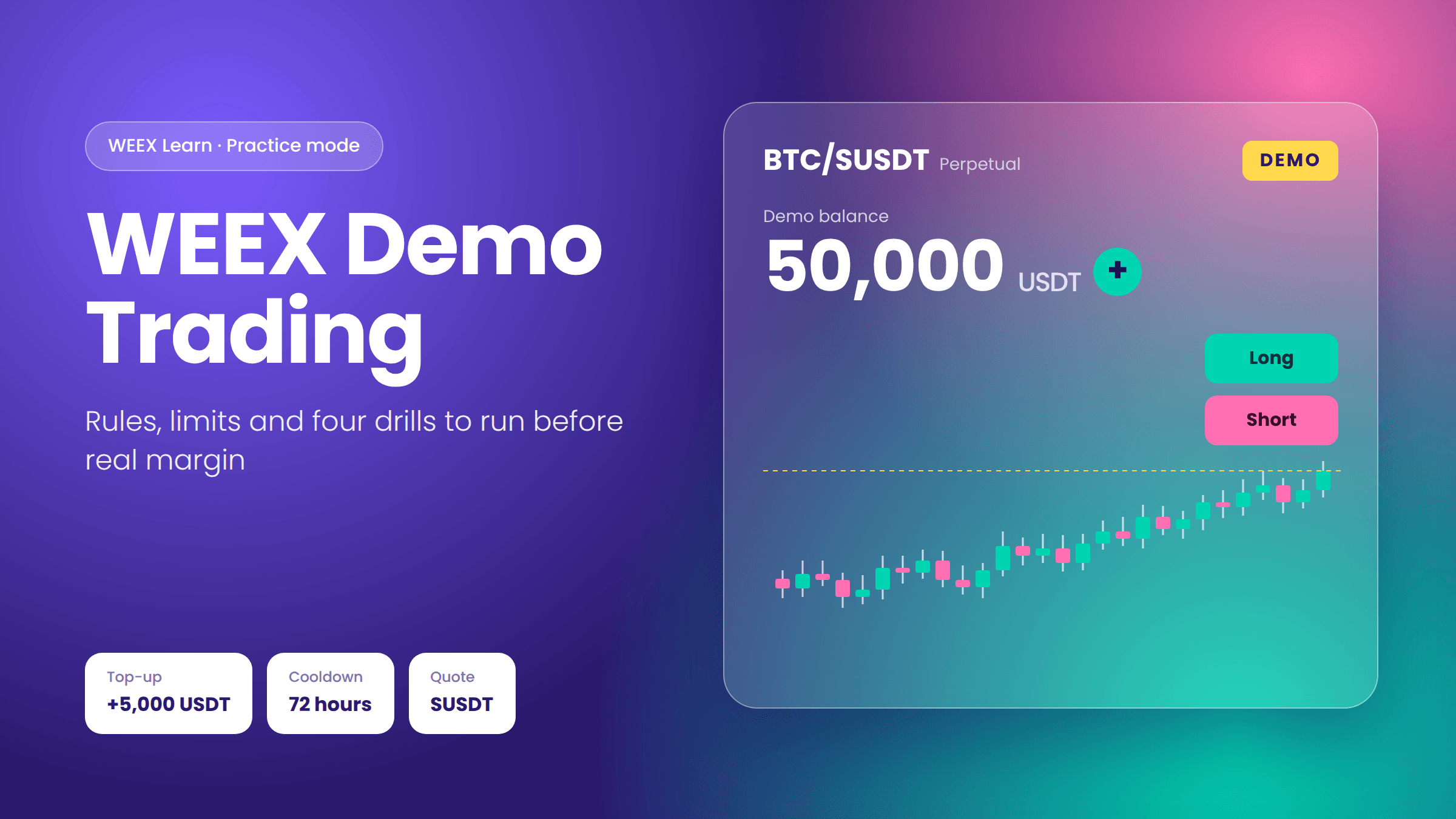
Your starting balance is 50,000 USDT in demo funds, and WEEX's help centre notes this is provided for both BTC and ETH futures. The demo pair list is not limited to the majors; as of September 2026 WEEX serves demo pages for a range of altcoin perpetuals as well, all quoted in SUSDT.
Two things are deliberately identical to live: the price feed and the order ticket. Candles, funding-rate countdown, mark price, and order book come from the live market, and the order form offers the same order types, leverage selector, and take-profit and stop-loss fields you will use with real margin. That is what makes the demo useful for learning the interface rather than just the concept.
Demo balance rules: 50,000 USDT start, 5,000 USDT top-ups, 72-hour cooldown
The funding rules are specific, and they shape how you should use the account.
- New accounts receive 50,000 USDT of demo funds.
- You can request additional demo funds by clicking the plus symbol next to the available balance (web: Futures, then Futures Demo; app: Futures, then Demo futures, then the plus symbol in the centre).
- Each request adds 5,000 USDT.
- A request is only allowed when your balance is below 5,000 USDT.
- After a successful top-up, you cannot request again for 72 hours.
Read those rules as a design choice rather than a limitation. The starting balance is generous so you can size positions realistically; the top-up is small and rate-limited so that blowing up the account has a cost, even if the cost is only three days of waiting. A trader who burns 50,000 demo USDT in an afternoon and then survives on 5,000 USDT top-ups has learned something about their risk sizing that a reset button would have hidden.
The more important point for anyone planning to move to live: if you cannot keep a 50,000 USDT demo balance stable for a month, the problem is not the account size, and funding a real account will not fix it.
What matches live trading and what does not
Demo trading is honest about prices and dishonest about everything that depends on you being in the market. Knowing which is which prevents the classic demo-to-live shock.
What matches: the price feed, mark price, funding-rate schedule, leverage tiers, liquidation mechanics as displayed on the terminal, order types, and the layout of positions, open orders, and history panels. If you learn to set a stop-loss triggered on mark price rather than last price in the demo, that skill transfers exactly.
What does not match, in order of how much it distorts results:
- Fills. Demo orders are simulated against the live book, but your order does not consume real liquidity or move the market. Market orders on thin altcoin perpetuals fill in the demo at prices you would not get live, especially at size. Treat demo fills on anything outside BTC and ETH as optimistic.
- Slippage during volatility. In a real cascade, your stop becomes a market order competing with everyone else's. The demo cannot reproduce that queue.
- Psychology. Losing 5,000 SUSDT does not feel like losing 5,000 USDT, and that difference is the single biggest reason demo-profitable traders lose live. Every experienced operator says this; it remains true.
- Balance scale. Most people do not fund a live account with 50,000 USDT. If you practise with positions sized for 50,000 and then go live with 2,000, either your position sizes shrink to near-meaningless or your leverage rises to compensate. Practise at the balance you intend to fund. Spend down the demo to a realistic figure and treat that as your account.
-- Price
Four drills worth running in the WEEX demo
The demo is most valuable for mechanics you cannot afford to learn live. These four cover the failures that account for most beginner losses in perpetuals.
- Order-type drill. Place a limit entry, a market entry, a stop-market, and a take-profit, then cancel and modify each. Do it until you can do it without reading labels. Fat-finger errors on a live ticket are expensive and entirely preventable.
- Stop-loss trigger drill. Open a position and attach a stop-loss triggered on mark price, then another triggered on last price. Watch how each behaves through a funding settlement or a sharp wick. Understand why mark-price triggers protect you from wick liquidations and last-price triggers do not.
- Liquidation-price drill. Open the same notional size at 3x, 10x, and 25x and note the liquidation price on each. Then work out how far the market has to move against you in percentage terms. Most beginners have never done this arithmetic and are surprised how close 25x liquidation sits.
- Sizing-rule drill. Decide on a fixed risk per trade, say 1% of balance, and size every position so that the distance from entry to stop equals that 1%. Run twenty trades this way. If you cannot follow the rule in the demo, you will not follow it live.
Log every trade with entry reason, stop, size, and result in R (multiples of the risk unit) rather than SUSDT. A demo journal measured in R is the one artefact that transfers cleanly to a live account of any size.
When the WEEX demo stops teaching you and what to do next
The demo stops adding information once you can execute the four drills cleanly and your R-based journal shows a stable process over a few weeks. Past that point, what you lack is exposure to real fills and real emotion, and no simulator provides those.
The sensible transition is a small live account, positions sized so that a full stop-out is uncomfortable but irrelevant, and lower leverage than you used in the demo. Keep the demo open alongside it for testing any new setup or order type before it touches real margin. Traders who automate should note that WEEX also exposes demo endpoints in its futures API, so a strategy can be forward-tested programmatically against the same simulated account before it is pointed at live; that workflow is covered in the next article in this series.
FAQ
1. Is WEEX demo trading free?
Yes. It requires a WEEX account but no deposit or verification, and the 50,000 USDT of demo funds has no real value.
2. What is SUSDT?
SUSDT is the simulated stablecoin used to quote WEEX demo futures pairs such as BTC/SUSDT. It tracks the live USDT-quoted market price but cannot be deposited, withdrawn, or converted.
3. How do I get more demo funds on WEEX?
Click the plus symbol next to your demo available balance. You receive 5,000 USDT per request, only when your balance is below 5,000 USDT, and no more than once every 72 hours.
4. Does WEEX demo trading support spot?
As of September 2026 the demo covers futures. Spot practice is best done with very small real-money orders on a liquid pair.
5. Are demo results a good predictor of live results?
Only for mechanics and process discipline. Demo fills on illiquid pairs are optimistic and demo losses carry no emotional weight, so expect live results to be worse until you have adjusted.
6. Can I run a trading bot against the WEEX demo?
Yes. WEEX's futures API includes simulated endpoints under a /sim/ path for placing orders and reading balance and positions in demo mode.
Risk Warning
Futures trading with leverage carries a high risk of rapid and total loss of the margin you post, and losses in live markets are frequently larger than demo results suggest because of slippage, liquidity gaps during volatility, and the psychological effect of real money. Demo trading on WEEX uses simulated funds and cannot reproduce real fills or real stress; treat it as training for mechanics and process, not as evidence that a strategy is profitable. Cryptocurrency prices are volatile and you may lose part or all of any capital you commit to live trading. This article describes WEEX features as of September 2026 and is not investment advice.
This content is provided for general informational purposes only and doesn't constitute financial, investment, legal, or tax advice. Any events, rewards, online promotions, or related information mentioned herein should not be considered a recommendation, solicitation, or invitation to purchase, sell, trade, or otherwise deal in any crypto assets. Crypto assets are highly volatile and may result in loss. The availability of WEEX services, products, and related events may vary by region. You are responsible for ensuring that your participation is in accordance with applicable local laws and regulations.
You may also like
What Is SafePal Wallet? A Complete Beginner's Guide
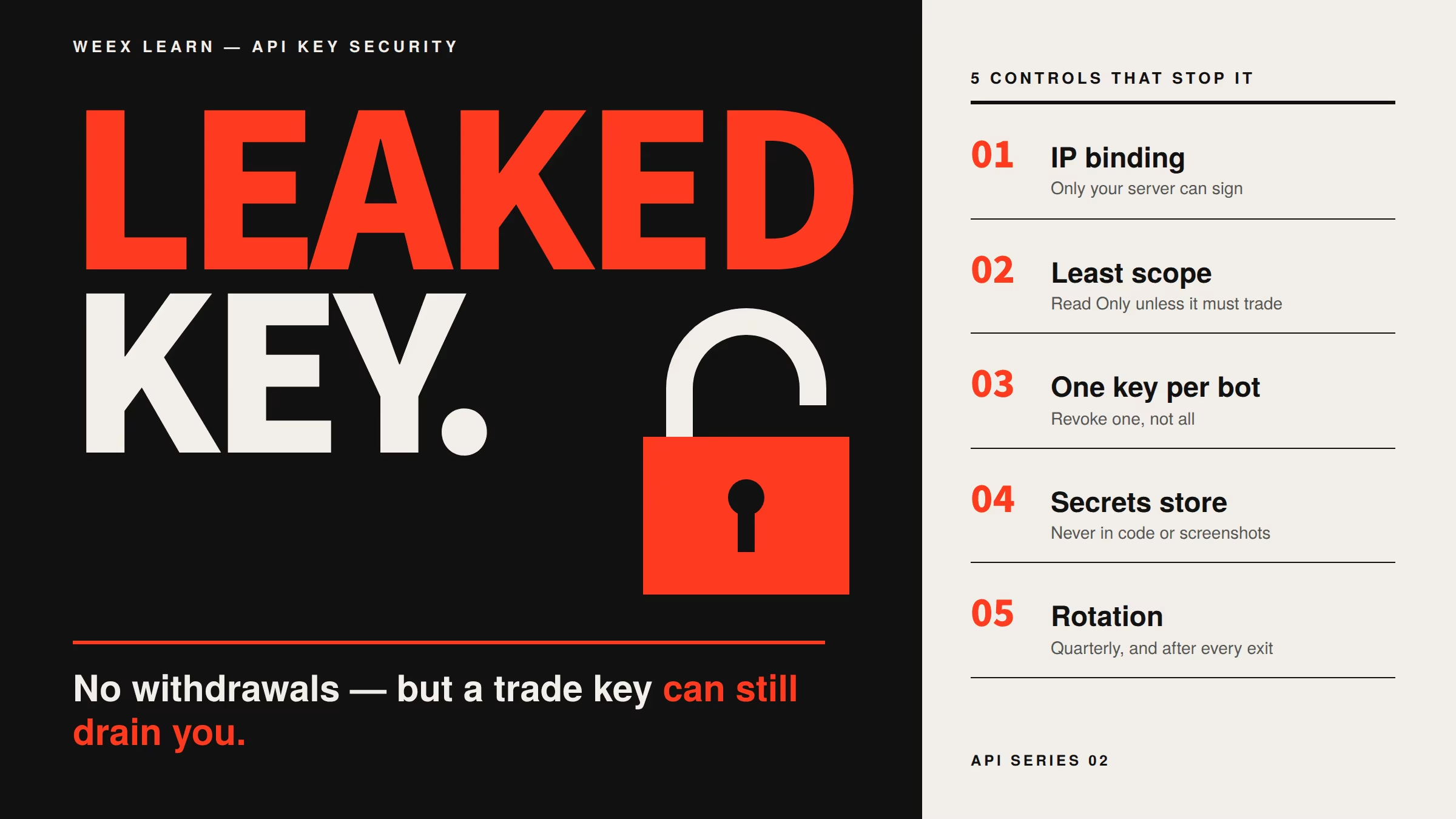
WEEX API Key Security: What a Leaked Key Can Still Do to You

TOKEN2049 Singapore Events 2026: Side Events, VIP Lounges and What to Do During TOKEN2049 Week
Lost Your 2FA Device? Here's What to Do Next
How to Install Trust Wallet Safely: What Most Guides Leave Out
Senate CLARITY Act Cloture Vote Today: Can Trump's Ethics Compromise Get 60 Votes?

Trust Wallet vs MetaMask: Which One Is Better for Beginners?

Trust Wallet Seed Phrase: How to Store It Safely and What Never to Do
Puebla Mexico Crypto Farm Seized: Is Bitcoin Mining Legal in Mexico?

What Is Trust Wallet? A Complete Beginner's Guide
AVAX Futures: Trading the Avalanche RWA Catalyst With Leverage
HYPE Token Unlock and Leverage: What the $1.2B Number Hides
Zcash Futures: What the $34.5M Short Squeeze Cost the Bears
How to Short Intel Stock with Futures: Where to Set TP and SL
Crypto Futures Trading: Leverage, Funding and Apple Perps
How to Trade Tesla (TSLA) Stock Token with USDT on WEEX: A Trading Guide for Beginers in 2026
How to Trade NVIDIA (NVDA) Stock Token with USDT on WEEX
FOMO Token: Which One You're Actually Buying and the Risks

MU Stock Reclaims $1,000 Again: What's Actually Different This Time

Hunter Biden's LAPTOP Memecoin: What TRUMP's Trajectory Suggests Could Happen Next
XST Coin Price Fell Over 40% for Two Straight Days: What That Pattern Actually Means
Is The US Becoming The Crypto Capital? Brad Garlinghouse's Bold Predictions Explained
Hunter Biden's LAPTOP Meme Coin: What's Actually Confirmed So Far

Top Crypto Events in 2026: TOKEN2049 Singapore Guide
How to Trade U.S. Stocks with USDT on WEEX: Step-by-Step Guide
StonkFun Just Became Solana's Hottest Launchpad: STONK Surges 250% to Prove It
How to Trade U.S. Stocks Without a Brokerage Account Using USDT
Nike Stock Price Prediction 2026: What the $50 Target Actually Requires to Happen
Nike Is Being Removed From the S&P 100: What a 12 Year Low Actually Means for the Stock
Pi Network in 2026: Why Supply, Not Users, Sets PI's Price
What Is SafePal Wallet? A Complete Beginner's Guide
WEEX API Key Security: What a Leaked Key Can Still Do to You
TOKEN2049 Singapore Events 2026: Side Events, VIP Lounges and What to Do During TOKEN2049 Week
Lost Your 2FA Device? Here's What to Do Next
How to Install Trust Wallet Safely: What Most Guides Leave Out
Senate CLARITY Act Cloture Vote Today: Can Trump's Ethics Compromise Get 60 Votes?





