
15,400 people lost over $13 million after copying the wallet of a crypto specialist

 Prefer us on Google
The cryptocurrency expert Norberto Giudice ---also known as CriptoNorber--- found himself in the middle of a controversy after 15,400 people copied his crypto wallet and their respective operations on the BingX exchange and accumulated a loss of over $13 million. The mechanism is known as copy trading, which allows users to copy the portfolios of experienced traders in real-time, as explained by Binance.* In this case, Giudice opened two investment strategies in September: one linked to bitcoin and another to solana. Both were betting that the prices of these cryptocurrencies would rise, so the operations were aimed at making profits in the event of a market recovery. But the scenario was not as expected. Bitcoin recorded a drop of 29%, while solana plummeted more than 40%. The recent hacking of the Binance exchange, the defeat of Donald Trump's government in the U.S. elections, the inflation data from the United States ---which raised expectations regarding a new interest rate hike--- and the Nvidia scandal are some of the reasons that explain this setback. The drop left the five operations that Giudice had open in negative territory, which also used a leverage of five times. In that sense, the declines also impacted the thousands of investors who had replicated his movements. "Neither I nor the* copy traders make money when people lose, quite the opposite. My goal has always been to share knowledge or experience so that we all win," clarified Giudice on his YouTube channel. He also emphasized that he himself recorded money losses. On the other hand, he pointed out that the copy trading system of BingX began to "present failures, especially regarding margin reloads for some users." "While they were present on Telegram providing support and trying to generate solutions, there are many people who were liquidated along the way," he detailed. LA NACION consulted Giudice about this aspect. In the expert's words, although the platforms allow copying the strategies of a trader, they also usually allow the user to close the trade at any time and set a **"take profit" or **"stop loss". "In general, they also send notifications to the copier about their gains and losses to remind them of their exposure and to limit it if they consider it necessary," he added. In that sense, he indicated that these options were available for investors on BingX. However, the possibility of adding margin ---the option that allows one to stay in the trade without being liquidated--- "came after liquidations of people who had requested it." "In response to this, the platform announced a partial subsidy for some investors, subject to the conditions and evaluations established in its official statement," he elaborated. "Like any investor, I am responsible for my own portfolio and each person is responsible for theirs. I try to make every investor understand that they are responsible for their money, whether things go well and they are happy or whether things go wrong. At the same time, I do not encourage anyone to invest or to follow my strategies because each person has the responsibility to evaluate what is suitable for their risk profile. And I reiterate what I said, from my position I have the responsibility to remind them not only that every investment carries a risk, but also to encourage them to educate themselves and measure that risk for their finances," Giudice stated.
The risks of copy trading
The case brings back to the table the risks of delegating buying and selling decisions to third parties. For Julián Colombo, director of Bitso for South America, it is essential that the user understands what they are doing, from the assets they trade and whether they are using leverage, to what the loss would be in the worst-case scenario. "Copying another trader does not eliminate market risk. The first risk is assuming that someone else's past good performance guarantees future results, and it does not guarantee them. The second is replicating a strategy that does not fit one's own profile: the person being copied may have a different risk tolerance, different capital, and different objectives," he specified. However, Bitso is not a platform that offers copy trading. He also pointed out that when there is leverage, "everything is amplified." "Just as it can increase profits, it also accelerates losses. If the market moves against you and there is not enough collateral, the position can be automatically liquidated and all assigned capital can be lost. That is why we insist on something we always repeat: there are no easy ways to make money, and every investment carries risk," he emphasized. Regarding who should be responsible in case of losses, Colombo stated that it is a "shared responsibility," where each one "plays a different role." "The user decides what to invest in, how much, and at what level of risk, and that decision is theirs. That is why our job is to ensure they make it informed: that they understand the product before using it, that they know the risks, and that they have tools to manage them. The platform, for its part, must be transparent, verify that the user understands what they are contracting, control who they enable, set risk limits, and protect account security," he said. Regarding the trader, he maintained that they have the responsibility not to present their experience or results misleadingly. "And the platform must be transparent, verify that the user understands what they are contracting, control who they enable, and set risk limits," he added.
Recommendations for Users
On the other hand, Colombo provided some recommendations to avoid potential risks. One of them is that "everyone should do their own trading ": "Decisions must be personal and respond to each person's profile, capital, and objectives. Following what someone else does on social media does not replace personal analysis." He also suggested investing only the money one is willing to lose and not concentrating everything in a single operation. He also emphasized the importance of using available risk control tools, such as stop loss, and closely monitoring open positions. Finally, he recommended protecting the account and trading only on platforms registered with the local authority. "A loss due to a market movement in a strategy that the user chose and understood is not the same as a loss caused by misleading information or platform failures. That is why, rather than looking for someone to blame afterward, we believe the priority is to prevent: educate, assess, and communicate risks before the user trades," Colombo summarized.
This content is provided for general informational purposes only and doesn't constitute financial, investment, legal, or tax advice. Any events, rewards, online promotions, or related information mentioned herein should not be considered a recommendation, solicitation, or invitation to purchase, sell, trade, or otherwise deal in any crypto assets. Crypto assets are highly volatile and may result in loss. The availability of WEEX services, products, and related events may vary by region. You are responsible for ensuring that your participation is in accordance with applicable local laws and regulations.
You may also like
The Tech Sell-Off Is Creating the Best Buying Window in 2 Years. Here's What I'm Buying.

Why the Big Short Seller is Buying Tencent Against the Trend?
From Securing Private Keys to Constraining Agents: New Frontiers of Crypto Security in the AI Era
The AI Power Surge Returns to Rationality: Where to Find Valuation Lows

Prediction: Micron Stock Will Be at This Price at the End of 2027

How to Use Tokenized Stocks on the Blockchain?

Bitcoin ETF Surpasses 2,200 Institutional Holders, Primarily Investment Advisors

First Circle Capital Announces Final Closing of $26 Million Fund to Invest in Fintech in Africa

A New Path for API3: Fixed Supply, On-Chain Curation, and Infrastructure for AI Agents

Nestlé Expands into Wearable Devices, Plans to Match Nutritional Products with Health Data

ECB Governing Council Member Kocher Warns Against Lagging in Inflation Response
Over 20% of Generation Z Own Cryptocurrency, Barriers to Adoption for the General Public Include 'Fragmentation of Financial Services' = SoFi Survey

Where Will SpaceX Stock Be in 5 Years?

Ray Dalio's Latest Interview: Why Great Technologies Are Often Not Great Investments?

Will On-Chain BTC Lending Become Mainstream? Data and Institutional Trends Point to Traditional Finance

Is BTC Different This Time?

Tonight, the last major inflation report before the Federal Reserve's December decision is released!
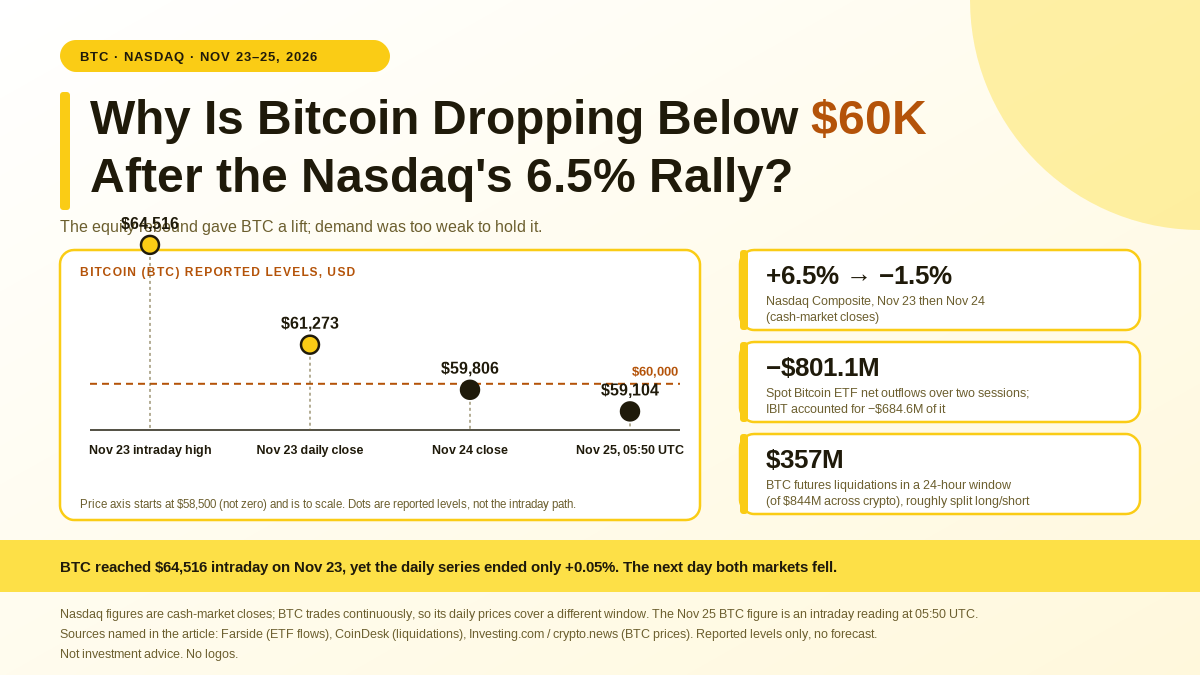
Why Is Bitcoin Dropping Below $60K After the Nasdaq’s 6.5% Rally?
Why is Bitcoin dropping below $60,000 after the Nasdaq rallied 6.5%? See what $801.1 million in ETF outflows, exchange flows, and liquidations reveal.
Report: AI Industry Leaders Divided Over Whether Humans Should Surrender Autonomous Decision-Making Power

Remy Cointreau Group's Stock Price Soars Amid Transformation Progress

Warren Buffett's Successor, Greg Abel, Has Quietly Purchased 3 Stocks Since the Start of the Fourth Quarter, Including Shares of a Legal Monopoly

Not Tesla. Not Nvidia. This "Magnificent Seven" Stock Could Be Overdue for a Big Rally.

Iliad Partners Announces Final Close of Its First Fund at $33.4 Million

Fidelity Lists AAVE, LINK and UNI: How Do Crypto Trading Fees Compare?
Jensen Huang's Situation May Be Even More Challenging Now

BlackRock Launches Tokenized Fund in Hong Kong! Reaches $100 Million, Supports HKD Stablecoin HKDAP for Subscription

Private Financing Market Mirrors IPO Market: Leading Companies Dominate

The Huge Concern for AI Stocks: Oversupply of Chips
Diverging Market Views on Wall Street for 2026: Tom Lee vs. Castle Securities, Caution Against a Repeat of 2018 Market Risks

Bitcoin, US Stocks, and Gold: Which Will Bottom First?
The Tech Sell-Off Is Creating the Best Buying Window in 2 Years. Here's What I'm Buying.
Why the Big Short Seller is Buying Tencent Against the Trend?
From Securing Private Keys to Constraining Agents: New Frontiers of Crypto Security in the AI Era
The AI Power Surge Returns to Rationality: Where to Find Valuation Lows
Prediction: Micron Stock Will Be at This Price at the End of 2027
How to Use Tokenized Stocks on the Blockchain?
Latest articles




Latest coin listings on WEEX


