
A computation bug that allowed Truebit to be hacked for 8535 ETH


Original Title: "Truebit Protocol $26.44M Hack Contract Vulnerability Analysis"
Original Source: ExVul Security
On January 8, 2026, the Truebit Protocol was hacked, resulting in a loss of 8,535.36 ETH (approximately $26.44 million). The official Truebit Protocol announcement was made early the next day. The ExVul security team conducted a detailed vulnerability analysis of this attack, with the following results:
Attack Process
Attacker's Address:
0x6c8ec8f14be7c01672d31cfa5f2cefeab2562b50
Attack Transaction Hash:
0xcd4755645595094a8ab984d0db7e3b4aabde72a5c87c4f176a030629c47fb014
The attacker completed the attack by looping 4 times through calls to getPurchasePrice→0xa0296215→0xc471b10b transactions. The analysis focuses on the first loop as an example.
1. The attacker first called the getPurchasePrice(240442509453545333947284131) function, which returned 0.

2. The attacker called the 0xa0296215(c6e3ae8e2cbab1298abaa3) function with a msg.value of 0 and successfully minted 240442509453545333947284131 TRU tokens.

3. The attacker called the 0xc471b10b(c6e3ae8e2cbab1298abaa3) function. They then burned 240442509453545333947284131 TRU tokens and received 5105.06 ETH.
Attack Logic Analysis
By understanding the above attack process, it is evident that there are issues in the logic of the getPurchasePrice function and the 0xa0296215 function. The following is an in-depth analysis (as the contract is not open-source, the following code is decompiled code).
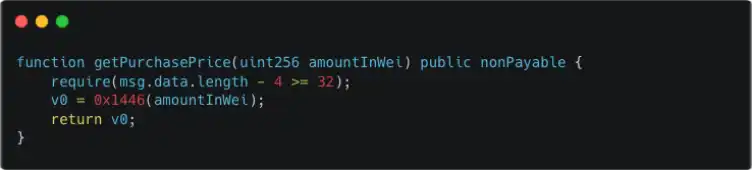
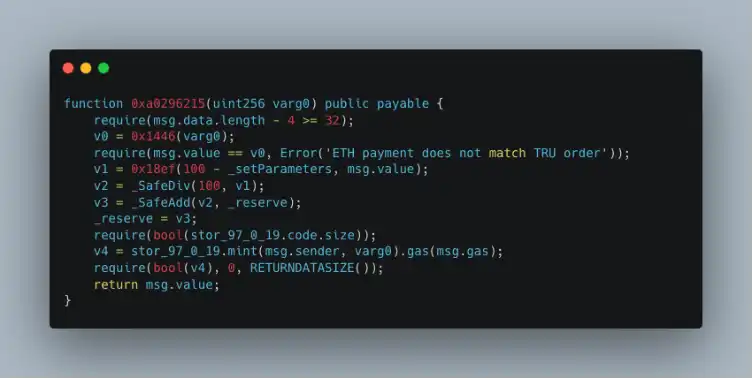
By comparing the similarities of two functions, we can discover that the 0x1446 function is used to determine how much ETH is needed to purchase a specific amount of TRU. Clearly, there is a flaw in the logic of the 0x1446 function, leading to an incorrect ETH calculation. The following is a detailed analysis of the logic in the 0x1446 function.
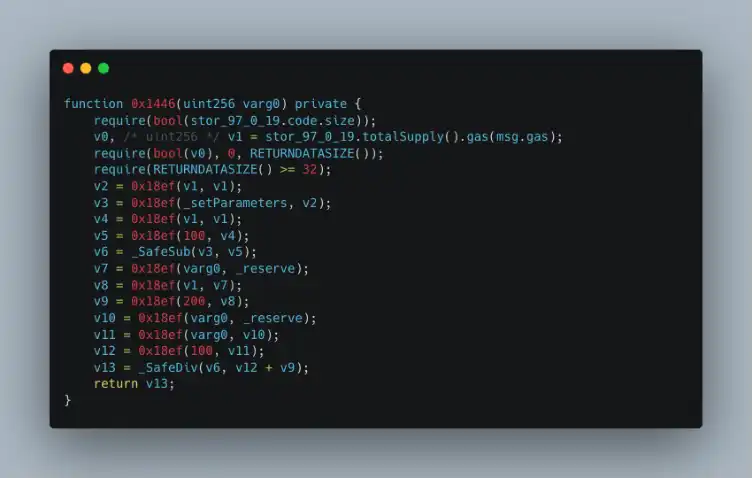
Observing the logic in the 0x1446 function, because the final calculation result v13 == 0, it is certain that the calculation logic mentioned earlier is flawed. It is important to note that the function 0x18ef is equivalent to _SafeMul, so the issue lies in using native addition v12 + v9 (the contract version is ^0.6.10, hence no overflow check).
v12 and v9 represent:
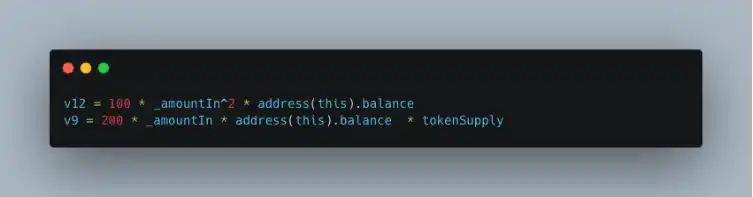
Through the above analysis, the attacker's approach is to input a huge _amountIn to overflow v12 + v9 into a very small value, ultimately resulting in (v12 + v9) / v6 == 0.
Summary
The fundamental reason for the attack on the Truebit Protocol this time is the presence of a severe integer overflow bug in its token purchase price calculation logic. Since the contract uses Solidity version ^0.6.10 and does not perform safety checks on crucial arithmetic operations, it ultimately led to a significant loss of 8,535.36 ETH. The new version of Solidity itself has already alleviated overflow vulnerabilities. This attack should be seen as a hacker leveraging AI to automatically scan some live but older DeFi protocols to discover vulnerabilities (including the recent Balancer and yETH attacks). We believe that such AI-driven attacks on older DeFi protocols will become more common in the near future. Therefore, we recommend that projects conduct new security audits on their contract code. If vulnerabilities are found, they should promptly upgrade the contract or transfer assets, maintain on-chain monitoring, promptly detect anomalies, and minimize losses.
This article is contributed content and does not represent the views of BlockBeats.
You may also like

The other side of Musk's trillion-dollar fortune: 85% cannot be sold

The U.S. government prohibits foreigners from using Fable 5, Anthropic issues a rebuttal

Citibank releases "2030 Asset Tokenization Market Outlook": 6 major trends may create a $8.2 trillion market

The trillion-dollar valuation test: Are the three major super IPOs a celebration for tech stocks or a nightmare for the crypto market?

Morning Report | Digital Asset completes $355 million financing led by a16z Crypto; Meta completes operational separation from Manus

a16z Crypto Partner: Cash flow is the moat

Cryptocurrency market makers collectively seek change as it becomes increasingly difficult to make money

How TradeXYZ, xStocks, and Alpaca break down the SpaceX IPO into three different strategies
$75 billion in risk asset redistribution: How will SpaceX's IPO affect U.S. stocks and Bitcoin?

Why Is BlackRock Investing $5 Billion in the SpaceX IPO?
Morning News | CME Group launches Nasdaq Cryptocurrency Index futures; Asset management giant Janus Henderson strategically invests in Ethena

Bitcoin Layer 2 Network Botanix: Why Did We Choose to Dissolve?

Why did Oracle deliver the strongest financial report in history, yet its stock price fell?
When the P2P illicit funds from ten years ago turned into 60,000 bitcoins
Dialogue with OmenX Founder: Why does the prediction market need an evolution from "spot" to "derivatives"?
Galaxy in-depth report: Is Solana still worth paying attention to?
Young people in South Korea make a "final effort" in the epic bull market
The pricing controversy of Trade.xyz exposes the fatal weakness of Pre-IPO perpetual contracts
The other side of Musk's trillion-dollar fortune: 85% cannot be sold
The U.S. government prohibits foreigners from using Fable 5, Anthropic issues a rebuttal
Citibank releases "2030 Asset Tokenization Market Outlook": 6 major trends may create a $8.2 trillion market
The trillion-dollar valuation test: Are the three major super IPOs a celebration for tech stocks or a nightmare for the crypto market?
Morning Report | Digital Asset completes $355 million financing led by a16z Crypto; Meta completes operational separation from Manus
a16z Crypto Partner: Cash flow is the moat


