
Behind the $LAPTOP Crash: On-Chain Evidence Shows “Public Wallets Did Not Sell, but Linked Wallets Cashed Out Early”

 Prefer us on Google


The $LAPTOP token launched by Hunter Biden on September 9 plunged more than 99% from its all-time high of $199 within hours of going live. Biden publicly denied that the team had sold tokens before the crash, instead blaming “sniper bots and thin liquidity.”
However, two sets of evidence released by on-chain analyst Booksey (@Booksey) directly challenge that denial. Booksey is not the only investigator examining the token. Data published by several independent blockchain-tracking accounts, including Lookonchain and Arkham, points in the same direction.
My position is clear: the official claim that “we did not sell” does not align with the actual flow of funds visible on-chain. This is not simply a matter of conflicting narratives. The transactions are public and can be verified one by one.
Timeline: The Token Was Not Really “Born” on September 9
According to the deployment timeline compiled by Booksey, the $LAPTOP contract had existed since April 27, 2026, approximately four and a half months before its official launch.

The timeline includes the following key events:
- March 23–26: A Cayman Islands foundation and a British Virgin Islands company completed their legal registrations before any code was deployed on-chain.
- April 27 at 17:12 UTC: The contract was deployed on Base through a CREATE2 factory. The entire supply of one billion tokens was minted in the same transaction. From that moment, the complete token supply existed on-chain, although no liquidity pool had been created and public trading was not yet possible.
- May 28: The deployer transferred administrative control of the token contract to the team’s 2-of-3 multisignature Safe.
- June 17: The project completed its MiCAR white paper filing in the European Union and designated September 9 as the official “offer date.”
- September 1: The team conducted two small test transfers.
- September 3–4: Three large insider distributions began.
- September 7: The team created five new Safes and completed a “large transaction” later that day. Insiders had already used tokens visible only to the team to establish a Uniswap liquidity pool—two full days before the public could buy the token.
- September 7 at 01:04 UTC: A Safe holding 80 million tokens transferred four batches containing 300 million, 300 million, 50 million, and 50 million tokens.
- September 9 at 02:27 UTC: An Aerodrome liquidity pool went live with approximately $55,000 in USDC.
- September 9 at 12:02:45 UTC: Bots added liquidity to the pool, marking what the project described as the “official launch.”
Booksey’s argument was that the token’s “launch” was simply the moment when someone added enough liquidity to make the asset tradable. The contract itself could exist for months without an audit, legal documentation, or exchange coordination.
In other words, the entire funding structure shown in the first screenshot could theoretically have been traced two days before the public launch. The public simply could not purchase the token yet.
Team Wallets Showed “Zero Realized Profit,” but Linked Wallets Cashed Out
The second image is even more significant. Its headline reads: “The Team’s Own Wallets: Zero Realized So Far.”
The table lists several official or publicly identified wallets:
- Founder and event Safe holding 300 million tokens
- Airdrop-claim Safe holding 24.43 million tokens
- Newly funded Binance wallet holding 60 million tokens
- Aerodrome bribe contract holding 14.5 million tokens
Every listed wallet was marked as unused or unsold. The 30% of the supply publicly held by the team—valued at approximately $627 million on paper at the time—had apparently not moved.
But the next section of the table, titled “Who Made Money: The Pre-Launch Recipients,” lists an entirely different group of addresses:
- A “sales wallet” funded by a $2.5 million airdrop Safe reportedly cashed out approximately $2.34 million in USDC.
- Three market-making addresses that received tokens before the launch transferred approximately $1.27 million through the Bitvavo exchange between September 10 and September 12.
- A market-making Safe seeded with 1.15 million USDC and 9.8 million ETH traded on both sides of the Aerodrome pool and reportedly generated more than a small profit from its own operating capital.
- Two airdrop-claim wallets each sold 4,276 tokens, cashing out approximately $647,000 in total.
Booksey Called It a “Carefully Timed Liquidity Extraction”
In a detailed on-chain investigation published on September 9, Booksey provided a more specific breakdown of the funds that moved during the first three hours of trading.
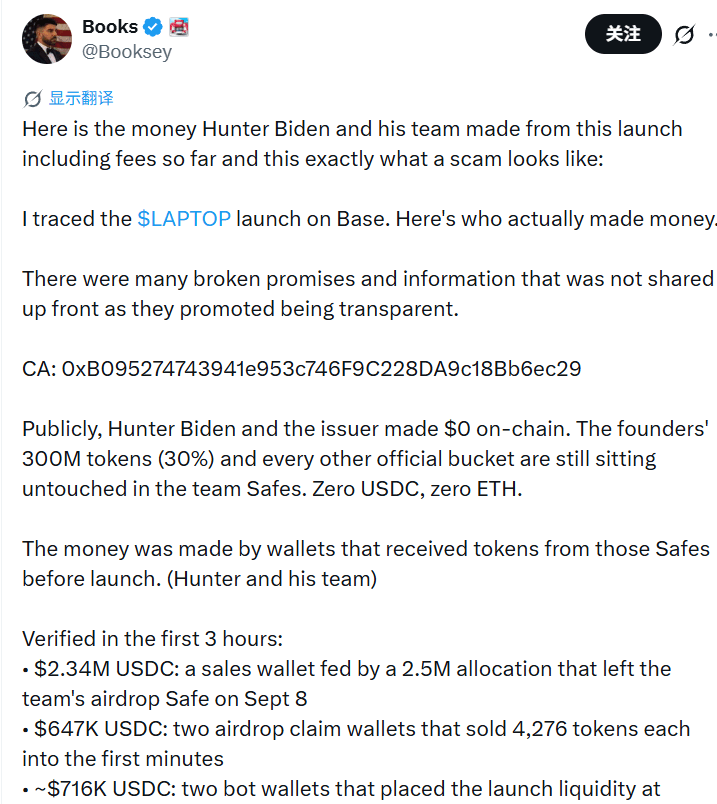
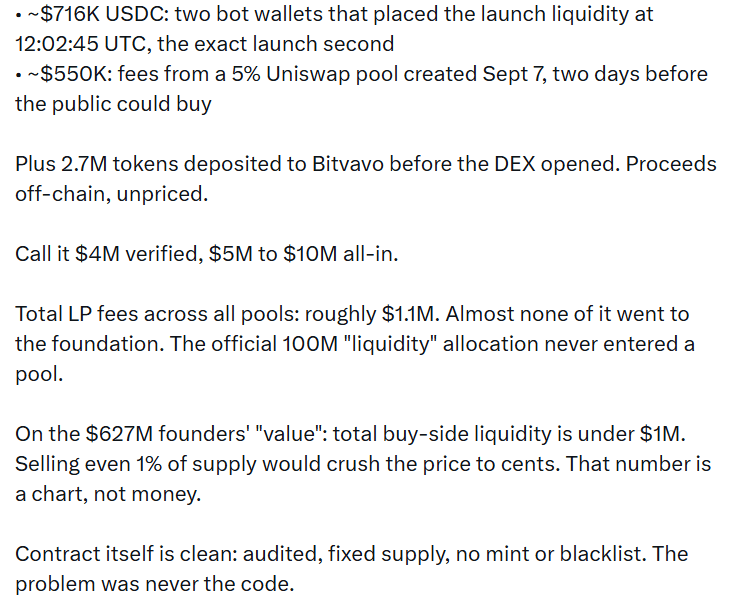
The main figures included:
- Publicly identified allocations, including the founder’s 300 million tokens and other official distributions, remained untouched on-chain.
- Funds that had already moved out of those Safes and into linked wallets generated approximately $2.34 million in verified sales during the first three hours after launch.
- Two airdrop wallets realized approximately $647,000.
- Two bot wallets reportedly positioned liquidity at the exact moment trading opened and generated approximately $716,000.
- Another $550,000 reportedly came from a Uniswap pool carrying a 5% fee that had been created on September 7—two days before the public could buy the token.
Booksey placed the conservatively verified amount at approximately $4 million, while estimating that the total could be between $5 million and $10 million under a broader accounting method.
He also reported that another 2.7 million tokens had been deposited into the Bitvavo exchange before decentralized-exchange trading opened. The destination of any resulting proceeds remains unclear.
In an earlier and more concise post, Booksey used even more direct language:
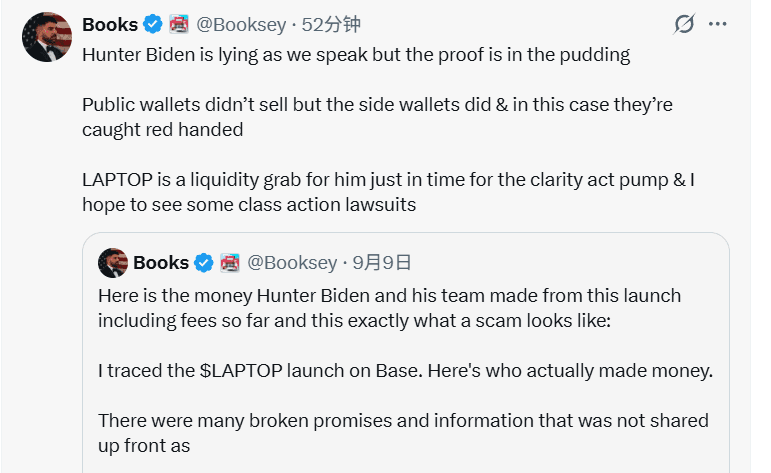
Original post: https://x.com/Booksey/status/2097714627891036316
-- Price
Multiple Independent Sources Point to the Same Pattern
If Booksey were the only account making these allegations, greater caution would be necessary. But when the available public reporting is examined together, several findings appear to support one another:
- BeInCrypto reported that a project wallet received 100 million tokens—10% of the total supply—one week before the launch and sold 42.5 million tokens when trading opened. Market maker GSR reportedly received another large pre-launch allocation and also sold tokens quickly.
- On-chain tracking account Lookonchain identified a wallet associated with “Safe architect FloB.” The wallet claimed 8,553 tokens through an airdrop and sold them at an average price of $75.70, receiving approximately $647,429. This figure closely matches the $647,000 attributed to two airdrop wallets in Booksey’s table, providing a form of independent cross-verification.
- Arkham’s holdings data showed that the two largest wallets each controlled 30% of the total supply, with both wallets directly connected to the project.
- The liquidity pool reportedly peaked at only approximately $48,000, despite briefly supporting a fully diluted valuation of around $144 billion. This extreme imbalance is consistent with a market in which a relatively small amount of capital can produce an enormous paper valuation.
The exact figures reported by Booksey, Lookonchain, and Arkham vary because the investigators used different accounting methods and wallet classifications. However, they all point toward the same basic conclusion:
The official wallets may not have sold, but a group of wallets with direct financial connections to the project’s Safes received positions before the public launch and realized profits as soon as trading opened.
Hunter Biden’s Response
Following the crash, Hunter Biden rejected claims that the token had been a “rug pull” or had simply fallen 99% in the way critics described.
He emphasized that he had not personally profited, argued that the token’s fully diluted valuation remained above $1 billion, and said the team was working to improve its liquidity structure. He attributed the crash primarily to sniper bots and insufficient liquidity.
The team subsequently announced that it would add four million tokens—equivalent to 0.4% of the total supply—to the Aerodrome liquidity pool beginning September 10. The move was presented as one of several measures intended to deepen liquidity.
However, this response did not directly address the on-chain evidence.
It disputed the narrower allegation that publicly identified team holdings had been sold. Booksey and other investigators were making a different allegation: that linked wallets, rather than the team’s publicly labeled wallets, received tokens or funding before the public launch and then realized profits.
These are not the same claim. Treating them as interchangeable avoids the central issue raised by the transaction data.
My Assessment
When the deployment timeline, fund-flow records, and independent blockchain analyses are considered together, three conclusions appear defensible.
1. The “Fair Launch” Narrative Was Misleading
The contract had been deployed approximately four and a half months earlier, and the full token supply had already been minted.
By September 7—two days before the public could buy the token—insiders had already created a liquidity pool using tokens that were not yet available to public buyers. Internal transfers and market preparations were also underway.
This means that September 9 was not the beginning of the launch process for insiders. It was closer to the final step before public trading.
Presenting the project as a piece of performance art reflecting on the laptop controversy may have shaped public perception, but it did not clearly communicate the extent of the preparation, allocation, and liquidity activity that had already taken place behind the scenes.
That remains a transparency problem regardless of whether the publicly disclosed team wallets sold any tokens.
2. “The Team Did Not Sell” May Be Technically True but Substantively Misleading
If assets can move from team-controlled Safes into linked wallets and those linked wallets can subsequently realize profits, then pointing to untouched public wallets does not resolve the underlying concern.
This is precisely why on-chain investigators follow the actual movement of funds rather than relying solely on wallet labels.
Lookonchain’s independent identification of approximately $647,429 in proceeds from an airdrop-linked wallet closely matches the amount reported in Booksey’s analysis. That consistency suggests that the allegations are based on traceable transaction activity rather than unsupported speculation.
3. The Evidence Does Not Automatically Prove Fraud or Illegal Conduct
I would not currently describe the incident as definitively fraudulent or illegal. Those are legal conclusions that would require findings from regulators or a court.
Booksey has expressed a desire to see a class-action lawsuit, but that is not the same as an official determination that the law was broken.
Nevertheless, this was a public token launch involving a politically prominent figure, and retail traders suffered real losses. Reports indicate that more than 80% of traders lost money during the collapse.
The available on-chain evidence is sufficient to raise serious questions about whether insiders were positioned before public buyers and whether linked wallets benefited from the initial trading activity.
The public does not need to wait for a final legal judgment before questioning the integrity and transparency of the launch.
If you are following or currently holding $LAPTOP, do not assume that the broader allegations of insider benefit have been disproven simply because the team denied selling from its publicly identified wallets.
“Public team wallets did not sell” and “linked wallets benefited before or during the launch” are two different statements. Both can be true at the same time.
Until regulators or independent auditors provide a clearer account of the token allocations and fund flows, $LAPTOP should be treated as a highly speculative, politically connected meme coin—not as a long-term conviction investment.
This article is for informational purposes only and does not constitute financial or investment advice.
FAQ
1. Why Did the $LAPTOP Token Crash More Than 99%?
The collapse appears to have been driven by extremely thin liquidity, concentrated token ownership, sniper-bot activity, and rapid selling by wallets that received tokens before the public launch. With only a small amount of liquidity supporting an enormous paper valuation, relatively modest sales could cause the token’s price to fall dramatically.
2. Did Hunter Biden or the Official $LAPTOP Team Wallets Sell Tokens?
The publicly identified team wallets reportedly did not sell their holdings during the initial collapse. However, on-chain investigators identified several linked or pre-launch recipient wallets that sold tokens or otherwise realized profits shortly after trading opened.
3. What Is the Difference Between Official Team Wallets and Linked Wallets?
Official team wallets are addresses publicly labeled as belonging to founders, treasury allocations, airdrop reserves, or project operations. Linked wallets may not carry an official label, but their transaction history can show direct funding relationships with team-controlled Safes or other project addresses.
4. Was $LAPTOP Really a Fair Launch?
The available timeline raises doubts about describing the event as a conventional fair launch. The contract and entire supply existed months before the public launch, while insiders reportedly received allocations and established liquidity infrastructure before ordinary users could trade the token.
5. Does the On-Chain Evidence Prove That $LAPTOP Was a Scam?
No. On-chain data can document token transfers, wallet relationships, liquidity activity, and sales, but it does not independently establish criminal intent or prove that a law was violated. A formal determination of fraud or illegal conduct would require investigation and findings by regulators or a court.
6. Is $LAPTOP Still a High-Risk Token?
Yes. Its extreme volatility, thin liquidity, concentrated supply, political association, and unresolved questions about pre-launch distributions make it a highly speculative asset. Anyone considering trading it should carefully examine liquidity conditions, wallet concentration, and verified on-chain activity before making a decision.
This content is provided for general informational purposes only and doesn't constitute financial, investment, legal, or tax advice. Any events, rewards, online promotions, or related information mentioned herein should not be considered a recommendation, solicitation, or invitation to purchase, sell, trade, or otherwise deal in any crypto assets. Crypto assets are highly volatile and may result in loss. The availability of WEEX services, products, and related events may vary by region. You are responsible for ensuring that your participation is in accordance with applicable local laws and regulations.
You may also like

US Dollar Stagnates, Inflation and Interest Rates in Focus

Rising Oil Prices Recalibrate the Landscape for Argentine Investors: Which Alternatives Are Gaining Ground

Oil Above $100: What Changes for Petrobras and the Ibovespa
Government Introduces Border Regime at the Border with Russia and Belarus

Find out now if your congressman votes in favor of Bitcoin

RBC Crypto Forum: Key Topics Currently Discussed by the Crypto Community

Crypto Stops Being a "Separate World": How It Is Merging with Traditional Finance

Coinbase Payments in Stablecoins: Betting on a New Revenue Source

The Progress of AI Concerns Leading Mathematicians

Senasa mandates microchip identification for equines and strengthens controls for international trade
South Korea Warns of Risks from Leveraged AI ETFs

Block Files Application for Builders Bank and Trust Dedicated to Bitcoin
$LAPTOP Price: What 36 Months of Token Unlocks Could Mean Going Forward

Arc Public Mainnet Launches on September 16, Fees in USDC

BCA Macro Outlook: How Much Longer Can U.S. Stocks Rise? The AI Investment Cycle May Only Have Completed Two-Thirds

Changes in Traffic on Kyiv Bridges During Air Alerts

The Era of AI Spending Money... Will Stablecoins Become the Payment Network for the 'Agent Economy'?
UBS Says 'Gold Prices Have Fully Priced in the Fed'

Qianwen Unveils New AI Glasses N1 with Iris Payment Feature, Pricing Expected to be Lower than S1
Apple Stock: John Ternus's First Big Product Bet Is a $1,999 Foldable iPhone
Apple stock dipped as CEO John Ternus unveiled the $1,999 iPhone Duo, a bet designed to offset rising memory costs, here's what's actually driving the move.

Drone Nearly Strikes Zelensky's Plane During Takeoff from Moldova

DSRV Integrates Canton Coin Custody Service

Solana’s 300ms speed boost to outrun trading bots might come with a hidden cost
It looks like a stock and trades like a stock, but it isn’t actually a stock – what is it?
Changelly review 2026: fees, limits, KYC and exchange rates
Residency in Paraguay: the hidden cost of the new exit door for Brazilians
Monero: How the Most Private Cryptocurrency Works and Its Investment Significance

Egypt: Bitcoin Usage Soars as the Pound Collapses
Bitcoin, Yen, and Debt: Scott Bessent Challenges Traders Worldwide

EDX Markets Integrates Fireblocks Network Link
US Dollar Stagnates, Inflation and Interest Rates in Focus
Rising Oil Prices Recalibrate the Landscape for Argentine Investors: Which Alternatives Are Gaining Ground
Oil Above $100: What Changes for Petrobras and the Ibovespa
Government Introduces Border Regime at the Border with Russia and Belarus
Find out now if your congressman votes in favor of Bitcoin
RBC Crypto Forum: Key Topics Currently Discussed by the Crypto Community
Contents
Latest articles


Latest coin listings on WEEX


