
Bonding Curve and LP Incentives: Key Modules and Evolution Trends of New Token Liquidity Mechanisms

 Prefer us on Google



Author: Web3 Research of Go2Mars
What truly needs to be measured is not which protocol can attract the most initial funds, but whether a token can generate sustained trading demand after graduation, whether LPs can obtain reasonable returns from real transactions, and whether the protocol can ensure that the incentive mechanism still holds value after the rewards end.
What truly needs to be measured is not which protocol can attract the most initial funds, but whether a token can generate sustained trading demand after graduation, whether LPs can obtain reasonable returns from real transactions, and whether the protocol can ensure that the incentive mechanism still holds actual value after the rewards end.
When a new token enters the market, the first issue to address is not how to attract more traders, but how to establish a trading environment that can function normally in the absence of a mature order book and market makers. The Bonding Curve provides a preset pricing mechanism that allows tokens to be traded from the moment of issuance; once the market reaches the set conditions, the tokens enter the AMM liquidity pool to accommodate subsequent transactions.
These two stages address different issues. The Bonding Curve solves the cold start of the early market, while the AMM provides an environment for subsequent trading and liquidity management. Even after a token completes graduation, it does not mean that it has formed stable trading demand, nor does it imply that LPs will remain in the pool. What truly deserves attention is how initial liquidity is established, how liquidity rights are distributed after graduation, and how the protocol can design mechanisms to encourage participants to continuously create real trading activities.
Multiple protocols are converging in their designs for configurable issuance, liquidity rights distribution, and multi-layer incentives, reflecting the market's increasing demand for "real usage-driven liquidity."
I. Bonding Curve: An Effective Path to Reduce Initial Liquidity Organization Costs
The first problem faced by new token launches is the cold start of liquidity. Tokens that have not yet formed a market typically lack a mature order book and sufficient traders and market makers. If a traditional AMM approach is used to launch, it requires preparing tokens and assets on the other side in advance to establish an initial liquidity pool. This poses a practical barrier for new projects lacking funds and market resources.
The Bonding Curve changes this process. It does not require the issuer to first establish a complete AMM trading pool at launch, but instead provides continuous pricing for the token through a price curve preset in a smart contract. Users buy tokens using quoted assets like SOL or USDC, and the contract calculates the transaction price based on the current state of the curve; as buying and selling occur, the reserves and marginal prices in the curve change accordingly.
In a typical Constant Product Bonding Curve, the pricing mechanism is based on the product relationship between two reserve amounts. When buying, the reserve of quoted assets increases while the reserve of tokens decreases, causing the marginal price to rise; the reverse occurs when selling. Traders do not need to wait for an order book or external market makers to provide quotes; the transaction price is directly determined by the on-chain reserves and curve rules.
A key point to distinguish here is that the Bonding Curve reduces the requirement for issuers to provide AMM liquidity in advance, but it does not mean that trading does not require funds. The quoted assets invested by buyers still constitute the source of funds in the curve trading process. It changes the way initial liquidity is organized, rather than eliminating the capital required for liquidity.
Pump.fun is a standardized implementation of this model. Each newly issued coin starts from a Bonding Curve, using a Constant Product mechanism composed of virtual SOL and token reserves. Buyers and sellers interact directly with the curve, without the need for an order book or external matching, allowing the token to enter trading immediately after issuance. The unified pricing rules provide an initial trading environment and price discovery mechanism for the new token, significantly lowering the issuance threshold.
Meteora's Dynamic Bonding Curve (DBC) goes further in terms of configurability. Launch Partners can establish independent configurations for different issuance platforms, including quoted assets, curve structures, trading fees, and graduation conditions. DBC supports configuring different liquidity distributions across various price ranges, with a single curve covering up to 20 price ranges, combined with dynamic fees and fee scheduling mechanisms. This means that issuance platforms can adjust issuance parameters according to their product strategies, rather than forcing all new tokens to adopt the same curve. This configurability allows for a more tailored organization of early liquidity to specific issuance scenarios, making it a relatively complete implementation in current Bonding Curve designs.
Raydium LaunchLab also employs Bonding Curves for early issuance, with the curve, quoted assets, and graduation conditions determined by launch configurations. Its design supports various curve forms such as Constant Product, Linear Price, and Fixed Price, although current operations primarily use Constant Product. It connects curve issuance with subsequent CPMM markets, forming a direct link from issuance to trading markets.
The differences among the three models are as follows: Pump.fun provides a relatively standardized virtual reserve curve for issuance and trading environments; Meteora DBC opens the curve, fees, and liquidity distribution for Launch Partner configuration; Raydium LaunchLab connects curve issuance with its subsequent CPMM market. The core value of the Bonding Curve lies in reducing the organizational costs of initial issuance, allowing tokens to begin trading even without a mature market. It addresses how the market can start, rather than whether the market can sustain itself. With enhanced configurability, this mechanism is evolving from "unified curves" to "scenario-based issuance."
II. Graduation: A Key Link in the Migration and Distribution of Liquidity Rights
The Bonding Curve can provide an initial trading environment for new tokens, but as trading demand and capital scales change, projects need to connect early issuance mechanisms with more mature AMM markets. Graduation is a key link in this process.
Graduation is not just a state where a token reaches a specified market value. More accurately, it represents the point at which the early trading mechanism meets preset conditions, and the protocol migrates the asset reserves in the curve and related liquidity to a new AMM pool. Once the migration is complete, trading is no longer conducted through the original Bonding Curve but follows the rules of the new AMM pool. Different protocols have varying designs regarding triggering conditions, asset migration methods, and the distribution of liquidity rights after graduation. Those with relatively complete designs have integrated "how to migrate" and "how to distribute rights" into the same set of rules.
Pump.fun's graduation is triggered by market conditions on the Bonding Curve. When the token meets the preset graduation conditions, the original curve closes, and the liquidity pool is migrated to PumpSwap. The entire migration process is executed as a single operation, either completed in full or not at all, and once completed, it is irreversible, without requiring the issuer to create a new trading pool. The migrated SOL and tokens will jointly constitute the standard liquidity pool of PumpSwap, held by the protocol. After graduation, this portion of migrated liquidity will not be additionally increased or withdrawn by the protocol.
This design clearly divides issuance and subsequent trading into two distinct phases: the Bonding Curve is responsible for initial price formation, while PumpSwap handles AMM trading after graduation. Its advantage lies in the relatively standardized migration process, as the issuer does not need to reorganize initial liquidity configuration after graduation. The total transaction fee during the Bonding Curve phase is 1.25%, of which 0.30% is allocated to the token creator, and 0.95% goes to the protocol, with LPs not receiving trading fees during this phase. Only after the token graduates and enters the PumpSwap standard liquidity pool do LPs begin to receive corresponding fee distributions. For liquidity pools paired with SOL, LP fees will vary based on the token's market value range, currently between 0.02% and 0.20%. Early curve trading does not directly allocate fees to LPs; only after graduation do they enter the new fee rules. This arrangement clearly separates the revenue structures of the two phases, and the standardization of migration comes at the cost of early trading activities not being directly convertible into LP earnings.
Meteora DBC's graduation emphasizes flexibility at the configuration level. The issuer can preset how much SOL, USDC, and other quoted assets need to be accumulated to trigger graduation when creating the issuance mechanism. When the quoted asset reserves in the Bonding Curve reach this target, the token will migrate from the DBC to the subsequent AMM. Currently, newly created Meteora DBC configurations use DAMM v2 as the target pool after graduation; DAMM v1 is no longer used for new related configurations, but previously established pools can still complete migration.
Unlike simply migrating assets to AMM, DBC allows Launch Partners to determine how liquidity rights will be distributed after graduation before issuance. The platform and token creators can specify how much liquidity share each will receive and how much needs to be locked. After graduation, these liquidity shares can continue to generate trading fees, and the platform and creators will participate in subsequent revenue distribution according to their respective shares and permissions. This makes graduation not just a technical asset migration but also involves the distribution of subsequent liquidity rights. The issuer can plan the funding arrangements and revenue allocations after graduation before the token goes live. This ability to "determine rights distribution before issuance" is a relatively complete implementation in current graduation designs.
Raydium LaunchLab also triggers graduation by reaching preset targets for quoted asset reserves. When the SOL or other quoted assets accumulated in the Bonding Curve reach the predetermined amount, the system will stop the original curve trading and use the remaining tokens and quoted assets in the curve to create a new CPMM liquidity pool. After that, token trading will be handled by the new AMM pool. Once graduation is complete, LaunchLab will revoke the original token issuance permissions to prevent the issuer from continuing to add tokens through the original issuance mechanism.
After the migration executed on August 17, 2026, the locked liquidity shares originally allocated to the platform and creators will be unified into the platform's locked portion, with the relevant fee management authority also held by the platform. Another portion will be permanently destroyed and will no longer be available as manageable or claimable liquidity shares. Therefore, the transaction fees earned by the Creator before graduation and the fee rights corresponding to the locked LP after graduation are two different sources of income and cannot be confused. Creators essentially lose their independent rights to locked LP earnings after graduation. This means that those who previously regarded "continuous earnings for creators" as a narrative actually received transaction fees earned before graduation, not the locked LP rights after graduation.
From three cases, it can be seen that the core of Graduation is not just moving tokens from the Bonding Curve to AMM, but determining how the initial reserves are converted into AMM liquidity, as well as how subsequent liquidity rights and fees are distributed. Pump.fun adopts a standardized automatic migration mechanism; Meteora DBC provides more detailed configurations for platforms, creators, and liquidity shares; Raydium LaunchLab completes the migration through CPMM and incorporates the locking, destruction, and fee management authority of initial liquidity into the platform configuration. Completing Graduation only signifies that the tokens have entered a new trading environment. The AMM pool has been established, but it does not mean that there will necessarily be enough traders to continuously provide trading volume, nor does it guarantee that the initial liquidity will be retained long-term.
3. Initial Liquidity Does Not Equal Long-Term Liquidity
After Graduation, tokens enter the AMM market, and LPs begin to face a different yield and risk structure compared to the early Bonding Curve. At this point, whether liquidity can be retained depends on whether trading activities can continuously generate sufficient returns for LPs.
For LPs, providing liquidity is not simply about depositing funds into a pool. It is essentially a decision that involves taking on asset price risk, liquidity risk, and opportunity cost of capital. Whether LPs continue to provide funds typically depends on Trading Volume (which determines the scale of fee income), Trading Fees (the actual fees distributed), Impermanent Loss (relative losses due to price deviations), Market Risk (price volatility and declining trading demand), and Incentives (additional rewards).
Additional rewards can enhance LPs' expected returns and attract funds into specific liquidity pools. However, rewards themselves do not equate to real trading demand. If LP participation primarily relies on additional Token Rewards, then after the rewards end, whether the funds continue to remain will become a significant issue. This is also a core limitation faced by traditional Liquidity Mining. Using TVL as a reward reference can attract more funds into the pool in the short term, but an increase in fund size does not necessarily accompany a synchronized increase in trading volume and fee income. When rewards become the primary source of LP earnings, participants may focus more on reward efficiency rather than the long-term trading value of the pool itself.
Therefore, it is necessary to distinguish between two often-discussed metrics: TVL reflects how much capital enters the liquidity pool, while Fees and Trading Volume more directly reflect whether the funds are being utilized in the market. An increase in TVL can indicate that funds are entering, but it cannot independently prove that market demand is growing, nor can it prove that LPs have obtained sustainable earnings. For new tokens, Graduation is merely a node for entering the AMM market from the issuance mechanism. True long-term liquidity must be built on sustained trading demand, reasonable fee earnings, and a risk-return relationship.
-- Price
4. Evolution of LP Incentive Mechanisms: From Fund Size to Real Use and Contribution
Once initial liquidity is established, the protocol needs to consider how to continuously attract LPs and ecosystem participants. Early Liquidity Mining typically revolved around TVL, rewarding users who provided funds through Token Rewards. As the protocol's requirements for liquidity quality and real trading activities increase, the incentive mechanisms have begun to extend from merely rewarding fund size to include fee performance and ecological contributions. This change has gradually manifested in multiple protocols, with Meteora's design being relatively complete in this regard, while other protocols are also gradually adding similar modules. This reflects a trend: protocols are beginning to incorporate post-graduation liquidity ownership, fee distribution, and real use incentives as part of system design, rather than merely as a supplement after issuance.
TVL-based Incentives
The core of TVL-based Incentives is to distribute rewards based on the amount of funds provided by LPs and their participation time. Meteora's early LP Stimulus Season 1 calculated points based on both trading fees and daily TVL: for every $1 in trading fees generated, 1,000 points could be earned, and for every $1 in daily TVL, 1 point could be earned. This design encourages LPs to provide funds while retaining a certain weight on trading activity. For protocols needing to establish liquidity in the early stages, the size of funds itself is significant, as trading pools require sufficient asset reserves to provide basic trading depth.
However, the problem is also evident: when rewards are strongly correlated with TVL, the protocol may attract a large amount of funds but may not necessarily bring real trading demand in sync. Once funds enter the liquidity pool, if there is a lack of sustained trading, the generated fees may not be sufficient to support LPs in continuing to provide liquidity after the rewards end. Therefore, TVL-based Incentives are more suitable for addressing early liquidity initiation issues but should not be viewed as the sole standard for measuring long-term liquidity quality.
Fee-based Incentives
Fee-based Incentives further shift the basis of rewards to actual trading fees. Unlike simply rewarding fund size, this model focuses more on whether LPs create value for the protocol through real trading activities. Meteora's LP Stimulus Season 2 reflects this change. The event runs from July 1, 2025, to June 30, 2026, with the point rules adjusted from the dual calculation of TVL and fees in Season 1 to only counting fees generated from eligible DLMM and DAMM v2 liquidity pools. Season 2 allocates a total of 20 Million MET, accounting for about 2% of MET Supply. Standard DLMM and DAMM v2 pools earn 1,000 points for every $1 in fees generated; eligible trades during the DAMM v2 Beta period earn 2,000 points; and the Launch Pool uses a lower weight of 200 points.
Another form of Fee-based Incentives is to directly allocate a portion of the protocol's fees to participants who help bring in real users and trading activities. Meteora's Referral Staking falls into this category. Participants can create a Referral Code after staking MET, recommending users to use Meteora's DLMM. Referrers can earn 8% of the protocol fees generated by eligible users, while users using the referral code can earn 2% of the protocol fees generated by their eligible liquidity positions.
Data from the first three Cycles shows that over 128 Million MET has been staked, with referral users generating over $39 Million in fees, and over $1.9 Million in USDC rewards have been allocated (including estimated rewards for the third Cycle). Entering Cycle 4, the conditions for receiving current Staking Rewards have added an LP usage threshold: stakers must generate at least $10 in fees from eligible LP positions opened within this Cycle to receive current rewards. This adjustment further binds MET Staking to actual LP activities, reducing situations where tokens are merely held and staked without participating in product use. It forces a connection between "staking" and "real LP usage," representing a relatively complete implementation of current Fee-based incentives.
However, Fee-based Incentives still need to consider reward costs, fee quality, and whether trading has real demand. Fees are the result of actual activities, but not all fees represent long-term market value. If the reward mechanism only focuses on short-term fee quantities, it may still lead to low-quality trading or artificially created trading activities.
Contribution-based Incentives
Contribution-based Incentives expand the reward targets from LPs and fund providers to include ecosystem contributors, such as educators, content creators, strategy researchers, and community organizers. The logic here is that liquidity growth does not solely depend on whether funds are sufficient. For complex DeFi products, whether users understand market-making mechanisms, how to configure liquidity positions, and how to manage risks will also affect whether users are willing to participate and continue using the protocol.
Meteora's Expert Contributors program is a case in this direction. Season 2 allocates 6 Million MET to Expert Contributors, accounting for about 0.6% of MET Supply. This is also the final part of the LP Stimulus Plan; thereafter, Meteora will focus on Referral Staking and Meteora Campaigns. Overall statistics from Meteora for Season 2 show that the collective contributions of Expert Contributors and the LP Army have helped over 40,000 wallets participate in LP for the first time, bringing over 20,000 new members to regional communities and generating a cumulative fee of $360 Million.
Compared to TVL-based and Fee-based Incentives, Contribution-based Incentives do not directly reward fund size, nor do they directly distribute based on the fees of individual liquidity pools. They primarily influence user education, product awareness, and ecological participation, serving as indirect support for liquidity growth.
From this perspective, LP incentives have evolved beyond merely distributing Token Rewards to fund providers, gradually forming three distinct incentive directions: capital participation, real transactions, and ecological contributions. Meteora's design in configurable issuance, liquidity rights allocation, and multi-layered incentives is relatively complete, and other protocols are gradually adding similar modules. This reflects a trend: protocols are beginning to incorporate post-graduation liquidity ownership, fee distribution, and real usage incentives as part of their system design, rather than just as a supplement after issuance. The value of these modules lies in their advancement of liquidity retention from "rewarding capital scale" to "rewarding real usage and contributions."
V. Mechanism Comparison and Current Observations
Placing Pump.fun, Meteora, and Raydium within the same framework reveals that all three attempt to address the liquidity connection issue following Token Launch, but they adopt different approaches in curve design, Graduation processes, and LP incentives. Relatively complete modules have begun to emerge across different protocols.
Pump.fun focuses on standardizing early issuance and subsequent trading. The Bonding Curve is responsible for initial trading, automatically migrating to PumpSwap once conditions are met. Its advantage lies in the directness of the process, but the liquidity post-graduation is primarily supported by the standard liquidity pool formed by migration, with LP earnings depending on subsequent trading and applicable fee rules. LPs in the early Bonding Curve phase do not earn fees, creating a clear difference from the fee structure post-graduation.
Meteora's design places greater emphasis on the configuration of issuance parameters and subsequent liquidity rights. DBC allows Launch Partners to determine price curves, dynamic fees, Graduation conditions, and the LP shares that both the platform and creators can obtain post-graduation before issuance. After entering DAMM v2, both parties can manage their corresponding liquidity rights according to pre-set ratios and earn fee income from them. In terms of incentives, Meteora covers funding provision, real product usage, and ecological participation through LP Stimulus, which shifts from TVL + fees to pure fees, Referral Staking that binds staking to real usage, and Expert Contributors that encompass education and community contributions. These modules are relatively complete and represent noteworthy directions in current mechanism design.
Raydium LaunchLab focuses on connecting the issuance curve with existing CPMM markets. Before graduation, trading fees are distributed to liquidity providers, protocols, and eligible creators according to preset rules. The portion allocated to curve liquidity providers is included in the liquidity parameters of the Bonding Curve, affecting subsequent liquidity calculations; after graduation, trading continues to distribute fees according to the fee rules of the newly created CPMM liquidity pool. After August 17, 2026, the migration will merge the locked shares of the platform and creators into platform control and permanently destroy another portion. This means that creators essentially lose their independent locked LP earnings rights post-graduation.
These three cases illustrate that the design of liquidity in DeFi protocols is no longer just about how to successfully issue tokens and enter AMM, but further involves the ownership of liquidity post-graduation, the distribution of trading fees, and whether participants can obtain continuous returns from the actual use of the protocol. The mechanism design itself cannot directly prove that long-term liquidity has been formed. To determine whether a Launch-to-AMM process is truly effective, it is still necessary to observe post-graduation trading volume, fees, LP retention, and changes in funds after incentives end.
Currently, the three projects lack a unified statistical standard for the time series of liquidity retention post-Graduation, so one cannot judge which project has better long-term liquidity performance solely based on issuance quantity, TVL, or reward scale. What can be compared at this stage are their different mechanisms in early issuance, liquidity migration, and LP earnings distribution.
From the overall process, the Bonding Curve addresses initial trading and price discovery, AMM Graduation resolves the connection of subsequent trading environments, while LP Incentives attempt to solve the issue of how funds and participants can continue to retain. What truly needs to be measured is not which protocol can attract the most initial funds, but whether a continuous trading demand can be formed after the token graduates, whether LPs can obtain reasonable returns from real transactions, and whether the protocol can maintain the actual value of the incentive mechanism even after rewards end. The current gap in publicly available data lies in the lack of unified, verifiable tracking of post-graduation LP retention time, whether fees are concentrated in a few pools, and changes in funds after incentives end. These indicators are the key observation points for determining whether long-term liquidity has truly formed.
Configurable issuance, pre-determined liquidity rights allocation before issuance, and incentives that bind real usage from TVL are becoming modules that multiple protocols are collectively strengthening. The value of these designs lies in their advancement of liquidity from "cold start at issuance" to "sustained use post-graduation." The relative completeness of current mechanisms does not equate to the formation of long-term liquidity; effective validation still requires looking at post-graduation trading volume, fee quality, and fund retention after incentives end.
This content is provided for general informational purposes only and doesn't constitute financial, investment, legal, or tax advice. Any events, rewards, online promotions, or related information mentioned herein should not be considered a recommendation, solicitation, or invitation to purchase, sell, trade, or otherwise deal in any crypto assets. Crypto assets are highly volatile and may result in loss. The availability of WEEX services, products, and related events may vary by region. You are responsible for ensuring that your participation is in accordance with applicable local laws and regulations.
You may also like

LlamaRisk Proposes to Lower Collateral Rates for Coinbase Tokenized Stocks on Aave V4

India's Central Bank Proposes 'Trusted Person' Confirmation for Electronic Transfers

PAXG puts gold in a wallet. Getting the bullion out is another matter

XRP Ledger lending upgrade just 5 votes away from approval
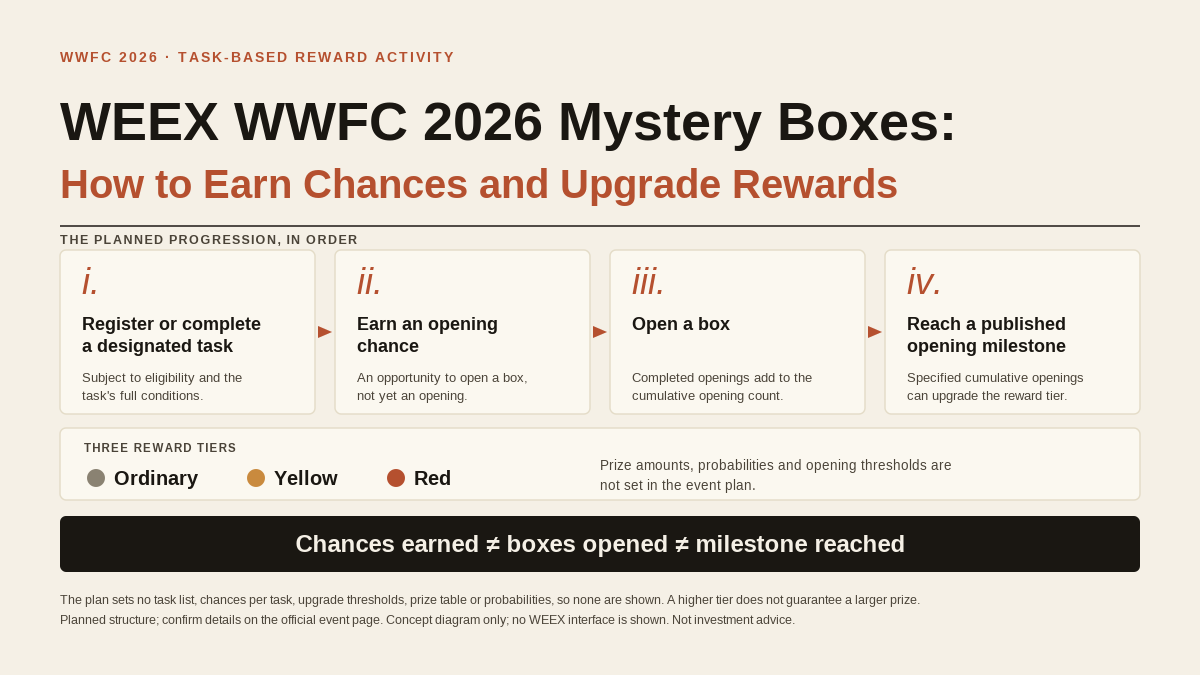
WEEX WWFC 2026 Mystery Boxes: How to Earn Chances and Upgrade Rewards
Explore WEEX WWFC 2026 mystery boxes: how to earn opening chances, understand three reward tiers, and track cumulative openings toward reward upgrades.
Crypto PNL vs Trading Volume: How WEEX WWFC 2026 Leaderboards Work
Compare crypto PNL, trading volume, and ROI with worked examples, and learn how to read the four planned WEEX WWFC 2026 leaderboards accurately.

Cardano’s $5M event budget faces 5 times more opposition

Repaying a Bitcoin-backed loan on Sui can leave you waiting to withdraw native BTC

Why Bitcoin’s quantum security upgrade may take years
Cysic CEO: Over 6 Million BTC Public Keys Exposed, Accounting for 31.2% of Circulation

Penetrating Social Trading Ledgers: Who is Really Making Profits Amidst the Traffic Noise?

Nearly two-thirds of Square Bitcoin payments were under $20

India Plans to Ease Disclosure Requirements for Foreign Investment Funds
Overview of 6 New AI Mining Projects: Perhaps the Most Noteworthy Track After Privacy Narratives
Bitcoin buyers face a trading issue as stablecoins just suffer their biggest supply drop since 2022
Will the Market Rebound After Thanksgiving? Bank of America: Likely Short-Term, Major Trends Require Three Conditions

XRPL Credit Updates Approaching 29 Vote Threshold
NEAR is cutting inflation. Who pays the cost of fewer new tokens?
What Does the New Bitcoin Price Event Contract Filing Actually Specify?

Report Warns West Antarctic Ice Sheet May Have Crossed Climate Tipping Point
Is Wall Street Trapped? The $80,000 Cost Line of Bitcoin ETF
Meta Plans to Launch AI Device Muse Charm at $300, Smartwatch Delayed to 2027
Oddo BHF Maintains Neutral Outlook on French Government Bonds, AI Sector Repricing in Early Stages

XRPL open-sources a lending app. How would borrowing work?
Institutional Withdrawal and Retail Frenzy: Why is the Eastern European Crypto Market Exhibiting 'Abnormal' Trends?
Optimism Launches Election for Security Council Leader with a 24-Month Term

Hong Kong SFC flags Hyperliquid as suspicious trading platform, can HYPE price hold $65?
Who benefits from Sui’s staking rewards before all its tokens circulate?
1inch moves nearly 9,000 Ethereum after year-long dormancy amid treasury sales

Why Does BlackRock Care About MEV Acquittals? A Trial of 'The Attacker Being Attacked'
LlamaRisk Proposes to Lower Collateral Rates for Coinbase Tokenized Stocks on Aave V4
India's Central Bank Proposes 'Trusted Person' Confirmation for Electronic Transfers
PAXG puts gold in a wallet. Getting the bullion out is another matter
XRP Ledger lending upgrade just 5 votes away from approval
WEEX WWFC 2026 Mystery Boxes: How to Earn Chances and Upgrade Rewards
Explore WEEX WWFC 2026 mystery boxes: how to earn opening chances, understand three reward tiers, and track cumulative openings toward reward upgrades.
Crypto PNL vs Trading Volume: How WEEX WWFC 2026 Leaderboards Work
Compare crypto PNL, trading volume, and ROI with worked examples, and learn how to read the four planned WEEX WWFC 2026 leaderboards accurately.
Latest articles



Latest coin listings on WEEX


