BTC Bounces Back to $92,000 Support Amid Institutional Buy-the-Dip


Original Article Title: "Institutional Buying Against the Trend, BTC Pullback Fails to Conceal Long-Term Bull Market Signal"
Original Source: BitpushNews
Due to the rise in U.S. Treasury yields and investors adjusting their expectations for the Federal Reserve's monetary policy, the U.S. Dollar Index (DXY) hit a new high, causing a second consecutive day of correction in the cryptocurrency market.
CMC data shows that in the past 24 hours, BTC briefly dropped to a intraday low of $92,600, rebounding to around $94,400 at the time of writing, still down 2.1% in the past 24 hours, with Ethereum falling to around $3,330.
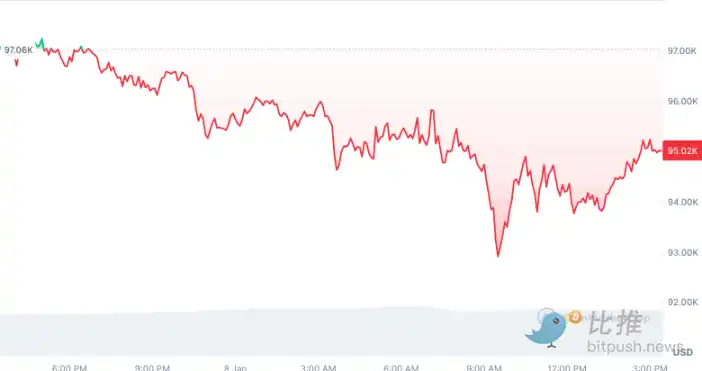
This trend is closely related to strong economic data released by the U.S., including a sharp increase in job vacancies and better-than-expected manufacturing performance. These data further solidify Federal Reserve Chairman Powell's view that there may be no need for aggressive rate cuts this year to effectively control inflation. The "Fed megaphone" Nick Timiraos pointed out that today's released Fed meeting minutes further indicated that officials are generally willing to keep rates unchanged at the meeting scheduled at the end of this month. As a result, the market adjusted its expectations for the Federal Reserve's future monetary policy, causing a drop in risk assets.
CoinGlass data shows that the two-day retreat has led to the liquidation of nearly $1 billion worth of cryptocurrency leverage derivative positions, primarily long positions betting on price increases.
Macroeconomic and Policy Expectations Dominate Market Sentiment
This Bitcoin price correction reflects the market's adjustment of its earlier optimistic expectations for Bitcoin. The previous optimism was mainly based on two assumptions: first, that the Federal Reserve would adopt a looser monetary policy, actively cutting interest rates; and second, that if Trump were re-elected as U.S. President, it would bring a clearer regulatory framework for the cryptocurrency industry. However, current economic data and the Fed's statements have raised doubts in the market about the extent to which these two assumptions will materialize.
Philipp Pieper, co-founder of Swarm Markets, pointed out that in the absence of new market narratives driving the market, the cryptocurrency market is gradually returning to the logic of traditional financial markets. When interest rates are low, investors typically tend to increase their allocation to risk assets (such as cryptocurrencies and tech stocks) in search of higher returns. However, due to the unclear cryptocurrency policies of the Trump administration, the market sentiment is cautious, and this uncertainty is expected to persist for some time.
An analysis report from 10x Research also emphasizes the importance of macroeconomic data on Bitcoin's price. The report believes that the Fed's response to U.S. economic data and global liquidity conditions are the two key macroeconomic factors influencing Bitcoin's price trends. In the short term, Bitcoin's price may therefore enter a volatile "banana zone." The "banana zone" vividly describes the turbulent price movements of assets under the combined influence of macro factors.
BitMEX Co-founder Arthur Hayes also analyzed the impact of USD liquidity on Bitcoin price in his latest blog post, suggesting that Bitcoin and cryptocurrency prices typically rise when USD liquidity increases.
Institutional Accumulation Exceeds 34,000 BTC in the Past 30 Days
Despite short-term market correction pressures, analysts remain optimistic about Bitcoin's long-term prospects. On-chain data from CryptoQuant indicates that the market's "potential demand remains very strong." The institution measures market demand by comparing the amount of idle Bitcoin to the new Bitcoin supply from miners. When the reduction in idle Bitcoin far exceeds the new supply, it indicates strong market demand.
A CryptoQuant analyst wrote that around December 21, 2024, institutional investors sold about 79,000 BTC in a week, leading to a 15% pullback in the market. However, large institutions then took advantage of the market consolidation phase to continue buying below $95,000 using a time-weighted average price (TWAP) strategy. In the past 30 days, institutional investors have accumulated over 34,000 BTC, providing buy-side support for Bitcoin's recent rebound.
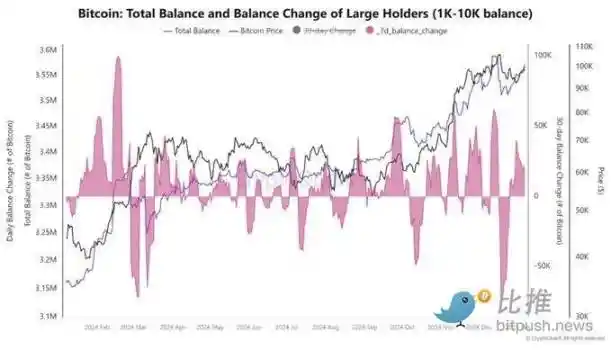
Despite adjustment periods in institutional portfolios, the trend of on-chain Bitcoin accumulation has been evident since June 2023. This indicates that amidst retail demand being at a five-year low, institutional investors' interest in Bitcoin remains high.
CryptoQuant analysis also shows that Bitcoin's pullback has significantly reduced traders' unrealized profits, which is a normal occurrence after a substantial rally. Currently, traders' realized price is around $88,000 (usually forming price support in a bull market).
Historical data shows that after the past two U.S. presidential elections, Bitcoin experienced pullbacks in January, with a 36% decline in January 2017 and January 2021.
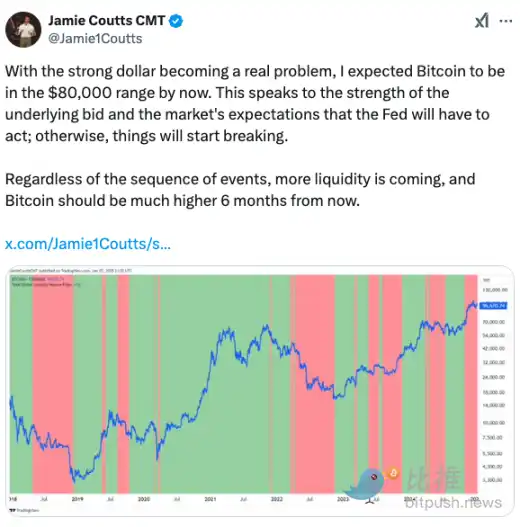
Real Vision's Chief Crypto Analyst Jamie Coutts commented on the X platform, saying, "As the strength of the U.S. dollar becomes a real issue, I originally expected Bitcoin to be around $80,000 now, but it didn't drop to that level, indicating strong potential buying pressure and the market's expectation that the Fed will have to take action; otherwise, the situation will start to deteriorate. However events unfold, more liquidity is on the way, and Bitcoin should be much higher in six months."
Overall, Bitcoin's recent pullback has been mainly influenced by macroeconomic data and changing expectations regarding the Federal Reserve's policy. In the short term, the market may continue to experience a period of volatility. However, institutional investors' ongoing accumulation behavior and the strong demand reflected in on-chain data will provide support for the long-term trend.
You may also like

Major Update for ChatGPT: Cross-Platform Functionality, One-Click Website Creation, and Lower Costs
BTC Challenges 64,000 After Breaking 63,000, Market Trading 'Manageable Risks'
As the Bubble Bursts, Who Dominates Attention in the AI Era? A 2026 Guide to Influential AI KOLs in China and the UK
Old Money in Crypto Shifts: Paradigm Raises $1.2 Billion, Half Bet on AI and Robotics
Bitdeer unveils $36M Nevada factory to shake up Bitcoin mining
Perplexity Fine-Tuned a Chinese AI Model to Match Claude Opus 4.8 at One-Third the Cost
Bank of Korea defends bank-first stablecoin plan amid bill deadlock
JPMorgan says bitcoin's main risk isn't Strategy, but blockchain adoption that doesn't benefit public chains and tokens
Fear & Greed Index Today: What Extreme Fear Means for Crypto, Stocks and Gold
Labour MPs Push to Make UK Crypto Donation Ban Permanent
Supreme Court ruling expanding Trump's authority over federal agencies raises questions for SEC, CFTC as crypto rulemaking advances
'Bottom building in progress': Analysts say bitcoin holder capitulation signals late-stage bear market
A Comprehensive Analysis: Starting from 1996, Who is Laying the Foundation for the Next Generation of Capital Markets
Luke Dashjr, the Biggest Anti-Spammer of Bitcoin, Inscribed Phrases on the Network in 2011
Whales bought 270,000 BTC while ETFs bled $7 billion. One side is wrong
The crypto IPO class of 2025-26 is down as much as 89%. Autopsy of a listing boom
Robinhood Chain Mining Guide: A Comprehensive Tutorial from Cross-Chain to Memecoin
BitGo CEO says single-digit percentages of bitcoin's supply are 'probably right' for large holders amid Strategy's sale
Major Update for ChatGPT: Cross-Platform Functionality, One-Click Website Creation, and Lower Costs
BTC Challenges 64,000 After Breaking 63,000, Market Trading 'Manageable Risks'
As the Bubble Bursts, Who Dominates Attention in the AI Era? A 2026 Guide to Influential AI KOLs in China and the UK
Old Money in Crypto Shifts: Paradigm Raises $1.2 Billion, Half Bet on AI and Robotics
Bitdeer unveils $36M Nevada factory to shake up Bitcoin mining
Perplexity Fine-Tuned a Chinese AI Model to Match Claude Opus 4.8 at One-Third the Cost