
DeepSeek Suddenly Liquidates Bitcoin


Original Title: "DeepSeek Sudden Burst Shocks Bitcoin"
Original Source: Carbon Chain Value
The development trend of Ai+Crypto seems to be rapidly unfolding. However, the way this unfolding is happening is a bit different from what everyone had imagined. It is unfolding in the form of a sudden burst. Ai first burst the traditional capital market, and then burst into the Crypto market.
On January 27, the emerging Chinese Ai giant model DeepSeek's download volume surpassed ChatGPT for the first time. Topping the U.S. APPStore charts. Triggering global attention and coverage from the technology, investment, and even media sectors.
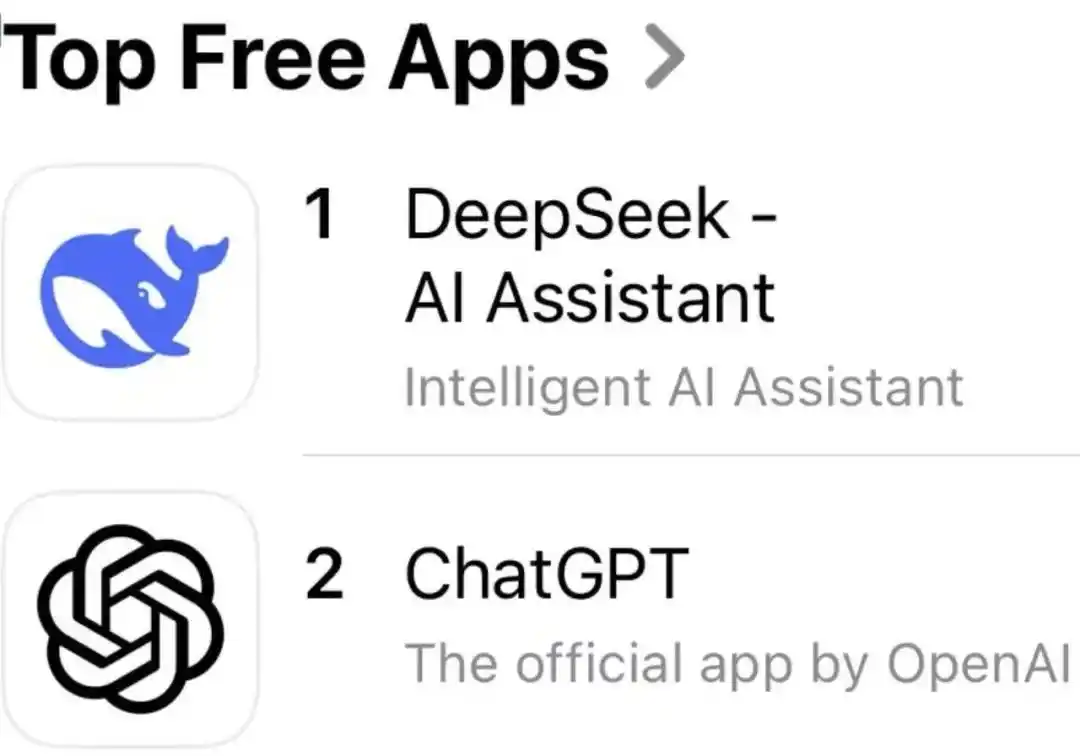
Behind this event, not only does it make people think of the possibility of reshaping the future development landscape of Chinese and American technology, but it also conveys a brief sense of panic to the American capital market. As a result, Nvidia fell by 5.3%. ARM fell by 5.5%. Broadcom fell by 4.9%. TSMC fell by 4.5%. Additionally, Micron, AMD, Intel all experienced corresponding declines. Even the Nasdaq 100 futures fell by -400 points. It is expected to mark the largest single-day decline since December 18. According to incomplete statistics, the U.S. stock market is expected to evaporate over $1 trillion in market value during Monday's trading, shedding a third of the total cryptocurrency market value.
Following the trend of the U.S. stock market, the cryptocurrency market also witnessed a sudden drop due to DeepSeek's actions. Bitcoin broke below $100,500, with a 24-hour drop of 4.48%. ETH fell below $3,200, with a 24-hour drop of 3.83%. Many are still puzzled as to why the cryptocurrency market experienced a rapid plunge. It may be related to reduced expectations of a Fed rate cut and other macro factors.
So where does the market panic come from? DeepSeek did not develop with a massive capital and a huge number of GPUs like OpenAI, Meta, or even Google. OpenAI was founded 10 years ago, has 4,500 employees, and has raised $6.6 billion in funding to date. Meta spent $600 billion to develop an AI data center almost the size of Manhattan. In contrast, DeepSeek, founded less than 2 years ago, has 200 employees, development costs of less than $10 million, and did not spend a fortune accumulating Nvidia's GPU.
Some can't help but ask: How can they compete with DeepSeek?
DeepSeek has disrupted not only the cost advantage on the capital/technology front but also people's inherent traditional beliefs and ideologies.
The Product VP of DropBox exclaimed on social media platform X that DeepSeek is a classic disruptive story. Existing enterprises are optimizing existing processes, while disruptors are rethinking fundamental methods. DeepSeek asked: What if we do this smarter instead of putting more hardware in?
It's worth noting that currently, the cost of training top-tier AI large models is extremely expensive. Companies like OpenAI, Anthropic, etc., spend upwards of $100 million on computations alone. They need large data centers equipped with thousands of $40,000 GPUs. It's like needing an entire power plant to run a factory.
Suddenly, DeepSeek appeared and said, "What if we do this with $5 million?" They didn't just talk the talk; they walked the walk. Their model is on par with or even surpasses GPT-4 and Claude in many tasks. How did they do it? They rethought everything from scratch. Traditional AI is like writing each number with 32 decimal places. DeepSeek is like, "What if we only use 8 decimal places? It's still accurate enough!" Memory requirements reduced by 75%.
The Product VP of DropBox said the staggering result is that training costs decreased from $100 million to $5 million. The required GPUs decreased from 100,000 to 2,000. API costs dropped by 95%. It can run on gaming GPUs without data center hardware. Most importantly, they are open source. It's not magic; it's just incredibly clever engineering.
Some have even stated that DeepSeek has completely disrupted traditional notions in the field of artificial intelligence: "China only knows how to do closed-source/proprietary technology. Silicon Valley is the global center for AI development, with a huge lead. OpenAI has an unparalleled moat. You need to spend tens of billions or even hundreds of billions of dollars to develop SOTA models. The value of the model will continue to accrue (the fat model hypothesis and the scalability assumption mean that model performance is linearly related to training input costs (computation, data, GPU). All these traditional views, even if not completely overturned overnight, have been shaken."
The prominent US equity investment firm Archerman Capital, in its briefing on DeepSeek, stated, "First, DeepSeek represents a victory for the entire open-source relative to closed-source, and contributions to the community by DeepSeek will quickly translate into prosperity for the entire open-source community. I believe that the open-source power, including Meta, will further develop open-source models based on this. Open-source is a collective effort of many people contributing to achieve great things."
Secondly, OpenAI's groundbreaking approach may currently seem a bit rudimentary, but we cannot rule out the possibility that a new paradigm shift will occur once a certain threshold is reached. This could widen the gap between closed source and open source, although this is hard to predict. Looking at the historical experience of AI development over the past 70 years, computational power has been crucial and may continue to be so in the future.
Furthermore, DeepSeek aims to make open-source models as good as closed-source models, with even higher efficiency. This reduces the need to spend money on OpenAI's API, as private deployment and independent fine-tuning will provide greater room for downstream applications. In the coming one or two years, we are likely to witness a more diverse range of inference chip products and a more prosperous LLM application ecosystem.
Lastly, the demand for computational power will not decrease. The Jevons Paradox illustrates how, during the first Industrial Revolution, the efficiency improvement of steam engines actually increased the total consumption of coal in the market. Similarly, from the era of brick-sized cell phones to the era of Nokia phones, it was precisely because they became cheaper that they became widespread, and it was because they became widespread that the total market consumption increased.
You may also like

Pantera Capital Partner: How Tokenization is Restructuring the Private Equity and Early Investment Ecosystem?

New York Proposes Stricter Stablecoin Issuer Rules Aligned With Federal GENIUS Act
NYDFS proposed stricter stablecoin issuer rules aligned with the GENIUS Act, covering reserves, custody, redemption timelines, audits, and capital buffers.
Every exchange is a "Universal Exchange."

The counterattack of traditional finance: Alliance chains are quietly reviving

CryptoQuant Says Bitcoin Profitable Supply Is Near 45% Pressure Zone as On-Chain Data Points to Market Repricing
CryptoQuant said Bitcoin’s profitable supply is nearing the 45% pressure zone, signaling rising market stress, unrealized losses, and a possible on-chain repricing phase.

Bitcoin Falls Below 200-Week Moving Average as On-Chain Data Shows Over Half of Supply in Loss
Bitcoin dropped below its 200-week moving average as on-chain data showed over 50% of circulating supply is now in loss, signaling rising market stress.

CFTC Reportedly Plans New Prediction Market Rules Focused on Manipulation Risk and Public Interest Review
The CFTC is reportedly preparing new prediction market rules focused on manipulation risk, public interest review, and retail trader protections.

Meet the new WEEX trial fund—your gateway to greater profits

WEEX Labs Lands at Dutch Blockchain Week: A Disruptive Crypto × AI Conversation Sets Sail in Amsterdam

SK Hynix Reportedly Plans U.S. ADR Listing as Early as August, With SEC Approval Possible in Late June
SK Hynix may pursue a U.S. ADR listing as early as August, with SEC approval reportedly possible in late June amid strong AI chip supply chain demand.

SpaceX vs Tesla vs xAI: Which Elon Musk Trade Has the Biggest Upside in 2026?
OpenAI Reveals It Has Confidentially Submitted an S-1 to the SEC, Keeping the Door Open for a Future IPO
On June 9, according to an OpenAI announcement, the company recently confidentially submitted a draft S-1 registration statement to the U.S. Securities and Exchange Commission (SEC), beginning the preliminary compliance process for a potential initial public offering. OpenAI said it chose to disclose this proactively because it expected the news might leak; however, the company has not yet set a specific listing timeline, and related arrangements may still take some time.

Latest research from 13 top universities including Cornell University: The current state, challenges, and misconceptions of the fusion of Crypto and AI
Deconstructing Anthropic: The Best AI Company, Possibly Also a Type of Organizational Invention
Apollo and Blackstone Reportedly Back $35 Billion Anthropic Chip Financing as Deal Details Remain Unclear
On June 9, according to currently available news alerts, Apollo and Blackstone Group participated in a $35 billion financing for an Anthropic “chip project.” Based on the original wording of the report, the funding has already been raised, but public information remains limited. The financing structure, use of proceeds, project entity, and whether Apollo and Blackstone participated through equity, debt, or project financing have not yet been disclosed.

Humanity Protocol Security Incident Escalates: More Than $31 Million Stolen From Related Addresses as Attacker Continues Selling H for ETH
On June 9, according to monitoring by Onchain Lens, more than $31 million has been stolen from addresses linked to Humanity Protocol, and the attack is still ongoing, with the hacker continuously swapping H tokens for ETH. Project founder Terence Kwok later confirmed the security incident on X, saying the issue involved a private key leak.

Bloomberg: As Bitcoin Weakens, Stablecoins and RWA Continue to Drive Expansion in Crypto Businesses
In June, Bloomberg reported that despite Bitcoin falling below $60,000 last week, wiping out about $235 billion in market value within seven days, and dropping close to 50% from last year’s peak, some core businesses in the crypto industry are still expanding, mainly in stablecoins, real-world asset tokenization (RWA), payments, and infrastructure. The report also noted that overall altcoin activity has contracted significantly: altcoin market capitalization has fallen from a peak of about $431 billion in November 2021 to around $170 billion, and among the tens of millions of tokens issued in recent years, fewer than 1,700 still maintain meaningful trading activity.

Galaxy Deep Research Report: How Hyperliquid's HIP-4 Upgrade Changes the Landscape of Prediction Markets?
Pantera Capital Partner: How Tokenization is Restructuring the Private Equity and Early Investment Ecosystem?
New York Proposes Stricter Stablecoin Issuer Rules Aligned With Federal GENIUS Act
NYDFS proposed stricter stablecoin issuer rules aligned with the GENIUS Act, covering reserves, custody, redemption timelines, audits, and capital buffers.
Every exchange is a "Universal Exchange."
The counterattack of traditional finance: Alliance chains are quietly reviving
CryptoQuant Says Bitcoin Profitable Supply Is Near 45% Pressure Zone as On-Chain Data Points to Market Repricing
CryptoQuant said Bitcoin’s profitable supply is nearing the 45% pressure zone, signaling rising market stress, unrealized losses, and a possible on-chain repricing phase.
Bitcoin Falls Below 200-Week Moving Average as On-Chain Data Shows Over Half of Supply in Loss
Bitcoin dropped below its 200-week moving average as on-chain data showed over 50% of circulating supply is now in loss, signaling rising market stress.


