
Digital Credit: Comparing The Six Bitcoin Preferred Stocks

 Prefer us on Google



Digital credit is an emerging asset class that transforms corporate Bitcoin balance sheets into income producing securities. Strategy pioneered the market with five perpetual preferred equity instruments: STRK, STRF, STRD, STRC, and STRE (the first four are listed in the U.S.). Strive subsequently introduced SATA and SATS, bringing the category to six U.S. instruments across two issuers.
These securities offer investors preferred equity (read: credit-like) exposure to companies whose balance sheets are dominated by Bitcoin. Their perpetual structure means investors principally rely on recurring dividends and the continued financial strength of the issuer. Unlike term debt, there is no maturation date at which the full principal is ever paid back.
Evaluating digital credit requires examining four characteristics: creditworthiness, investor protections, liquidity, and dividend profile.
This article explains all four dimensions and then offers a ranking for the six digital credit instruments along these lines. None of this should be taken as investment advice---it is only a systematic framework for analyzing digital credit.
1. Creditworthiness
Creditworthiness measures an issuer's ability to support its financial obligations.
Traditional credit analysis focuses on earnings, free cash flow, and refinancing capacity. Companies with strong cash generation can service interest and repay maturing debt. Digital credit issuers today derive financial strength primarily from their Bitcoin reserves, placing greater emphasis on net asset coverage. In the future we could certainly see digital credit issuers that also have significant cash flows on top of Bitcoin holdings, which would add to creditworthiness.
The central question is how much Bitcoin supports each dollar of credit obligations. One useful measure is the BTC Rating, which compares the dollar value of Bitcoin reserves with the outstanding credit, accounting for the seniority of each credit instrument. Cash reserves can further strengthen creditworthiness by reducing net obligations.
For example, a 5x BTC Rating indicates five dollars of Bitcoin supporting every dollar of notional credit claims. Higher ratings provide greater protection against Bitcoin price declines.
Seniority matters because instruments from the same issuer can have different claims on the same asset base. A senior preferred instrument benefits from greater coverage than a junior preferred instrument: all senior claims are included in the BTC Rating calculation of a junior instrument.
Creditworthiness also depends on corporate governance and capital allocation. Management must preserve sufficient Bitcoin coverage while funding recurring dividends. Issuing additional credit increases dividend obligations, while assets accumulation (Bitcoin or cash) strengthen the asset base. Excessive leverage, poor treasury management, or sustained Bitcoin declines can weaken coverage over time.
Investors must therefore evaluate both their assumptions about Bitcoin's long term performance and management's ability to maintain a sustainable capital structure.
2. Investor Protections
Investor protections determine what happens when an issuer fails to pay its promised dividends.
While creditworthiness concerns an issuer's ability to pay, investor protections govern the consequences of missed payments, and more specifically the compensation investors may receive for delayed income.
The first distinction is cumulative versus noncumulative dividends. Cumulative dividends continue accumulating when payments are skipped, preserving the investor's claim to unpaid distributions. Noncumulative dividends permit the issuer to permanently forgo a payment.
The second distinction is the treatment of unpaid dividends. Some instruments preserve unpaid amounts without additional compensation. Others compound arrears at the regular dividend rate. The strongest protections impose penalty rates, which cause unpaid dividends to compound at progressively higher rates as deferrals continue.
Penalty rates create financial incentives for management to maintain regular payments. They also compensate investors for the additional risk and delay associated with missed distributions.
Other investor protections may include restrictions on payments to junior shareholders, preferred shareholder voting rights or director elections, and dedicated dividend reserves.
These provisions establish the contractual guardrails surrounding dividend payments. Stronger protections increase the cost of deferral and improve the investor's position to receive income.
3. Liquidity
Liquidity measures how easily investors can enter and exit positions without materially affecting market prices. This is especially important for digital credit, which does not mature and pay back principal on a fixed date. A liquid market is how an investor would "get his money back" if he wants to exit his position.
Digital credit has developed substantial secondary market liquidity, particularly in its leading instruments. The six U.S.-listed digital credit tickers are among the most actively traded preferred equity securities in the U.S. markets.
Two metrics help investors evaluate liquidity.
Absolute trading volume measures the total dollar value traded over a given period. Greater volume accommodates larger transactions and makes it easier for institutions to establish or liquidate positions.
Relative liquidity, or turnover, measures trading volume as a percentage of an instrument's market capitalization. It captures how actively a security trades relative to its outstanding size.
For example, an instrument with $50 million in daily volume and a $1 billion market capitalization has 5% daily turnover. Another instrument trading $100 million daily with a $10 billion market capitalization has only 1% turnover. The second instrument offers greater absolute trading capacity, while the first experiences substantially greater trading activity relative to its size.
Absolute volume facilitates large transactions, while relative turnover reveals the level of trading activity relative to the capital outstanding.
-- Price
4. Dividend Profile
Dividend profile describes the characteristics of the income an investor receives. Three main considerations are the dividend rate policy , payment frequency , and dividend yield.
The first distinction is between fixed and variable dividends. Fixed dividends establish a predetermined annual payment per share. Investors know the nominal income they are entitled to receive, allowing them to plan around a predictable cash flow stream. Variable dividends allow issuers to adjust the payout rate over time. These adjustments can respond to market interest rates, investor demand, or the trading price of the instrument. Fixed dividends prioritize income predictability for investors with reduced flexibility for issuers. Variable dividends provide flexibility for issuers but less predictability for investors.
The second consideration is payment frequency. Traditional preferred securities generally pay quarterly. Digital credit has introduced monthly, twice monthly, and daily dividend schedules. More frequent payments improve cash flow availability, accelerate reinvestment opportunities, and reduce the concentration of distributions around individual payment dates. After January 1 2027, all six instruments will be doing daily dividends.
The third consideration, and perhaps the most important out of anything mentioned in this article, is the raw dividend yield. This is the annualized income received divided by the trading price of the credit. A higher yield is generally preferred, but it also must be contextualized against risks and other considerations.
Ranking the Six Instruments
The following framework ranks the six instruments relative to one another. Rank 1 represents the strongest position and rank 6 the weakest, with ties where instruments share identical characteristics.
Creditworthiness and investor protections receive overall rankings. Liquidity is segmented into absolute trading volume and turnover. Dividend profile is segmented into rate certainty and yield. While each category's segments can be evaluated together as a composite metric based on the investor's own needs, I am choosing to segment them for more precision. I have also thrown out payment frequency since all six will be daily in less than two months.
For dividend rate certainty, fixed dividends rank ahead of variable dividends because their nominal payments are predetermined. This ranking specifically measures income predictability.
|----------------|------------------|--------------------------|--------------------|--------------|-----------------|-----------| | Instrument | Creditworthiness | Investor protections | Trading volume | Turnover | Rate Policy | Yield | | STRF | 1 | 2 | 5 | 6 | 1= | 5 | | STRC | 2 | 3 | 1 | 3 | 5= | 4 | | STRK | 3 | 4 | 4 | 4 | 1= | 6 | | STRD | 4 | 6 | 6 | 5 | 1= | 2 | | SATA | 5 | 1 | 2 | 2 | 5= | 3 | | SATS | 6 | 5 | 3 | 1 | 1= | 1 |
Equal signs indicate tied rankings. Liquidity rankings are based on average daily trading volumes from November 2--11, 2026, and turnover is calculated using the latest reported shares outstanding.
Notes about instrument rankings
Creditworthiness: Strategy's preferreds rank ahead of Strive's because of their greater asset coverage. Within each issuer, seniority determines the ranking. STRF has the highest BTC Rating because it is Strategy's most senior preferred, while SATS has the lowest coverage because it ranks below SATA in Strive's capital structure.
Investor protections: SATA and STRF rank first and second because unpaid dividends compound at escalating penalty rates and holders can elect directors following prolonged dividend deferrals. SATA's higher penalty rate ceiling and dividend reserve give it the edge. STRC and STRK both compound unpaid dividends at the regular dividend rate. I rank STRC ahead of STRK based on its higher current compounding rate, although STRK also gives holders the right to elect directors after prolonged dividend deferrals. SATS has cumulative dividends, but unpaid dividends do not compound. STRD ranks last because its dividends are noncumulative, meaning any skipped dividends are permanently forgone. Investors also have no right to bring on directors.
Of the six, STRC and SATA are variable rate instruments and the remaining four are fixed rate. This makes the dividend rate policy pretty straightforward.
The remaining columns---volume, turnover, and yield---are trackable numbers. For instance, here are turnover and volume numbers from the BFC Digital Credit Dashboard:
Conclusion
Each of the six digital credit instruments has a different set of tradeoffs. Investors who prioritize creditworthiness may prefer STRF, while those who prioritize dividend certainty and yield may prefer SATS.
The relative importance of each of these dimensions depends on the investor's own needs. As digital credit continues to develop, investors can use this framework to evaluate new instruments and determine which ones are best suited to their objectives.
Disclaimer: This content was prepared on behalf of Bitcoin For Corporations for informational purposes only. It reflects the author's own analysis and opinion and should not be relied upon as investment advice. Nothing in this article constitutes an offer, invitation, or solicitation to purchase, sell, or subscribe for any security or financial product.
This content is provided for general informational purposes only and doesn't constitute financial, investment, legal, or tax advice. Any events, rewards, online promotions, or related information mentioned herein should not be considered a recommendation, solicitation, or invitation to purchase, sell, trade, or otherwise deal in any crypto assets. Crypto assets are highly volatile and may result in loss. The availability of WEEX services, products, and related events may vary by region. You are responsible for ensuring that your participation is in accordance with applicable local laws and regulations.
You may also like

Patch Released for Ethereum Gloas Fork

Bitcoin: Fearing Kidnappings, Whales Entrust $5 Billion to BlackRock

Interpretation of FATF Report on Scam Compound Funds: Virtual Assets Become Core Money Laundering Channels

How Much Is Anthropic Really Worth?

Lessons from Five Years of Real Estate Tokenization: Why Only Two Models May Succeed?

South Korea Proposes Withdrawal Suspension for Cryptocurrency: What Happens When Exchanges Suspect a Hack
Canton Coin ETF and November 13: What the SEC Filing States and Does Not State

Exclusive: Canton Strategic CEO warns MEV could raise costs for tokenized stock traders

Former Polychain Partner Launches Startup: Enters Tokenized Real Estate, Secures $50 Million Seed Round Funding to Create the 'S&P 500' of Real Estate
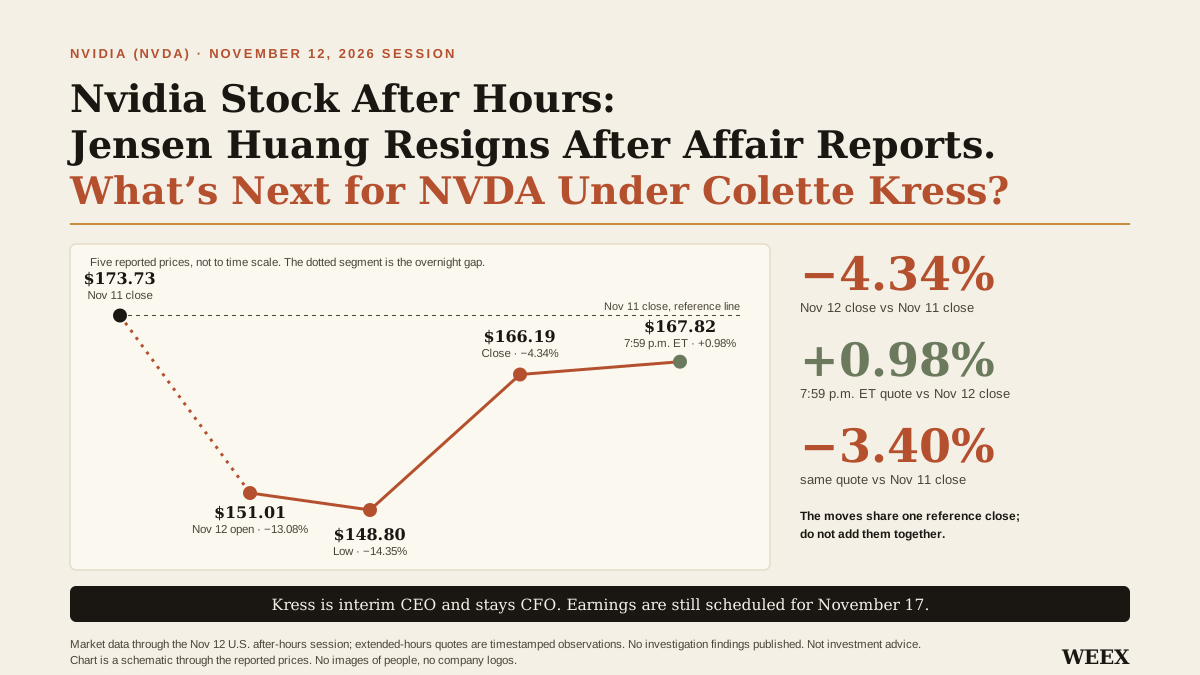
Nvidia Stock After Hours: Jensen Huang Resigns After Affair Reports. What’s Next for NVDA Under Colette Kress?
Nvidia fell 4.34% after Jensen Huang resigned, then rose 0.98% after hours. See what Colette Kress’s appointment means for NVDA and November 17 earnings.

Dai Zhifeng from Zhongtai Securities: A-shares Adjustment Does Not Change the Long-term Positive Foundation

PNC’s Coinbase Pilot Turns Incoming USDC Into Business Bank Deposits

CITIC Securities: Changes in Technology Company Management May Intensify Market Volatility

CITIC Securities: Changes in Technology Company Management May Intensify Market Volatility

Helius encrypts Solana transfers without removing operator trust

Apple's Market Cap Grew From $347 Billion to $4.6 Trillion During Tim Cook's 15 Years as CEO. Here's What That Growth Curve Means for Apple's Next Chapter Under John Ternus.

Rumble (RUM) Sells Two-Thirds Of Its Bitcoin As AI Business Grows

Apple Becomes a Safe Haven Amid AI Sell-off, Bernstein: 37x P/E Still Not Expensive

SpaceX Starship's 15th Test Flight to Challenge Two-Stage Capture, Aiming for Humanity's First Fully Reusable Orbital Rocket
Deutsche Bank Introduces Custody Services for Five Cryptocurrencies

Net Short Positions of Leveraged Funds Drop to 12,955 BTC, Down 89% from Peak

Intuitive Machines Q3 Revenue Reaches $269.3 Million, Raises Full-Year Guidance to $920 Million to $950 Million
The Hidden Costs of Sandwich Attacks: How Much Retail Investors Overpay for 'Free Trading'?

From Coinbase to Wall Street: Digital Asset Custody Enters a New Phase of Institutionalization

The Next Battle in Crypto Security: How to Rebuild the Authorization System Beyond Smart Contracts?
Greg Abel Has Plowed $14.4 Billion Into Warren Buffett's Favorite Stock This Year, and It's Not Apple
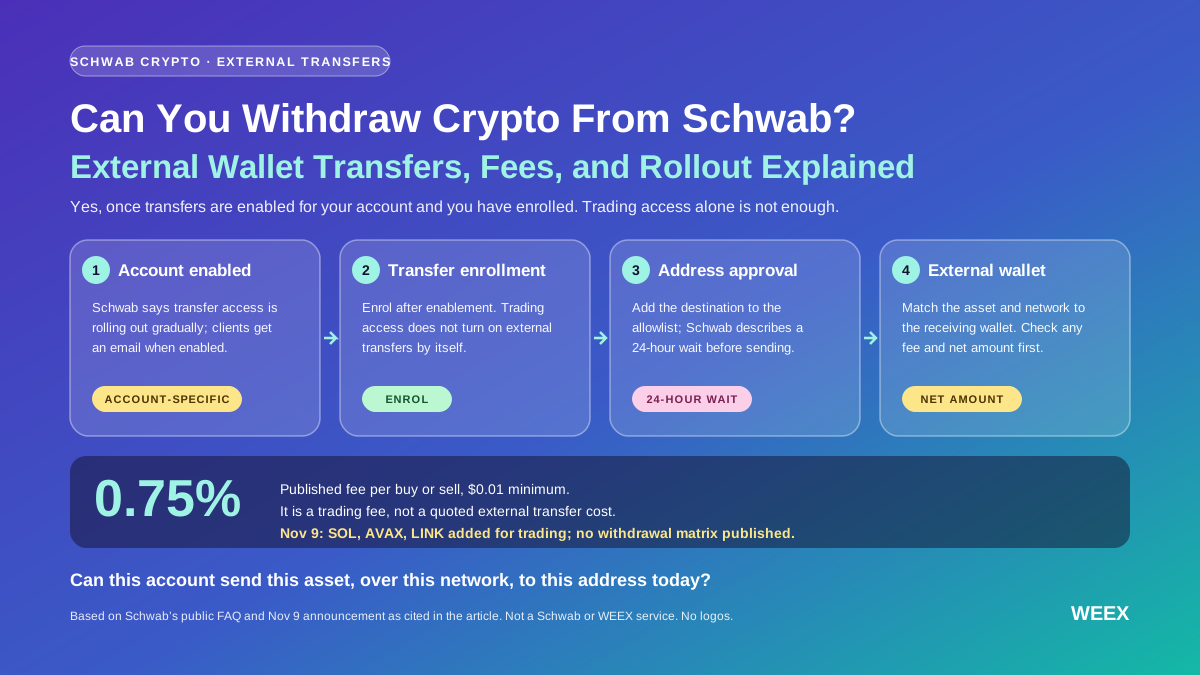
Can You Withdraw Crypto From Schwab? External Wallet Transfers, Fees, and Rollout Explained
Find out when Schwab Crypto allows external wallet withdrawals, how the 24-hour address wait works, and why the 0.75% trading fee is separate.

BAE Systems Raises Full-Year Free Cash Flow Guidance to £3 Billion

Zhang Yiming's Latest Statement: ByteDance Has the Capability to Compete with Anthropic and OpenAI, but Catching Up to the Cutting Edge Will Not Happen Until 2029 at the Earliest

End-of-2026 Review: Politics, AI, and the Federal Reserve - The Market is Experiencing a "Risk Repricing"
Patch Released for Ethereum Gloas Fork
Bitcoin: Fearing Kidnappings, Whales Entrust $5 Billion to BlackRock
Interpretation of FATF Report on Scam Compound Funds: Virtual Assets Become Core Money Laundering Channels
How Much Is Anthropic Really Worth?
Lessons from Five Years of Real Estate Tokenization: Why Only Two Models May Succeed?
South Korea Proposes Withdrawal Suspension for Cryptocurrency: What Happens When Exchanges Suspect a Hack
Latest articles


Latest coin listings on WEEX


