
Nvidia Stock After Hours: Jensen Huang Resigns After Affair Reports. What’s Next for NVDA Under Colette Kress?

 Prefer us on Google




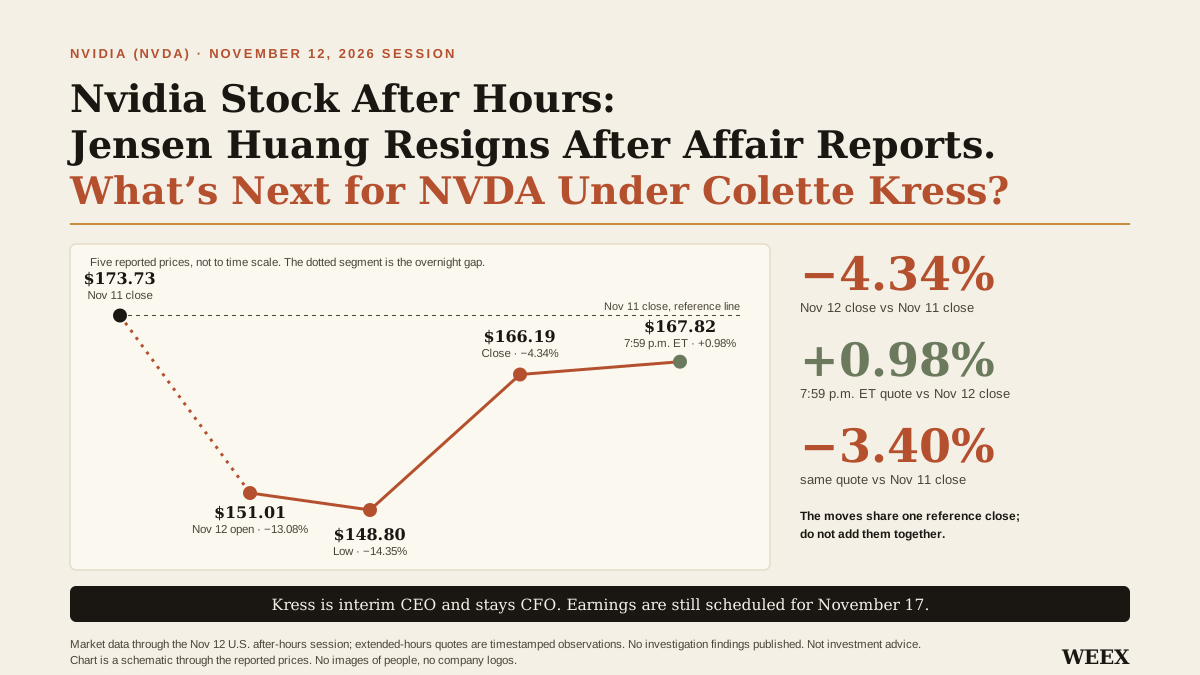
Nvidia (NVDA) opened about 13.08% lower on November 12 after the company confirmed Jensen Huang’s resignation, but recovered much of that loss to close at $166.19, down 4.34%. At 7:59 p.m. ET, the stock was quoted at $167.82, up 0.98% after hours from Thursday’s close. Nvidia appointed longtime CFO Colette Kress as interim CEO and named Harvey C. Jones board chair. The company kept its November 17 earnings schedule.
Thursday’s recovery shows why the opening selloff alone gives an incomplete picture. Nvidia regained more than $15 per share between the open and close, yet still finished well behind both the semiconductor sector and the Nasdaq-100 proxy. That combination points to a company-specific concern that survived the broader market’s rebound. The most useful question now is whether the transition changes what investors will pay for Nvidia’s earnings, or changes the earnings themselves through customer orders, product deliveries, financing commitments, or export rules.
Key Takeaways
- Jensen Huang resigned from three positions. Nvidia’s board accepted his resignation as CEO, president, and director on November 11. The company disclosed it on November 12. The SEC filing records a resignation.
- The two after-hours moves went in opposite directions. Nvidia fell about 8.6% at a reported observation on November 11 after board reports, then gained 0.98% at a November 12 evening observation after the resignation was public.
- Thursday’s rebound did not erase the relative weakness. NVDA closed down 4.34%, versus 0.26% for the iShares Semiconductor ETF and 0.32% for Invesco QQQ Trust.
- Kress is interim CEO and remains CFO. Nvidia is considering internal and external candidates for the permanent job. The leadership announcement did not publish investigative findings or revise financial guidance.
- November 17 earnings will test the operating case. The quarter ended before the board announcements. Fourth-quarter guidance and any changes to deliveries or customer commitments are more useful for assessing the business after the transition.
Market data through the November 12 U.S. after-hours session. Company disclosures checked November 13, 2026, at 10:50 a.m. UTC+8.
What Happened at the Nvidia Board Meeting? Jensen Huang Resigns and Colette Kress Takes Over
Nvidia’s Form 8-K filed with the SEC says the board accepted Jen-Hsun Huang’s resignation on November 11, effective immediately. The departure covered his positions as president, CEO, and board member. The company publicly announced the transition on November 12, ahead of Thursday’s regular trading session. The two dates refer to different events: the board action and its public disclosure.
The company’s transition announcement named Colette Kress interim CEO while she continues as executive vice president and CFO. Kress joined Nvidia as CFO in 2013. The board said it would consider both internal and external candidates for the permanent CEO position. It also appointed Harvey C. Jones, a director since 1993, as Nvidia’s first board chair.
That settles the question investors were asking Wednesday night: Huang is out, and Nvidia has an interim leader. It does not settle how responsibilities will be divided in practice. Kress holds the interim CEO and CFO titles; Jones chairs the board. The announcement does not describe who will lead every major customer negotiation, approve every new strategic financing commitment, or represent Nvidia in every discussion with regulators. Those details matter because the business implications depend on who can make and execute decisions, not just who holds a title.
| Date | What happened | Why it matters |
|---|---|---|
| November 8 | Nvidia published Huang’s acknowledgment of marital infidelity and announced an independent investigation. | His acknowledgment and the inquiry are part of the public record. Neither establishes every subsequent allegation. |
| November 10 | Independent directors confirmed they had retained outside counsel. | The board moved from announcing a review to naming who would conduct it. |
| November 11 | Media reported that the board was weighing Huang’s future. The SEC filing subsequently recorded that the board accepted his resignation that day. | The evening selloff occurred while investors were still trading on reports, before the company’s public confirmation. |
| November 12 | Nvidia disclosed the resignation, Kress’s interim appointment, and Jones’s appointment as chair. | Investors could now assess the actual transition rather than a list of possible outcomes. |
| November 17 | Nvidia is scheduled to release third-quarter results and hold its earnings call. | Management can explain whether the company’s operating outlook has changed. |
What Did Jensen Huang Confirm About the Affair, and What Remains Unresolved?
In his November 8 message to employees, Huang acknowledged being unfaithful to his wife, apologized, and said he would cooperate with the independent investigation. Reuters subsequently reported on a separate alleged relationship involving an Nvidia employee. That reporting should be attributed separately. Huang’s public acknowledgment did not establish all the details reported afterward, and the CEO transition release did not publish findings about either relationship.
The company’s initial board statement said the inquiry followed reporting that Huang had been the target of a foreign intelligence effort. The board also said that, at the time, it had no reason to believe national security or Nvidia secrets had been compromised. On November 10, independent directors said they had retained Joon H. Kim and Wachtell, Lipton, Rosen & Katz to conduct the investigation.
The resignation is a confirmed governance outcome. It does not establish a security breach, an export-control violation, or a completed finding about workplace conduct. It also does not establish that the investigation is over. For investors, the relevant follow-up is whether Nvidia, its independent directors, or a regulator discloses a specific finding that changes how the business operates. Repeating personal allegations adds little to that assessment.
The wording also matters for readers searching “Nvidia CEO fired.” Before the announcement, news outlets reported that the board was considering or preparing for his removal. The company’s subsequent filing records that the board accepted his resignation. The earlier reporting explains what investors were reacting to Wednesday evening; the filing is the better source for how Huang’s departure was formally recorded.
-- Price
Nvidia Stock After Hours: Why Did NVDA Fall Wednesday and Rise Thursday?
There were two different evening sessions. On November 11, Nvidia finished regular trading at $173.73, up 2.87% from the previous close. Associated Press reported that the stock subsequently fell about 8.6% after reports about the board. AP did not give an exact timestamp for that quote, so it should be described as a reported observation rather than the final trade of the session.
On November 12, after Nvidia publicly announced the leadership transition, the stock opened at $151.01 and touched $148.80. It then recovered to close at $166.19. Stock Analysis recorded $167.82 at 7:59 p.m. ET, up 0.98% from the Thursday close. Investing.com’s historical data also shows the $166.19 regular close. Extended-hours prices are timestamped observations and may differ across feeds or venues.
| Trading point | NVDA price or change | Comparison |
|---|---|---|
| November 11 regular close | $173.73, +2.87% | Versus the November 10 regular close of $168.89. |
| November 11 after hours | About −8.6% | Versus the November 11 regular close; exact quote time unavailable. |
| November 12 regular open | $151.01, −13.08% | Versus the November 11 regular close. |
| November 12 intraday low | $148.80, −14.35% | Versus the November 11 regular close. |
| November 12 regular close | $166.19, −4.34% | Versus the November 11 regular close. |
| November 12, 7:59 p.m. ET | $167.82, +0.98% | Versus the November 12 regular close. |
The gap from Wednesday’s close to Thursday’s open was $22.72. Nvidia recovered $15.18 from Thursday’s open to close, or roughly two-thirds of that opening gap. It also closed about 10.05% above its opening price. Both facts can be true alongside a 4.34% daily loss: one calculation starts at Thursday’s open, and the other starts at Wednesday’s close.
The after-hours bounce was smaller. Even at $167.82, NVDA was about 3.40% below Wednesday’s regular close. So “Nvidia rose after hours” and “Nvidia remained lower after Huang’s resignation” describe different baselines. It would also be misleading to add Wednesday night’s 8.6% reported drop to Thursday’s 4.34% loss: both use the same $173.73 reference close and capture overlapping repricing.
Reuters reported that Vanda Analytics tracked roughly $111 million of retail Nvidia buying in the first half hour of Thursday’s session. That provides evidence of early demand during the selloff. It cannot explain all the volume throughout the day or prove that investors decided the transition would have no lasting impact. The narrower conclusion is that the initial markdown did not hold through the close.
Was Nvidia (NVDA) Falling With Chip Stocks or Underperforming Them?
The cleanest comparison is to use the same completed regular-session window for Nvidia, iShares Semiconductor ETF (SOXX), and Invesco QQQ Trust (QQQ). SOXX gives a semiconductor benchmark. QQQ tracks the broader Nasdaq-100 and helps show whether the move extended beyond chip stocks. Both include Nvidia exposure, so neither is a fully independent control.
| U.S. regular-session close | Nvidia (NVDA) | iShares Semiconductor ETF (SOXX) | Invesco QQQ Trust (QQQ) |
|---|---|---|---|
| November 6 | $186.64 | $136.53 | $656.10 |
| November 9 | $178.67 | $146.76 | $679.35 |
| November 10 | $168.89 | $146.59 | $674.76 |
| November 11 | $173.73 | $155.40 | $690.38 |
| November 12 | $166.19 | $154.99 | $688.17 |
| November 12 close-to-close return | −4.34% | −0.26% | −0.32% |
| November 6–12 close-to-close return | −10.96% | +13.52% | +4.89% |
On Thursday alone, Nvidia underperformed SOXX by about 4.08 percentage points and QQQ by 4.02 percentage points. Across the longer window, starting from the last close before the November 8 board statement, Nvidia trailed SOXX by 24.48 percentage points and QQQ by 15.85 percentage points. The stock-specific weakness was already visible before the resignation became public.
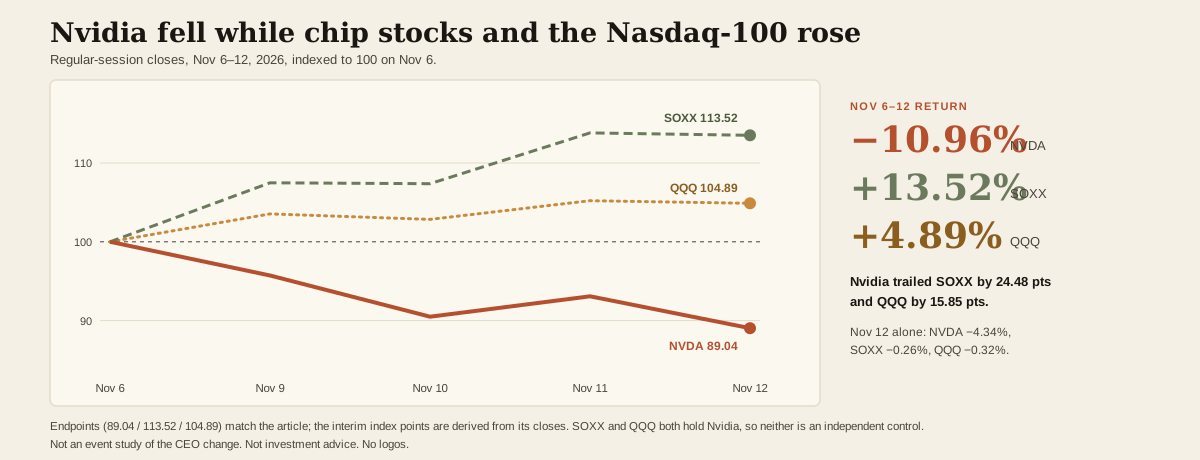
The opening and closing comparisons tell different parts of Thursday’s story. SOXX itself opened roughly 3.17% below Wednesday’s close and ended down only 0.26%. QQQ opened about 1.46% lower and ended down 0.32%. The broader market also recovered from its opening weakness. That makes it difficult to credit Nvidia’s entire rebound to confidence in Kress. By the close, though, Nvidia still carried a much larger loss than either benchmark.
This comparison does not measure the exact dollar impact of Huang’s departure. The sector funds have different holdings and respond to other earnings, interest rates, and market news. A formal event study would use more trading sessions, synchronized intraday prices, and a semiconductor peer basket that excludes Nvidia. The data here answers a narrower question: a broad chip selloff does not fully explain the difference between Nvidia’s return and the sector’s over this window.
What Does Colette Kress’s Appointment Change for Nvidia (NVDA)?
An internal interim appointment provides continuity in financial reporting and gives customers and suppliers a named executive to deal with. Kress was already the CFO responsible for explaining Nvidia’s results and outlook. She now also leads the company while the board looks for a permanent CEO. The immediate benefit is that the identity of the decision-maker is clearer. The harder question is how the leadership team shares responsibilities previously concentrated around the founder.
The impact may differ across three kinds of decisions. Routine operating decisions include shipments, support, and work already underway on products. These can continue through existing teams and processes. Strategic decisions include large capacity reservations, investments, and financing arrangements that may need senior approval. External decisions include discussions with government officials and negotiations with customers whose infrastructure plans span several years. The appointment answers who holds the interim role, but the earnings call and subsequent disclosures will give a better picture of whether the pace or terms of those decisions change.
The board chair appointment adds another distinction. Jones chairs the board; Kress manages the company as interim CEO while remaining CFO. The board will lead the permanent search, and the previously announced investigation was assigned to independent directors assisted by outside counsel. A candidate’s name appearing in the press tells investors less than a formal appointment with an effective date and a defined remit. An update on the search also does not answer when the investigators will report back.
One practical test is whether Nvidia can explain who owns its largest commitments. For example, Nvidia and Oracle announced plans in October to expand Oracle Cloud Infrastructure deployments using Vera Rubin systems. The existence of the plan is public. What matters now is whether the timetable, scope, or financing changes. A restatement of a long-term partnership is reassuring as a relationship signal; a specific shipment or deployment milestone provides stronger evidence that the operating plan is holding.
Could the CEO Transition Affect Nvidia (NVDA) Revenue, Margins, or Cash Flow?
Customer orders and AI infrastructure financing
An announced AI project can involve several distinct commitments: a customer’s capital budget, a financing package, a reservation for manufacturing capacity, and orders for delivered systems. A change in one does not automatically undo the others. A cloud company can maintain its total AI spending budget while changing which systems it buys or when it installs them. A developer can keep the same deployment goal but defer orders if financing closes later than expected.
For Nvidia, a project delay can push revenue into a later quarter without changing the total value of the order. A reduction in volume can affect multiple quarters. A shift from one system configuration to another can change the revenue or gross profit Nvidia earns per installation even if the customer’s total spending does not fall. Those differences matter more than the broad label “AI spending slowdown.”
Nvidia’s second-quarter filing disclosed that one direct customer accounted for 16% of quarterly revenue. That is evidence of customer concentration, not a measure of exposure to this controversy. A direct customer can also be an intermediary that buys for other organizations. To connect a named customer development to earnings, look for the relevant buyer, what was actually ordered, and whether the change affects shipment timing, volumes, or payment terms.
Capacity and product deliveries
Reuters reported that some partners and suppliers were considering contingencies while Huang’s future was uncertain. Supplier contingency planning can show that the transition is being taken seriously. It is not evidence that Nvidia canceled manufacturing capacity or that a product is late. The stronger signals would be a revised production schedule, a named change in committed capacity, or a customer confirming that a planned deployment has moved.
The distinction between a launch and a ramp is particularly useful. An initial shipment can arrive on time while the schedule for large-scale deployments changes. Equally, a supplier can continue producing components while a customer waits for its power, networking, or facilities to be ready. Investors should listen for whether Nvidia is discussing chips already delivered, complete systems in deployment, or units expected to ship later. Each milestone has a different connection to recognized revenue.
Export controls and regulatory scrutiny
Nvidia’s August earnings release and outlook assumed no Data Center compute revenue from China in the third-quarter forecast. That is a useful starting point for evaluating subsequent reports. A restriction confined to sales that the company had already excluded should not automatically be modeled as a new reduction to that forecast.
The analysis changes if a future action affects products, customers, licenses, or routes that were included in expectations, or if it changes the outlook for later quarters. A lawmaker calling for tighter controls and a regulator issuing an effective rule are different events. The useful sequence is to identify the actual action, determine which products and counterparties it covers, and check whether the affected sales were in the relevant guidance. The resignation announcement itself provided no basis for estimating a new export-related revenue loss.
What to Watch in Nvidia (NVDA) Earnings on November 17
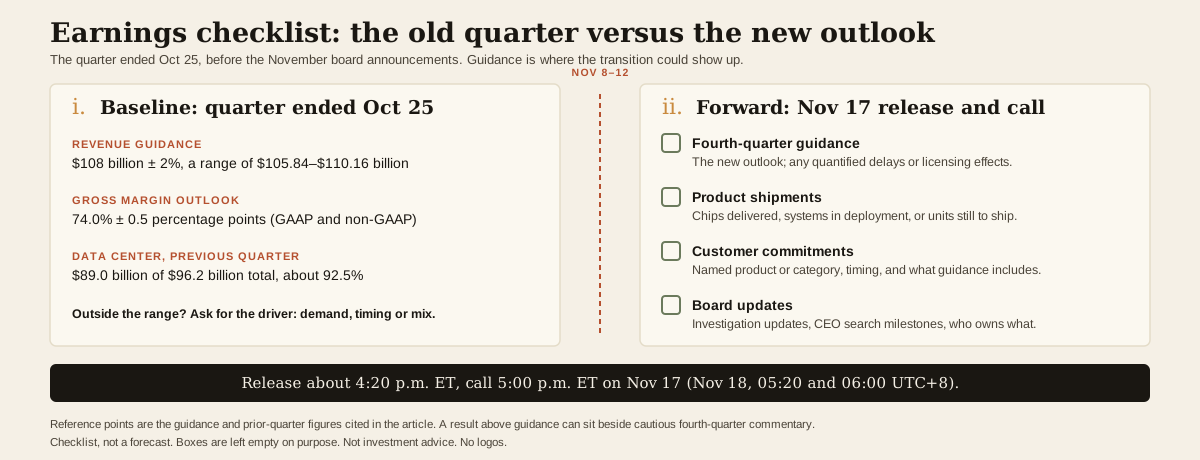
Nvidia kept its third-quarter fiscal 2027 earnings release on November 17 at approximately 4:20 p.m. ET, followed by a call at 5:00 p.m. ET. Those times are November 18 at 05:20 and 06:00 UTC+8, respectively. The transition announcement explicitly reaffirmed the schedule. Keeping the date gives investors a confirmed checkpoint; it does not mean the company has reaffirmed every financial assumption from August.
The third quarter ended on October 25, before the November board announcements and CEO transition. That makes the quarter a useful baseline for the business Nvidia had entering the crisis, but an incomplete measure of any operational impact from the leadership change. A result above guidance can coexist with cautious fourth-quarter commentary. A miss can also reflect conditions that predated Huang’s departure. The more revealing numbers will be new guidance and any explanation of how deliveries, customer plans, or margins have changed since the quarter ended.
| Metric or disclosure | Reference point | What would change the analysis |
|---|---|---|
| Third-quarter revenue | Prior guidance: $108 billion, plus or minus 2%; range $105.84–$110.16 billion | A result outside the range calls for a specific explanation of demand, shipment timing, product mix, or another driver. |
| Third-quarter gross margin | Prior GAAP and non-GAAP outlook: 74.0%, plus or minus 0.5 percentage points | Management should distinguish launch costs or mix changes from a more durable change in pricing or profitability. |
| Data Center revenue | $89.0 billion of $96.2 billion in the previous quarter, about 92.5% of total revenue | Compute and networking details can help distinguish demand changes from shifts in what Nvidia is able to deliver. |
| Fourth-quarter guidance | The August revenue range applies to Q3, not Q4 | The new outlook is more useful for gauging conditions after the transition, especially if management quantifies delays or licensing effects. |
| Cash flow and commitments | Review investments, purchase commitments, and financing separately | A project may preserve future chip sales while changing when cash is committed or how much balance-sheet risk Nvidia takes. |
| Leadership and investigation | Interim CEO, CFO, and board chair identified; permanent search underway | Listen for a clearer division of responsibilities, formal investigation updates, and milestones for the CEO search. |
Watch how management talks about commitments. “Demand remains strong” is useful context, but it does not tell investors whether deliveries were moved or how much revenue was affected. More informative commentary names the product or customer category, says when systems are expected to ship, and explains what is already included in guidance. On margins, the important distinction is between temporary costs from introducing a new system and a lasting change in the economics of selling it.
There is also a useful cross-check between Nvidia’s report and customers’ statements. If Nvidia expects a deployment to progress but the customer describes a later schedule, compare the milestone each company is discussing before concluding they disagree. One may mean hardware delivery; the other may mean installed capacity ready for use. Clarifying that difference can prevent a reader from treating ordinary scheduling differences as evidence that the leadership transition interrupted a project.
Three Scenarios for Nvidia (NVDA) After the Founder’s Exit
Operating continuity with a lingering valuation discount. Nvidia delivers within or above its previous range, gives a credible fourth-quarter outlook, and describes customer and supplier commitments as intact. Investors may still assign a lower valuation while the permanent search and investigation continue. In this scenario, the main change is the price investors pay for expected earnings. An improvement in the stock’s relative performance against SOXX after specific governance updates would be consistent with some of that discount easing, though it would not prove why investors bought.
Selective delays without a broad demand break. Nvidia or a named customer discloses that one or more projects are slipping because of financing, capacity, licensing, or deployment constraints. If the underlying orders remain in place, analysts may move revenue between quarters without reducing their longer-term forecast by the same amount. The questions to ask are how much revenue moved, into which period, and whether the delay raises inventory or financing costs. The same headline can be far more consequential if orders shrink or disappear instead of shifting.
A wider revision to the business outlook. Guidance weakens and management identifies measurable changes in major orders, margins, licensing, or financing. In that case, the stock could face both lower earnings expectations and a lower valuation multiple. This scenario needs more evidence than an analyst cutting a price target or a premarket quote falling. A price-target cut may simply reflect a lower multiple applied to the same earnings forecast. Look for actual changes in the underlying estimates and the reasons given for them.
A simple example shows why the distinction matters. Start with a hypothetical stock price indexed to 100. If the valuation multiple falls 8% and earnings expectations stay unchanged, the index falls to 92. If expected earnings also fall 5%, the index falls to 87.4. If the valuation multiple then recovers fully while the earnings cut remains, the index returns only to 95. These numbers are illustrative. They are not a forecast for Nvidia or a claim about how Thursday’s stock move was divided.
The order of evidence matters as much as the scenarios. The CEO announcement establishes who is in charge. The earnings release will establish what was reported for a completed quarter. Guidance, customer updates, and regulatory actions can change expectations for future quarters. An intraday share-price move gives an immediate indication of how investors are reacting, but it cannot substitute for any of those documents.
How to Follow Nvidia (NVDA) Futures and Stock-Linked Spot on WEEX
The prices used in this analysis refer to Nasdaq-listed Nvidia common stock. The WEEX NVDA/USDT perpetual futures market is a separate, USDT-settled derivative. Its price can differ from the share price, especially around an earnings release or during sessions with different liquidity. The contract does not give a trader Nvidia shares or shareholder voting rights.
If comparing prices across the two markets, match the timestamps first. On the futures page, check the last price against the mark price, then review the order book, funding rate, margin mode, and liquidation level. A gap can leave fewer orders at the expected price, and a stop trigger does not guarantee execution at that level. The WEEX NVDA/USDT stock-linked spot page is a separate product; check its trading rules and terms rather than assuming the shared ticker gives both products the same ownership or settlement features.
WEEX Editorial View
The biggest change since Wednesday night is that the leadership question now has a concrete answer. Huang has left the company’s executive and board roles, Kress is running Nvidia on an interim basis, and the board is looking for a permanent successor. The first full trading session shows investors were willing to buy the stock well above its opening low, but Nvidia still underperformed the semiconductor sector. Both observations matter. Together, they suggest that the opening markdown overstated the loss investors were willing to sustain that day, while concerns specific to Nvidia remained.
For the next update, we would give more weight to fourth-quarter guidance, named customer or supplier commitments, and any formal change in export rules than to a fresh list of potential CEOs. If those operating signals hold up, the leadership transition mainly changes how investors price uncertainty. If Nvidia can quantify lost volumes, delayed deliveries, or lower margins, the market will have a clearer reason to revise earnings. November 17 is the first scheduled opportunity for management to make that distinction.
FAQ
1. Did Jensen Huang Resign or Get Fired From Nvidia?
Nvidia’s Form 8-K says the board accepted Huang’s resignation as CEO, president, and board member on November 11, effective immediately. The company announced it publicly on November 12. Earlier reporting described preparations for his possible removal; the filing records the outcome as a resignation.
2. Why Was Nvidia Stock Down After Hours on November 11?
The drop followed reports that Nvidia’s board was considering Huang’s future after allegations involving his personal conduct. AP reported a decline of about 8.6% at one after-hours observation. That reading was measured against Wednesday’s regular close of $173.73.
3. What Was the Nvidia Stock Price After Hours on November 12?
Stock Analysis showed $167.82 at 7:59 p.m. ET, up 0.98% from Thursday’s $166.19 regular close. That was a November 12 evening quote, not a November 13 regular-session price.
4. Who Is Running Nvidia Now?
Colette Kress is interim CEO and continues as executive vice president and CFO. Harvey C. Jones chairs the board. Nvidia said it would consider internal and external candidates for the permanent CEO role.
5. When Are Nvidia’s Earnings, and What Could Move NVDA Next?
Nvidia expects to release results on November 17 around 4:20 p.m. ET and hold its call at 5:00 p.m. ET. The most useful updates will be fourth-quarter guidance, customer delivery schedules, changes to financing or licensing assumptions, and any formal development in the leadership search or investigation.
This content is provided for general informational purposes only and doesn't constitute financial, investment, legal, or tax advice. Any events, rewards, online promotions, or related information mentioned herein should not be considered a recommendation, solicitation, or invitation to purchase, sell, trade, or otherwise deal in any crypto assets. Crypto assets are highly volatile and may result in loss. The availability of WEEX services, products, and related events may vary by region. You are responsible for ensuring that your participation is in accordance with applicable local laws and regulations.
You may also like

Anthropic Yet to Go Public, Crypto Players Already Cashing In

Interpretation of FATF Report on Scam Compound Funds: Virtual Assets Become Core Money Laundering Channels

How Much Is Anthropic Really Worth?
Research Reveals 3D Spatial Navigation Map of Hand in the Brain to Aid Brain-Machine Interface Development

Michael Dempsey: Crypto Venture Capital Stagnates, Talent Shifts to AI

Yen Fluctuations Highlight Current Trading Difficulties, Investors Have Huge Divergence on Long-term Outlook

Bloom Energy vs. Constellation Energy: On-Site Power or Grid Power, Which Wins the Data Center?

Former Polychain Partner Launches Startup: Enters Tokenized Real Estate, Secures $50 Million Seed Round Funding to Create the 'S&P 500' of Real Estate

Seminar: The History of Hyperliquid and On-Chain Finance Guest: Takuya Fujita (11/18 19:30 @ Gentosha)

Jensen Huang's Sudden Departure Raises Questions: Did the White House Intervene? Is a Return Possible?
In-Depth Interview | Fu Peng: I Have No Faith in BTC

Cerebras Conference Call: Secures Major Deal with Microsoft, HBM Shortage Becomes an Opportunity, WSE-5 Chip to Enter Mass Production Next Summer

SoundHound AI Stock Is Down Almost 60% in 2026, but Wall Street Thinks It Can Soar 155% By the End of 2027. Here’s Why It Could Be One of the Best Buys Amid the Tech Sell-Off.
What is being said at the tables: the market begins to see 2027 as an all-or-nothing scenario

Kalshi Negotiates New Round of Financing, Valuation Expected to Reach $65 Billion

Republican Senator Wants to Freeze AI Data Center Boom as Congress Pushes to Expand It

Why the Path to Quantum Resistance Runs Uphill for Bitcoin Wallet Makers

Pimco CEO Warns: AI Companies Risk Borrowing "Too Much" ($10 Trillion)

Silver ETF vs. Silver Miners ETF: Which Has Held Up Better This Year?

Why AMD Shares Are Surging and What a $10,000 Investment in the Stock Could Be Worth in 3 Years

Cardano Academy launches practicum with on-chain credentials
Warren Buffett Doesn't Follow His Own S&P 500 Advice. Should You?

A $776 Car Payment Is a Warning for Ford and General Motors

2 Chip Stocks to Buy Instead of Nvidia Right Now

History Says This Is the Smartest ETF to Buy During the Next Bear Market

EU to Continue Providing Financial and Military Aid to Ukraine
The market demanded liquidity and the Economy granted it: what to expect for interest rates after the Treasury auction

Qualcomm CEO on Tech Stock Plunge: "There is No AI Sector Correction for Us"
Stock Market Crash: What History Says Comes Next After the Market's Big Single-Day Dip.
Worried that AI will take your job? Tony Robbins says it's time to create a self-reinvention plan
Anthropic Yet to Go Public, Crypto Players Already Cashing In
Interpretation of FATF Report on Scam Compound Funds: Virtual Assets Become Core Money Laundering Channels
How Much Is Anthropic Really Worth?
Research Reveals 3D Spatial Navigation Map of Hand in the Brain to Aid Brain-Machine Interface Development
Michael Dempsey: Crypto Venture Capital Stagnates, Talent Shifts to AI
Yen Fluctuations Highlight Current Trading Difficulties, Investors Have Huge Divergence on Long-term Outlook
Latest articles


Latest coin listings on WEEX


