
Fact Check: How Much Money Did the University of Chicago Lose in its Crypto Investment?


Original Article Title: "Fact Check: How Much Money Did the University of Chicago Really Lose in Crypto Trading?"
Original Article Author: Darren Terminator
Recently, Jiemian News seized the opportunity of the publication of Professor Zhao Dingxin's "Lectures on Society and Political Movements" (the second edition of this book is really good) to interview Professor Zhao. In the interview, Professor Zhao said that the University of Chicago's recent various budget cuts were because "it is said that the school seemed to have listened to investment advice from certain Nobel laureates, traded cryptocurrencies, and lost over six billion dollars. It can be said that the University of Chicago's reduction in liberal arts has nothing to do with Trump's policies."
So did the University of Chicago really lose over six billion dollars in crypto trading?

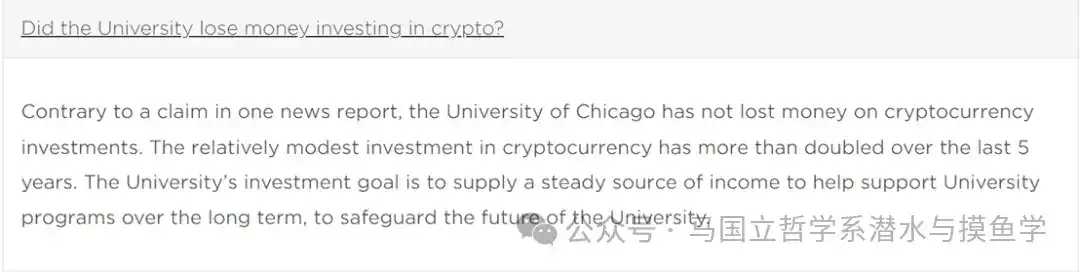
Coincidentally, in the FAQ updated by the University of Chicago in December 2025 [1], the matter of cryptocurrency trading was mentioned. According to the official website: "Contrary to a claim in a news report, the University of Chicago did not suffer losses in cryptocurrency investments. Our school's investment in cryptocurrency is relatively small but has more than doubled in the past five years. Our investment goal is to provide a stable source of income to long-term support our school's various projects and secure our school's future."
So is the University of Chicago's Provost definitely telling the truth?
Hard to say. However, intuitively speaking, the total amount of the University of Chicago's donation funds in the last five years is approximately around $100 billion (a record high in the 2021 fiscal year, around $116 billion; in the 2025 fiscal year, around $109 billion [2]). Unless the University of Chicago is really crazy enough to take at least 60% of its own donation funds to trade crypto (which obviously violates various regulations), or embezzle a large amount of operating funds to trade crypto and lose it all, it should not have lost as much as sixty billion.
So how much was actually lost? Or did they actually make a killing as stated in the official FAQ?
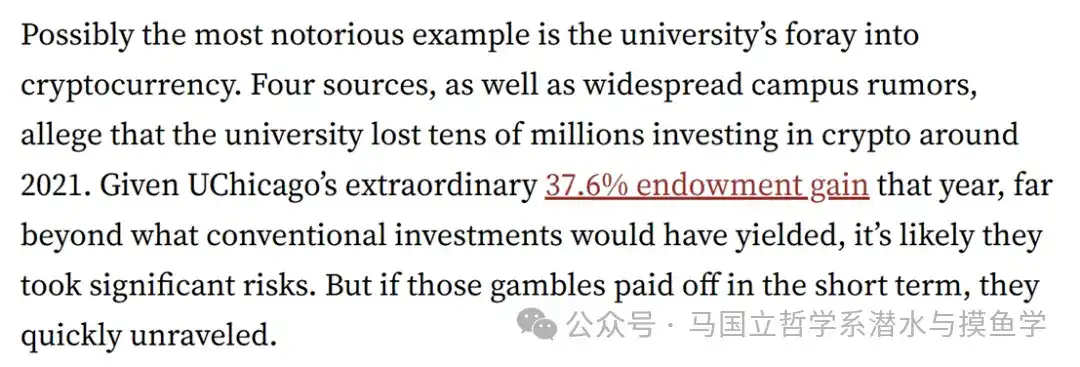
The Stanford Daily [3], Financial Times [4], and Investopedia [5] reported on this last year. According to The Stanford Daily, their four sources said: "The University of Chicago lost tens of millions of dollars in cryptocurrency investment around 2021."
So what does the University of Chicago's financial report [6] say?
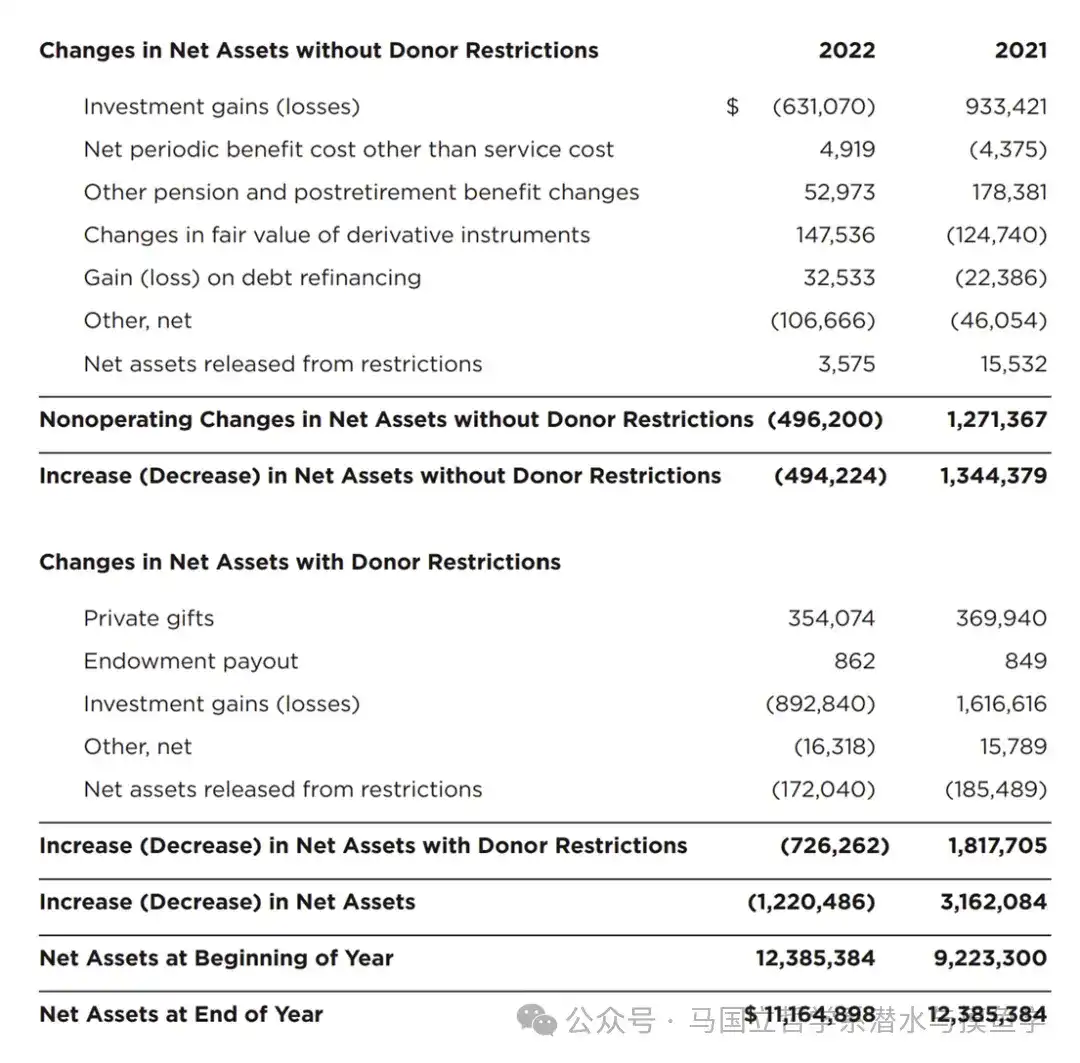
Unfortunately, the financial report did not directly tell us how much money was lost in crypto trading. However, in the 2022 fiscal year report, the University of Chicago disclosed its cryptocurrency investment (fair market value): around $64 million as of June 2021 and around $45 million as of June 2022 (a difference of approximately $19 million). In subsequent reports, perhaps due to either significant gains or losses, the University of Chicago changed its reporting method and no longer disclosed its cryptocurrency investments. However, according to a 2025 Q&A session, the University of Chicago is still cautiously investing in cryptocurrency.
Of note, the 2022 financial report indicated that as of June that year, the University of Chicago endowment fund had incurred a total loss of approximately $1.5 billion. The 2023 financial report then showed that the University of Chicago's investments only incurred a small loss. In the following two years, the University of Chicago turned a profit.
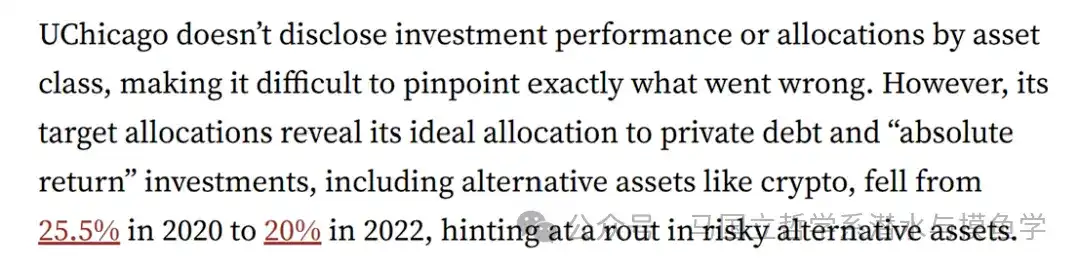
However, we do not know the specific sources of these losses and gains, especially how much was related to crypto trading. The Stanford University newspaper provided a somewhat unreliable clue: "[The University of Chicago's] target asset allocation shows that the University's ideal mix for private debt and 'absolute return' investments (which include alternative assets like cryptocurrency) has decreased from 25.5% in 2020 to 20% in 2022, implying a significant retreat (or downturn) in high-risk alternative assets."
However, the Stanford University newspaper also made an interesting observation: "From 2013 to 2023, the University of Chicago endowment fund's annualized return rate was only 7.48%, while the stock market's annualized return rate for the same period was 12.8%, and the Ivy League average was 10.8%. If the University of Chicago had simply followed the market performance, its endowment fund would now have an additional $6.45 billion. This (dreamy) sum of money would have been more than enough to pay off all of the school's debt. Of course, universities cannot simply replicate market indices as they must hedge during economic downturns to maintain financial stability. But even if the University of Chicago had only achieved the average level of its Ivy League peer group, its endowment fund size would still be $3.69 billion higher today. This would be enough to cover the school's current budget deficit for the next 15 years."
However, apart from crypto trading and investment losses, what other reasons could explain the University of Chicago's budget cuts?
A common explanation, besides calling Trump a rogue, often emphasizes the University of Chicago's own strategic mistakes: debt leveraging, extensive infrastructure projects, and aggressive expansion. As of the end of June 2025, the University of Chicago's debt is around $9.2 billion, approximately 90% of the endowment fund. Although the financing cost of this debt is relatively low, unlike across the pond, the University of Chicago still needs to pay over $200 million in interest this fiscal year.
Such a high level of debt is certainly not coming out of thin air. Since the turn of the century, the University of Chicago has spent a lot of money on new laboratories, libraries, dormitories, technology, and other facilities to enhance its reputation, attract students, and compete with various long-standing prestigious schools. However, these expansions have been largely supported by significant borrowing. Yet, new infrastructure brings ongoing operating costs, and the university has not figured out how to sustainably fund these expenses in the long term.
The University of Chicago's student newspaper [10] quotes Professor Clifford Ando of the university, who suggests that any parents who are considering sending their child to the University of Chicago need to think about whether the high tuition fees they are paying are contributing to their child's education or to the university's debt. The reckless expansion and the resulting debt issue are clearly the responsibility of a management team that acted irrationally and overly ambitiously. What's even more ironic is that between 2006 and 2022, the university president's base salary increased by 285%. Now, faced with some financial challenges, the university's leadership has shifted the burden onto students and regular faculty members: even in years when assets are sold, staff are laid off, and admissions are frozen, executive compensation continues to rise.
So, what should be the University of Chicago's next steps?
In addition to continuing cost-cutting measures, the university, of course, needs to increase revenue. Evidently, a common trick used by U.S. universities to generate more income is to admit more undergraduate students. The University of Chicago is now following suit, but the justification is sure to be noble.

[1]https://provost.uchicago.edu/actions-budget
[2] Throughout this article, the University of Chicago's budget, endowment, and debt are all calculated by combining the main university campus, the Medical Center, and the Marine Biological Laboratory. Common news reports (especially the university's own press releases) usually combine these figures for the endowment but only consider the main campus for the debt.
[3]https://stanfordreview.org/uchicago-lost-money-on-crypto-then-froze-research-when-federal-funding-was-cut/
[4]https://www.ft.com/content/4501240f-58b7-4433-9a3f-77eff18d0898?utm_source=chatgpt.com
[5]https://www.msn.com/en-us/money/careersandeducation/university-s-investment-losses-spark-outrage-resulting-in-drastic-program-cuts/ar-AA1Nxhgx
[6]https://intranet.uchicago.edu/en/tools-and-resources/financial-resources/accounting-and-financial-reporting/financial-statements
[7]https://www.wsj.com/us-news/education/colleges-face-a-financial-reckoning-the-university-of-chicago-is-exhibit-a-8918b2b0
[8]https://www.ft.com/barrier/corporate/d5c7c0f4-abf1-4469-8dca-87ff01cbebf6
[9] The main campus's debt is around $6 billion. Perhaps this is the source of Professor Zhao's $6 billion.
[10]https://chicagomaroon.com/40486/news/uchicago-professor-sounds-alarm-over-troubling-university-finances/
You may also like

The U.S. government prohibits foreigners from using Fable 5, Anthropic issues a rebuttal

The other side of Musk's trillion-dollar fortune: 85% cannot be sold

Citibank releases "2030 Asset Tokenization Market Outlook": 6 major trends may create a $8.2 trillion market

The trillion-dollar valuation test: Are the three major super IPOs a celebration for tech stocks or a nightmare for the crypto market?

Morning Report | Digital Asset completes $355 million financing led by a16z Crypto; Meta completes operational separation from Manus

a16z Crypto Partner: Cash flow is the moat

Cryptocurrency market makers collectively seek change as it becomes increasingly difficult to make money

How TradeXYZ, xStocks, and Alpaca break down the SpaceX IPO into three different strategies

$75 billion in risk asset redistribution: How will SpaceX's IPO affect U.S. stocks and Bitcoin?

Why Is BlackRock Investing $5 Billion in the SpaceX IPO?
Morning News | CME Group launches Nasdaq Cryptocurrency Index futures; Asset management giant Janus Henderson strategically invests in Ethena

Bitcoin Layer 2 Network Botanix: Why Did We Choose to Dissolve?

Why did Oracle deliver the strongest financial report in history, yet its stock price fell?
When the P2P illicit funds from ten years ago turned into 60,000 bitcoins
Dialogue with OmenX Founder: Why does the prediction market need an evolution from "spot" to "derivatives"?
Galaxy in-depth report: Is Solana still worth paying attention to?
Young people in South Korea make a "final effort" in the epic bull market
The pricing controversy of Trade.xyz exposes the fatal weakness of Pre-IPO perpetual contracts
The U.S. government prohibits foreigners from using Fable 5, Anthropic issues a rebuttal
The other side of Musk's trillion-dollar fortune: 85% cannot be sold
Citibank releases "2030 Asset Tokenization Market Outlook": 6 major trends may create a $8.2 trillion market
The trillion-dollar valuation test: Are the three major super IPOs a celebration for tech stocks or a nightmare for the crypto market?
Morning Report | Digital Asset completes $355 million financing led by a16z Crypto; Meta completes operational separation from Manus
a16z Crypto Partner: Cash flow is the moat


