

From Aave to Ether.fi: Who Captured the Most Value in the On-Chain Credit System?

Original Title: Why the DeFi Lending Moat is Bigger Than You Think
Original Author: Silvio, Crypto Researcher
Original Translation: Dangdang, Odaily Planet Daily
As the market share of Vaults and Curators in the DeFi world continues to rise, the market is starting to question: Is the lending protocol's profit space being continuously squeezed? Is lending no longer a good business?
However, if we shift our focus back to the entire on-chain credit value chain, the conclusion is quite the opposite. Lending protocols still occupy the strongest moat in this value chain. We can quantify this with data.
On Aave and SparkLend, the interest fees paid by Vaults to the lending protocol actually exceed the income generated by the Vaults themselves. This fact directly challenges the mainstream narrative of "distribution is paramount".
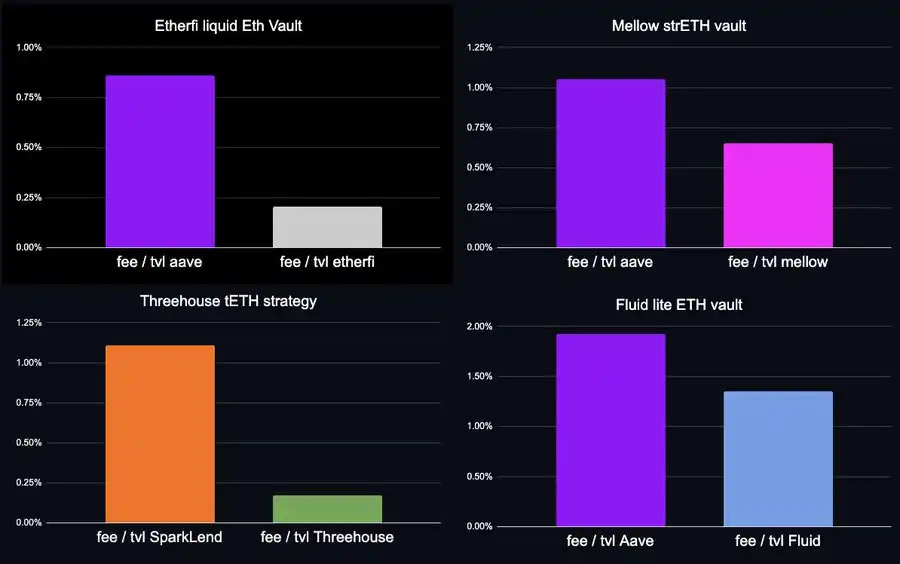
At least in the lending sector, distribution is not king.
In simple terms: Aave not only earns more than various Vaults built on top of it, but also surpasses those asset issuers used for lending, such as Lido and Ether.fi.
To understand the reasons behind this, we need to break down the complete value chain of DeFi lending and, following the flow of funds and fees, reassess the value capture capabilities of each role.
DeFi Lending Value Chain Breakdown
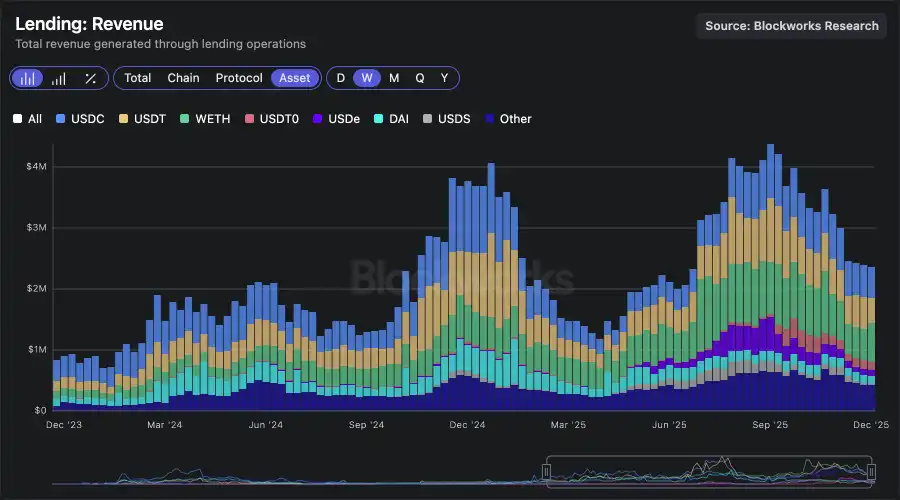
The total annual revenue of the entire lending market has exceeded 100 million US dollars. This part of the value is not generated by a single link, but is composed of a complex stack: the underlying settlement blockchain, asset issuers, fund lenders, the lending protocol itself, and the Vaults responsible for distribution and strategy execution.
In previous articles, we have mentioned that the widespread use cases in the current lending market stem from basis trading and liquidity mining opportunities, and have dissected the key strategic logic behind them.
So, who is really supplying capital in the "real" DeFi lending market?
I analyzed the top 50 wallet addresses on Aave and SparkLend and labeled the major borrowers.
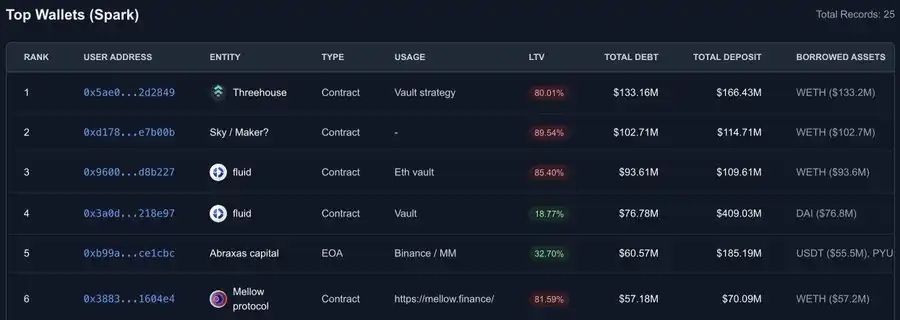
1. The largest borrowers are various types of treasuries and strategy platforms such as Fluid, Treehouse, Mellow, Ether.fi, Lido (also asset issuers). They have distribution capabilities to end users, helping users earn higher yields without having to manage complex strategies and risks themselves.
2. There are also large institutional funders like Abraxas Capital deploying external capital into similar strategies, with their economic model fundamentally akin to treasuries.
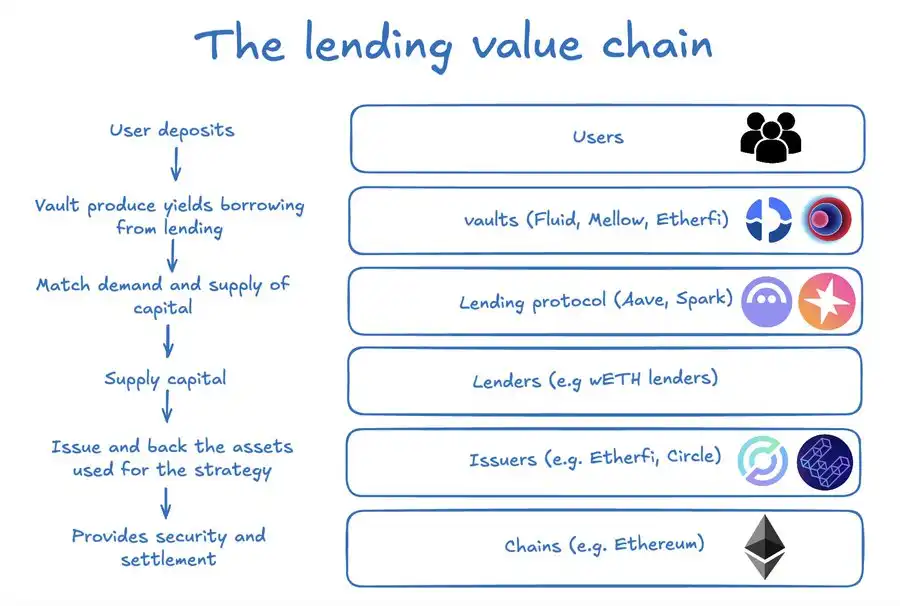
But treasuries are not the whole picture. In this chain, there are at least the following types of participants:
· Users: Deposit assets, seeking additional yield through treasuries or strategy managers
· Lending Protocol: Provides infrastructure and liquidity matching, earns interest from the borrowing side, and takes a certain percentage as protocol revenue
· Lenders: Capital providers, could be ordinary users or other treasuries
· Asset Issuers: Most on-chain lending assets are backed by underlying assets that generate revenue, some of which is captured by the issuer
· Blockchain Network: The underlying "railroad tracks" where all activities take place
Lending Protocols Earn More Than Downstream Treasuries
Take Ether.fi's ETH liquidity collateral treasury as an example. It is the second-largest borrower on Aave with an outstanding loan size of around 15 billion USD. The strategy itself is very typical:
· Deposit weETH (approx. +2.9%)
· Borrow wETH (approx. -2%)
· Treasury charges a 0.5% platform management fee on TVL
In Ether.fi's total TVL, approximately $215 million is actual net liquidity deployed on Aave. This portion of TVL generates approximately $1.07 million in platform fee revenue for the treasury annually.
However, at the same time, the strategy incurs approximately $4.5 million in interest cost to Aave annually (calculation: $1.5 billion borrowings × 2% borrowing APY × 15% reserve factor).
Even in one of the largest and most successful loop strategies in DeFi, the value captured by the lending protocol is still several times that of the treasury.
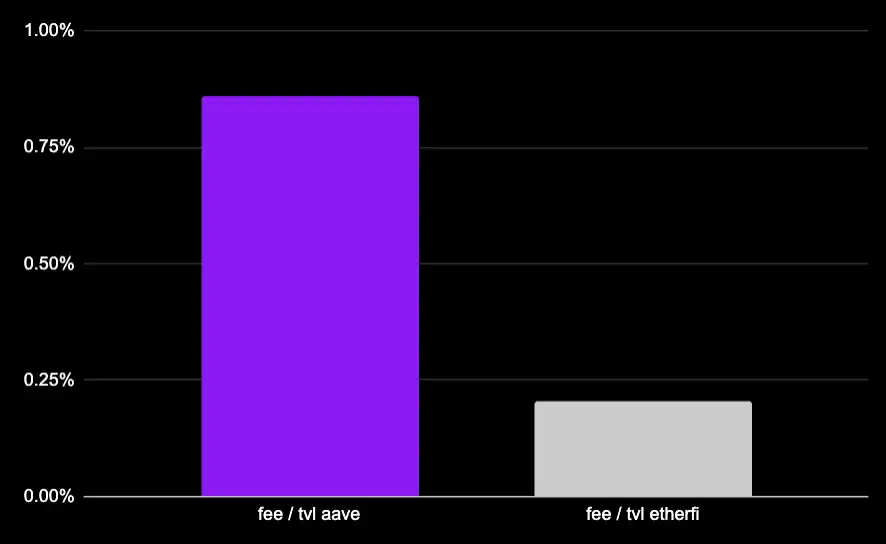
Of course, Ether.fi is also the issuer of weETH, and the treasury itself directly creates demand for weETH.
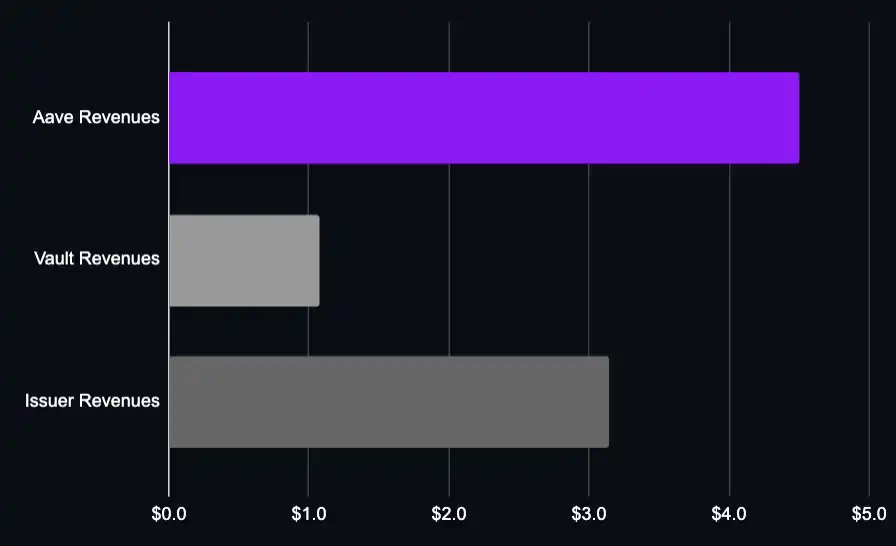
But even considering treasury strategy revenue + asset issuer revenue together, the economic value created by the lending layer (Aave) is still greater.
In other words, the lending protocol is the most value-enhancing part of the entire stack.
We can perform a similar analysis on other commonly used treasuries:
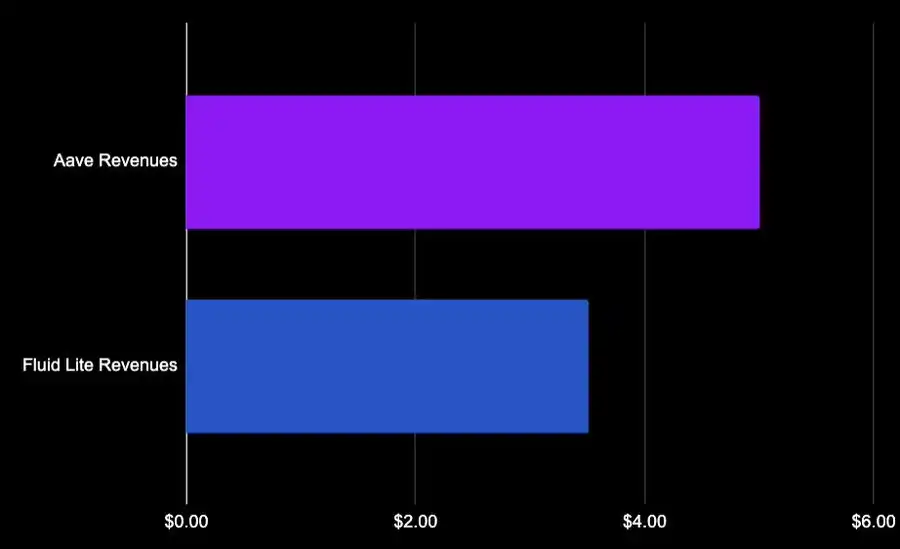
Fluid Lite ETH: 20% performance fee + 0.05% exit fee, no platform management fee. Borrowed $1.7 billion wETH from Aave, paid approximately $33 million in interest, of which about $5 million goes to Aave, Fluid's own revenue is close to $4 million.
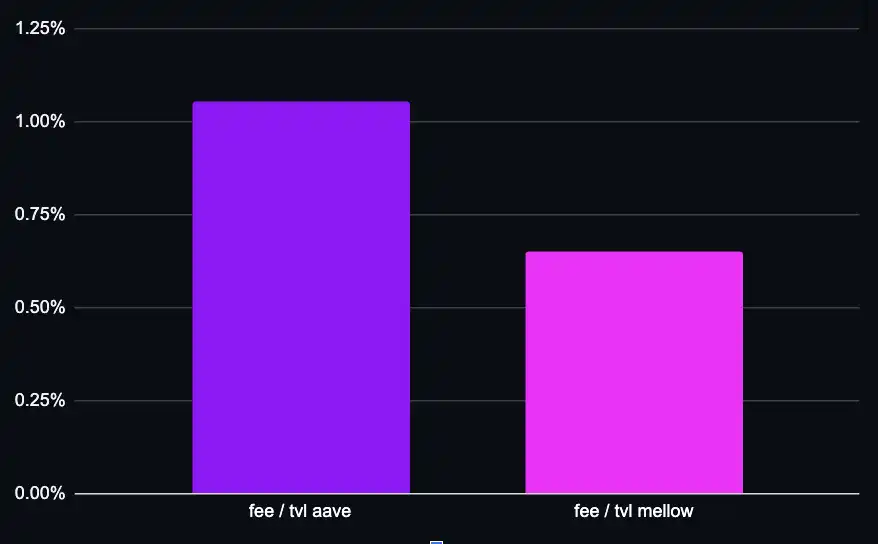
Mellow protocol charges a 10% performance fee on strETH, borrowing volume of $165 million, TVL only about $37 million. Once again, we see that in terms of TVL, the value captured by Aave exceeds that of the treasury itself.
Let's look at another example: in SparkLend, the second-ranked lending protocol on Ethereum, Treehouse is a key participant, operating an ETH loop strategy:
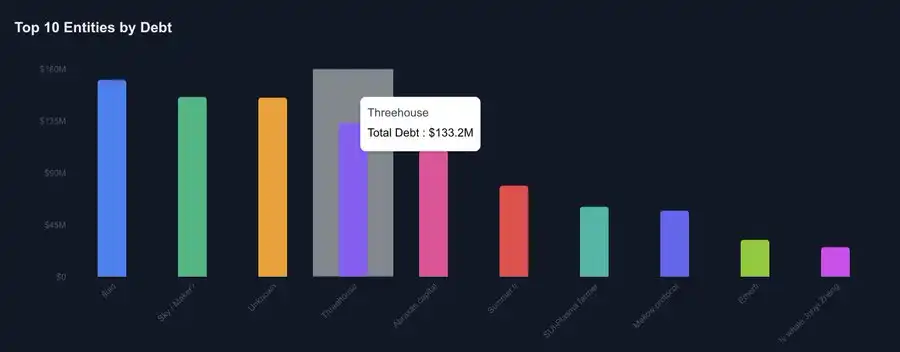
· TVL around 34 million USD
· Borrowing at 133 million USD
· Performance fee charged only on margin yield above 2.6%
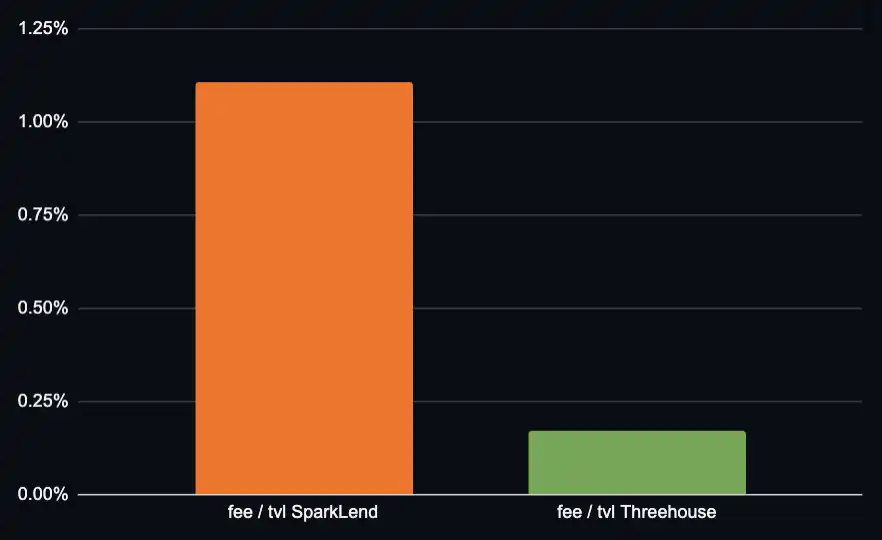
SparkLend, as a lending protocol, has a higher value capture potential in TVL terms compared to the treasury.
The treasury's pricing structure has a significant impact on its own captured value; however, for a lending protocol, its revenue depends more on the nominal size of borrowings, which is relatively stable.
Even with a shift to a dollar-denominated strategy, although the leverage is lower, higher interest rate levels often offset this impact. I do not believe the conclusion will fundamentally change.
In a relatively closed market, more value may flow to the curator, such as the Stakehouse Prime Vault (26% performance fee with incentives provided by Morpho). However, this is not the final state of the Morpho pricing mechanism, as the curator itself is also collaborating with other platforms for distribution.
Lending Protocol vs Asset Issuer
So, the question is: Is it better to be with Aave or with Lido?
This question is more complicated than comparing treasury models because the staked assets not only generate their own yield but also indirectly create stablecoin interest income for the protocol through the lending market. We can only make rough estimates.
Lido has about 44.2 billion USD in assets in the Ethereum core market, used to support lending positions, with an annualized performance fee income of about 11 million USD.
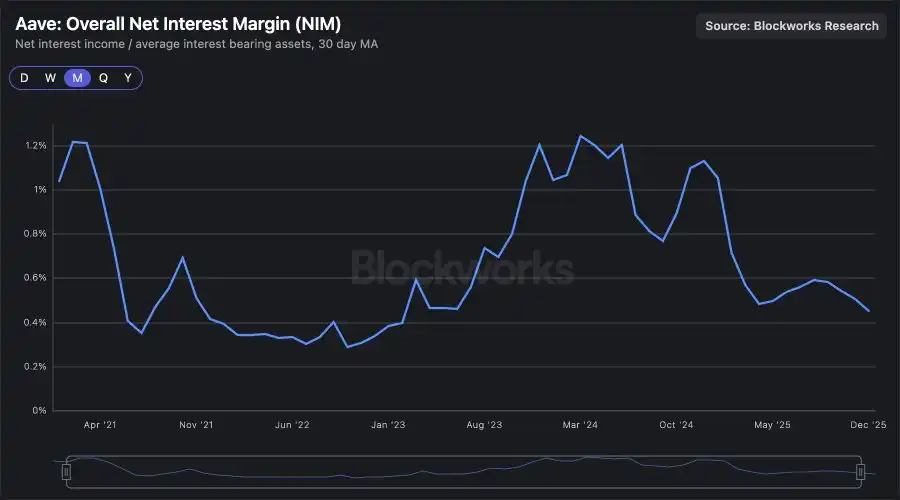
These positions roughly equally support ETH and stablecoin borrowing. Calculated with the current net interest margin (NIM) of about 0.4%, the corresponding lending revenue is about 17 million USD, which is already significantly higher than Lido's direct revenue (and this is at a historically low NIM level).
The True Moat of a Lending Protocol
If we were to compare using only the traditional financial deposit profit model, the DeFi lending protocol would seem to be a low-profit industry. However, that comparison overlooks where the true moat lies.
In an on-chain credit system, the value captured by lending protocols surpasses the downstream distribution layer and also, in aggregate, exceeds the upstream asset issuer.
Seen in isolation, lending may seem like a low-margin business; however, placed within the complete credit stack, it is actually the layer with the strongest value capture capability relative to all other participants—the custodian, issuer, distribution channels.
You may also like

The arrival of the Web 3.0 era: A review of Hong Kong court rulings on digital assets

Track Markets At a Glance: New WEEX Price Widgets for iOS & Android
To streamline your market data access, WEEX has officially launched "Market Watchlist" desktop widgets

The billion-dollar lesson: The focus of DeFi security is shifting from code to operational governance

A Brief Analysis of Stablecoin Licenses and On-Chain Funding
BVNK Founder: Three Stages of Stablecoin Development

The truth about Trump's son's Bitcoin game: he made a staggering $100 million while retail investors lost $500 million

What Is Futures Trading? Hours, Platforms, and How to Start Trade Futures(2026 Guide)
Learn how to start futures trading, understand trading hours, and choose the best futures trading platform. Includes real data, strategies, and ways to maximize returns with rebates.

The Rise of Composable RWA

MAGA Up 350% in 24 Hours, PEPE Up 46% in One Day: Which Memecoins Are Next in 2026?
MAGA +350% in 24hrs. PEPE +46% in one day. RAVE +4,500% then -90%. In 2026's memecoin market, the gains are real. So are the traps? Here's how to tell the difference before you buy.

RCD Espanyol vs Real Madrid: Can the Pericos Delay the Inevitable?
RCD Espanyol vs Real Madrid lineups, standings, and stats for May 3, 2026. Real Madrid visits RCDE Stadium as Barcelona closes in on the LALIGA title. Full preview inside.
MegaETH goes live with an FDV exceeding 2 billion USD. Which ecological projects are worth paying attention to?

Dialogue with "Wood Sister" Cathie Wood: The next bull market is about to arrive
Can prediction markets win the competition for perpetual contracts?

Who is trading on Trade.xyz?

Binance quietly placed a bet on a leading large model company

Best Crypto Discord Server 2026: Why Jacob’s Crypto Clan Is Gaining Massive Attention
Jacob’s Crypto Clan has grown into one of the most active crypto Discord communities, with over 45K members and continuing to expand. This rapid growth reflects strong demand for structured trading insights and real-time collaboration.

Tom Lee Buying ETH: Why Wall Street’s Loudest Ethereum Bull Keeps Doubling Down
Tom Lee keeps buying ETH through every dip, every drawdown, and every moment of market doubt. Inside the strategy that's turning Ethereum into a treasury asset — and what it signals for the rest of the market.

Stripe Sessions 2026: AI Agent, Global Payments, and Invisible Crypto Infrastructure
The arrival of the Web 3.0 era: A review of Hong Kong court rulings on digital assets
Track Markets At a Glance: New WEEX Price Widgets for iOS & Android
To streamline your market data access, WEEX has officially launched "Market Watchlist" desktop widgets
The billion-dollar lesson: The focus of DeFi security is shifting from code to operational governance
A Brief Analysis of Stablecoin Licenses and On-Chain Funding
BVNK Founder: Three Stages of Stablecoin Development
The truth about Trump's son's Bitcoin game: he made a staggering $100 million while retail investors lost $500 million


