
How to Build RWA Global Cross-Border Arbitrage: The Intersection of Tradition and Innovation?



Original Title: "How to Build RWA Global Cross-Border Arbitrage: The Intersection of Tradition and Innovation?"
Original Author: Yekai (WeChat/Twitter: YekaiMeta)
Is your industry facing difficulties in financing and poor liquidity? Are you looking for a breakthrough in cross-border expansion?
The emergence of RWA (Real World Asset Tokenization) has provided a new solution for digitizing traditional assets and enhancing liquidity. By combining with ATS (Alternative Investment Trading), RWA not only enables enterprises to achieve global cross-border financing and cross-domain arbitrage but also promotes industry upgrading and efficient capital allocation. In this episode, Yekai will analyze how to unlock global asset tokenization through RWA.
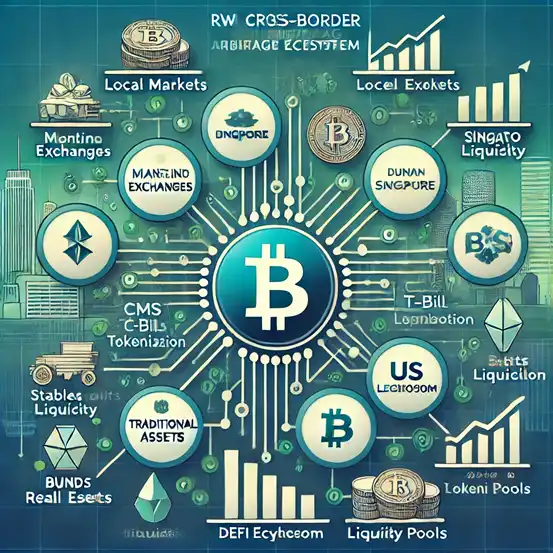
Core Issue: Lack of Liquidity and Globalization Challenges
Traditional industries face difficulties in financing and restricted asset circulation, especially in global expansion. Regulatory differences and capital barriers make it challenging for enterprises to operate efficiently. Additionally, the value of assets in circulation has not been fully realized, the high friction cost of the traditional financial system hinders industrial development, and the lack of liquidity prevents the full realization of asset value.
Currently, compliant RWA issuance in Hong Kong is still in the private placement and PI stage, lacking a secondary market and liquidity. However, when an enterprise issues RWA, it is not just for a single private placement financing similar to overseas debt financing of tens of millions of dollars but requires the rolling release of asset value and liquidity. The combination of RWA and ATS brings a new solution to this situation. Even non-standard traditional assets are transformed into standardized tokenized assets through RWA, transitioning from traditional alternative investments to standardized, tokenized alternative investment financial products.
Unique Value of RWA: Fusion of Tradition and Virtual
RWA connects real-world assets (such as bonds, real estate, and commodities) to the DeFi ecosystem by tokenizing them, bridging traditional finance with DeFi. It not only facilitates on-chain assets but also allows these assets to trade dynamically in liquidity pools, unlocking their value potential. As a combination of real-world and virtual assets, RWA's mission is to achieve asset refinancing and redistribution in the virtual asset world.
Among these, ATS Alternative Investment is the key engine for RWA's globalization.
1. Global Expansion:
ATS connects mainland China, Hong Kong, Singapore, Dubai, and the U.S. markets through ATS regulatory compliance and an ATS exchange, supporting cross-border asset trading and arbitrage.
2. Enhanced Liquidity:
ATS replaces traditional exchanges with a liquidity pool (Dark Pool upgraded to Liquidity Pool) and combines automated market making (AMM) algorithms to achieve efficient, private large-scale transactions.
3. Transparency and Efficiency:
Through dynamic pricing and smart contracts, price manipulation is reduced, providing a fair trading environment for global investors.
Where Is the Opportunity? Global RWA Model
1. U.S. Model: T-Bill tokenization combined with DeFi lending pools drives the efficient conversion of short-term and long-term financial products, similar to projects like Ondo and Mapple, as well as tokenization of MMF money market funds such as BlackRock's BUIDL.
2. Hong Kong Model: Leveraging compliant licensed exchanges to provide tokenization of assets like bonds and stocks in private and primary markets, with several successful issuance cases to date.
3. Singapore Model: Under Singapore's regulated CMS and RMO frameworks, providing asset tokenization for enterprises and protective secondary market support, particularly suitable for enterprises with overseas asset structures.
4. Dubai Model: Through digital banking and money services licenses, providing convenient trading and liquidity services for tokenization of renewable energy, real estate, and commodities. RWA assets can also be pledged under Dubai's digital financial regulatory framework, with RWA assets + secondary layer native tokens trading on exchanges such as Binance and OKX.
In summary, the liquidity design best suited for global RWA cross-border arbitrage includes: Hong Kong primary, Singapore/Dubai secondary, and borderless global DeFi tertiary.
At the core of RWA is not issuing debt, but "cross-domain", transforming traditional financial products backed by medium to long-term real-world assets into short-term, highly liquid tokenized assets to achieve cross-domain arbitrage. What opportunities are there for this kind of cross-domain RWA arbitrage: What is cross-domain that connects global markets?
• From Traditional to Crypto: Allocating traditional funds to the cryptocurrency market, generating liquidity through assets such as pledging Treasury bonds to mint USDT for high-yield strategies.
• From Local to Global: From onshore to Hong Kong, from Hong Kong to Singapore, from Singapore to Dubai, building a cross-border asset flow network among onshore China, Hong Kong, Singapore, and Dubai.
• From Long Cycle to Short Cycle: Transforming long-term assets into short-term high-turnover cash flow, utilizing Defi pools for arbitrage opportunities and liquidity enhancement.
• From Traditional Stock Market to Cryptocurrency Exchange: Transitioning from A-shares and H-shares to licensed exchanges and top-tier exchanges to achieve cross-border links for R-shares.
• From Traditional Asset Market to Virtual Asset Market: Moving from industry trading markets to cryptocurrency exchanges, also involving cross-border links and futures-spot arbitrage.
This cross-border arbitrage of RWA must be based on AI Agent intelligent trading. Within the RWA ecosystem, the combination of blockchain, DePIN, AI artificial intelligence, etc., is precisely where the AI Agent, in collaboration with smart contracts, RWA asset Oracles, etc., realizes automatic cross-border arbitrage, rather than relying on manual brick-and-mortar efforts by traditional financial institutions, managers, or traders. Just like DeepSeek AI Agent from Magic Square Quant, which can engage in quantitative trading arbitrage algorithm trading, it can also become an innovative AGI model.
How to Achieve: From Non-Standard to Standardized Cross-Border Upgrade and Industrial Closed Loop?
1. Tokenization of Underlying Assets
Based on compliant RWAs, through Fund DAOs and smart contracts, achieve private placement and primary markets, tokenize industrial assets on the chain, and distribute them to global liquidity pools, enabling dynamic pricing and transparent transactions.
2. Defi Staking and Trading with Liquidity
Staking underlying RWA assets to generate Crypto native FT tokens and implement second-layer Defi Lego design to achieve cross-border secondary market upgrades; utilizing the Liquidity Pool model to address traditional dark pool issues, supporting anonymous and efficient block trades, simultaneously safeguarding market stability and increasing fund liquidity.
3. Industry Upgrading and Circularity
Through RWA Tokens and Industry Stablecoins, integrating cross-border and cross-domain industrial chain payments, settlements, and financing scenarios, the procurement payment settlement and investment and financing in the industrial chain have interest rate differentials and profit margins. Based on these, a positive cycle can be established: underlying RWA assets—secondary market circulation—industry upgrading and scenario application—asset income enhancement.
Goal: Build a Comprehensive Tokenized Asset Fusion Network
• From Regional to Global: Mainland China—Hong Kong—Singapore/Dubai—Global Digital Financial Defi, establishing a cross-domain asset network.
• From Traditional to DeFi: Integrating the traditional financial market with the DeFi ecosystem to achieve efficient asset transformation.
• From Financing to Upgrading: Not only solving the financing problem but also promoting the tokenization upgrading of the industrial chain and enhancing liquidity.
Embarking on the Future of Cross-Domain RWA Arbitrage
The combination of RWA and ATS is reshaping the global asset trading landscape. If you wish to break through financing barriers, optimize capital flow, or explore global arbitrage opportunities, RWA will be an unmissable solution. Want to learn more? Join our community to explore the infinite possibilities of industrial digitization and asset tokenization!
#ARAW Always RWA Always Win!
By 2025, the RWA market will quickly find its place amidst rapid growth. In the new year, Kai Ge is officially opening up to recruit disciples for mentoring. Young talents aspiring to the RWA field are welcome to seize the leading position. Reply "Disciple Class" in the official account to join the preparatory group.
WeChat cannot answer questions one by one. After the core disciple class, there will be a partner class and a listed company research camp. If you have needs or questions, you can bring them to the classroom for serious learning, interactive discussion, and scenario simulation. Add WeChat YekaiMeta to join the RWA study group for discussion.
This article is contributed content and does not represent the views of BlockBeats.
You may also like

Pantera Capital Partner: How Tokenization is Restructuring the Private Equity and Early Investment Ecosystem?

New York Proposes Stricter Stablecoin Issuer Rules Aligned With Federal GENIUS Act
NYDFS proposed stricter stablecoin issuer rules aligned with the GENIUS Act, covering reserves, custody, redemption timelines, audits, and capital buffers.
Every exchange is a "Universal Exchange."

The counterattack of traditional finance: Alliance chains are quietly reviving

CryptoQuant Says Bitcoin Profitable Supply Is Near 45% Pressure Zone as On-Chain Data Points to Market Repricing
CryptoQuant said Bitcoin’s profitable supply is nearing the 45% pressure zone, signaling rising market stress, unrealized losses, and a possible on-chain repricing phase.

Bitcoin Falls Below 200-Week Moving Average as On-Chain Data Shows Over Half of Supply in Loss
Bitcoin dropped below its 200-week moving average as on-chain data showed over 50% of circulating supply is now in loss, signaling rising market stress.

CFTC Reportedly Plans New Prediction Market Rules Focused on Manipulation Risk and Public Interest Review
The CFTC is reportedly preparing new prediction market rules focused on manipulation risk, public interest review, and retail trader protections.

Meet the new WEEX trial fund—your gateway to greater profits

WEEX Labs Lands at Dutch Blockchain Week: A Disruptive Crypto × AI Conversation Sets Sail in Amsterdam

SK Hynix Reportedly Plans U.S. ADR Listing as Early as August, With SEC Approval Possible in Late June
SK Hynix may pursue a U.S. ADR listing as early as August, with SEC approval reportedly possible in late June amid strong AI chip supply chain demand.

SpaceX vs Tesla vs xAI: Which Elon Musk Trade Has the Biggest Upside in 2026?
OpenAI Reveals It Has Confidentially Submitted an S-1 to the SEC, Keeping the Door Open for a Future IPO
On June 9, according to an OpenAI announcement, the company recently confidentially submitted a draft S-1 registration statement to the U.S. Securities and Exchange Commission (SEC), beginning the preliminary compliance process for a potential initial public offering. OpenAI said it chose to disclose this proactively because it expected the news might leak; however, the company has not yet set a specific listing timeline, and related arrangements may still take some time.

Latest research from 13 top universities including Cornell University: The current state, challenges, and misconceptions of the fusion of Crypto and AI
Deconstructing Anthropic: The Best AI Company, Possibly Also a Type of Organizational Invention
Apollo and Blackstone Reportedly Back $35 Billion Anthropic Chip Financing as Deal Details Remain Unclear
On June 9, according to currently available news alerts, Apollo and Blackstone Group participated in a $35 billion financing for an Anthropic “chip project.” Based on the original wording of the report, the funding has already been raised, but public information remains limited. The financing structure, use of proceeds, project entity, and whether Apollo and Blackstone participated through equity, debt, or project financing have not yet been disclosed.

Humanity Protocol Security Incident Escalates: More Than $31 Million Stolen From Related Addresses as Attacker Continues Selling H for ETH
On June 9, according to monitoring by Onchain Lens, more than $31 million has been stolen from addresses linked to Humanity Protocol, and the attack is still ongoing, with the hacker continuously swapping H tokens for ETH. Project founder Terence Kwok later confirmed the security incident on X, saying the issue involved a private key leak.

Bloomberg: As Bitcoin Weakens, Stablecoins and RWA Continue to Drive Expansion in Crypto Businesses
In June, Bloomberg reported that despite Bitcoin falling below $60,000 last week, wiping out about $235 billion in market value within seven days, and dropping close to 50% from last year’s peak, some core businesses in the crypto industry are still expanding, mainly in stablecoins, real-world asset tokenization (RWA), payments, and infrastructure. The report also noted that overall altcoin activity has contracted significantly: altcoin market capitalization has fallen from a peak of about $431 billion in November 2021 to around $170 billion, and among the tens of millions of tokens issued in recent years, fewer than 1,700 still maintain meaningful trading activity.

Galaxy Deep Research Report: How Hyperliquid's HIP-4 Upgrade Changes the Landscape of Prediction Markets?
Pantera Capital Partner: How Tokenization is Restructuring the Private Equity and Early Investment Ecosystem?
New York Proposes Stricter Stablecoin Issuer Rules Aligned With Federal GENIUS Act
NYDFS proposed stricter stablecoin issuer rules aligned with the GENIUS Act, covering reserves, custody, redemption timelines, audits, and capital buffers.
Every exchange is a "Universal Exchange."
The counterattack of traditional finance: Alliance chains are quietly reviving
CryptoQuant Says Bitcoin Profitable Supply Is Near 45% Pressure Zone as On-Chain Data Points to Market Repricing
CryptoQuant said Bitcoin’s profitable supply is nearing the 45% pressure zone, signaling rising market stress, unrealized losses, and a possible on-chain repricing phase.
Bitcoin Falls Below 200-Week Moving Average as On-Chain Data Shows Over Half of Supply in Loss
Bitcoin dropped below its 200-week moving average as on-chain data showed over 50% of circulating supply is now in loss, signaling rising market stress.


