
In addition to $VINE with a $400 million market cap, which other Silicon Valley tech companies may potentially issue tokens?

One week after the release of TrumpCoin, the blockchain remains in a frenzy. Today, another tech giant has released a coin on the chain. First, the late legendary "crypto punk" and "father of cybersecurity" John McAfee cyber-resurrected, with his widow Janice using McAfee's X account to release $Ainti, claiming to have AI-revived McAfee's legacy. Another living legend and one of the founders of Vine, the pioneer of short video format, Rus Yusupov, has released a coin named $Vine Memecoin. This is likely the first well-known tech company founder to personally launch a coin following the TrumpCoin craze. At the time of writing, the coin has reached a peak market cap of $250 million.
What is Vine
Vine was one of the first platforms to popularize short-form video content. It was known for its 6-second looping videos, which forced creators to tell a complete story or convey an idea in a very short time. U.S. users became accustomed to consuming quick, short video content, laying the groundwork for later platforms like TikTok, Instagram Reels, and Snapchat.
Vine videos became part of pop culture, with many classic short videos being repeatedly referenced or imitated, even entering mainstream entertainment. Personalities like Logan Paul and Jake Paul transitioned from Vine stars to YouTube celebrities. King Bach rose to fame making humorous short videos on Vine and later became a well-known actor and producer. Additionally, Liza Koshy and Shawn Mendes evolved from Vine niche stars to mainstream artists. Despite being acquired by Twitter in 2012 and shut down in 2016, Vine was not just a short video platform for U.S. users but more like the starting point for individual content creation and rapid consumption culture spread.
How did Vine become a $2.5 billion token
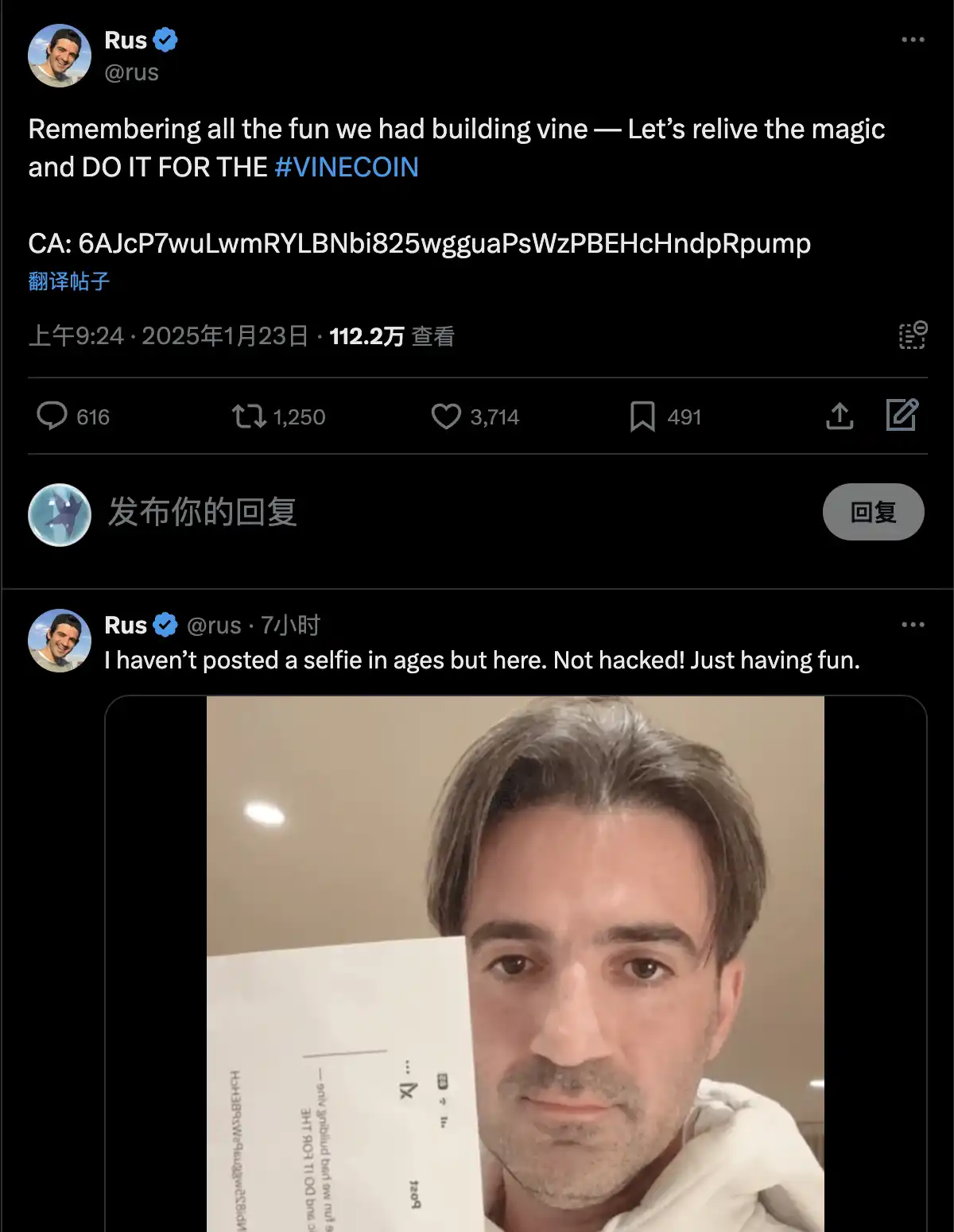
This morning at 8:17 AM, the $Vine founded by Pumpfun initially had no difference from the previous meme coins, until the token surged to a $30 million market cap. After years of silence, Vine founder Rus's X account claimed CA and posted a tweet holding a GIF to prove authenticity. Simultaneously, multiple addresses that bought in on the internal exchange from Coinbase began mass selling, and the market was filled with speculation that the GIF was AI-generated. Concurrently, due to panic caused by the Nasdaq hack and the release of the Memecoin $STONKS, the price of $Vine plummeted by 90%, leaving only a $3 million market cap.

One hour later, in a style reminiscent of Vine's short videos, Rus released a 3-second video proving that he was not an AI. At the same time, addresses receiving funds and ending in "waamGQ," "MGVWa," "qedvzf," among others, made significant purchases, occupying the top 30 holders. Most of them still hold their positions. Rus then posted a tweet with a Bullx sign overlaid with the Vine logo and an upward arrow, in a DeFi on-chain style. Following this tweet, the token price surged to nearly a $50 million market cap.
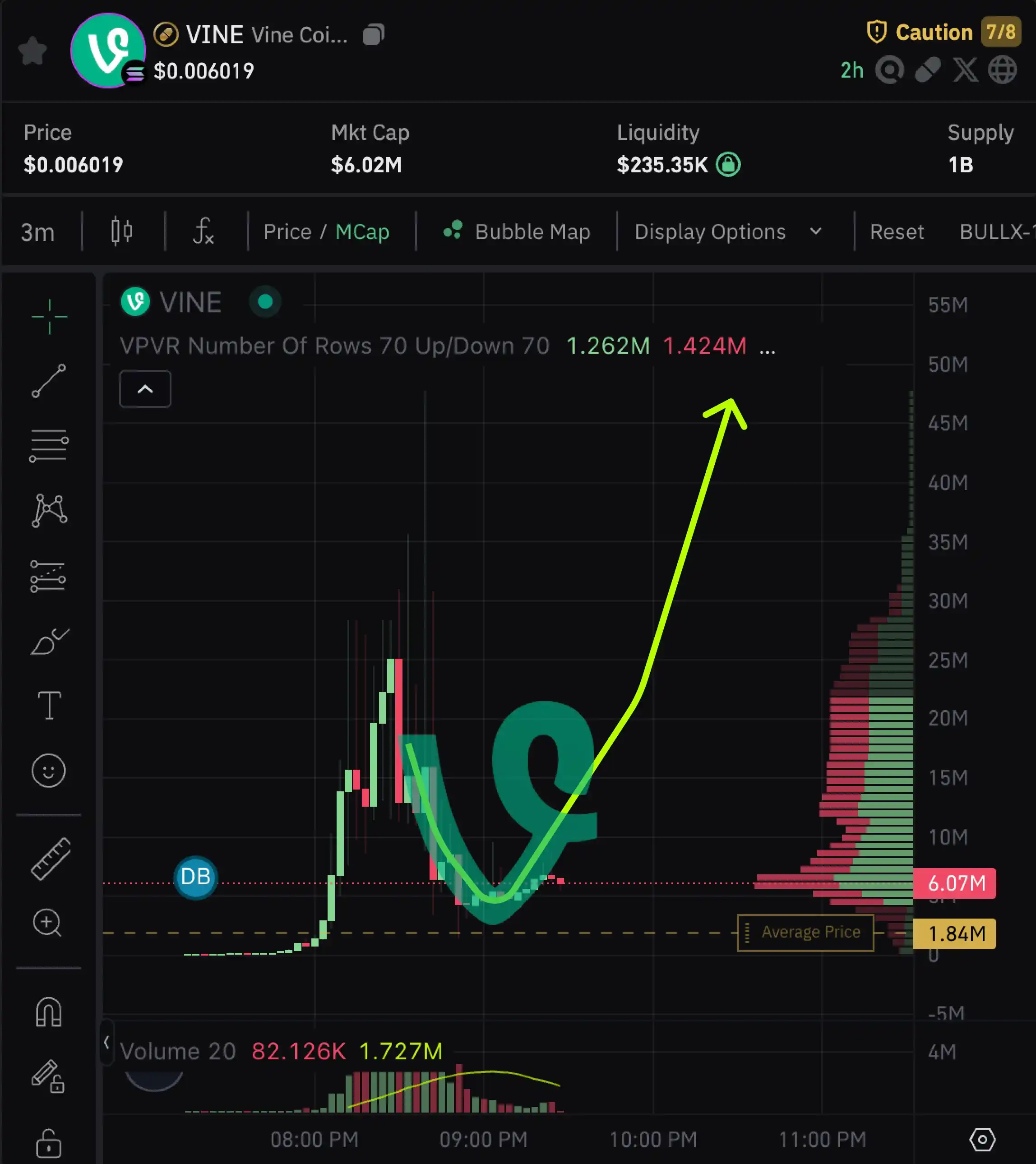
Two hours later, an announcement was made to lock the DEV wallet tokens until April 20 at 4:20 p.m. The announcement was accompanied by retweets of several top European and American Alpha Group comments on $Vine. With a professional team controlling the market and the anticipation of Musk discussing Vine again, along with the bullish sentiment from the dual buffs of Vine's 12th anniversary, the market cap skyrocketed, breaking through the $400 million mark after consolidating at a high level. Despite discussions within the market about Rus launching the token to ride the wave of Musk's popularity and without any announcement benefiting Vine's development, that is the core of a Memecoin. When it shifts from a cultural core to an application core, it transforms from a memecoin to a coin. Therefore, this article will not delve further into the intricacies of these relationships.
How Are Relics of the Web1.0 and Web2.0 Eras Being Revived in Web3.0
Considering the hype generated by Vine, it will undoubtedly trigger a series of Internet companies exiting the stage of history to revive through Crypto, whether truly seeking rebirth or simply capitalizing on attention finance to earn a profit. For retail investors, this presents an opportunity.
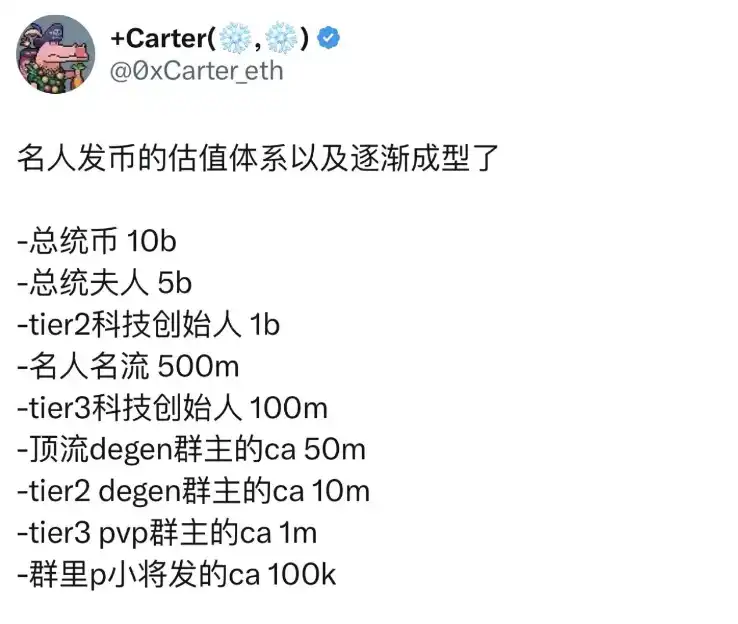
While a President or First Lady may only have this one opportunity in four years, tech companies have countless opportunities. Taking the example of Rus's $Vine release, these companies are more likely to participate in this game if they possess several key elements:
1. The company is a pioneer in a certain field or was once, if not still, well-known in a specific region.
2. The company is not currently operating well to avoid future legal troubles and prevent larger losses.
3. The company is somehow connected to Crypto, either through the founder's interest or investments, or through an acquisition by a Crypto-related team.
The author has compiled several projects that meet the above criteria:
Napster
Founded by Shawn Fanning and Sean Parker in 1999, prior to which the relationship between record companies and artists was close, controlling distribution and promotion. Users could only access new songs through channels such as record stores, TV/radio, etc. Physical record sales were profitable, especially in the 1990s when CD sales peaked. Napster, however, used peer-to-peer (P2P) technology to allow users to directly share their MP3 files, creating a global music downloading network. It quickly accumulated tens of millions of users. Due to its decentralized server model that prevented record companies from cutting off the source, it profoundly impacted the traditional record industry. However, it was shut down by court order in 2001 due to copyright lawsuits. Its influence led to a rethink of the music industry's model, as well as the subsequent legal digital music rights platforms like iTunes and Spotify.
After multiple acquisitions and transformations, the Napster brand was acquired in 2022 by Hivemind Capital Partners and Algorand. They plan to launch the "Napster Web3 Music Platform" and have announced the intention to issue Napster Tokens, but as of now, no tokens have been launched.
Napster Twitter: @Napster
Shawn Fanning Twitter: @ShawnFanning
Sean Parker Twitter: @sparker
Hivemind: @HivemindCap
Algorand: @AlgoFoundation

Myspace
Founded by Tom Anderson and Chris DeWolfe, later sold to Specific Media, with Justin Timberlake also joining in its investment. Before MySpace emerged, the internet social landscape was fragmented, with most interactions happening on forums, instant messaging, and personal blogs. MySpace allowed users to massively showcase personalized profiles, interact with friend networks, and connect with a vast number of music artists. If Napster before it was about letting users listen to music, then MySpace was about enabling artists to better promote themselves and get closer to their fans. This also laid the foundation for user habits and technological patterns in later social media forms (Facebook, Instagram, Twitter, etc.).
Currently, this project has minimal connection to Crypto. However, the author believes that founder Tom Anderson's tweet from 3 years ago, Buying The Dip, along with Tom's laser eye, appears very Meme.
Tom Anderson: @myspacetom
Chris DeWolfe: @Chris_DeWolfe

Mark Cuban
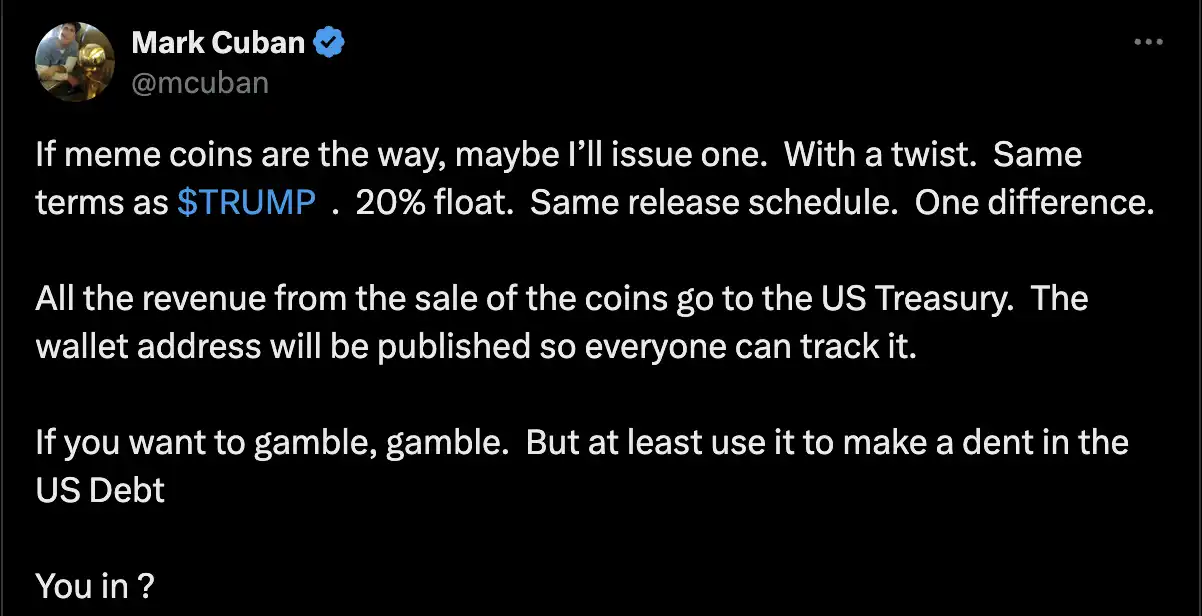
Dallas Mavericks owner and prominent Silicon Valley investor Mark Cuban expressed his willingness to launch a MemeCoin on X targeting $Trump. The mechanism is largely similar, with the key difference being that all profits from it would go to replenish the U.S. Treasury. The market is very excited about this approach, as opposed to $Trump which might end up in an individual's pocket; players are more hopeful for a more transparent outcome. Although the actions of every businessman are highly likely to consider risk and reward, the narrative of being a meme coin is indeed worth looking forward to.
Mark Cuban: @mcuban
Netscape
Founded by Marc Andreessen and co-founder Jim Clark in 1994. The famous Netscape Navigator browser ushered in the commercial browser era. There is currently no Twitter account for Jim or Netscape.
LimeWire
Launched in 2000, similar to Napster, LimeWire was also a P2P file-sharing software commonly used for downloading music, videos, etc. Due to copyright and infringement disputes, it was forced to shut down around 2010. In 2022, Austrian entrepreneurs Paul & Julian Zehetmayr and others acquired the LimeWire brand and announced a transformation into an NFT trading platform. Although the platform now has its own token, it is not ruled out that the founders may release a Memecoin.
Paul Zehetmayr: @pzehetmayr
Julian Zehetmayr: @julianzehetmayr

Yahoo!
Founded in 1994 by Jerry Yang and David Filo, Yahoo! had global leadership in portal search, email, instant messaging, and other areas. It was once an Internet traffic giant. In the era when the Chinese Internet was just starting to take root, Yahoo! was almost universally known. After leaving Yahoo!, Jerry Yang founded AME Cloud Ventures to invest in technology and startups, including some projects in the crypto field.
Jerry Yang, David Filo: N/A
AME Cloud Ventures website: amecloudventures.com
AME Managing Director Jeff Chung @jefchung
In addition to the projects mentioned above, there are many other excellent products at that time that may participate in this movement, whether it's bringing back memories of the 00s or just a new round of meme coin gameplay. The impact caused by Trump Coin is gradually spreading, and as influencers are becoming more brazen in launching coins, it is hoped that everyone will stay calm while following Alpha and stay away from SCAM.
You may also like

CFTC Reportedly Plans New Prediction Market Rules Focused on Manipulation Risk and Public Interest Review
The CFTC is reportedly preparing new prediction market rules focused on manipulation risk, public interest review, and retail trader protections.

Meet the new WEEX trial fund—your gateway to greater profits

WEEX Labs Lands at Dutch Blockchain Week: A Disruptive Crypto × AI Conversation Sets Sail in Amsterdam

SK Hynix Reportedly Plans U.S. ADR Listing as Early as August, With SEC Approval Possible in Late June
SK Hynix may pursue a U.S. ADR listing as early as August, with SEC approval reportedly possible in late June amid strong AI chip supply chain demand.

SpaceX vs Tesla vs xAI: Which Elon Musk Trade Has the Biggest Upside in 2026?
OpenAI Reveals It Has Confidentially Submitted an S-1 to the SEC, Keeping the Door Open for a Future IPO
On June 9, according to an OpenAI announcement, the company recently confidentially submitted a draft S-1 registration statement to the U.S. Securities and Exchange Commission (SEC), beginning the preliminary compliance process for a potential initial public offering. OpenAI said it chose to disclose this proactively because it expected the news might leak; however, the company has not yet set a specific listing timeline, and related arrangements may still take some time.

Latest research from 13 top universities including Cornell University: The current state, challenges, and misconceptions of the fusion of Crypto and AI
Deconstructing Anthropic: The Best AI Company, Possibly Also a Type of Organizational Invention
Apollo and Blackstone Reportedly Back $35 Billion Anthropic Chip Financing as Deal Details Remain Unclear
On June 9, according to currently available news alerts, Apollo and Blackstone Group participated in a $35 billion financing for an Anthropic “chip project.” Based on the original wording of the report, the funding has already been raised, but public information remains limited. The financing structure, use of proceeds, project entity, and whether Apollo and Blackstone participated through equity, debt, or project financing have not yet been disclosed.

Humanity Protocol Security Incident Escalates: More Than $31 Million Stolen From Related Addresses as Attacker Continues Selling H for ETH
On June 9, according to monitoring by Onchain Lens, more than $31 million has been stolen from addresses linked to Humanity Protocol, and the attack is still ongoing, with the hacker continuously swapping H tokens for ETH. Project founder Terence Kwok later confirmed the security incident on X, saying the issue involved a private key leak.

Bloomberg: As Bitcoin Weakens, Stablecoins and RWA Continue to Drive Expansion in Crypto Businesses
In June, Bloomberg reported that despite Bitcoin falling below $60,000 last week, wiping out about $235 billion in market value within seven days, and dropping close to 50% from last year’s peak, some core businesses in the crypto industry are still expanding, mainly in stablecoins, real-world asset tokenization (RWA), payments, and infrastructure. The report also noted that overall altcoin activity has contracted significantly: altcoin market capitalization has fallen from a peak of about $431 billion in November 2021 to around $170 billion, and among the tens of millions of tokens issued in recent years, fewer than 1,700 still maintain meaningful trading activity.

Galaxy Deep Research Report: How Hyperliquid's HIP-4 Upgrade Changes the Landscape of Prediction Markets?
Binance Research: RWA Market Expected to Expand Nearly 6x from Early 2025, with Public Equities and Onchain Payments Heating Up Together
In June, Binance Research said in its monthly market report that the real-world asset (RWA) market is expected to grow by about 589% from the beginning of 2025. Bond- and money market fund-related RWA expanded by about $6.5 billion, up 83% year over year, while publicly traded equity RWAs grew by about 422%. The report also noted that monthly crypto debit card transaction volume exceeded $747 million in May, up 48.6% year to date.

Japan to Assess a Framework for Yen Stablecoins and Crypto ETFs as Asia’s Compliant Payments Narrative Heats Up
Recently, according to the original report, Japan is considering the launch of yen stablecoins and cryptocurrency ETFs. Public information remains limited at this stage, and there is still no complete policy text, regulatory draft, or clear implementation timeline, so this is better characterized as a “policy discussion” rather than formal implementation. The original wording also noted that advancing stablecoin regulation in Asia is driving XRP usage and supporting growth in the XRPL ecosystem. However, based on currently available public information, there is not enough evidence to directly establish a clear causal relationship between this round of discussion in Japan and XRP or XRPL.

ZachXBT: Humanity private key leak and abnormal surge in H token should be viewed separately
On June 9, according to related disclosures, on-chain investigator ZachXBT posted an update on Humanity’s roughly $31 million security incident, saying that after further analyzing fund flows, he currently tends to believe the project team was not involved in an “inside job” or a self-staged attack. According to him, the official explanation about the private key leak was broadly accurate, but before the token unlock, the price of H had been artificially pushed higher, and the hacker later took advantage of that market environment; therefore, the private key leak and the earlier abnormal price pumping should be regarded as two separate and independent events. This reframing has shifted the market’s understanding of the nature of the incident. Earlier discussion around Humanity had focused on whether the team directly participated in the attack or used the security incident to cover up internal operations. ZachXBT’s latest remarks shift the focus from “whether it was self-theft” to “whether there were pre-unlock market structure issues.” He also questioned whether the team may have.

Morning Report | OpenAI has submitted an S-1 registration statement draft to the U.S. SEC; Morpho completes $175 million financing

Morning Report | BitMine increased its holdings by 126,971 ETH last week; trader Eugene announced his exit from the crypto market

Wang Chuan: How can one not feel anxious after the neighbor Old Wang made thirty times profit by investing in storage stocks? (Seven) - A quarter-century cycle
CFTC Reportedly Plans New Prediction Market Rules Focused on Manipulation Risk and Public Interest Review
The CFTC is reportedly preparing new prediction market rules focused on manipulation risk, public interest review, and retail trader protections.
Meet the new WEEX trial fund—your gateway to greater profits
WEEX Labs Lands at Dutch Blockchain Week: A Disruptive Crypto × AI Conversation Sets Sail in Amsterdam
SK Hynix Reportedly Plans U.S. ADR Listing as Early as August, With SEC Approval Possible in Late June
SK Hynix may pursue a U.S. ADR listing as early as August, with SEC approval reportedly possible in late June amid strong AI chip supply chain demand.
SpaceX vs Tesla vs xAI: Which Elon Musk Trade Has the Biggest Upside in 2026?
OpenAI Reveals It Has Confidentially Submitted an S-1 to the SEC, Keeping the Door Open for a Future IPO
On June 9, according to an OpenAI announcement, the company recently confidentially submitted a draft S-1 registration statement to the U.S. Securities and Exchange Commission (SEC), beginning the preliminary compliance process for a potential initial public offering. OpenAI said it chose to disclose this proactively because it expected the news might leak; however, the company has not yet set a specific listing timeline, and related arrangements may still take some time.


