
Key Members Depart to Establish "Forked EF": How Much Longer Can the Ethereum Foundation Endure?


On January 21st, Ethereum's well-known core developer Eric Conner announced his departure from the Ethereum Foundation on social media, citing a series of issues within the Ethereum Foundation, including lack of transparency, disconnect from the community, and resistance to change.
The criticism of the Ethereum Foundation (EF) has been ongoing, and in recent months, Ethereum's lackluster performance has further fueled community dissatisfaction. Many prominent investors and developers have expressed their opinions and frustrations with the EF. However, the departure of a veteran developer indicates that internal disagreements within the EF have reached an irreconcilable point, pushing the EF into a crisis.
Amid escalating public opinion and the community's unresolved anger, a grassroots movement has quietly formed the Second Foundation.
With Ethereum facing internal and external challenges, reform is urgently needed.
Who is Eric?
Ethereum's renowned core developer Eric Conner has left the ecosystem community after nearly 11 years of collaboration with Ethereum, citing Vitalik's rejection of a leadership restructuring proposal.
Eric is a co-author of EIP-1559, a significant network upgrade that changes the way Ethereum transaction fees operate. He was not formally employed by Ethereum but has been providing guidance, investment, and has been one of the key figures driving ecosystem development since the early days.
On January 21st, Ethereum core developer Eric Conner posted on social media, saying, "I am no longer `.eth.` Maybe one day someone in leadership will realign with the community, but for now, I'm out. Deep down I sincerely hope Ethereum succeeds. Good luck."
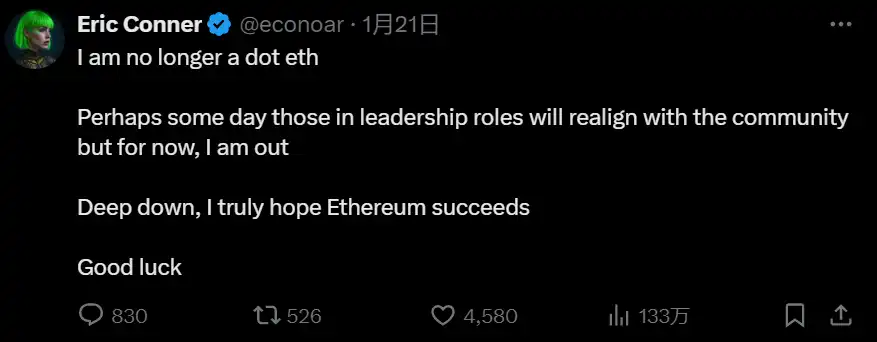
He later posted about why he entered Ethereum and why he chose to leave. Eric first encountered Bitcoin in 2012 and after the Mt. Gox incident, he witnessed many friends suffer heavy losses due to reliance on centralized exchanges. Eric and a few friends attempted to develop the first decentralized exchange (DEX) on Ethereum—EtherEx. Although the project failed due to premature timing, it immersed him in the Ethereum community.
Previously, Eric had expressed that the Ethereum Foundation's lack of transparency and growing sense of disconnect from the community were becoming stronger. The Foundation could have cut 80% of its budget, allowing Ethereum to operate and grow smoothly. The issue is that the current Foundation does not report to stakeholders, is gradually sinking into a quagmire, and is resistant to change. The Foundation currently exhibits a "counter-victory and competitive mindset," leading many community members to question whether to continue to stay.
A Frozen Path, Not a Day's Cold
Since last year's EDCON in Montenegro, the industry's dissatisfaction with the Ethereum Foundation has begun to surface. L2, as a solution to improve Ethereum's scalability, has been shackled with the "Ethereum alignment" shackle from day one, accepting and executing the will of the EF. Everyone is expressing loyalty to Ethereum, aiming to create the most EVM-compatible L2 solution. For a long time, rather than focusing on the product and technology itself, how to gain EF's approval has been the primary concern for project teams, leading to the distortion of the Ethereum ecosystem under EF's pressure.

Related Read: "EF Has No Dreams"
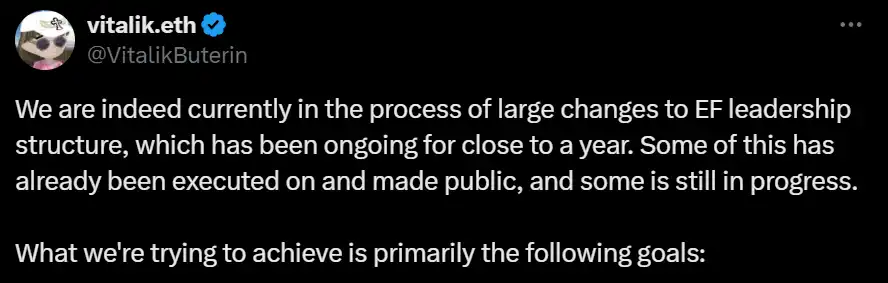
The intricate vested interests within the EF, the EF's constraints on a project's "orthodoxy" in terms of ideology, and the gradual departure of major protocols from Ethereum leading to betrayal, have seemingly plunged this organization into a midlife crisis, facing difficulties in structure, efficiency, and culture. As the meme trend drives Solana's resurgence, Ethereum's weak performance during several Bitcoin ATH breakthroughs, and the recent issuance of coins by Trump on Solana driving SOL to a new high, Ethereum's decline is evident, intensifying the community's dissatisfaction with Ethereum. Under public pressure, on the 18th, Vitalik himself responded to the doubts in a post, indicating a large-scale restructuring of the EF leadership and the specific objectives of the reform.
A stone has caused a thousand-layer wave, and a crusade against the EF has followed.
On the 20th, Synthetix and Infinex founder Kain Warwick first expressed his dissatisfaction with L2: "If I were to operate the EF, I would definitely put pressure on Layer 2 to demand they use sequencers' revenue to burn ETH. Ethereum has a significant advantage in this negotiation...".
At the same time, Aave founder Stani Kulechov also stated that after reading the Ethereum 2024 budget report, he believed that there are 12 areas for improvement to ensure the EF's sustainable development, including slowing down the burn rate, reducing the number of employees, and establishing a sustainable revenue model. However, on the 21st, Stani Kulechov posted again, saying: "I don't advocate for dissolving the EF, but rather recommend a better, faster, stronger, and more extensive EF path... We should focus less on internal politics or neutrality and focus more on advancing technological progress as quickly as possible."
During the evening, Evgeny Gaevoy, Founder and CEO of the top market-making institution Wintermute, also shared his views on Ethereum, mentioning the current risk of Ethereum being caught in a "death spiral": "If there is no casino, the only use of ETH is to send stuff in Zazulu, then the price will be low and the security will be low. As the ETH price drops, fewer and fewer dapps believe it is secure and will escape to other chains, which could form a very (deadly) spiral, further lowering the price."
Facing sudden community backlash, the Ethereum Foundation (EF) apparently did not have a well-prepared plan to calm the situation, and even went against the grain by selling off ETH in response to the community's staking proposal. The next day, Vitalik announced in a post that the Ethereum Foundation's financial update, indicating that the Ethereum Foundation had set up a new 3-of-5 multi-signature wallet, which EF will use to participate in the DeFi ecosystem and has conducted test transactions on Aave.
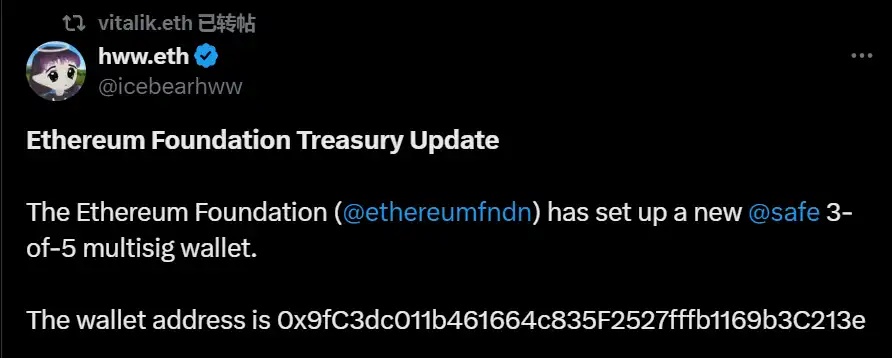
However, the community does not seem convinced and mocked, asking if they were ready to sell again. In this EF criticism battle, the community's anger has not subsided, and the smoke is still lingering.
Even a Second Foundation Emerges, Which Way Now?
On January 22, there were market rumors that Lido founder Konstantin Lomashuk had established the Ethereum Second Foundation. Currently, the Second Foundation's official Twitter account (@2nd_foundation_) is live, and Konstantin Lomashuk quickly retweeted its first tweet.
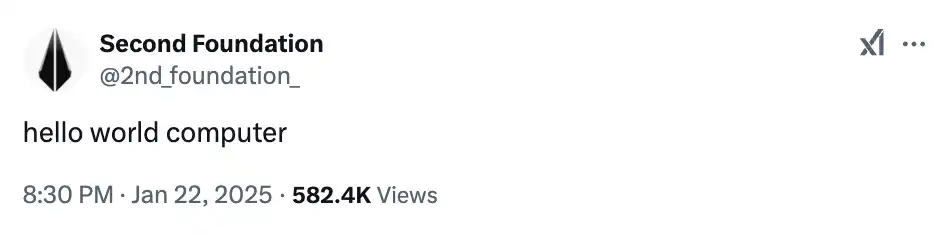
On January 23, Lido founder Konstantin Lomashuk posted again, saying that the tweet was just an idea, and the "Second Foundation" has not been formally established.
He stated that Ethereum is the ultimate world computer, and every member of the Ethereum community can contribute to its growth, development, and success. If a Second Foundation is truly established in the future, it must have a clear goal to complement the tremendous work done by current contributors. "Thank you for your support; I also believe that Ethereum needs more organizations to collectively drive development. I will share more thoughts after further discussions with those who reach out to me."
Although this plan is not currently being executed, the combination of Eric Conner's departure has sparked intense debate within the Ethereum community about the internal and external challenges facing Ethereum.
Regardless of how the domestic and international communities debate, one consensus is that the Ethereum Foundation needs to make a choice because there is a natural difference between left and right, and one cannot be both left-wing and right-wing. During industry difficulties, idealism of the left is needed, and during industry development, accelerationism of the right is needed. A netizen commented, "If Ethereum follows the path of a networked nation, political diversity will inevitably exist. If multiple foundations can ensure confrontation and cooperation, it will lead Ethereum towards a greater future."
Second Foundation currently seems like a troublemaker, but some also question why not look forward to having more control departments in decentralized organizations, as Vitalik stated in an article on January 21 that the future of the Ethereum blockchain is decentralized, and the Ethereum Foundation is just a part of it. He further noted, "EF should not 'overreach'; it should confidently represent the part of Ethereum it can effectively represent while deliberately creating and nurturing open spaces for other organizations to represent other aspects of Ethereum. Some of these aspects may even be better suited to exist in a for-profit form."
You may also like

WEEX Labs Lands at Dutch Blockchain Week: A Disruptive Crypto × AI Conversation Sets Sail in Amsterdam

SK Hynix Reportedly Plans U.S. ADR Listing as Early as August, With SEC Approval Possible in Late June
SK Hynix may pursue a U.S. ADR listing as early as August, with SEC approval reportedly possible in late June amid strong AI chip supply chain demand.

SpaceX vs Tesla vs xAI: Which Elon Musk Trade Has the Biggest Upside in 2026?

OpenAI Reveals It Has Confidentially Submitted an S-1 to the SEC, Keeping the Door Open for a Future IPO
On June 9, according to an OpenAI announcement, the company recently confidentially submitted a draft S-1 registration statement to the U.S. Securities and Exchange Commission (SEC), beginning the preliminary compliance process for a potential initial public offering. OpenAI said it chose to disclose this proactively because it expected the news might leak; however, the company has not yet set a specific listing timeline, and related arrangements may still take some time.

Latest research from 13 top universities including Cornell University: The current state, challenges, and misconceptions of the fusion of Crypto and AI
Deconstructing Anthropic: The Best AI Company, Possibly Also a Type of Organizational Invention
Apollo and Blackstone Reportedly Back $35 Billion Anthropic Chip Financing as Deal Details Remain Unclear
On June 9, according to currently available news alerts, Apollo and Blackstone Group participated in a $35 billion financing for an Anthropic “chip project.” Based on the original wording of the report, the funding has already been raised, but public information remains limited. The financing structure, use of proceeds, project entity, and whether Apollo and Blackstone participated through equity, debt, or project financing have not yet been disclosed.

Humanity Protocol Security Incident Escalates: More Than $31 Million Stolen From Related Addresses as Attacker Continues Selling H for ETH
On June 9, according to monitoring by Onchain Lens, more than $31 million has been stolen from addresses linked to Humanity Protocol, and the attack is still ongoing, with the hacker continuously swapping H tokens for ETH. Project founder Terence Kwok later confirmed the security incident on X, saying the issue involved a private key leak.

Bloomberg: As Bitcoin Weakens, Stablecoins and RWA Continue to Drive Expansion in Crypto Businesses
In June, Bloomberg reported that despite Bitcoin falling below $60,000 last week, wiping out about $235 billion in market value within seven days, and dropping close to 50% from last year’s peak, some core businesses in the crypto industry are still expanding, mainly in stablecoins, real-world asset tokenization (RWA), payments, and infrastructure. The report also noted that overall altcoin activity has contracted significantly: altcoin market capitalization has fallen from a peak of about $431 billion in November 2021 to around $170 billion, and among the tens of millions of tokens issued in recent years, fewer than 1,700 still maintain meaningful trading activity.

Galaxy Deep Research Report: How Hyperliquid's HIP-4 Upgrade Changes the Landscape of Prediction Markets?
Binance Research: RWA Market Expected to Expand Nearly 6x from Early 2025, with Public Equities and Onchain Payments Heating Up Together
In June, Binance Research said in its monthly market report that the real-world asset (RWA) market is expected to grow by about 589% from the beginning of 2025. Bond- and money market fund-related RWA expanded by about $6.5 billion, up 83% year over year, while publicly traded equity RWAs grew by about 422%. The report also noted that monthly crypto debit card transaction volume exceeded $747 million in May, up 48.6% year to date.

Japan to Assess a Framework for Yen Stablecoins and Crypto ETFs as Asia’s Compliant Payments Narrative Heats Up
Recently, according to the original report, Japan is considering the launch of yen stablecoins and cryptocurrency ETFs. Public information remains limited at this stage, and there is still no complete policy text, regulatory draft, or clear implementation timeline, so this is better characterized as a “policy discussion” rather than formal implementation. The original wording also noted that advancing stablecoin regulation in Asia is driving XRP usage and supporting growth in the XRPL ecosystem. However, based on currently available public information, there is not enough evidence to directly establish a clear causal relationship between this round of discussion in Japan and XRP or XRPL.

ZachXBT: Humanity private key leak and abnormal surge in H token should be viewed separately
On June 9, according to related disclosures, on-chain investigator ZachXBT posted an update on Humanity’s roughly $31 million security incident, saying that after further analyzing fund flows, he currently tends to believe the project team was not involved in an “inside job” or a self-staged attack. According to him, the official explanation about the private key leak was broadly accurate, but before the token unlock, the price of H had been artificially pushed higher, and the hacker later took advantage of that market environment; therefore, the private key leak and the earlier abnormal price pumping should be regarded as two separate and independent events. This reframing has shifted the market’s understanding of the nature of the incident. Earlier discussion around Humanity had focused on whether the team directly participated in the attack or used the security incident to cover up internal operations. ZachXBT’s latest remarks shift the focus from “whether it was self-theft” to “whether there were pre-unlock market structure issues.” He also questioned whether the team may have.

Morning Report | OpenAI has submitted an S-1 registration statement draft to the U.S. SEC; Morpho completes $175 million financing

Morning Report | BitMine increased its holdings by 126,971 ETH last week; trader Eugene announced his exit from the crypto market

Wang Chuan: How can one not feel anxious after the neighbor Old Wang made thirty times profit by investing in storage stocks? (Seven) - A quarter-century cycle
Cryptocurrency CEXs are flocking to sell US stocks, and traditional brokerages are facing an "uninvited guest."
$75 billion in foreign capital has fled, and South Korean retail investors have absorbed it all using leverage
WEEX Labs Lands at Dutch Blockchain Week: A Disruptive Crypto × AI Conversation Sets Sail in Amsterdam
SK Hynix Reportedly Plans U.S. ADR Listing as Early as August, With SEC Approval Possible in Late June
SK Hynix may pursue a U.S. ADR listing as early as August, with SEC approval reportedly possible in late June amid strong AI chip supply chain demand.
SpaceX vs Tesla vs xAI: Which Elon Musk Trade Has the Biggest Upside in 2026?
OpenAI Reveals It Has Confidentially Submitted an S-1 to the SEC, Keeping the Door Open for a Future IPO
On June 9, according to an OpenAI announcement, the company recently confidentially submitted a draft S-1 registration statement to the U.S. Securities and Exchange Commission (SEC), beginning the preliminary compliance process for a potential initial public offering. OpenAI said it chose to disclose this proactively because it expected the news might leak; however, the company has not yet set a specific listing timeline, and related arrangements may still take some time.
Latest research from 13 top universities including Cornell University: The current state, challenges, and misconceptions of the fusion of Crypto and AI
Deconstructing Anthropic: The Best AI Company, Possibly Also a Type of Organizational Invention


