[Key Summary] Outline of Digital Asset Law Released After 3 Years and 5 Months

 Prefer us on Google


Financial Services Commission, National Assembly, Digital Asset Exchange. Source=AI Generated
On the 24th, the Financial Services Commission disclosed the main contents of the proposed "Law on Innovation in the Digital Asset Industry and User Protection (Digital Asset Law)" which includes provisions for ownership distribution of virtual asset (digital asset) exchanges, licensing for stablecoin issuance, allowance for liquidity provision, and mandatory disclosure of issuance and circulation.
It has been about 3 years and 5 months since the "Act on the Protection of Users of Virtual Assets" passed the National Assembly in June 2023, which called for the preparation of a second phase of legislation as an accompanying opinion. While regulations on anti-money laundering and unfair trading were previously governed by the Specific Financial Information Act and the Act on the Protection of Users of Virtual Assets, this proposed law focuses on institutionalizing the entire digital asset industry and market.
Restrictions on Voting Rights for Violating 20% Ownership Limit
The Financial Services Commission designates operators with licenses for trading, brokerage, and custody of digital assets, who possess sufficient capital and market operation capabilities, as digital asset platform operators. A separate designation procedure has been established in addition to licensing for existing exchange operators.
A stock ownership restriction system equivalent to that of Alternative Trading Systems (ATS) will be introduced for platform operators. The ownership limit will be set at 20%, with the possibility of owning up to 34% if approved by the Financial Services Commission for financial institutions. If this standard is violated, the Financial Services Commission will issue corrective orders and restrict voting rights on excess shares.
Both existing and new exchanges will have a three-year grace period after designation, and small to medium-sized exchanges will be allowed an additional three-year grace period considering the need for investment attraction. With the introduction of this regulation, changes in the share structure of major exchanges such as Bithumb, Digital X, and GoPax are expected to be inevitable. In the case of Dunamu, the operator of Upbit, if it is incorporated as a 100% subsidiary of Naver Financial, it will be subject to ownership distribution regulations.
Exchanges will also be subject to governance structure regulations similar to those for financial companies and listed companies, including the appointment of a majority of outside directors on the board, establishment of an audit committee, and appointment of a compliance officer. Operations that have been conducted under self-regulation, such as trade execution, trading support (listing), and monitoring of unusual transactions, will also be incorporated into public regulation.
Tether and Circle Must Register in Korea
The Financial Services Commission defines digital assets that maintain stable value based on a single currency value and are primarily used as payment means as "digital payment tokens." A licensing system equivalent to that of financial companies will be introduced for domestic stablecoin issuance businesses. They must have a minimum capital of 5 billion KRW, personnel and physical facilities, qualifications for major shareholders and executives, and a conflict of interest prevention system. Initially, issuance will be allowed only for consortia with a majority stake held by banks, but non-bank institutions such as fintech and technology companies will also be allowed to participate as major shareholders.
Issuers must obtain approval from the Financial Services Commission for issuance plans that include issuance volume, limits, and management of reserve assets, in addition to licensing. The right of stablecoin holders to redeem at face value must be guaranteed, and interest payments are prohibited. 100% or more of the issuance balance must be deposited or entrusted to management institutions such as banks. Reserve assets must be managed as highly liquid assets such as deposits and government bonds denominated in the same currency as the pegged currency.
Overseas issuers such as Tether and Circle must establish domestic branches and register with the Financial Services Commission to conduct issuance and redemption operations in Korea. To circulate stablecoins issued overseas in Korea, separate notification to the Financial Services Commission is required, and exchanges can only support trading of notified overseas stablecoins. The Financial Services Commission will designate important digital payment tokens considering the issuance amount and number of users, apply strengthened capital and reserve asset management regulations, and establish the right to request data from the Bank of Korea and the right to joint inspection.
New Trading, Brokerage, Custody, and Management Businesses Established
The Financial Services Commission classifies the digital asset industry into trading, brokerage, custody, and management businesses, applying a licensing system to trading, brokerage, and custody businesses, and a registration system to management businesses. Trading businesses are those that buy and sell digital assets for their own account, enter into contracts with issuers or exchanges, and can perform liquidity provision tasks by presenting trading quotes. Exchanges must disclose the quote presentation history and performance evaluation results of liquidity providers.
Brokerage businesses are those that buy and sell or broker digital assets on behalf of others and are obligated to process orders under the best execution duty, providing the most favorable conditions for users. Custody businesses can store and manage digital assets or private keys and can perform staking as a subsidiary task. Management businesses can engage in discretionary management of digital assets and trading advisory services. The Financial Services Commission also presented prime brokerage, which provides integrated services such as trading processing, custody, and investment advisory for institutional users, as a new business model example.
Domestic ICOs Allowed After 9 Years
The Financial Services Commission will allow domestic digital asset issuance and sales (ICOs) based on sufficient information disclosure. This is about 9 years after ICOs were banned through emergency measures on virtual currencies in 2017. The obligation for disclosure of digital asset issuance and circulation will be imposed separately on issuers and exchanges that solicit acquisition rights.
Issuers who wish to solicit acquisition of digital assets from unspecified individuals must prepare a white paper containing the use of funds, issuance volume, project details, and risk factors, and report it to the Financial Services Commission. In addition to issuers, network developers, project teams, and co-issuers who actively participate in issuance, development, and operation may also bear the obligation of disclosure.
Exchanges will be held responsible for the circulation disclosure of the digital assets they support. Exchanges must prepare and submit trading support reports and digital asset descriptions to the Financial Services Commission for disclosure. Any information that may significantly affect prices, such as changes in issuance or circulation volume or hacking, must be disclosed immediately.
An integrated disclosure system will be introduced to allow information related to digital asset issuance and circulation to be checked in one place, similar to the electronic disclosure system (DART) of the capital market. If important matters are falsely stated or omitted in the white paper or trading support report, liability for damages will be imposed on the disclosure obligation subject and executives, and grounds for penalties and criminal punishment for inadequate disclosure will also be established.
Up to 5-Year Trading Restrictions for Unfair Trading
Regulations on unfair trading and user protection measures will also be strengthened. The Financial Services Commission will be able to impose payment suspension or prohibition of digital asset trading through a resolution of the Financial Services Commission in cases of significant suspicion related to unfair trading such as market manipulation. Those subject to trading prohibition measures will be restricted from opening digital asset accounts and trading for up to 5 years.
The payment suspension period for financial accounts and digital asset accounts will be a maximum of 12 months. Digital assets under review for trading support will also be included in the scope of unfair trading regulations. Regulations prohibiting the use of undisclosed important information will also apply to those who have not lost their insider status for less than a year.
Digital asset businesses will be required to secure IT safety at the level of financial companies and will also be subject to strict liability for damages in the event of incidents such as hacking or IT failures. If an incident occurs due to a violation of the obligation to secure IT safety, punitive penalties of up to 10% of the maximum revenue may be imposed.
Regular inspections of user assets and periodic audits by external accounting firms will also be mandatory. Grounds for bankruptcy isolation of user assets will be established, and obligations for explanations, prohibition of undue solicitation, and regulations on terms and advertisements under the Financial Consumer Protection Act will also apply.
In the review by the National Assembly and the future legislative process, issues such as the limitation of exchange shares and the composition of shareholders of stablecoin issuers are expected to be major points of contention. In particular, there are opposing opinions from both ruling and opposition parties regarding the limitation of exchange shares, so the results of the National Assembly's Political Affairs Committee's bill review will be closely watched.
-- Price
This content is provided for general informational purposes only and doesn't constitute financial, investment, legal, or tax advice. Any events, rewards, online promotions, or related information mentioned herein should not be considered a recommendation, solicitation, or invitation to purchase, sell, trade, or otherwise deal in any crypto assets. Crypto assets are highly volatile and may result in loss. The availability of WEEX services, products, and related events may vary by region. You are responsible for ensuring that your participation is in accordance with applicable local laws and regulations.
You may also like

SafePal August Security Incident Involves Order Information, System No Longer Vulnerable
Israeli bank lets customers buy Bitcoin but charges them 2% to get in and 2% to get out

Bitcoin privacy weakness links wallet addresses to network nodes in 30 out of 30 tests

AirnodeHub Introduces Provider-Signed APIs for the Emerging Agent Economy

TSMC Stock Price Prediction for December 2026
Central Bank of Argentina Calls for Curbing MEP Dollar and Stablecoin Transactions

Spain Lets AML Unit Freeze Crypto Accounts Without A Judge

Kalshi Courts Small Businesses With 'Microinsurance' as State Crackdowns Bite

Bithumb's Personal Information Leak Victims Expand, Unauthorized Access Lasted About 15 Days
Solana introduces AI-powered Playground for blockchain developers
Regulation of Stablecoin Circulation Should Be Filled by Electronic Financial Transactions Act
Why Bitcoin Core developers want to make wallet rebroadcasting optional
BCRA Strengthens Controls on Fintech and Wallets Granting Loans: What the New Regime Requires

Polish Prosecutors Search Locations Related to ZondaCrypto and TV Republika Case

Aethir Mesh Generates Over $6 Million in Revenue in Five Months, Processing Over 29 Trillion Tokens

Interpretation of the Report 'Reporting Suspicious Crypto Activity: Bridging Supervisory Expectations and Operational Realities'
Supersmooth Proposes to Become Aave's Official Position Management Partner

SEC staff issue Molecule no-action letter on biotech tokens
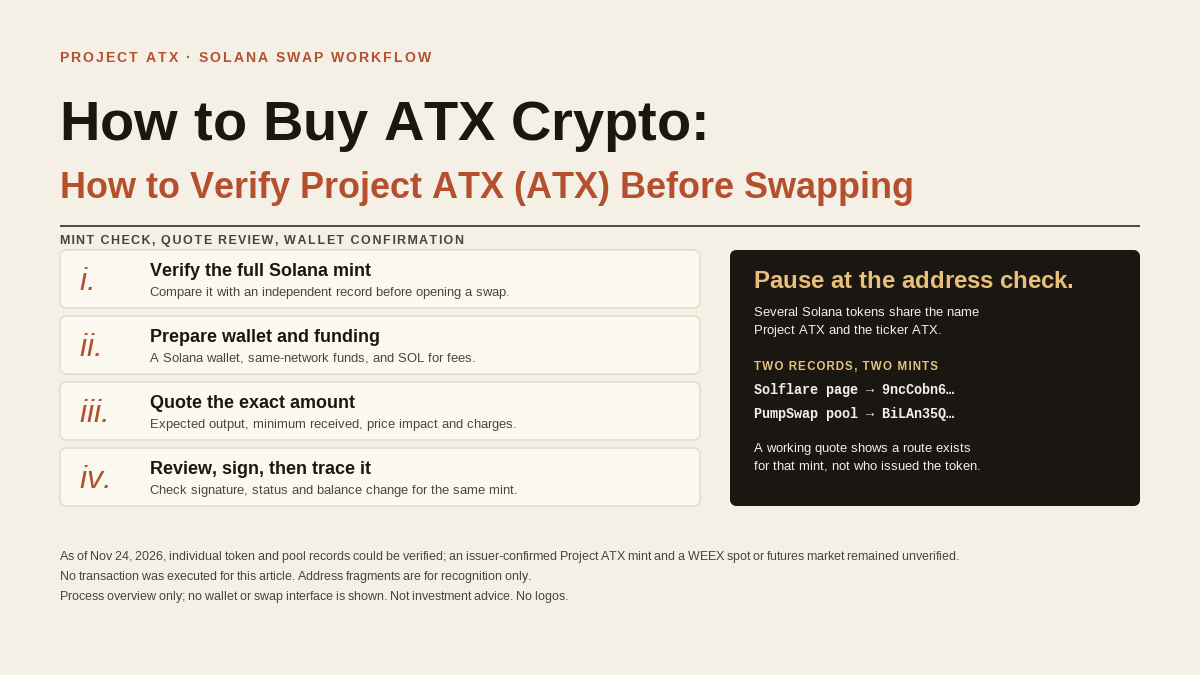
How to Buy ATX Crypto: How to Verify Project ATX (ATX) Before Swapping
Learn how to buy ATX crypto on Solana. Verify the Project ATX mint, review swap quotes and fees, and confirm the exact token you receive on-chain.
Interpretation of South Korea's Digital Asset Law Proposal: ICO Ban Lifted, Banks to Lead Stablecoin

Binance to suspend crypto withdrawals across all networks on Nov. 25

[Basic Law] ④ The Exchange is Responsible for Public Disclosure of Listed Digital Assets

[Basic Law] ② Tether and Circle Must Establish Branches and Register with the Financial Services Commission to Operate in Korea
New York Judge Rejects Attorney General's Request for Temporary Restraining Order Against Kalshi

White House reviews final CFTC prediction market rule

Paraguay authorizes forensic investigation on former president Peña's phones

Microsoft CEO Predicts IDE Usage Will Change Within Six Months

Crypto: 176 Gendarmes Mobilized Against a Network of Fraud Involving Stolen Data

How to Join a Crypto Trading Competition Team: WEEX WWFC 2026 Guide
Learn how to create or join a WEEX WWFC 2026 team, compare registration stages, understand the 10-member lock, and review team bonus allocation.

Cardano’s $5M event budget faces 5 times more opposition
SafePal August Security Incident Involves Order Information, System No Longer Vulnerable
Israeli bank lets customers buy Bitcoin but charges them 2% to get in and 2% to get out
Bitcoin privacy weakness links wallet addresses to network nodes in 30 out of 30 tests
AirnodeHub Introduces Provider-Signed APIs for the Emerging Agent Economy
TSMC Stock Price Prediction for December 2026
Central Bank of Argentina Calls for Curbing MEP Dollar and Stablecoin Transactions
Latest articles



Latest coin listings on WEEX



