
Litecoin Aims for the Next ETF, Shiba ETF Application May Speed Up Due to Trump Taking Office

Original Article Title: "Litecoin Curve Speeds Toward Next ETF, Altcoin ETF Application May Accelerate Due to Trump Administration"
Original Article Author: Weilin, PANews
On January 17th, Nasdaq has submitted a 19b-4 form for Canary Funds' Litecoin spot ETF, marking the official entry of the application into a 240-day review period. During this process, the Securities and Exchange Commission (SEC) will have the authority to approve, reject, or request more information. Meanwhile, Bloomberg analyst James Seyffart revealed that Canary Funds has submitted a revised version of the S-1 document for the Litecoin ETF, implying that the SEC may have started to participate in the review. The Litecoin ETF has seen new developments in the two-step approval process required for an ETF.
With the Trump administration about to take office, the market is full of expectations for the regulatory direction of future Altcoin ETFs, especially regarding the approval of Litecoin, Solana, and XRP ETFs.
Nasdaq Submits 19b-4 Form for Canary's Litecoin ETF
On January 17th, Nasdaq submitted a 19b-4 form for Canary Funds' Litecoin ETF application. The filing indicates that U.S. Bancorp Fund Services, LLC will serve as the manager, and U.S. Bank N.A. will be responsible for cash custodianship of the ETF. According to the document, Coinbase Custody Trust Company LLC will custody the Litecoin for the ETF.
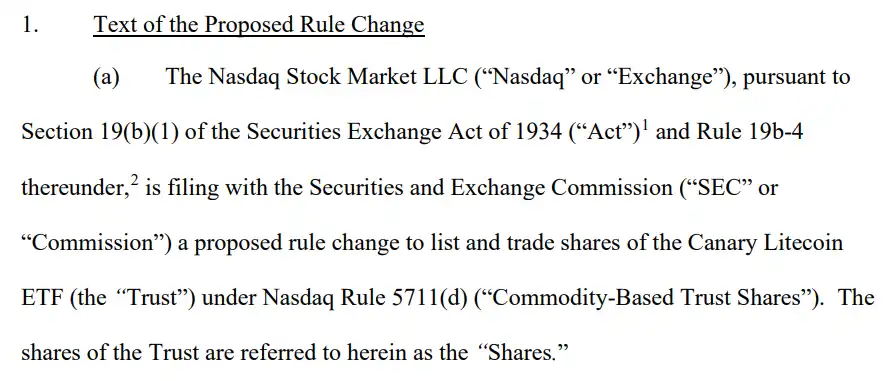
Under SEC regulations, this form initiates a 240-day approval cycle. During this period, the SEC will decide whether to approve the application or request further information. "This 19b-4 filing from Nasdaq pushes the internal processes at the SEC forward, but the SEC still needs to acknowledge the filing, which typically happens within weeks," said James Seyffart, Bloomberg's ETF analyst. "If and when the SEC acknowledges this filing, we'll be able to get a clearer picture of the potential timelines for rejection or approval."
"Bitcoin, 'Lite' Silver," a slogan from the early days of the crypto world. Litecoin is a fork of Bitcoin, meaning its protocol follows the same basic rules as Bitcoin; for example, it uses the Proof-of-Work consensus mechanism. Initially created by Charlie Lee in 2011, Litecoin is primarily aimed at small transactions. The relatively limited direct intervention by its core developers has made its "decentralization" feature more prominent. It is worth noting that the SEC has never considered Litecoin a security, unlike larger market cap cryptocurrencies like SOL and XRP that the SEC has deemed "securities," indicating that LTC has some facilitation in the approval process.
As of 2:00 p.m. on January 17, Litecoin's market capitalization was $10.48 billion. According to CMC data, it is currently ranked 19th in the cryptocurrency market by market capitalization, with a price increase of 16% in the past 24 hours. This growth trend has made the approval of a Litecoin ETF more attractive, especially in the case where the SEC has not deemed Litecoin a security.
The 19b-4 form is the second part of the ETF's two-step approval process, following the amended S-1 form submitted by Canary Capital on Wednesday. On January 16, Canary Funds submitted an amended S-1 filing for a Litecoin ETF application. Analyst James Seyffart stated that, while not guaranteed, this may indicate SEC involvement in this filing, which is a positive sign for predicting the increased likelihood of a Litecoin ETF approval.
Bloomberg analyst Eric Balchunas also mentioned hearing some rumors that feedback from the SEC has been received on the Litecoin S-1 filing, and the revised filing is a good sign for our prediction that Litecoin is likely to be the next approved cryptocurrency ETF.
3 Altcoin ETFs Could Attract $14.6 Billion in Inflows
On January 17, Bloomberg ETF analyst James Seyffart tweeted that the recent Solana ETF application has not yet been acknowledged by the SEC but believes that approval for a Solana or XRP ETF is only a matter of time.
As early as December 18, Bloomberg analyst Eric Balchunas stated, "We expect a wave of cryptocurrency ETFs to arrive in 2025, though not all at once. The first may be a Bitcoin + Ethereum combo ETF, followed by a Litecoin (as it's a Bitcoin fork = commodity), then HBAR (as it's not classified as a security), and finally XRP/Solana (both of which have been classified as securities in pending lawsuits)."
Last year, the SEC received multiple applications for ETFs tracking cryptocurrencies other than Bitcoin, from XRP to Solana and Litecoin, but ultimately only approved an ETF related to Ethereum. With the crypto-supportive Trump administration set to take office next week, according to Bloomberg's ETF analysts Eric Balchunas and James Seyffart, Litecoin (LTC) may be the first cryptocurrency to receive approval.
JPMorgan analysts expect that if multiple altcoin ETFs receive SEC approval, it could attract inflows of up to $14 billion. According to JPMorgan's analysis, a Solana ETF is expected to attract $3 billion to $6 billion in funds within 6 to 12 months, while an XRP ETF could attract $4 billion to $8 billion. This forecast is based on the "adoption rates" of existing cryptocurrency ETFs. For example, a Bitcoin ETF has already attracted around $108 billion in assets one year after launch, with a penetration rate of 6% of Bitcoin's market cap. Similarly, an Ethereum ETF attracted $12 billion in assets within six months, with a penetration rate of 3% of Ethereum's market cap.
In the case of Solana and XRP, JPMorgan analysts predict that at a 3% penetration rate, Solana could attract $2.7 billion and XRP could attract $430 million. At a 6% penetration rate, Solana's inflows could reach $5.2 billion, and XRP could reach $8.4 billion.
For Litecoin, if estimated using this method and if it were to be embraced by Wall Street at the same rate as Bitcoin, demand for the product could skyrocket to $580 million based on a 6% penetration rate of a Bitcoin ETF.
Multiple Crypto ETF Applications in the Pipeline, Grayscale Solana ETF Receives Preliminary Response on January 23
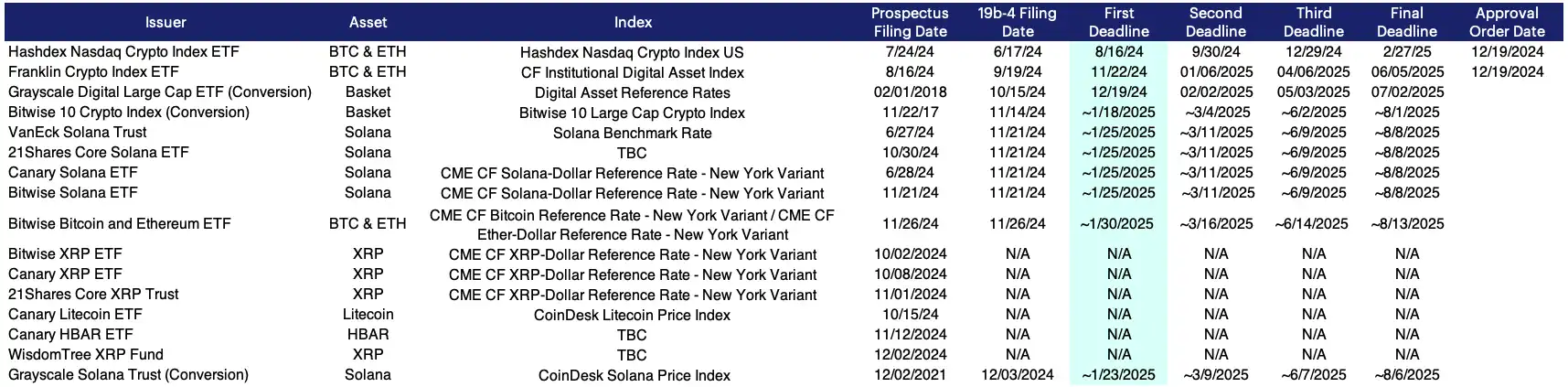
A list of crypto ETF applications as of mid-December 2024, including two recently approved applications. ("N/A" indicates the proposed listing exchange has not submitted Form 19b-4.) Source: Bloomberg, CF Benchmarks
On December 19, last year, the SEC officially approved the first batch of "Bitcoin + Ethereum" mixed exchange-traded funds (ETFs), namely the Hashdex Nasdaq Crypto Index US ETF (Nasdaq Exchange) and the Franklin Crypto Index ETF (Cboe BZX Exchange), expected to launch for trading in January 2025. These moves set the stage for new ETF approvals after Bitcoin and Ethereum spot ETFs.
As of mid-December 2024, multiple altcoin ETF applications are awaiting SEC approval. Among them, Grayscale's Solana ETF is expected to receive a preliminary response from the SEC by January 23, with other Solana ETF applications expiring on January 25. Meanwhile, Ripple's XRP ETF application is also under review, with multiple companies including WisdomTree, Bitwise, 21Shares, and Canary Capital having submitted applications.
Comparing Three Types of ETFs, Katalin Tischhauser, Investment Research Director of Crypto Bank Sygnum, pointed out that the likelihood of Solana becoming the third crypto asset to receive approval for a US spot ETF by the end of January is slim. She stated that the SEC has not yet begun to assess the market for Solana as an underlying asset, meaning that the approval of a Solana ETF may require more time.
With the Trump administration taking office in just four days, the market is full of anticipation for the approval prospects of a cryptocurrency ETF. On January 17, according to foreign media reports, US President-elect Trump expressed willingness to establish a US-preferred strategic reserve and prioritize cryptocurrencies such as Solana (SOL) and XRP, bringing positive news that also boosted the overall market sentiment.
Currently, ETF applications for altcoins like LTC, Solana, and XRP may see more opportunities in a new policy environment. With the assumption that the new SEC Chairman Paul Atkins will reverse the SEC's previous regulatory and approval approach, it is expected that approval of altcoin ETFs will become a significant topic in the crypto market in the coming months, and the development of this process is worth close attention.
You may also like

Galaxy Deep Research Report: How Hyperliquid's HIP-4 Upgrade Changes the Landscape of Prediction Markets?

ZachXBT: Humanity private key leak and abnormal surge in H token should be viewed separately
On June 9, according to related disclosures, on-chain investigator ZachXBT posted an update on Humanity’s roughly $31 million security incident, saying that after further analyzing fund flows, he currently tends to believe the project team was not involved in an “inside job” or a self-staged attack. According to him, the official explanation about the private key leak was broadly accurate, but before the token unlock, the price of H had been artificially pushed higher, and the hacker later took advantage of that market environment; therefore, the private key leak and the earlier abnormal price pumping should be regarded as two separate and independent events. This reframing has shifted the market’s understanding of the nature of the incident. Earlier discussion around Humanity had focused on whether the team directly participated in the attack or used the security incident to cover up internal operations. ZachXBT’s latest remarks shift the focus from “whether it was self-theft” to “whether there were pre-unlock market structure issues.” He also questioned whether the team may have.

Morning Report | OpenAI has submitted an S-1 registration statement draft to the U.S. SEC; Morpho completes $175 million financing

Morning Report | BitMine increased its holdings by 126,971 ETH last week; trader Eugene announced his exit from the crypto market

Wang Chuan: How can one not feel anxious after the neighbor Old Wang made thirty times profit by investing in storage stocks? (Seven) - A quarter-century cycle

Cryptocurrency CEXs are flocking to sell US stocks, and traditional brokerages are facing an "uninvited guest."
$75 billion in foreign capital has fled, and South Korean retail investors have absorbed it all using leverage

Japan’s Three Megabanks Plan Joint Stablecoin Issuance in Fiscal 2026
MUFG, SMBC, and Mizuho reportedly plan to jointly issue fiat-pegged stablecoins in fiscal 2026, signaling Japan’s growing push into bank-led digital payment infrastructure.

Humanity Discloses H Token Dual-Chain Attack Details, With Losses on Ethereum and BSC Exceeding $36 Million
Humanity said the H token attack across Ethereum and BSC caused more than $36 million in losses after leaked ProxyAdmin keys enabled malicious contract upgrades and token minting.
White House Discusses CLARITY Act With Law Enforcement Ahead of Senate Vote
The White House discussed the CLARITY Act with law enforcement ahead of a Senate vote, focusing on illicit finance risks and developer protections.

Bitcoin Trading Guide 2026: Strategies for Experienced Traders

What Is XAUT and PAXG? Why Tokenized Gold Is Booming in 2026

Will the SpaceX IPO Hurt Bitcoin? Here's What Traders Are Watching

Foreign selling in the South Korean stock market accelerates, with cumulative net sales reportedly reaching $75 billion this year
On June 9, The Kobeissi Letter, citing Goldman Sachs data, reported that global investors are selling South Korean stocks at an unusually rapid pace. In the latest trading session, foreign investors sold about $801 million worth of Kospi constituent stocks again; total foreign outflows last week reached about $10 billion, and the market has been in net foreign selling on nearly every trading day over the past month. According to the data cited in the report, foreign investors have sold about $75 billion worth of South Korean stocks so far this year. Meanwhile, South Korean retail and institutional investors together recorded roughly $69 billion in net buying over the same period, suggesting that the market’s main buying support has come from domestic capital rather than returning overseas funds. The information currently disclosed still mainly comes from The Kobeissi Letter’s retelling and Goldman Sachs data summaries, while public details on the statistical period and the specific definition of “selling” remain relatively limited.

Fortune Warns of Strategy’s Financing Structure Risks as Bitcoin Premium Narrows
Fortune warned that Strategy’s Bitcoin treasury model faces growing financing risks as MSTR’s net asset premium narrows and preferred stock dividend pressure increases.

Ferrari Challenge Le Mans: Carl Moon to Dominate in WEEX Livery

Sahara AI Responds to SAHARA’s Sharp Drop: No Contract or Product Security Issues Found, Internal Investigation Underway
Sahara AI responded to SAHARA’s 60% price drop, saying no token contract or product security issues have been found and an internal investigation is underway.

WEEX Deposit/Withdrawal Dynamic Island: Your Asset Status, Always in Sight
Galaxy Deep Research Report: How Hyperliquid's HIP-4 Upgrade Changes the Landscape of Prediction Markets?
ZachXBT: Humanity private key leak and abnormal surge in H token should be viewed separately
On June 9, according to related disclosures, on-chain investigator ZachXBT posted an update on Humanity’s roughly $31 million security incident, saying that after further analyzing fund flows, he currently tends to believe the project team was not involved in an “inside job” or a self-staged attack. According to him, the official explanation about the private key leak was broadly accurate, but before the token unlock, the price of H had been artificially pushed higher, and the hacker later took advantage of that market environment; therefore, the private key leak and the earlier abnormal price pumping should be regarded as two separate and independent events. This reframing has shifted the market’s understanding of the nature of the incident. Earlier discussion around Humanity had focused on whether the team directly participated in the attack or used the security incident to cover up internal operations. ZachXBT’s latest remarks shift the focus from “whether it was self-theft” to “whether there were pre-unlock market structure issues.” He also questioned whether the team may have.
Morning Report | OpenAI has submitted an S-1 registration statement draft to the U.S. SEC; Morpho completes $175 million financing
Morning Report | BitMine increased its holdings by 126,971 ETH last week; trader Eugene announced his exit from the crypto market
Wang Chuan: How can one not feel anxious after the neighbor Old Wang made thirty times profit by investing in storage stocks? (Seven) - A quarter-century cycle
Cryptocurrency CEXs are flocking to sell US stocks, and traditional brokerages are facing an "uninvited guest."

Popular coins
Latest Crypto News


