
Pippin: The Undervalued AI Agent Framework Dark Horse with a Quick $200M Valuation

 Prefer us on Google



Original Title: Pippillions
Original Author: JW (Peace and Tranquility)
Original Translation: Deep Tide TechFlow

In the cryptocurrency field, especially in those hot emerging areas, I have observed a very common phenomenon: many people, after finding a "good project" and seeing it rise rapidly, often become overly focused, ignoring other possibilities. While this may bring short-term gains, if adjustments are not made promptly when the external environment changes, issues may arise.
I believe that the idea that a current leader in an emerging field that has only been around for 4 months can maintain a leading position in the long term is overly naive, especially with more excellent developers and technologies constantly emerging.
Pippin Framework
Pippin is an AI agent framework developed by @yoheinakajima, designed to help developers and creators leverage advanced AI technology in a modular way. Through Pippin, users can build digital assistants that can autonomously perform tasks, generate new plans, and seamlessly collaborate with external tools. As an open-source project, Pippin will be available for global use in the coming weeks.
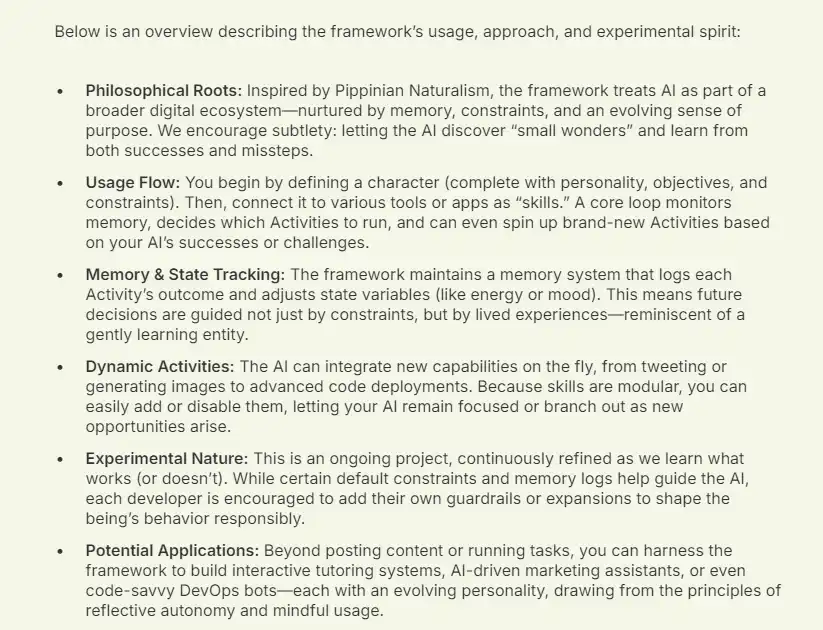
Here is an overview of the framework's usage, design philosophy, and experimental spirit:
· Philosophical Root: The framework is inspired by Pippinian naturalism, viewing AI as part of a broader digital ecosystem. It drives AI development through memory, constraint conditions, and an evolving sense of purpose. We advocate for a subtle design philosophy: let AI autonomously discover "small miracles" in life and learn and grow continuously through success and failure.
· Usage Flow: When using the framework, the first step is to define a role, including its personality, goals, and constraint conditions. Then, connect the role to various tools or applications, referred to as "skills." The core loop of the framework monitors the role's memory state, determines which activities need to be performed, and can even generate entirely new activities based on the AI's successful experiences or encountered challenges.
· Memory and State Tracking: The framework has a built-in memory system that can record the results of each activity and dynamically adjust state variables (such as energy or emotion). This means that the AI's future decisions are influenced not only by constraint conditions but also by "past experience," like an intelligent agent capable of gradual learning and adaptation.
· Dynamic Activities: This framework supports AI's dynamic expansion capability, from simple tasks like tweeting or generating images, to complex advanced code deployments. Because skills are modular, developers can easily add or disable specific skills, allowing AI to focus on certain tasks or expand its capabilities when new opportunities arise.
· Experimental Nature: This is an ongoing optimization project, evolving as developers continuously explore effective methods, improving the framework along the way. While the framework includes some default constraints and memory logs to guide AI behavior, developers can add their own safeguards or extend functionality as needed to shape AI behavior responsibly.
· Potential Applications: The scope of this framework is very broad; besides being used for content publishing or task execution, it can also be used to develop interactive educational systems, AI-driven marketing assistants, and even DevOps bots with coding capabilities. These applications all have evolving personalities, based on self-reflective abilities and responsible use design principles, providing innovative solutions across different domains.
Core Concepts and Methods
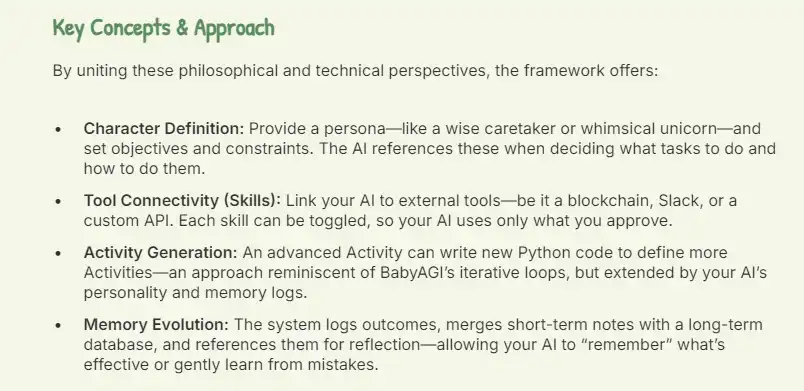
By blending philosophy and a technical perspective, this framework provides developers with the following key features:
· Role Definition: You can define a role for AI, such as a wise guardian or a whimsical unicorn, and set its goals and constraints. AI will act based on these role settings, referencing its personalized goals and limitations when performing tasks, deciding "what to do" and "how to do it."
· Tool Integration (Skills): The framework supports connecting AI to external tools, such as blockchain, Slack, or custom APIs. Each tool exists as a "skill" module and supports flexible on/off controls, ensuring AI only uses tools you authorize, maintaining task controllability and focus.
· Live Generation: AI can dynamically generate new Python code through advanced activities to define more activities. This approach draws on the iterative loop mechanism of BabyAGI but combines it with AI's personalized features and memory logs, making the generated activities more aligned with role settings and actual needs.
· Memory Evolution: The framework has a built-in memory system that records the outcomes of each activity, combining short-term notes with a long-term database. AI can reflect on these memories, gradually optimizing its behavior—not only remembering which methods are more effective but also gently learning from mistakes, providing references for future decisions.
Now you might be wondering, "JW, how is this different from other existing frameworks? What makes Pippin so special?"
Let me introduce you to its background.
BabyAGI (Foundation of Pippin)
BabyAGI is the first AI agent project open-sourced by @yoheinakajima. To date, it has garnered 20,000 stars on GitHub and has been cited in over 70 academic papers. It is one of the most influential agent frameworks to date, with its status unchallenged.
In fact, many believe that it was BabyAGI that sparked the wave of competition in the AI agent field.
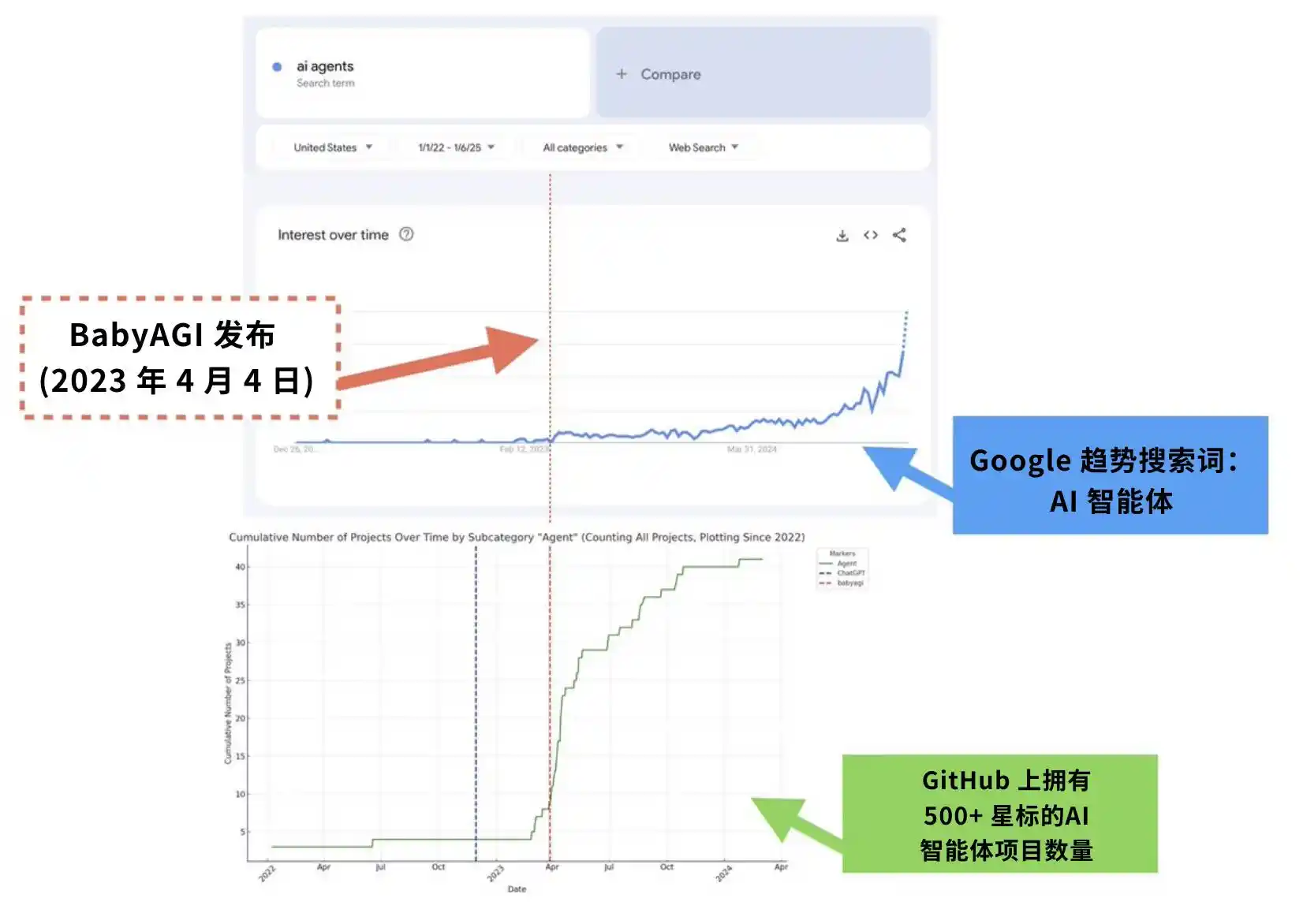
Original image from @JW100x, compiled by DeepTide TechFlow.
In essence, BabyAGI is a significant milestone in the AI agent industry, and Pippin is an extension of BabyAGI. It transforms BabyAGI into a modular agent framework and will be released as an open-source project for global adoption in the future. While Pippin has the potential to become one of the world's top agent frameworks, it is rarely mentioned at present (a clear sign of "tunnel vision").
Q&A with Yohei
Recently, I had a few interesting exchanges with @yoheinakajima. He allowed me to share some of the questions and answers:
Yohei: "For the past two years, I have been exploring an idea of developing an AI that can autonomously start a business. While I am unsure if the current AI models are ready to support this goal, once I am convinced it can be done, I will dedicate myself to building a business empire."
JW: "Will the Pippin framework play a role in such a project?"
Yohei: ":). I believe the current framework can be applied to any field, depending entirely on the developer's creativity."
The potential of the Pippin framework is limitless. As AI agent technology continues to advance, we may see it emerge not only in the crypto space but also potentially play a key role across various industries globally, driving industrial transformation.
Issues with Existing Frameworks
Through conversations with some AI developers, I learned that existing frameworks, especially TypeScript-based ones, face several challenges in practical development.
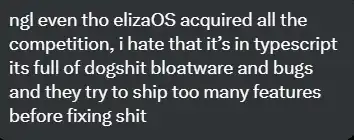
A developer closely working with Eliza (ai16z) mentioned: "Honestly, even though ElizaOS has acquired all its competitors, I really dislike that it is developed in TypeScript. The system is bloated with features and numerous bugs, and they are always eager to release too many new features before fixing existing issues."
Due to these issues, there is a pressing need in the market for a more efficient and user-friendly framework, which is exactly where the strength of the Pippin framework lies. Through BabyAGI's open-source code, we can already catch a glimpse of the potential of the Pippin framework's future.
In fact: "BabyAGI was introduced at the launch of ChatGPT-4, making it the earliest intelligent agent framework and arguably the origin of intelligent agent technology. The creator of BabyAGI undoubtedly is far ahead of AI16z. I believe ElizaOS's development is more like a complete framework port, and it is almost certain to surpass AI16z comprehensively. Our company has been using BabyAGI internally even before adopting ElizaOS."
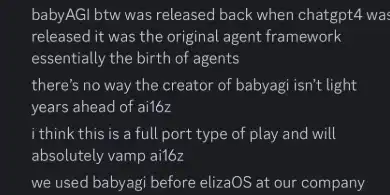
"In this case, this claim is indeed valid since the inspiration for ElizaOS is entirely derived from BabyAGI. Here, 'inspiration' can be understood almost as BabyAGI actually laid the groundwork for RAG (Retrieval-Augmented Generation) technology."
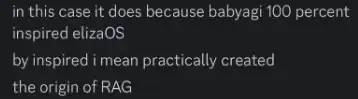
Many existing frameworks not only pale in comparison to BabyAGI (Pippin) but are even developed inspired by BabyAGI. While ai16z has its unique value in some aspects, its valuation is significantly higher than that of Pippin, which is clearly unreasonable.
"First-mover advantage" is indeed an important factor, but when more powerful technologies emerge, we need to reassess our biases; otherwise, we may miss out on real opportunities.
Do Not Overlook Yohei
Yohei is hailed as the "AI Father," with extensive experience in the AI field and has always been a pioneer in this field. He currently operates a venture capital fund and leverages his developed technology to guide investments. At present, his main task is the Pippin framework. He aims to build a business model based on the Pippin framework that can operate independently and be profitable continuously, and he indeed possesses the technical capabilities to achieve this goal.
P.S.: Yohei even caught the attention of Jeff Bezos, which is more than enough to prove his influence.
Disclaimer: This content is provided for general branding and informational purposes only and doesn't constitute financial, investment, legal, or tax advice. Any events, rewards, online events, or related information mentioned herein should not be considered a recommendation, solicitation, or invitation to purchase, sell, trade, or otherwise deal in any crypto assets or to use any services. Crypto assets are highly volatile and may result in loss. WEEX services and online events may not be available in all regions and are subject to applicable laws, regulations, and eligibility requirements. You are responsible for ensuring that your use of WEEX services complies with local laws and for carefully assessing the risks before participating in any crypto-related activities.
You may also like

Walsh's 'Unified Front': Aiming for Rate Cuts?

Ethereum vs Solana Whitepaper Comparison (2026)
French Tech: AI and Quantum on the Rise, Crypto Absent

Home Robot NEO Grows "Dexterous Hands": How Do Hands Become the API to the Physical World?

What is SCEX? The Cryptocurrency Exchange for Vietnam's Market by Sacombank

Major Update for ChatGPT: Cross-Platform Functionality, One-Click Website Creation, and Lower Costs

BTC Challenges 64,000 After Breaking 63,000, Market Trading 'Manageable Risks'

As the Bubble Bursts, Who Dominates Attention in the AI Era? A 2026 Guide to Influential AI KOLs in China and the UK

Old Money in Crypto Shifts: Paradigm Raises $1.2 Billion, Half Bet on AI and Robotics

Bitdeer unveils $36M Nevada factory to shake up Bitcoin mining

Perplexity Fine-Tuned a Chinese AI Model to Match Claude Opus 4.8 at One-Third the Cost

Bank of Korea defends bank-first stablecoin plan amid bill deadlock
JPMorgan says bitcoin's main risk isn't Strategy, but blockchain adoption that doesn't benefit public chains and tokens
Fear & Greed Index Today: What Extreme Fear Means for Crypto, Stocks and Gold
Labour MPs Push to Make UK Crypto Donation Ban Permanent

Supreme Court ruling expanding Trump's authority over federal agencies raises questions for SEC, CFTC as crypto rulemaking advances

'Bottom building in progress': Analysts say bitcoin holder capitulation signals late-stage bear market

A Comprehensive Analysis: Starting from 1996, Who is Laying the Foundation for the Next Generation of Capital Markets
Luke Dashjr, the Biggest Anti-Spammer of Bitcoin, Inscribed Phrases on the Network in 2011

Whales bought 270,000 BTC while ETFs bled $7 billion. One side is wrong

The crypto IPO class of 2025-26 is down as much as 89%. Autopsy of a listing boom
Robinhood Chain Mining Guide: A Comprehensive Tutorial from Cross-Chain to Memecoin
BitGo CEO says single-digit percentages of bitcoin's supply are 'probably right' for large holders amid Strategy's sale

Beyond Private Keys: How to Safeguard the Security Boundaries of Web3 from Wallets, L2 to Supply Chains?

Vanguard Enters the Market, Opening a New Crypto Gateway for 50 Million Traditional Investors

Why the OUSD Alliance of 150 Companies Still Cannot Shake USDT and USDC?
Citigroup Analysis: Is There Still 47% Upside for Nvidia? Can Rubin and CPO Deliver?
WEEX API Fast Connect: Turn Every Sign-In Into a Live Trader in Under 10 Seconds
WEEX API Fast Connect is a one-click OAuth authorization system that lets your users link their WEEX account without ever touching an API key. Frictionless onboarding, faster conversions, higher retention — built for WEEX Broker partners.
Bitcoin's dwindling exchange reserves don't pack the same bullish punch anymore

From Le Mans to the Rollercoaster: Carl Moon Takes On Portimão
Crypto world renowned KOL and racing driver Carl Moon, backed by WEEX, heads to the Ferrari Challenge Portugal round at the Algarve International Circuit, July 16–19, fresh off a podium finish at Le Mans. Here's why this race is one to watch.
Fast execution. Split-second accuracy. Security that never blinks. That's WEEX — and that's exactly how Carl races.
Walsh's 'Unified Front': Aiming for Rate Cuts?
Ethereum vs Solana Whitepaper Comparison (2026)
French Tech: AI and Quantum on the Rise, Crypto Absent
Home Robot NEO Grows "Dexterous Hands": How Do Hands Become the API to the Physical World?
What is SCEX? The Cryptocurrency Exchange for Vietnam's Market by Sacombank
Major Update for ChatGPT: Cross-Platform Functionality, One-Click Website Creation, and Lower Costs

Contents
Latest articles

Latest coin listings on WEEX


