PNET is becoming popular. Is it a good idea to use AI Agent as a personal trainer?




Original title: "PNET quickly became popular. Is it a good idea to hire an AI Agent as a private tutor for learning?"
Original source: TechFlow
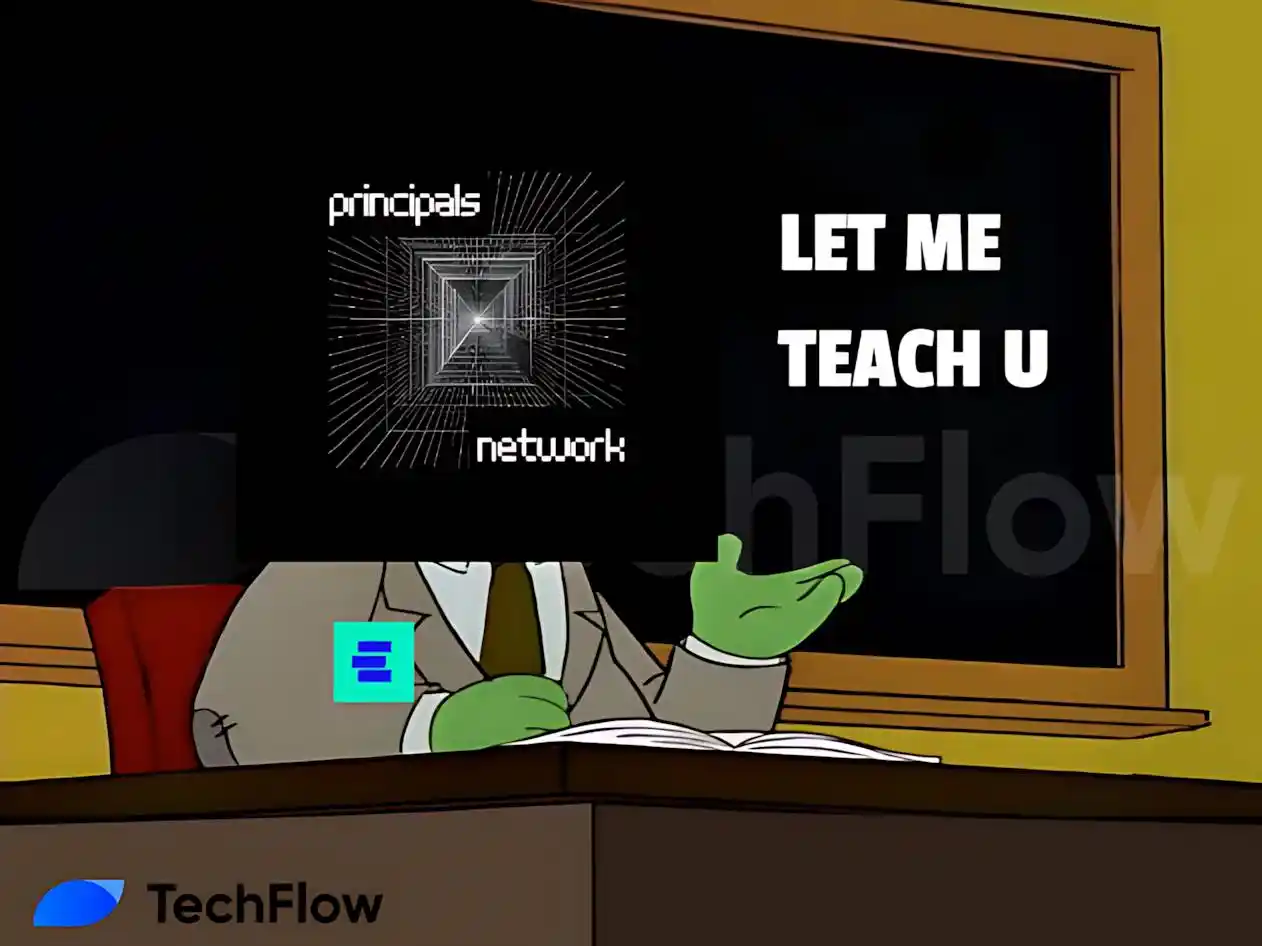
Welcome to the day of the recovery of the Solana chain ecosystem.
With Solana's official announcement of the AI hackathon, ai16z rebounded and surpassed GOAT in market value, and funds in the market began to pour into AI Agent-related projects.
If you look closely at the introduction of the hackathon, the goal of the event is very clear --- Build the best AI Agent product.
Official support, to some extent, also means that in the next period of time, the general environment will be favorable to those AI Agents that can solve practical problems or aim at specific directions.
And such expectations may have been priced in.
Today, a project called Principals Network, whose token $PNET (note that it is not PNUT Squirrel) has risen all the way within 24 hours of the token issuance, and its market value has reached 15M from the initial 200k. There have been sporadic discussions, but it is still outside the mainstream narrative.

And the goal of the project is very clear, that is, to aim at a specific direction: to make a decentralized education network with AI agents.
From a narrative perspective, the first one is very important.
It seems that this narrative of making a personalized education assistant and private tutor for an AI agent is the first time. Coupled with the support of the AI hackathon for discovering practical projects, the expectations of PNET have been further raised.
We took a look at its design documents and shared more information with you.
AI as personalized private tutor, with learning proof on the chain
Before we get to know PNET in depth, we need to understand the core problem it wants to solve.
Traditional online education platforms often face the contradiction between standardization and personalization: either the same course content or the high cost of one-to-one tutoring. In AI Agent, this problem seems to have found a new solution.
AI itself can become a personalized private tutor.
The core design of PNET revolves around three key elements:
1. AI Teaching Agents
These are not simple question-answering machines, but specially trained domain expert AIs; each agent focuses on a specific subject area, such as blockchain, artificial intelligence, or personal development. At the same time, they can understand the learner's cognitive level and develop personalized learning paths.
AI continuously optimizes teaching strategies through continuous interaction with learners, making teaching itself a kind of training tuning.
This layer of functions is integrated in the AI Engine layer and is uniformly scheduled by the Headmaster module. (See the architecture diagram below)
2. Decentralized Knowledge Graph
This layer is built in Academies and connects knowledge points in various disciplines. Continuous expansion and optimization through community contributions help AI agents understand the relevance of knowledge
This design can provide learners with a multi-dimensional knowledge exploration path, support interdisciplinary learning and knowledge integration
3. Proof of Learning
This function is built on the EDU Chain layer, recording every step of the learner's learning progress and generating verifiable proof of skills. The most important thing is that after you finish learning, it will be combined with the $PNET token incentive mechanism, providing learners with more external reward motivation.

These three points can theoretically form a self-sufficient cycle: AI teaching agents obtain teaching content and related information through knowledge graphs, the learning process is recorded through on-chain proofs, and fed back to AI agents to optimize teaching; the knowledge graph is constantly enriched and verified during the learning process.
A deeper look into the architecture of the project shows that the core of PNET is a decentralized education network built on the Solana ecosystem, which adopts a three-layer design: AI Principals, Academy System, and EDU Chain.
The AI Principals layer is the core of the entire system, with specially trained AI Agents acting as personalized tutors. These AI Agents can not only customize learning paths according to the characteristics of learners, but also provide real-time coaching and Q&A. The Academy System layer is responsible for managing educational content and resources, building a dynamically evolving curriculum system, and coordinating the interaction between learners and AI Principals. The bottom layer of EDU Chain is built on Solana, and mainly handles core functions such as education certificate certification, credit management, and token incentives.
The more detailed division of labor in the above architecture can be summarized as follows:
1. Infrastructure layer
· EDU Chain: as the underlying public chain infrastructure of the entire system
· $PNET: the native token of the ecosystem, used for incentives and governance
2. Core layer
· AI Engine: the core engine responsible for intelligent teaching
· Headmaster: the central scheduling module of the system
· Partners: partner access module
3. Subject content layer (Academies)
This layer is particularly interesting, covering multiple professional fields, such as Personal Development, Artificial Intelligence, Trading, Blockchain and other disciplines inside and outside the circle.
Currently, PNET has released a test network, but we have not actually seen the full picture of its product; the market is optimistic about the project more for the expected price in, but it is undeniable that this attempt to deeply combine AI, Web3 and education represents an innovative direction for online education.
Potential connection with Open Campus
PNET's market value soared from 200k to 15M in just 24 hours. In addition to the innovative narrative of AI Agent education, there is a deeper reason - its potential connection with Open Campus.
Looking at the project's documentation, it can be found that there is an ecological support relationship between Principals Network and Open Campus: as a winner of the Open Campus accelerator program, the former has confirmed that it will integrate EDU Chain's SSO (single sign-on) and authentication mechanism into its own platform. Behind this seemingly ordinary technical integration, there is actually a greater room for imagination.
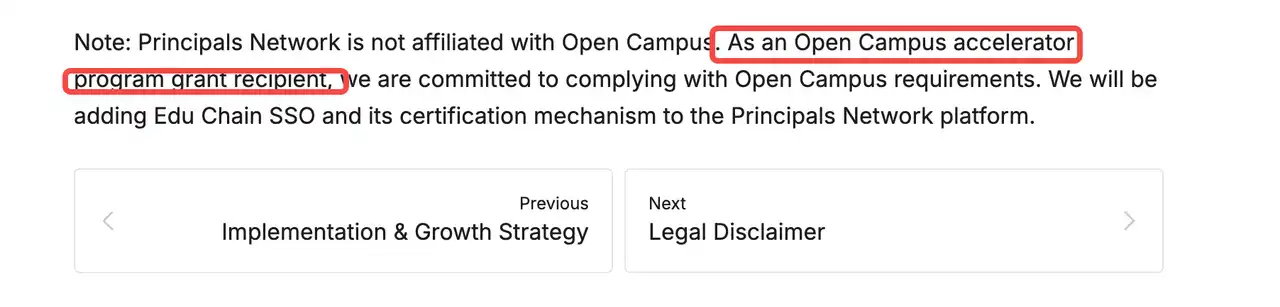
Open Campus is an important layout of Binance in the field of Web3 education. In 2023, it has received a strategic investment of 3.15 million US dollars from Binance Labs. Previously, the market generally understood that this was Binance's optimism about the Web3 education track.
Through this relationship, PNET's valuation story seems to have become more three-dimensional.
The project may no longer be just an educational innovation project that rides on the Solana AI craze, but may become an important node connecting the Binance ecosystem.
This double benefit superposition may explain why funds are pouring into PNET. Investors seem to have begun to pay for the background of a "Binance Web3 Education AI Project".
Of course, whether this expectation can be fulfilled depends on the actual progress of the project.
But then again, the best hype space for a project is still when its expectations are full but have not yet been fulfilled; of course, for Degens, it is best that expectations never be fulfilled.
You may also like
The cryptocurrency industry has become a traditional industry
Chip frenzy cooling down? Morgan Stanley's Wilson: Funds are shifting towards AI supercomputing giants like Microsoft and Amazon
Morning Report | Vitalik outlines Ethereum's long-term roadmap, Lean Ethereum will become the third major iteration; SK Hynix seeks to attract more AI investors by listing in the U.S
Trump, the best stock trader among U.S. presidents
From ByteDance to Financial Freedom: How did "Byte Brother" Leto develop his investment judgment skills to achieve a turnaround of 30 million?
Selling coins despite a loss of 55 million dollars, the faith in Strategy has reached the interest payment date
OUSD False Cooperation Controversy? The Credit Game of Stablecoins and Endorsements by Giants
Q-Day Countdown: Will Quantum Computing End Cryptocurrency?
The ten years of Cloud on the Air: From corner coffee to global financial infrastructure
$10,000 in TRUMP Token vs. $10,000 in Nasdaq: The "Trump Trade" That Actually Worked in 2026
The impact of OUSD on Circle, Tether, and Paxos: not a single negative factor, but a more complex reshaping of competition
Li Feifei's latest long article: When video generation, robots, and NVIDIA all claim to be world models, we need a taxonomy
Blaming the desolation of the cryptocurrency world on the rise of AI is a form of intellectual laziness
Strategy Founder: The Next 10 Years of Bitcoin
Forbes Special Report: Stablecoin cross-border payments are faster now, but not cheaper yet
A valuation of 8 billion dollars, doubling in 8 months! What makes the crypto-friendly bank Erebor Bank stand out?
340 billion valuation: Li Yanhong's largest IPO, a seat in Kunlunxin's shares is hard to come by
Stablecoins are the "royalists" of the crypto world: Open USD brings the old currency system into play
The cryptocurrency industry has become a traditional industry
Chip frenzy cooling down? Morgan Stanley's Wilson: Funds are shifting towards AI supercomputing giants like Microsoft and Amazon
Morning Report | Vitalik outlines Ethereum's long-term roadmap, Lean Ethereum will become the third major iteration; SK Hynix seeks to attract more AI investors by listing in the U.S
Trump, the best stock trader among U.S. presidents
From ByteDance to Financial Freedom: How did "Byte Brother" Leto develop his investment judgment skills to achieve a turnaround of 30 million?
Selling coins despite a loss of 55 million dollars, the faith in Strategy has reached the interest payment date