
The Crypto Market Faces a "203" Crash - What Are the Reasons?



On the last two days before the start of 2025, Bitcoin briefly dropped below $92,000, causing a total of $2.028 billion in liquidations across the network in the past 24 hours. Of this amount, long liquidations accounted for $1.766 billion, while short liquidations totaled $0.27 billion. Additionally, in the last 24 hours, a total of 700,594 people worldwide were liquidated, with the largest single liquidation occurring on Binance - ETHUSDT worth $25.635 million.
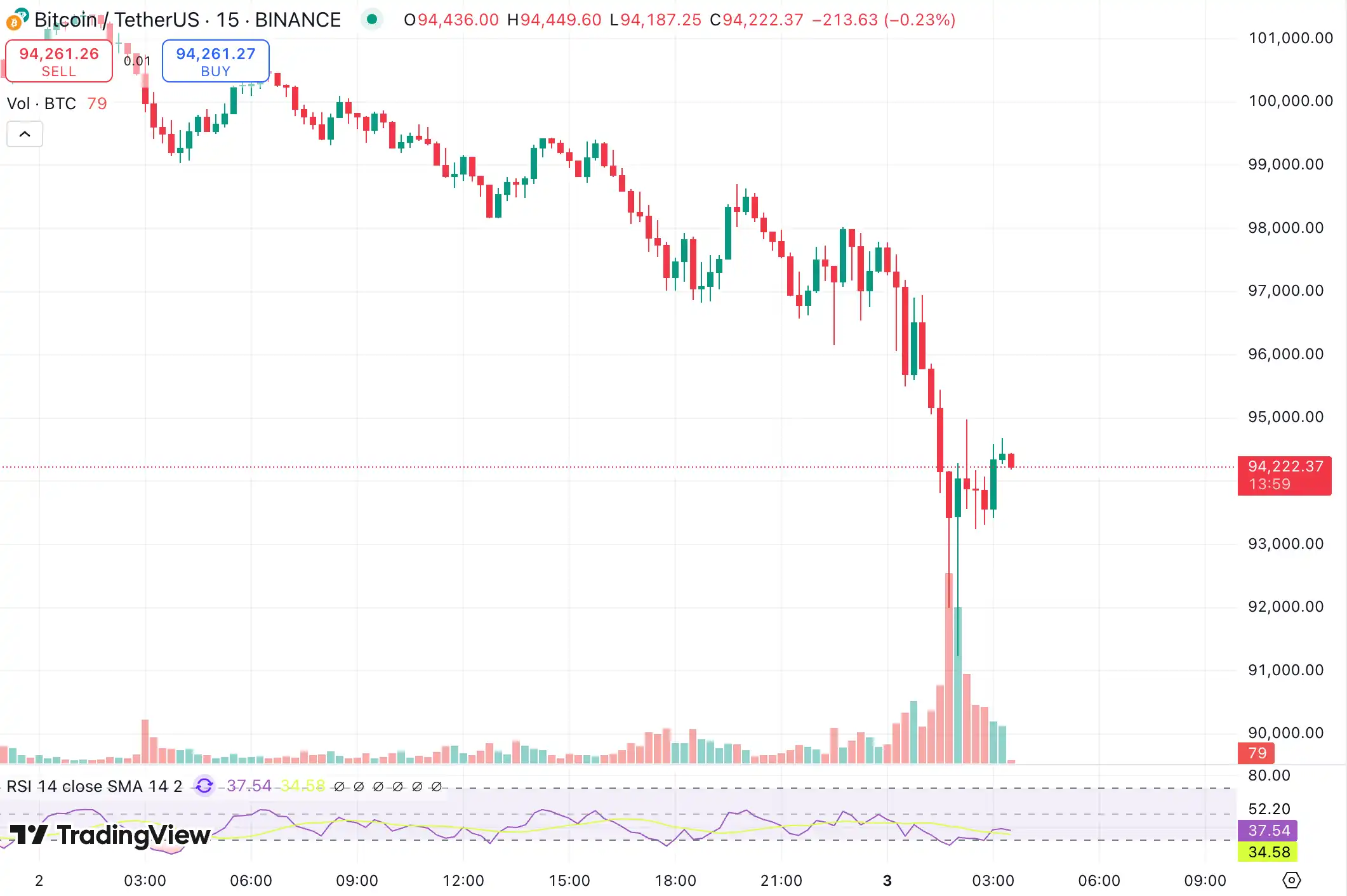
Since the Chinese New Year holiday this year, Bitcoin has experienced several sharp short-term drops. Here are the market reasons for Bitcoin's decline compiled by BlockBeats for reader reference only.
DeepSeek Triggers "Minor Financial Crisis"
On January 27, the domestic AI large model DeepSeek surpassed ChatGPT in downloads, ranking first on the U.S. App Store, attracting global attention and media coverage from the technology, investment, and media industries. Due to DeepSeek's performance comparable to large-scale cutting-edge models like OpenAI but with a training cost of less than $6 million, the AI industry's foundation, which has always believed in "great power yields great results," was shaken, leading the financial sector to view it as a black swan event triggering a financial crisis.
On January 29, multiple U.S. officials responded to DeepSeek's impact on the U.S., stating that DeepSeek was "stealing" and launching a national security investigation into its impact. Just the day before, U.S. President Trump described DeepSeek as a very positive technological achievement. On February 2, Cathie Wood, CEO of asset management company ARK Invest, stated in an interview that DeepSeek had proved that success in the AI field does not require a lot of money and accelerated cost deflation.
Impacted by DeepSeek, NVIDIA saw a 5.3% decline that day, the NASDAQ dropped over 400 points, and the U.S. stock market lost nearly $1 trillion in market value. Bitcoin and cryptocurrencies, as risk assets, also suffered the impact, with Bitcoin's daily decline reaching 4.4% and ETH falling by 3.8%. After a week of recovery, the market continued to show weakness, experiencing another sharp drop at the start of this week. The future trend of the crypto market may still need further observation based on the performance of U.S. stocks after the market opens.
Trump Administration's Tariffs Implemented
The tariff "big stick" promised by Trump during his U.S. presidential campaign has gradually been implemented in recent days. On February 2, the U.S. government announced a 25% tariff on imported goods from Canada and Mexico. President Trump signed a tariff order that day, imposing an additional 25% tariff on imported products from Canada and Mexico and a 10% tariff on energy resources from Canada. The tariffs are set to take effect on the 4th. The White House noted that if there is retaliation against U.S. tariffs, the U.S. may intensify its tariff measures.
On the previous day, Trump signed an executive order imposing a 10% tariff on goods imported from China. The White House stated that for all goods imported from China, the United States will impose an additional 10% tariff on top of the existing tariffs. Trump said that this aligns with his support for "protectionist measures."
On the 3rd day, Trump again stated he will "definitely" impose new tariffs on the European Union. He once again complained about the U.S. trade deficit with the EU and believed that the EU's imports of American cars and agricultural products were insufficient. Trump did not specify the tariff level or timetable. He told the media, "I'm not going to say there's a timetable, but it'll be soon."
According to Bloomberg, BTC Markets CEO Caroline Bowler stated: "Trump's tariff policy is affecting the entire market, and concerns about a trade war and stagflation-induced recession are spreading to the altcoin and bitcoin market." Due to the tariff news, BTC briefly fell to around $91,000, its lowest level in over two weeks. However, on the other hand, Bitwise Alpha's Head of Strategy Jeff Park also stated that Trump's trade tariff policy would raise bitcoin prices in the long term as it would lead to the weakening of the U.S. dollar in the global currency market and cause a drop in U.S. Treasury yields.
El Salvador Cancels Bitcoin's Legal Tender Status
On January 30, according to Cointelegraph, the Salvadoran Congress swiftly passed legislation to amend its Bitcoin law to comply with an International Monetary Fund (IMF) agreement. The ruling party legislator Elisa Rosales stated that this amendment aims to ensure Bitcoin's "permanence as legal tender" while promoting its "practical use."
On February 2, the Salvadoran Congress (controlled by the ruling party) quietly passed an amendment to the "Bitcoin Law," removing Bitcoin's official currency status, making its use entirely optional. This reform was made under pressure from the IMF over the past two years, with the IMF approving a $1.4 billion loan as a condition, requiring the Salvadoran government to "reduce the risk of Bitcoin."
El Salvador was once the world's first country to adopt Bitcoin as a legal tender and has now become the first country to abandon this policy. Bitcoin is no longer considered "currency" in El Salvador, as members of parliament voluntarily amended six articles of the "Bitcoin Law" and repealed three articles (making a total of 16 articles in the law since its inception). From now on:
· Bitcoin is no longer seen as "currency," and businesses are no longer required to accept Bitcoin payments.
· Its use will become voluntary and will no longer have legal tender status.
· The government will no longer accept Bitcoin for tax payments.
Even though the ruling party reluctantly accepted this amendment, they did not publicize it widely. Despite President Bukele being very active on social media, he has not yet made any comments on this matter. However, on-chain data shows that El Salvador is still accumulating Bitcoin. On February 1, El Salvador accumulated 5 BTC in the past 24 hours, bringing their total holdings to 6,055.18 BTC valued at $618,113,096. Previously, on January 20, El Salvador accumulated 11 BTC ($1,113,508). And on January 14, as reported by Bitcoin Magazine, El Salvador's senior Bitcoin advisor Max Keiser revealed that President Bukele of El Salvador is preparing to install a Bitcoin node in every household in the country.
You may also like

Pantera Capital Partner: How Tokenization is Restructuring the Private Equity and Early Investment Ecosystem?

New York Proposes Stricter Stablecoin Issuer Rules Aligned With Federal GENIUS Act
NYDFS proposed stricter stablecoin issuer rules aligned with the GENIUS Act, covering reserves, custody, redemption timelines, audits, and capital buffers.
Every exchange is a "Universal Exchange."

The counterattack of traditional finance: Alliance chains are quietly reviving

CryptoQuant Says Bitcoin Profitable Supply Is Near 45% Pressure Zone as On-Chain Data Points to Market Repricing
CryptoQuant said Bitcoin’s profitable supply is nearing the 45% pressure zone, signaling rising market stress, unrealized losses, and a possible on-chain repricing phase.

Bitcoin Falls Below 200-Week Moving Average as On-Chain Data Shows Over Half of Supply in Loss
Bitcoin dropped below its 200-week moving average as on-chain data showed over 50% of circulating supply is now in loss, signaling rising market stress.

CFTC Reportedly Plans New Prediction Market Rules Focused on Manipulation Risk and Public Interest Review
The CFTC is reportedly preparing new prediction market rules focused on manipulation risk, public interest review, and retail trader protections.

Meet the new WEEX trial fund—your gateway to greater profits

WEEX Labs Lands at Dutch Blockchain Week: A Disruptive Crypto × AI Conversation Sets Sail in Amsterdam

SK Hynix Reportedly Plans U.S. ADR Listing as Early as August, With SEC Approval Possible in Late June
SK Hynix may pursue a U.S. ADR listing as early as August, with SEC approval reportedly possible in late June amid strong AI chip supply chain demand.

SpaceX vs Tesla vs xAI: Which Elon Musk Trade Has the Biggest Upside in 2026?
OpenAI Reveals It Has Confidentially Submitted an S-1 to the SEC, Keeping the Door Open for a Future IPO
On June 9, according to an OpenAI announcement, the company recently confidentially submitted a draft S-1 registration statement to the U.S. Securities and Exchange Commission (SEC), beginning the preliminary compliance process for a potential initial public offering. OpenAI said it chose to disclose this proactively because it expected the news might leak; however, the company has not yet set a specific listing timeline, and related arrangements may still take some time.

Latest research from 13 top universities including Cornell University: The current state, challenges, and misconceptions of the fusion of Crypto and AI
Deconstructing Anthropic: The Best AI Company, Possibly Also a Type of Organizational Invention
Apollo and Blackstone Reportedly Back $35 Billion Anthropic Chip Financing as Deal Details Remain Unclear
On June 9, according to currently available news alerts, Apollo and Blackstone Group participated in a $35 billion financing for an Anthropic “chip project.” Based on the original wording of the report, the funding has already been raised, but public information remains limited. The financing structure, use of proceeds, project entity, and whether Apollo and Blackstone participated through equity, debt, or project financing have not yet been disclosed.

Humanity Protocol Security Incident Escalates: More Than $31 Million Stolen From Related Addresses as Attacker Continues Selling H for ETH
On June 9, according to monitoring by Onchain Lens, more than $31 million has been stolen from addresses linked to Humanity Protocol, and the attack is still ongoing, with the hacker continuously swapping H tokens for ETH. Project founder Terence Kwok later confirmed the security incident on X, saying the issue involved a private key leak.

Bloomberg: As Bitcoin Weakens, Stablecoins and RWA Continue to Drive Expansion in Crypto Businesses
In June, Bloomberg reported that despite Bitcoin falling below $60,000 last week, wiping out about $235 billion in market value within seven days, and dropping close to 50% from last year’s peak, some core businesses in the crypto industry are still expanding, mainly in stablecoins, real-world asset tokenization (RWA), payments, and infrastructure. The report also noted that overall altcoin activity has contracted significantly: altcoin market capitalization has fallen from a peak of about $431 billion in November 2021 to around $170 billion, and among the tens of millions of tokens issued in recent years, fewer than 1,700 still maintain meaningful trading activity.

Galaxy Deep Research Report: How Hyperliquid's HIP-4 Upgrade Changes the Landscape of Prediction Markets?
Pantera Capital Partner: How Tokenization is Restructuring the Private Equity and Early Investment Ecosystem?
New York Proposes Stricter Stablecoin Issuer Rules Aligned With Federal GENIUS Act
NYDFS proposed stricter stablecoin issuer rules aligned with the GENIUS Act, covering reserves, custody, redemption timelines, audits, and capital buffers.
Every exchange is a "Universal Exchange."
The counterattack of traditional finance: Alliance chains are quietly reviving
CryptoQuant Says Bitcoin Profitable Supply Is Near 45% Pressure Zone as On-Chain Data Points to Market Repricing
CryptoQuant said Bitcoin’s profitable supply is nearing the 45% pressure zone, signaling rising market stress, unrealized losses, and a possible on-chain repricing phase.
Bitcoin Falls Below 200-Week Moving Average as On-Chain Data Shows Over Half of Supply in Loss
Bitcoin dropped below its 200-week moving average as on-chain data showed over 50% of circulating supply is now in loss, signaling rising market stress.


