
The Link Between Bitcoin and Stocks Strengthened by ETF Effects

 Prefer us on Google


Although Bitcoin and stocks are different asset classes, the short-term correlation between the two markets has become more apparent in recent years. Bitcoin stands out as the native asset of a decentralized digital network, while stocks represent ownership stakes in companies. Nevertheless, on certain trading days, Bitcoin can experience significant increases alongside the S&P 500 index and technology stocks.
Market Sentiment Can Affect Both Assets Simultaneously
Often, changes in investor appetite are behind this trend. During periods when the market shows a greater willingness to take risks, investors tend to gravitate towards more volatile assets for the potential of higher returns. Bitcoin is increasingly being evaluated within this group. Therefore, an increase in overall risk appetite can drive up both BTC prices and particularly growth-focused stocks.
Interest rates also emerge as a significant connection point between the two markets. When U.S. Treasury yields decline, the returns offered by safer instruments decrease. In the same environment, the present value of expected future corporate profits can be calculated higher. This situation particularly supports technology and growth stocks. Although Bitcoin does not generate interest income, a decrease in yields can reduce the opportunity cost of holding a non-yielding asset.
Bitcoin does not track stocks directly, but during periods of relaxed financial conditions and increased risk appetite, both markets can move in the same direction.
In a contrary scenario, a sharp rise in interest rates can make cash and bonds more attractive, putting pressure on speculative technology stocks and crypto assets. The amount of capital investors can allocate to the market also affects pricing. When financial conditions loosen, access to credit becomes easier, volatility can decrease, and investors may shift towards areas with higher return potential than cash.
Institutional Investors Have Built a New Bridge
The role of institutional investors has become more pronounced in strengthening the link between Bitcoin and traditional markets. Spot Bitcoin ETFs provide investors with access to BTC through classic brokerage and portfolio management infrastructure. Thus, changes in institutional risk appetite can directly reflect on Bitcoin through ETF inflows and outflows. During the recent surge, approximately $1 billion flowed into spot Bitcoin ETFs in the U.S. in a single session.
Mini Dictionary: A Spot Bitcoin ETF is a fund that directly tracks Bitcoin and trades like a stock on the exchange. This structure allows investors to gain indirect access to Bitcoin prices without setting up a wallet or using a crypto exchange.
Stocks of companies related to crypto also create an additional bridge between the two worlds. Firms like Coinbase, Strategy, and mining companies can also rise in the stock market when Bitcoin strengthens. Thus, optimism in the crypto market is more directly transferred to stock indices.
Correlation Is Not Constant
However, not every market that moves together rises for the same reasons. Bitcoin's ETF flows, regulations, halving processes, large investor transactions, leverage usage, and market liquidations have their unique dynamics. Stocks, on the other hand, are shaped by corporate profits, dividend policies, buybacks, and corporate news flow.
A positive development specific to Bitcoin can lift BTC while the S&P 500 declines. Similarly, strong AI balance sheets may support technology stocks without generating the same level of demand on the Bitcoin side.
For this reason, the relationship between Bitcoin and stocks is not viewed as a permanent and immutable bond. While there may be sharp movements in the same direction at times, the factors determining pricing can differ across both markets. Especially in Bitcoin, where liquid supply is relatively limited, buyers being willing to pay higher prices can lead to rapid jumps in market value.
-- Price
This content is provided for general informational purposes only and doesn't constitute financial, investment, legal, or tax advice. Any events, rewards, online promotions, or related information mentioned herein should not be considered a recommendation, solicitation, or invitation to purchase, sell, trade, or otherwise deal in any crypto assets. Crypto assets are highly volatile and may result in loss. The availability of WEEX services, products, and related events may vary by region. You are responsible for ensuring that your participation is in accordance with applicable local laws and regulations.
You may also like

Stablecoins hold nearly $200 billion in US debt, but money funds bought the surge

Coin Metrics revises 19 months of Bitcoin ETF wallet data

HTX Research Analyst WZ: Crypto Market Pricing Extends Beyond Crypto, Regulation and Liquidity Become Key Variables

Ye Tan: The Internet Era is Coming to an End, the AI Era has Already Begun

Chainalysis: Crypto Economic Activity Down 1.6%, Market Value Shrinks by $2.1 Trillion

$1.7 Billion Inflow to Bitcoin ETFs in Two Days

Why Do You Always Make Small Profits and Then Lose Everything? Taleb Explained It with 'Asymmetric Leverage' Twenty Years Ago

Coinbase traced $1.1 million crypto trail behind AI phishing service EvilTokens

Over 70% of South Korean Crypto Investors Oppose Crypto Tax: What Are Their Concerns?

Nomura Warns of 'Double Whammy' Risk: The Next Market Storm May Start with Interest Rate Volatility

VVV Hits All-Time High: Founder’s Perspective on Models, Privacy, and Crypto

Binance Research Team: A Bull Market Requires the Resonance of Monetary Easing and Paradigm Innovation, with RWA as a Key Driving Force

Bitpace Partners with Fireblocks for Cross-Border Payments with Stablecoins
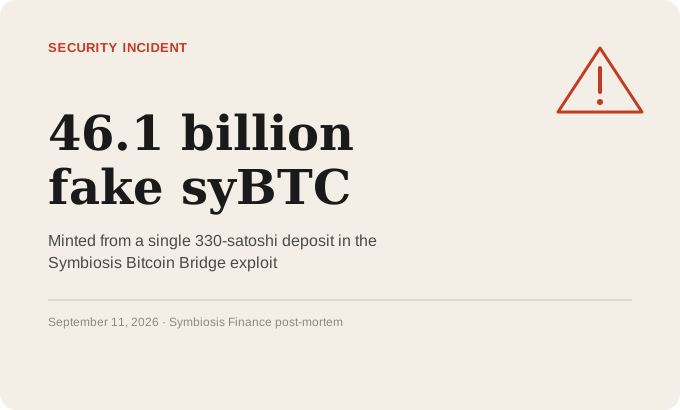
How Did a Hacker Create 46 Billion Fake Bitcoin in the Symbiosis Exploit? Decodes Bitcoin Hacker With WEEX Now
How two Symbiosis bridge bugs let a hacker mint 46.1 billion unbacked syBTC, drain Bitcoin pools and expose critical bridge risks.
[Interview] Lee Yun-ho, CEO of KIP: "We need to set the stage before the STO market opens... sharing RWA know-how with financial companies"
What is Fin.com? Understanding Cross-Border Payment Infrastructure via API

Uniswap (UNI) Price Jumps Toward $10 as CME Futures Launch Nears: What Traders Need to Know
Bernstein Research Report: Why Can Gold Still Surge to $5,700 Even with Continued Rate Hikes by the Fed?
Masayoshi Son is borrowing money again, betting billions on OpenAI

Hashed invests in $300 million digital-asset private credit fund
The IMF opens an office in Venezuela to supervise an economy that has already migrated to USDT
Crypto firms still face full AML rules after CLARITY Act vote
Discord Cointribune: The New Crypto Hub of France?

Glassnode Indicates Shift Towards Altcoin Season

Serenity: AI Causes Valuation Mismatch, Changing Value Investment Logic

Stablecoin Payment Platform Infini Completes $6 Million Seed Round Financing
SOXL Stock Jumped 12% Yesterday: Three Companies Explain the Entire Move
HODLing ETH: Should You Choose Staking for Yield or Collateralized Lending?
How Significant Are Changes in Overseas AI Investment?
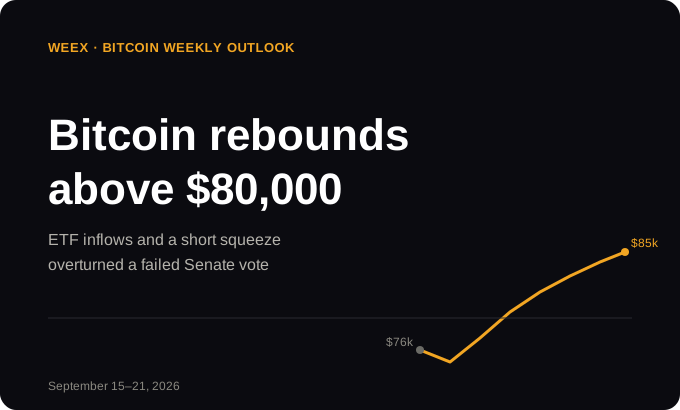
WEEX Bitcoin Weekly Outlook: Why Did Bitcoin Rebound Above $80,000 After the CLARITY Act Vote?
Bitcoin rebounded above $80,000 as SEC and CFTC action, renewed ETF inflows, and a short squeeze outweighed the failed CLARITY Act vote.
Stablecoins hold nearly $200 billion in US debt, but money funds bought the surge
Coin Metrics revises 19 months of Bitcoin ETF wallet data
HTX Research Analyst WZ: Crypto Market Pricing Extends Beyond Crypto, Regulation and Liquidity Become Key Variables
Ye Tan: The Internet Era is Coming to an End, the AI Era has Already Begun
Chainalysis: Crypto Economic Activity Down 1.6%, Market Value Shrinks by $2.1 Trillion
$1.7 Billion Inflow to Bitcoin ETFs in Two Days


