
The Most Epic Stress Test in History: Did Solana Actually Survive?


Original Article Title: "The Strongest Stress Test in History, Did Solana Come Through?"
Original Article Author: Azuma, Odaily Planet Daily
The back-to-back coin issuance by Trump and Melania has brought an unprecedented trading feast to the Crypto market, and also allowed the Solana network to undergo its largest and most powerful stress test in a real-world environment since its launch.
Since the launch and explosion of TRUMP and MELANIA, Solana has become the battlefield of hot money in the entire market. Countless users and funds have poured in crazily, causing the Solana network and its transaction-related infrastructure such as wallets, DEXs, and Bots to bear tremendous traffic pressure. Multiple projects, including Jupiter, have issued statements explaining that "all our systems are currently under extreme load."
Under heavy pressure, the congestion and failure of on-chain transactions on Solana have also increased significantly, and multiple users have reported transaction blocks on Solana today.
However, unlike the few times in the past two years when Solana was mocked after experiencing congestion or even downtime, the voices mocking Solana this time are much quieter. Because everyone knows how terrifying the stress test Solana went through this time was— it is no exaggeration to say that no blockchain has ever experienced such a level of real transaction activity under real-world conditions.
Several key data points can clearly reflect what Solana has experienced in these two days.
· As the preferred buy-in channel for non-industry users, Moonshot has topped the list of the most popular financial apps on the US Apple App Store. Yesterday morning, Moonshot revealed that the platform's 12-hour trading volume reached $4 billion, and more than 400,000 new users have joined the Solana ecosystem through its app; this afternoon, Moonshot updated the data again, stating that the daily active users have exceeded 1 million.
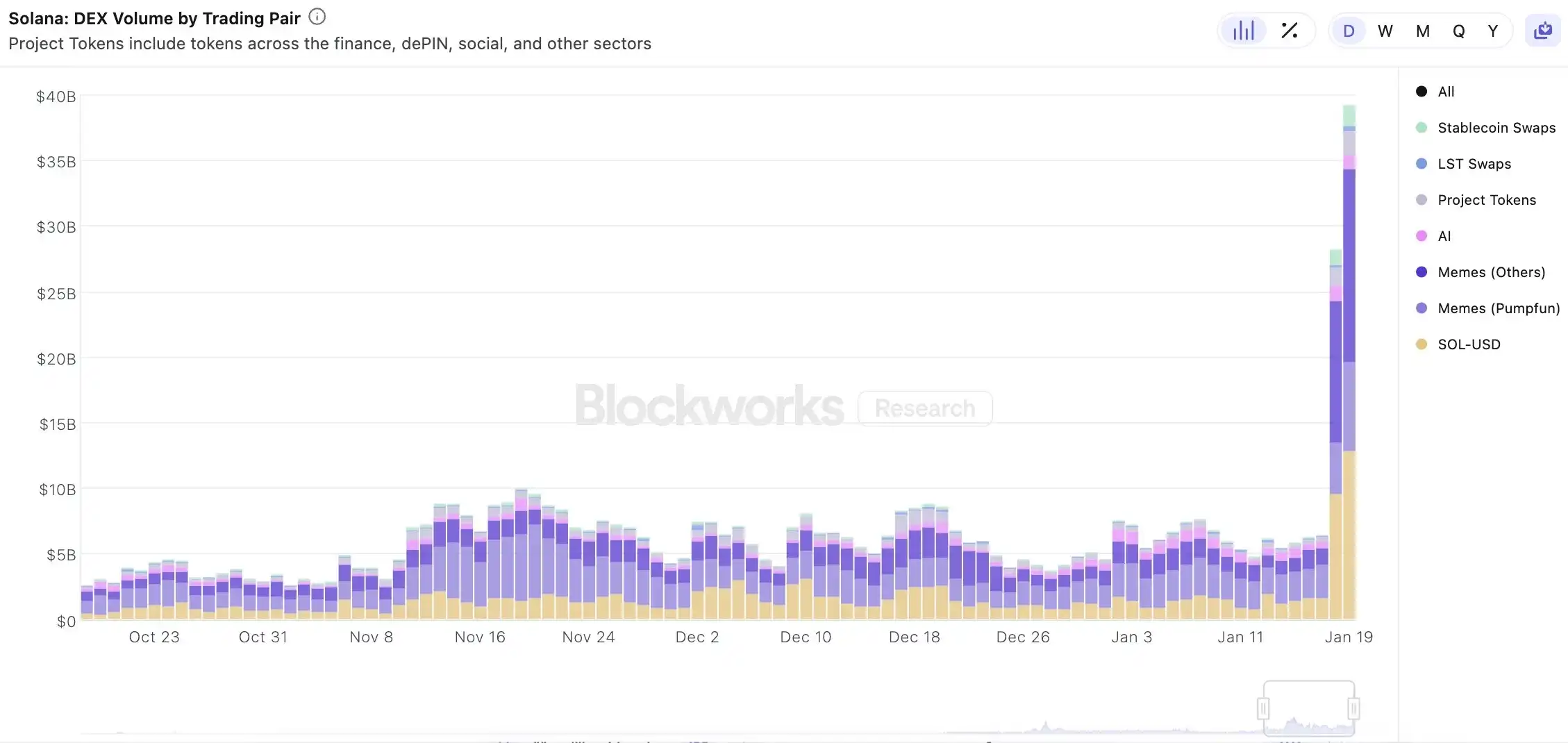
· On January 18, the total trading volume of Solana's DEX reached $28.2 billion, setting a new record high; just one day later, on January 19, this number rose to $39.2 billion, once again significantly surpassing the previous high.
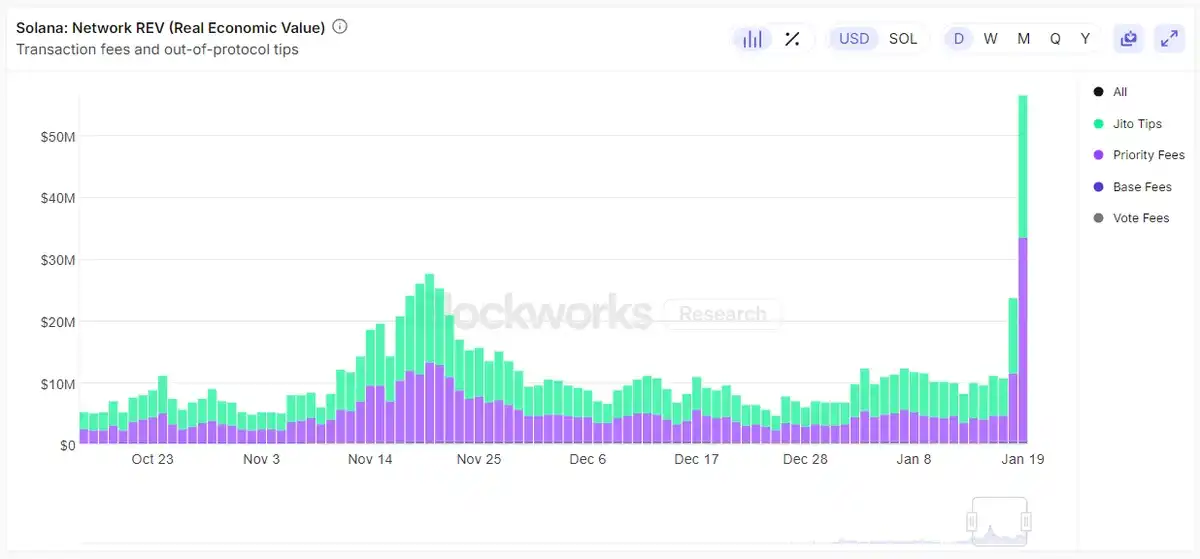
· On January 19, the "real economic activity" metric (REV) of the Solana network, mainly referring to total transaction fees consumed, hit a record high of $56.5 million, more than twice the previous high in November.
· In the afternoon today after Phantom resumed service, the wallet disclosed that users had collectively conducted 10 million transactions today, completing over $1.25 billion in transaction volume through the wallet's Swap feature.
Solana co-founder raj summarized the entire network transaction volume data in just one sentence, but it was enough to say it all—"This is a historical peak never seen before on any blockchain."

Facing such a large-scale ultimate stress test, it is difficult to guarantee which blockchain can smoothly pass.
Ethereum? Don't be ridiculous.
Layer 2? It even struggled a bit when faced with popular airdrops.
Move system? Maybe, but the ecosystem scale is ultimately limited, lacking evidence.
Not to mention those ghost chains that claim to have extremely high TPS but no one uses.
While Solana's performance may not be perfect, it has ultimately passed the test.
Trump's dramatic performance brought unprecedented attention to Solana, propelling SOL to break through the $260 barrier that had hindered the token from continuing its upward trend twice in four years.
Looking ahead, in the Meme new normal environment, Solana is bound to welcome more new traffic, users, and buying demand; all parties in the network and protocol will inevitably be more targeted in optimization and iteration after this stress test experience; despite being heavily drained in the short term, cutting-edge innovations such as AI on the Solana ecosystem are still ongoing; Multicoin Capital is also advancing a more flexible SOL issuance mechanism to reduce the inflation rate...
Even at the midpoint of the bull market, Solana's fundamental positive trend and imaginative space seem unscathed.
Instead of continuing to seek Alpha in the intricate relationships of the Trump family, it is better to grasp the largest Beta in front.
You may also like

Galaxy Deep Research Report: How Hyperliquid's HIP-4 Upgrade Changes the Landscape of Prediction Markets?

ZachXBT: Humanity private key leak and abnormal surge in H token should be viewed separately
On June 9, according to related disclosures, on-chain investigator ZachXBT posted an update on Humanity’s roughly $31 million security incident, saying that after further analyzing fund flows, he currently tends to believe the project team was not involved in an “inside job” or a self-staged attack. According to him, the official explanation about the private key leak was broadly accurate, but before the token unlock, the price of H had been artificially pushed higher, and the hacker later took advantage of that market environment; therefore, the private key leak and the earlier abnormal price pumping should be regarded as two separate and independent events. This reframing has shifted the market’s understanding of the nature of the incident. Earlier discussion around Humanity had focused on whether the team directly participated in the attack or used the security incident to cover up internal operations. ZachXBT’s latest remarks shift the focus from “whether it was self-theft” to “whether there were pre-unlock market structure issues.” He also questioned whether the team may have.

Morning Report | OpenAI has submitted an S-1 registration statement draft to the U.S. SEC; Morpho completes $175 million financing

Morning Report | BitMine increased its holdings by 126,971 ETH last week; trader Eugene announced his exit from the crypto market

Wang Chuan: How can one not feel anxious after the neighbor Old Wang made thirty times profit by investing in storage stocks? (Seven) - A quarter-century cycle

Cryptocurrency CEXs are flocking to sell US stocks, and traditional brokerages are facing an "uninvited guest."
$75 billion in foreign capital has fled, and South Korean retail investors have absorbed it all using leverage

Japan’s Three Megabanks Plan Joint Stablecoin Issuance in Fiscal 2026
MUFG, SMBC, and Mizuho reportedly plan to jointly issue fiat-pegged stablecoins in fiscal 2026, signaling Japan’s growing push into bank-led digital payment infrastructure.

Humanity Discloses H Token Dual-Chain Attack Details, With Losses on Ethereum and BSC Exceeding $36 Million
Humanity said the H token attack across Ethereum and BSC caused more than $36 million in losses after leaked ProxyAdmin keys enabled malicious contract upgrades and token minting.
White House Discusses CLARITY Act With Law Enforcement Ahead of Senate Vote
The White House discussed the CLARITY Act with law enforcement ahead of a Senate vote, focusing on illicit finance risks and developer protections.

Bitcoin Trading Guide 2026: Strategies for Experienced Traders

What Is XAUT and PAXG? Why Tokenized Gold Is Booming in 2026

Will the SpaceX IPO Hurt Bitcoin? Here's What Traders Are Watching

Foreign selling in the South Korean stock market accelerates, with cumulative net sales reportedly reaching $75 billion this year
On June 9, The Kobeissi Letter, citing Goldman Sachs data, reported that global investors are selling South Korean stocks at an unusually rapid pace. In the latest trading session, foreign investors sold about $801 million worth of Kospi constituent stocks again; total foreign outflows last week reached about $10 billion, and the market has been in net foreign selling on nearly every trading day over the past month. According to the data cited in the report, foreign investors have sold about $75 billion worth of South Korean stocks so far this year. Meanwhile, South Korean retail and institutional investors together recorded roughly $69 billion in net buying over the same period, suggesting that the market’s main buying support has come from domestic capital rather than returning overseas funds. The information currently disclosed still mainly comes from The Kobeissi Letter’s retelling and Goldman Sachs data summaries, while public details on the statistical period and the specific definition of “selling” remain relatively limited.

Fortune Warns of Strategy’s Financing Structure Risks as Bitcoin Premium Narrows
Fortune warned that Strategy’s Bitcoin treasury model faces growing financing risks as MSTR’s net asset premium narrows and preferred stock dividend pressure increases.

Ferrari Challenge Le Mans: Carl Moon to Dominate in WEEX Livery

Sahara AI Responds to SAHARA’s Sharp Drop: No Contract or Product Security Issues Found, Internal Investigation Underway
Sahara AI responded to SAHARA’s 60% price drop, saying no token contract or product security issues have been found and an internal investigation is underway.

WEEX Deposit/Withdrawal Dynamic Island: Your Asset Status, Always in Sight
Galaxy Deep Research Report: How Hyperliquid's HIP-4 Upgrade Changes the Landscape of Prediction Markets?
ZachXBT: Humanity private key leak and abnormal surge in H token should be viewed separately
On June 9, according to related disclosures, on-chain investigator ZachXBT posted an update on Humanity’s roughly $31 million security incident, saying that after further analyzing fund flows, he currently tends to believe the project team was not involved in an “inside job” or a self-staged attack. According to him, the official explanation about the private key leak was broadly accurate, but before the token unlock, the price of H had been artificially pushed higher, and the hacker later took advantage of that market environment; therefore, the private key leak and the earlier abnormal price pumping should be regarded as two separate and independent events. This reframing has shifted the market’s understanding of the nature of the incident. Earlier discussion around Humanity had focused on whether the team directly participated in the attack or used the security incident to cover up internal operations. ZachXBT’s latest remarks shift the focus from “whether it was self-theft” to “whether there were pre-unlock market structure issues.” He also questioned whether the team may have.
Morning Report | OpenAI has submitted an S-1 registration statement draft to the U.S. SEC; Morpho completes $175 million financing
Morning Report | BitMine increased its holdings by 126,971 ETH last week; trader Eugene announced his exit from the crypto market
Wang Chuan: How can one not feel anxious after the neighbor Old Wang made thirty times profit by investing in storage stocks? (Seven) - A quarter-century cycle
Cryptocurrency CEXs are flocking to sell US stocks, and traditional brokerages are facing an "uninvited guest."


