

They already knew the TGA Game of the Year in advance and made tens of thousands of dollars.


Today, the highly anticipated TGA (The Game Awards) in the gaming world finally came to a close.
Let's rewind to 3 hours before the end of the awards ceremony. At this moment, the "Best Indie Game" had just been awarded to the popular title "Light and Shadow: Expedition 33," but this made many fans worry instead. Never in history has a game won both the "Best Indie Game" and the "Game of the Year (GOTY)" awards at TGA.
As the frontrunner for the GOTY, "Light and Shadow" now needed to break the curse that had existed since TGA's inception, creating an unprecedented moment in the gaming world.
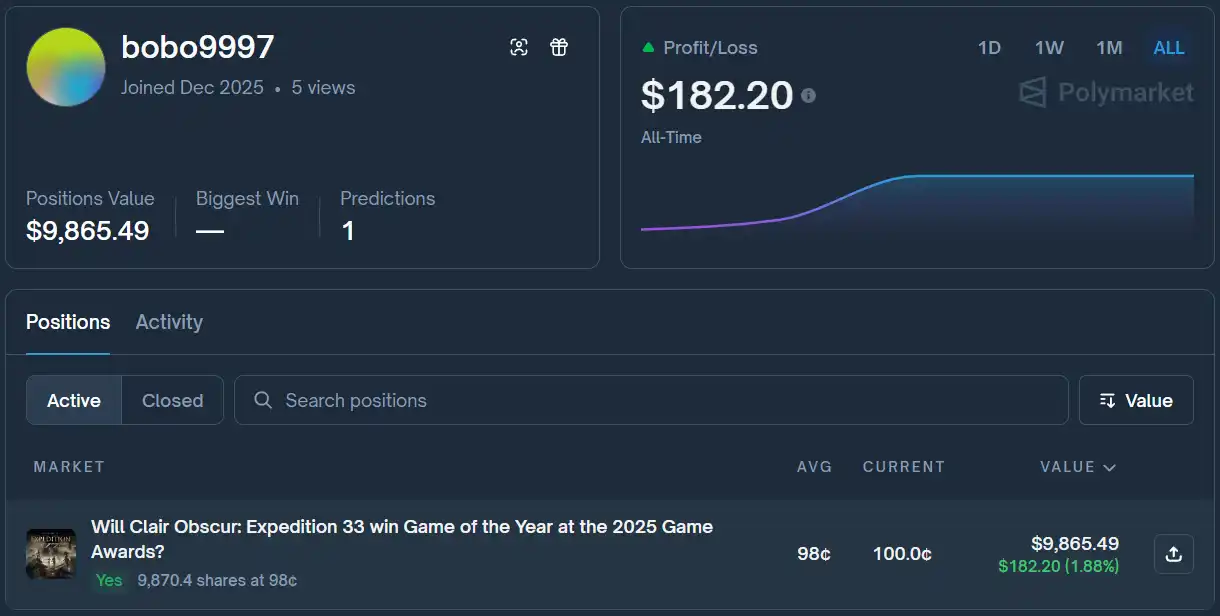
Just as everyone was anxiously concerned, a mysterious individual registered an account on a seemingly unrelated "prediction market" platform and deposited ten thousand dollars. He found the topic on the platform asking, "Will Light and Shadow win the 2025 GOTY?" and placed his entire ten thousand dollar deposit on "yes."
At this time, the price representing the probability of the topic being "yes" was $0.98 per share, which meant that even if "Light and Shadow" did make history by winning both awards, his ten thousand dollar bet would only yield a profit of less than two hundred dollars. However, if "Light and Shadow" failed to break the TGA curse, the probability of this topic would instantly drop to 0, which meant his newly deposited ten thousand dollars would be lost.
Just how much must a fervent fan of "Light and Shadow" love the game to take such a reckless risk? How did the prediction market attract gamers from around the world to speculate in advance on the frontrunners for the awards?
The "Predetermined" Script
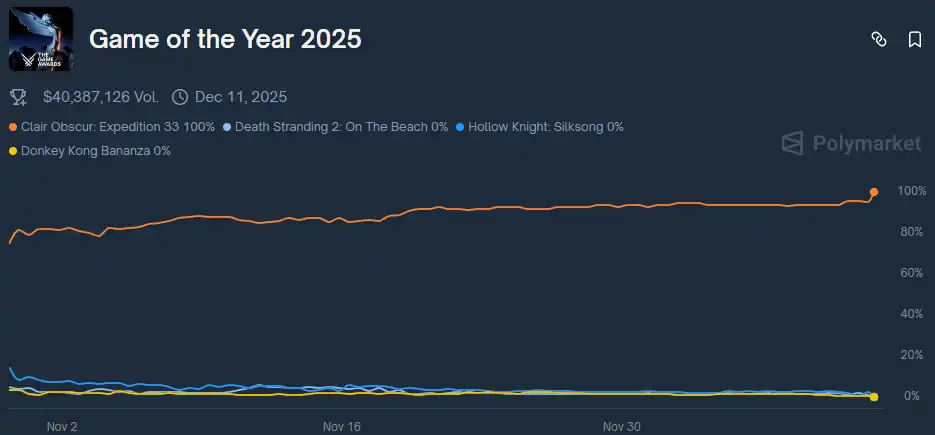
As early as October 30, a month and a half before the awards ceremony, the prediction market Polymarket launched the topic of the "2025 Game of the Year." The odds of "Light and Shadow" winning were firmly above 80% from the start, while the probabilities of other highly anticipated AAA titles winning were kept below 10%. Due to such a one-sided situation, which usually only occurs in events where the outcome is already certain, many traders sensed a hint of unusualness: this was not just optimism, this was certainty.
Among these traders who held a "certain" attitude, there were several whose trading styles were extremely uniform. DieselDiesel, trumpnogo, and kasae all bet on "Light and Shadow winning TGA 2025 GOTY" when the probability was around 85%, with their bets exceeding their usual amounts by tens or even hundreds of times. This highly concentrated, abnormal betting behavior exposed them to significant risks: if Light and Shadow ultimately did not win, they would not only lose all their past profits but also face substantial losses.
As time passed and the odds of winning The Game Awards increased, they did not profit by selling any of their held shares. Even with a significant unrealized gain hours before the award announcement, after the "Best Indie Game" award had already been announced, they remained unfazed as if they could see the future, joining forces with the mysterious figure mentioned at the beginning of this article to wager their entire account balance for a modest profit.
The Awarding of History and the Insider's Payoff
Amidst doubt and anxiety, as if following a script these traders had set over a month ago, The Game Awards dispelled the final suspense: the highly anticipated game, "Light and Shadow," having already won the "Best Indie Game" award, broke a historical curse and won the Best Game of the Year award.
While players on one side rejoiced, on the other side, the prediction market unveiled the final mystery: three traders who were certain a month ago that "Light and Shadow" would win the award solidified their roles as "seers," realizing massive profits:
DieselDiesel made a profit of $5,357 in this event, representing 176% of all their other trading profits;
trumpnogo made a profit of $2,958 in this event, representing 62% of all their other trading profits;
kasae made a profit of $1,658 in this event, representing 220% of all their other trading profits.
As for the mysterious figure mentioned at the beginning (bobo9997), they bet $10,000 on "Light and Shadow" making history to win $200.
Even Soothsayers Have to Eat
The most noteworthy commonality among these four traders is that while many players doubted whether "Light and Shadow" could break the historical curse, they were willing to risk nearly $100,000 in their positions to "bet" that this historic moment would occur. However, the proceeds from this "gamble" amounted to less than $2,000 combined.
At this point, let's assume these "seers" were TGA tally audit officials. For these insider individuals with a $100,000 annual income, if they were to monetize the information in a traditional manner, they would need to sell the insider information to platforms, risking various potential fines, dismissal, or even imprisonment.
Yet, with the advent of prediction markets, they could anonymously exchange the information gap for an amount equivalent to 1 to 3 months of their disposable income.
When we view everything through the lens of an insider who is assumed to already know the outcome, everything becomes clear: In a situation where it is already 100% certain that "Light and Shadow" will be the GOTY, their "wager" at the last moment is simply using the one-hour waiting time before the award ceremony to exchange for a seemingly high-risk yet actually variable-free profit of two thousand dollars.
This type of high-risk, yet variable-free earning "wager" for them was almost impossible to encounter before platforms like prediction markets emerged.
However, with the rise of Polymarket, how many people can resist converting information into tangible rewards in an anonymous manner?
You may also like

a16z founder's Stanford lecture: Whenever Wall Street and Silicon Valley have different ideas, it's Wall Street that ends up being wrong

Michael Saylor: After three consecutive quarters of losses, Strategy will sell Bitcoin to pay dividends

The toll station at Hormuz and the RMB that cannot be bought

Interview with Coinbase Institutional's Strategic Head: The Institutionalization of Crypto Reaches a Critical Point

Dialogue with Agora CEO Nick: The battle for stablecoin licenses has just begun

Morning Report | a16z Crypto completes $2.2 billion fundraising for its fifth fund; Bullish invests $4.2 billion to acquire share transfer agency Equiniti; PayPal's Q1 performance exceeds expectations

a16z Crypto: What We See Behind the $2.2 Billion New Fund
Web3 is dead, Web2+3 should rise

Stablecoins and Latin American Remittances: The Misunderstood $174 Billion Market

The arrival of the Web 3.0 era: A review of Hong Kong court rulings on digital assets

Track Markets At a Glance: New WEEX Price Widgets for iOS & Android
To streamline your market data access, WEEX has officially launched "Market Watchlist" desktop widgets

The billion-dollar lesson: The focus of DeFi security is shifting from code to operational governance
A Brief Analysis of Stablecoin Licenses and On-Chain Funding
BVNK Founder: Three Stages of Stablecoin Development
The truth about Trump's son's Bitcoin game: he made a staggering $100 million while retail investors lost $500 million

What Is Futures Trading? Hours, Platforms, and How to Start Trade Futures(2026 Guide)
Learn how to start futures trading, understand trading hours, and choose the best futures trading platform. Includes real data, strategies, and ways to maximize returns with rebates.

The Rise of Composable RWA

MAGA Up 350% in 24 Hours, PEPE Up 46% in One Day: Which Memecoins Are Next in 2026?
MAGA +350% in 24hrs. PEPE +46% in one day. RAVE +4,500% then -90%. In 2026's memecoin market, the gains are real. So are the traps? Here's how to tell the difference before you buy.
a16z founder's Stanford lecture: Whenever Wall Street and Silicon Valley have different ideas, it's Wall Street that ends up being wrong
Michael Saylor: After three consecutive quarters of losses, Strategy will sell Bitcoin to pay dividends
The toll station at Hormuz and the RMB that cannot be bought
Interview with Coinbase Institutional's Strategic Head: The Institutionalization of Crypto Reaches a Critical Point
Dialogue with Agora CEO Nick: The battle for stablecoin licenses has just begun
Morning Report | a16z Crypto completes $2.2 billion fundraising for its fifth fund; Bullish invests $4.2 billion to acquire share transfer agency Equiniti; PayPal's Q1 performance exceeds expectations


