
Worldwide Debut: Bitcoin Unified Asset Protocol 'Goldinals' Chinese Deep Dive

 Prefer us on Google

Article Source: Nubit
On January 10, 2025, Nubit, a Bitcoin project deeply rooted in native Bitcoin ecosystem development, released a Bitcoin asset protocol called "Goldinals" (Protocol Whitepaper: https://www.nubit.org/Goldinals.pdf).
According to the official statement, the Goldinals concept was proposed by Domo, the creator of the Ordinals protocol's first token ($ORDI) and BRC20, and was implemented by the Nubit team to achieve technical implementation. This protocol aims to introduce trustless asset management and programmability to the Bitcoin ecosystem, addressing the lack of interoperability between existing Bitcoin asset protocols (such as BRC-20, Runes, Ordinals, etc.), which has led to fragmented liquidity and security risks.
Goldinals's slogan is "The Unified Protocol for Bitcoin Assets," aiming to provide a unified standard for Bitcoin assets, compatible with existing protocols, while supporting more efficient asset creation, management, and interaction features. It will be a significant step for the Bitcoin ecosystem to advance into the asset programming domain.
Nubit, founded by UC Santa Barbara Professor YU FENG, aims to build "the Trustless World Computer for Bitcoin" by leveraging Bitcoin's native technologies such as BitVM to achieve Bitcoin's open scalability and programmability. Nubit enables developers to build any Bitcoin-native applications, bringing global users into the Bitcoin ecosystem.
Goldinals Design Principles Overview
Goldinals is a Bitcoin-native asset protocol designed to break free from Bitcoin's technical constraints while providing similar functionalities to mature asset standards on other blockchains (such as Ethereum's ERC-20).
In Ethereum, developers can leverage the ERC-20 standard to deploy, transfer, mint, and burn tokens through a simple API. However, the current Bitcoin-based BRC-20 protocol, while attempting to achieve similar functionality, heavily relies on off-chain indexers and additional trust assumptions, limiting its decentralization and security.
The Goldinals Asset Protocol, to address trust and security issues, provides a revolutionary on-chain alternative that implements a similar API directly on the Bitcoin network, including:
· Deploy: Initialize the protocol's global parameters and create a new token instance.
· Mint: Increase the token's supply and allocate the newly minted tokens to a specified address.
· Transfer: Transfer tokens between addresses while ensuring validity checks such as balance verification.
· Burn: Decrease the token's supply by permanently removing tokens through an on-chain operation.
Although the logic of the above APIs is similar to ERC-20, implementing these functions on Bitcoin requires overcoming its stateless design and Turing incomplete script language limitations. To tackle this challenge, Goldinals has designed a sophisticated three-stage state machine process to ensure the legitimacy, transparency, and trustlessness of operations.
Through the three-stage state machine, Goldinals cleverly adapts to Bitcoin's technical constraints by breaking down each operation into multiple steps, combined with on-chain data and zero-knowledge proofs (ZKPs), ensuring the security and trustworthiness of the final confirmed state. This design not only addresses Bitcoin's native technical limitations on complex operations but also eliminates reliance on centralized indexers, enabling every token operation to take place in a trustless environment. The following are the specific steps of Goldinals' three-stage state machine:
1. Preparation Stage:
In this stage, users declare the intent of the operation (such as transferring, minting, or burning tokens) through on-chain transactions. The transaction content includes the target address, operation type, and parameters, which are written to the Bitcoin chain via the OP_RETURN field, ensuring the data's permanent availability and transparency.
This process is like writing a check, where the user specifies the payee, amount, and purpose on the check, but it has not been formally delivered yet.
2. Kickoff Stage:
After a certain number of block confirmations, users can submit a "Kickoff Transaction," which includes:
1) Submission of Zero-Knowledge Proof (ZKP): Using mathematical methods to prove the legitimacy of the operation, such as sufficient balance or compliance with protocol rules.
2) Verification Data: Used to prove relevant information about the on-chain state.
3) State Update: Clearly states the impact of the requested operation on the protocol's global state.
The Kickoff Stage is a core step in confirming the operation, similar to a notary verifying the legality of a check. During this process, all operation conditions are strictly verified on-chain, while complex computation verification is achieved through BitVM's computing capability.
3. Challenge Stage:
After the Kickoff Stage is completed, the process enters the Challenge Stage, where the user's operation undergoes a security validation period. During this period, any network validator (referred to as a challenger) can validate the validity of the user-submitted zero-knowledge proof:
1) If any illegal operation is discovered, the challenger can challenge the legality of the operation through on-chain transactions;
2) If there is no valid challenge, the operation will be formally confirmed and updated in the protocol's global state.
This stage is similar to multiple auditors conducting a review of the transaction's legality, where only one honest challenger can prevent potential fraudulent behavior.
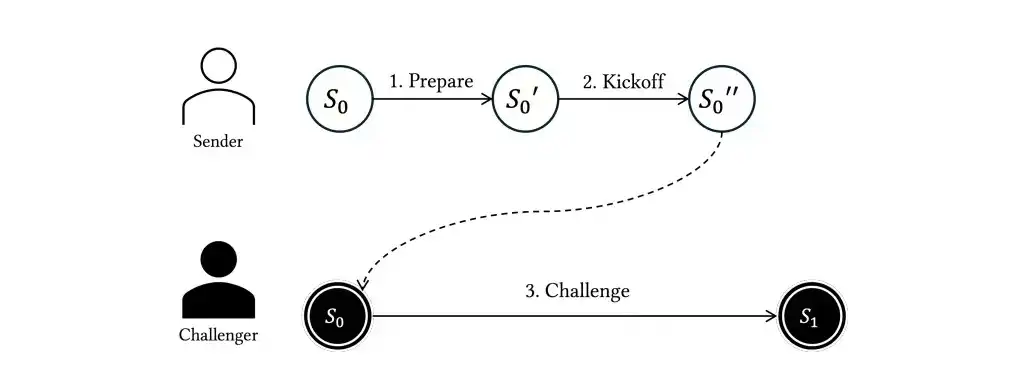
Through multi-stage verification, Goldinals has successfully addressed the limitations of Bitcoin's native technology. It ensures that all token operations can be carried out in a fully decentralized and trust-minimized environment, providing an efficient, transparent, and secure solution for complex asset operations.
This design not only allows developers to build powerful and secure Bitcoin-native applications through Goldinals' API but also brings trust and technological innovation to the entire Bitcoin ecosystem.
Revolutionary Protocol for Unified Bitcoin Ecosystem Assets
The launch of Goldinals may usher in a new era of unity and expansion for the Bitcoin asset ecosystem.
As a full-fledged ERC-20 standard on Bitcoin, Goldinals is compatible with existing Bitcoin asset protocols (such as BRC-20, Ordinals, Runes, and CAT), while supporting future Bitcoin assets and application development.
Through decentralized validation and on-chain programmability, Goldinals eliminates reliance on centralized indexers, enabling the Bitcoin asset ecosystem to truly achieve trustlessness and Bitcoin nativeness. Post Goldinals, existing Bitcoin applications can easily add new features or develop new assets without the need to painstakingly create new protocols. By unifying Bitcoin assets, Goldinals will provide the ultimate solution for upgrading the Bitcoin asset ecosystem.
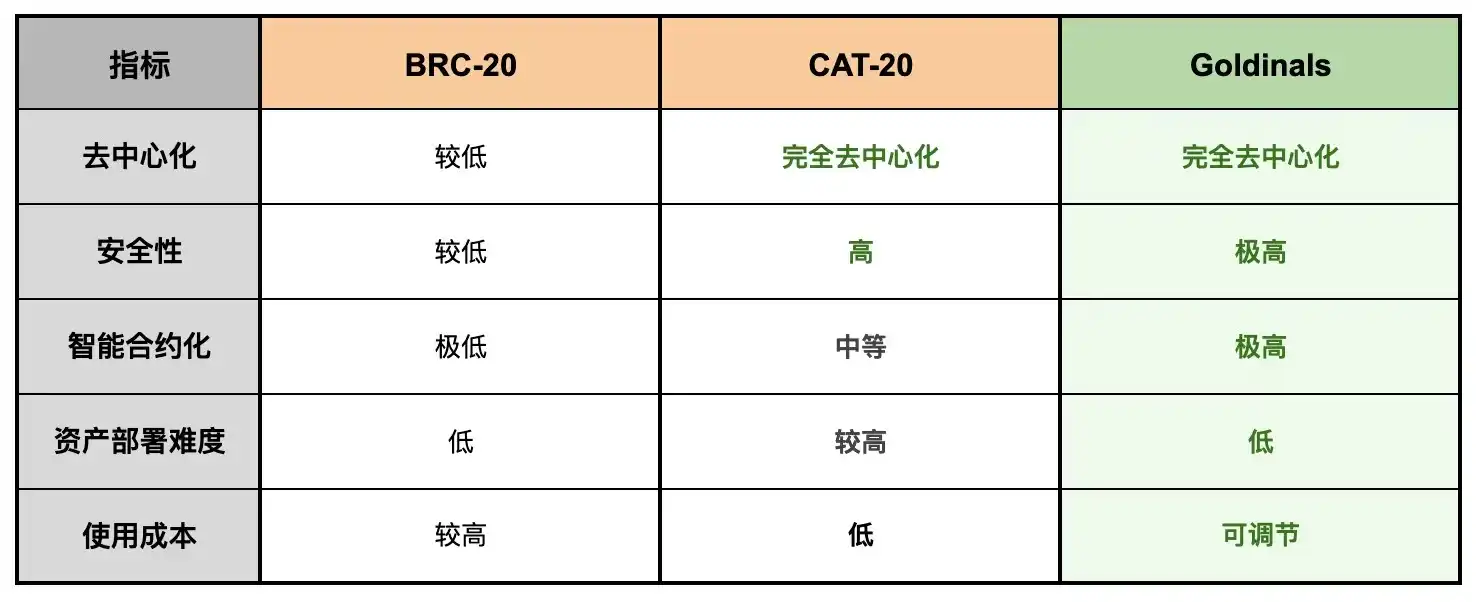
Initial observations suggest that Goldinals possesses the following significant advantages:
· Minimized Trust: All operations are directly validated on the Bitcoin chain without relying on centralized indexers or custodial solutions, ensuring full decentralization.
· Inherited Bitcoin Security: Goldinals records every token operation directly on the Bitcoin chain, relying on Bitcoin's finality and data availability to mitigate risks of L2 protocol disruptions.
· Native Programmability: Leveraging BitVM technology, Goldinals supports complex on-chain logic, including multi-signature wallets, conditional transfers, and token gating, expanding the application scenarios of the Bitcoin protocol.
· Efficiency and Scalability: Through zero-knowledge proofs and optimized design, Goldinals significantly reduces transaction costs while enhancing operational speed and scalability, providing a better experience for developers and users.
Building on these advantages, Goldinals is not only an upgrade to the Bitcoin asset protocol but also the foundational framework for the future development of the Bitcoin asset ecosystem.
Upon reviewing Nubit's official social media, we have found that Goldinals has been steadily expanding its ecosystem, which will encompass areas such as wallets, trading platforms, infrastructure, and financial solutions.
Its core partners include Babylon, Lombard, Yala, Succinct, StarkWare, Fractal Bitcoin, Merlin, sCrypt, and others. These partnerships will drive the innovative development of cross-chain bridges, stablecoins, and Bitcoin-native financial solutions.
In addition, Goldinals has also attracted over 30 Bitcoin ecosystem participants, including Milkyway, Wizz Wallet, Avalon Finance, and more. With Goldinals set to launch soon, developers and the community can participate and engage through the Goldinals website, ushering in a more open, programmable, and decentralized future for Bitcoin asset protocols.
Bitcoin 3.0: A Unified and Decentralized New Era
Goldinals has introduced a new trust-minimized token standard, injecting powerful decentralization and programmability into the Bitcoin asset ecosystem, marking a significant leap forward in the evolution of Bitcoin asset protocols. With compatibility with the existing ecosystem and seamless support for new application scenarios, Goldinals will provide a broader imagination space for Bitcoin's application in the global economy.
Whether issuing custom assets, building a stablecoin system, or achieving decentralized liquidity mining, Goldinals will empower developers and enterprises to explore new frontiers of Bitcoin, ushering in the golden age of Bitcoin 3.0.
Goldinals Whitepaper Original Text: https://www.nubit.org/Goldinals.pdf
This article is a contributed piece and does not represent the views of BlockBeats.
Disclaimer: This content is provided for general branding and informational purposes only and doesn't constitute financial, investment, legal, or tax advice. Any events, rewards, online events, or related information mentioned herein should not be considered a recommendation, solicitation, or invitation to purchase, sell, trade, or otherwise deal in any crypto assets or to use any services. Crypto assets are highly volatile and may result in loss. WEEX services and online events may not be available in all regions and are subject to applicable laws, regulations, and eligibility requirements. You are responsible for ensuring that your use of WEEX services complies with local laws and for carefully assessing the risks before participating in any crypto-related activities.
You may also like

Walsh's 'Unified Front': Aiming for Rate Cuts?

Ethereum vs Solana Whitepaper Comparison (2026)
French Tech: AI and Quantum on the Rise, Crypto Absent

Home Robot NEO Grows "Dexterous Hands": How Do Hands Become the API to the Physical World?

What is SCEX? The Cryptocurrency Exchange for Vietnam's Market by Sacombank
Major Update for ChatGPT: Cross-Platform Functionality, One-Click Website Creation, and Lower Costs

BTC Challenges 64,000 After Breaking 63,000, Market Trading 'Manageable Risks'
As the Bubble Bursts, Who Dominates Attention in the AI Era? A 2026 Guide to Influential AI KOLs in China and the UK

Old Money in Crypto Shifts: Paradigm Raises $1.2 Billion, Half Bet on AI and Robotics

Bitdeer unveils $36M Nevada factory to shake up Bitcoin mining
Perplexity Fine-Tuned a Chinese AI Model to Match Claude Opus 4.8 at One-Third the Cost

Bank of Korea defends bank-first stablecoin plan amid bill deadlock
JPMorgan says bitcoin's main risk isn't Strategy, but blockchain adoption that doesn't benefit public chains and tokens
Fear & Greed Index Today: What Extreme Fear Means for Crypto, Stocks and Gold
Labour MPs Push to Make UK Crypto Donation Ban Permanent
Supreme Court ruling expanding Trump's authority over federal agencies raises questions for SEC, CFTC as crypto rulemaking advances

'Bottom building in progress': Analysts say bitcoin holder capitulation signals late-stage bear market

A Comprehensive Analysis: Starting from 1996, Who is Laying the Foundation for the Next Generation of Capital Markets
Luke Dashjr, the Biggest Anti-Spammer of Bitcoin, Inscribed Phrases on the Network in 2011

Whales bought 270,000 BTC while ETFs bled $7 billion. One side is wrong

The crypto IPO class of 2025-26 is down as much as 89%. Autopsy of a listing boom
Robinhood Chain Mining Guide: A Comprehensive Tutorial from Cross-Chain to Memecoin
BitGo CEO says single-digit percentages of bitcoin's supply are 'probably right' for large holders amid Strategy's sale

Beyond Private Keys: How to Safeguard the Security Boundaries of Web3 from Wallets, L2 to Supply Chains?

Vanguard Enters the Market, Opening a New Crypto Gateway for 50 Million Traditional Investors

Why the OUSD Alliance of 150 Companies Still Cannot Shake USDT and USDC?
Citigroup Analysis: Is There Still 47% Upside for Nvidia? Can Rubin and CPO Deliver?
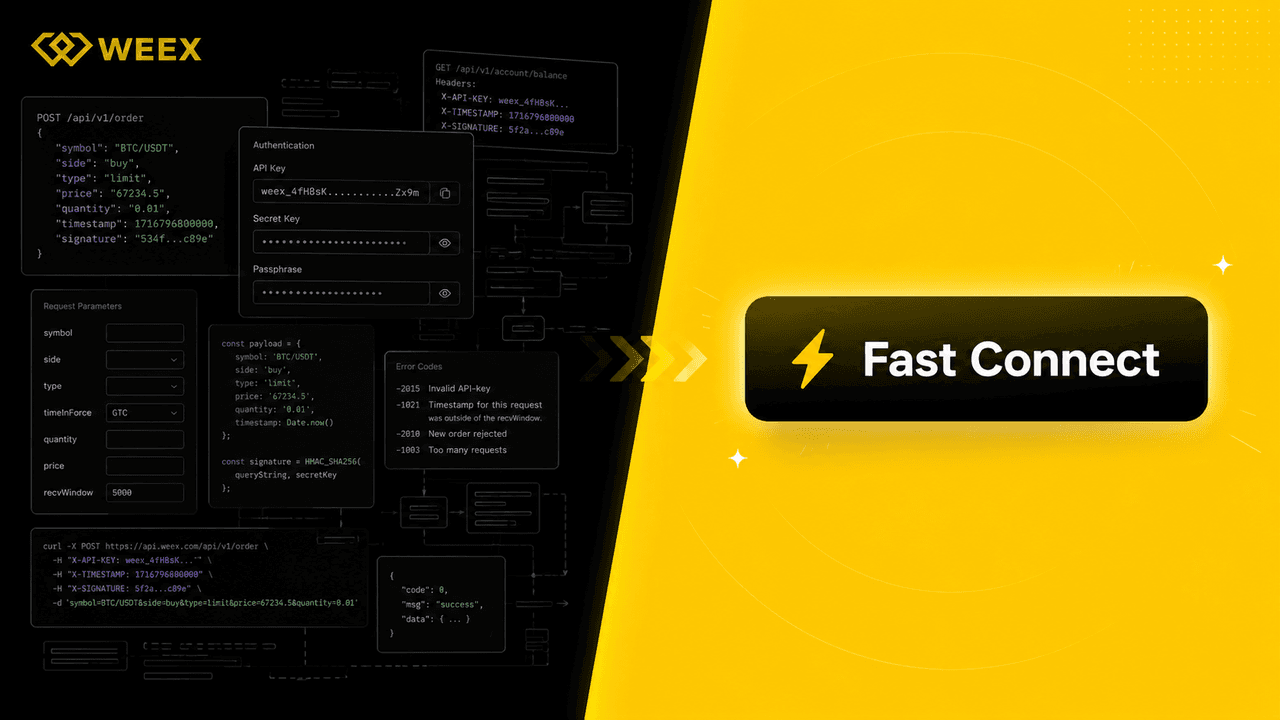
WEEX API Fast Connect: Turn Every Sign-In Into a Live Trader in Under 10 Seconds
WEEX API Fast Connect is a one-click OAuth authorization system that lets your users link their WEEX account without ever touching an API key. Frictionless onboarding, faster conversions, higher retention — built for WEEX Broker partners.
Bitcoin's dwindling exchange reserves don't pack the same bullish punch anymore

From Le Mans to the Rollercoaster: Carl Moon Takes On Portimão
Crypto world renowned KOL and racing driver Carl Moon, backed by WEEX, heads to the Ferrari Challenge Portugal round at the Algarve International Circuit, July 16–19, fresh off a podium finish at Le Mans. Here's why this race is one to watch.
Fast execution. Split-second accuracy. Security that never blinks. That's WEEX — and that's exactly how Carl races.
Walsh's 'Unified Front': Aiming for Rate Cuts?
Ethereum vs Solana Whitepaper Comparison (2026)
French Tech: AI and Quantum on the Rise, Crypto Absent
Home Robot NEO Grows "Dexterous Hands": How Do Hands Become the API to the Physical World?
What is SCEX? The Cryptocurrency Exchange for Vietnam's Market by Sacombank
Major Update for ChatGPT: Cross-Platform Functionality, One-Click Website Creation, and Lower Costs

Contents
Latest articles





Latest coin listings on WEEX


