AMD Stock vs Intel Stock: Why One Is Up 300% and the Other Is Struggling

 Prefer us on Google



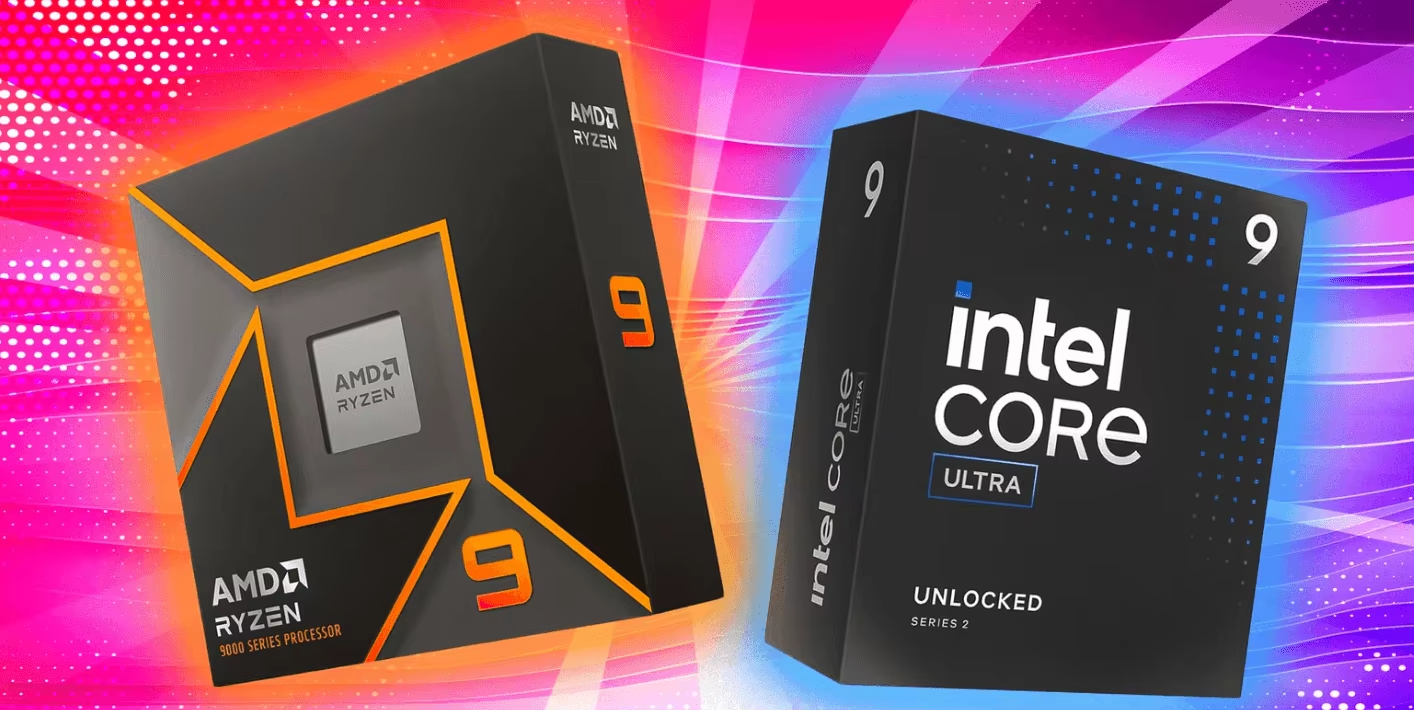
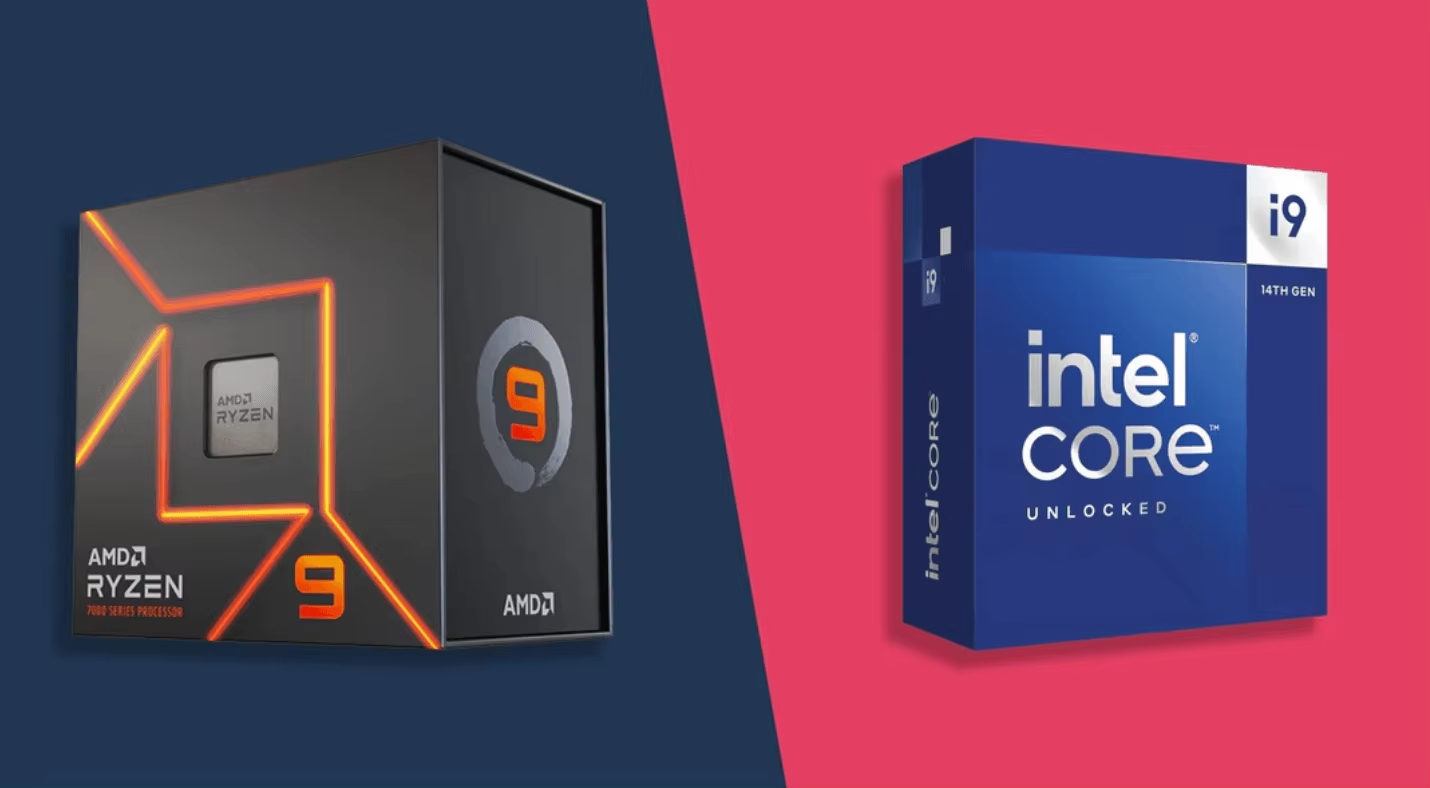
AMD stock and Intel stock make the same kind of chip. Both companies design x86 processors that power data centers, personal computers, and an expanding range of AI workloads. Both have been in the semiconductor business for decades. Both have hundreds of millions of devices running their architecture worldwide. The fact that one is up roughly 300% over the past year while the other has significantly underperformed the broader market is not a story about two companies in different industries. It is a story about two companies in the same industry executing in almost completely opposite directions at one of the most consequential moments in the history of computing.
Understanding the divergence between AMD stock and Intel stock is more useful than simply noting the performance gap, because the reasons behind it reveal something specific about where enterprise computing is heading and which company is positioned to benefit from that direction.
The Server CPU Market Where Everything Changed
The most important single market for evaluating AMD stock versus Intel stock is not gaming, not personal computers, and not consumer electronics. It is server CPUs, the processors that power data centers, cloud computing, and the AI infrastructure that has become the dominant theme in technology investment.
Intel dominated the server CPU market for decades with a market share that at times exceeded 95%. That dominance was so complete that AMD's EPYC server processor launch in 2017 was treated as an interesting development rather than a genuine threat. The conventional wisdom was that Intel's ecosystem advantages, the certified software, the validated configurations, the vendor relationships built over decades, were too deeply embedded for any competitor to meaningfully dislodge.
What happened over the next nine years is the most significant competitive shift in the semiconductor industry's recent history. AMD's EPYC processors consistently delivered better performance per dollar than Intel's competing Xeon processors across the workloads that matter most to data center operators. The performance advantage compounded across successive generations as AMD used TSMC's leading-edge manufacturing while Intel struggled with its own manufacturing technology transitions.
Lisa Su's revision of the server CPU market growth forecast from 18% annually to over 35% annually on AMD's Q1 2026 earnings call was the most concrete public statement available about the scale of what has happened in this market. A market growing at 35% annually reaching $120 billion by 2030 is a market that AMD is taking meaningful share of while Intel is defending ground it has been losing.
What Intel Has Been Dealing With
The Intel story is not simply that AMD executed better. It is that Intel faced a specific and compounding set of challenges that made executing well considerably harder than it had been during its period of dominance.
The manufacturing transition is the central challenge. Intel spent years attempting to develop its own leading-edge manufacturing to compete with TSMC's process technology, and the transition has been more difficult and more delayed than management projected at each stage. While AMD was producing its EPYC processors on TSMC's most advanced nodes, Intel was navigating the operational complexity of developing cutting-edge manufacturing technology while simultaneously designing competitive products. The resource and management attention that manufacturing challenges consumed created a window of opportunity for AMD that would not have existed if Intel's foundry ambitions had executed on schedule.
The product roadmap consequences of the manufacturing delays created a specific competitive gap in server CPUs that Intel has not yet fully closed. When consecutive processor generations arrive later than planned and at performance levels below what the original specifications promised, enterprise customers who might have waited for Intel to catch up make purchasing decisions in favor of AMD that become sticky over time. A data center built around EPYC processors represents an investment in software configuration, system management tools, and operational knowledge that creates real switching costs in the other direction.
The organizational complexity of running both a chip design business and a chip manufacturing business, which Intel calls its IDM 2.0 strategy, has created a management challenge with no clear historical precedent among large semiconductor companies. The capital intensity of leading-edge manufacturing is extraordinary, and committing that capital while simultaneously competing in the design business against fabless companies like AMD that can direct their entire investment toward design has stretched Intel's resources in ways that its income statement reflects.
The AI Workload Shift That Accelerated the Gap
The emergence of AI as the dominant data center workload in 2023 and 2024 initially appeared to be primarily a GPU story, with Nvidia capturing the most attention and investment. What became clear over the following two years is that AI workloads require substantial CPU compute alongside GPU acceleration, and the specific nature of AI inference and agentic workloads created a new category of server CPU demand that AMD was better positioned to capture than Intel.
Agentic AI, where AI systems take sequences of actions over extended periods rather than responding to single prompts, requires sustained CPU performance at levels that favor the most modern and efficient processor architectures. AMD's EPYC Venice processor, now in production on TSMC's 2nm process technology, is specifically designed for the kind of sustained compute performance that agentic workloads require. Intel's competing products have been progressing on their own roadmap but from a position that has not yet fully closed the performance gap that AMD's TSMC manufacturing advantage creates.
Lisa Su's server CPU market revision was specifically driven by agentic AI workload demand rather than by traditional enterprise server refresh cycles. That distinction matters for how AMD stock versus Intel stock should be evaluated going forward, because agentic AI demand is an incremental source of server CPU growth that sits on top of existing refresh cycles rather than replacing them. A market that was growing at 18% annually from existing sources is growing at 35% annually when agentic AI demand is added, and AMD's position in that incremental demand is stronger than Intel's because of the performance advantage AMD has established in the workloads agentic AI requires.
What the Financial Results Confirm
The performance gap between AMD stock and Intel stock has a direct counterpart in the financial results both companies have reported.
AMD's Q1 2026 data center revenue was $5.8 billion, up 57% year over year. Total revenue was $10.25 billion, up 38% year over year. EPS of $1.37 beat the estimate of $1.29 by approximately 6%. Q2 guidance of $11.2 billion was above consensus. These are the financial results of a company gaining market share in its most important market while simultaneously entering new high-growth markets with competitive products.
Intel's trajectory over the same period has been meaningfully different. The company has been working through the financial consequences of its manufacturing investment cycle, with data center revenue that has not demonstrated the same growth trajectory as AMD's. Intel's Xeon server processors continue to generate substantial revenue from the installed base, but the growth that AMD is generating from new deployments at hyperscalers and enterprise customers is not flowing to Intel at comparable rates.
The market has priced these financial trajectories into the stocks in the most direct way available. AMD stock up 300% reflects a market assigning a premium for a company gaining share in a growing market with a competitive product roadmap. Intel stock underperforming reflects a market discounting the uncertainty around when Intel's manufacturing investments will produce the competitive products needed to stabilize and eventually reverse its server market position.
Where Intel Is Actually Fighting Back
Honest comparison of AMD stock versus Intel stock requires acknowledging where Intel is making genuine competitive progress rather than treating the divergence as permanent.
Intel's 18A manufacturing process, its most advanced node in development, has been generating more positive commentary from third-party analysts than the previous generation's development cycles did. If 18A produces chips that are competitive with TSMC's 2nm and 3nm offerings at meaningful volumes, it changes the competitive dynamic in ways that AMD's manufacturing advantage depends on persisting.
Intel Foundry, the external manufacturing business Intel is building, has secured customers including Microsoft for certain chip designs. That external customer validation, while early stage, provides evidence that Intel's manufacturing technology is progressing toward competitive parity in ways that purely internal metrics cannot confirm.
The PC market, where Intel retains meaningful market share, provides a revenue base that funds the manufacturing investment and the server CPU roadmap development. Intel's consumer CPU business has not deteriorated as dramatically as its server business, providing a financial foundation that prevents the manufacturing transition from becoming an existential resource constraint.
For AMD stock versus Intel stock investors, the Intel fighting back narrative is relevant as a risk modifier rather than a near-term catalyst. Intel's recovery, if it materializes at scale, is a 2027 and 2028 story rather than something that significantly affects the competitive dynamics in the August 3 AMD earnings report or the Intel results that follow shortly after.
What This Means for the Investor Decision
The AMD stock versus Intel stock comparison has a specific practical dimension for investors who are deciding between the two rather than simply observing the performance gap.
AMD stock at current prices is priced for continued execution on the server CPU and AI GPU thesis. The Goldman $640 target and the broader analyst consensus around similar levels reflect an expectation that Q2 and subsequent quarters will confirm the server CPU market share gains and the Helios GPU deployment ramp. The 73 times forward earnings multiple is the market paying for a company in the middle of a significant and accelerating competitive win, which is a different and more favorable situation than paying for future competitive improvements that have not yet been demonstrated.
Intel stock at current prices reflects a market that has discounted substantially the uncertainty about when the manufacturing investments will produce competitive results and when the server market share trajectory will stabilize. That discount creates a different kind of investment proposition, one where the upside comes from the manufacturing transition succeeding rather than from continued execution on an already demonstrated competitive advantage.
The choice between AMD stock and Intel stock is therefore not primarily a choice between two companies in the same industry. It is a choice between two different investment theses with different risk profiles. AMD offers demonstrated execution at a premium multiple. Intel offers manufacturing transition optionality at a discounted multiple.
For those looking to participate in global financial markets, having access to the right trading platform matters. WEEX offers crypto and stock trading products, covering major global markets including US stocks and digital assets.
Conclusion
AMD stock is up roughly 300% while Intel stock has significantly underperformed because the two companies made different strategic decisions at a critical moment in semiconductor history and executed on those decisions with very different results.
AMD's decision to use TSMC's manufacturing rather than build its own foundry allowed it to concentrate entirely on chip design, producing EPYC processors that closed and eventually reversed the performance gap with Intel's Xeon server CPUs. The agentic AI workload shift amplified the consequences of that design advantage by creating a new source of server CPU demand that AMD's most modern architecture is specifically well-positioned to capture.
Intel's decision to maintain its own manufacturing while simultaneously designing competitive chips created a resource and management challenge that the financial results reflect. The manufacturing investments may eventually produce the competitive products Intel needs to stabilize its server position, but the timeline has been longer than management projected and the market has priced that delay into a stock that trades at a significant discount to where it was during its period of server CPU dominance.
For investors evaluating AMD stock versus Intel stock today, the question is whether to pay the AMD premium for demonstrated execution or the Intel discount for manufacturing transition optionality. The 300% performance gap between them over the past year reflects the market's current answer to that question.
FAQ
1. Why has AMD stock outperformed Intel stock so dramatically?
AMD used TSMC's leading-edge manufacturing to produce EPYC server CPUs that consistently outperformed Intel's competing products on performance per dollar. While Intel navigated a challenging manufacturing transition, AMD gained server CPU market share across consecutive generations. The agentic AI workload shift amplified the competitive advantage by creating new demand in the workloads where AMD's architecture is strongest.
2. Is Intel making a comeback against AMD?
Intel's 18A manufacturing process has generated more positive third-party commentary than previous development cycles and Intel Foundry has secured external customers including Microsoft. However, the competitive recovery is a 2027 and 2028 story rather than something that significantly affects the near-term competitive dynamics where AMD is continuing to gain server market share.
3. What is the server CPU market share situation between AMD and Intel?
Intel dominated server CPUs for decades with market share that at times exceeded 95%. AMD's EPYC processors have been gaining share consistently since 2017, with the pace of gains accelerating as AMD's manufacturing advantage through TSMC's leading-edge nodes has compounded across successive processor generations.
4. Should investors buy AMD stock or Intel stock?
The two represent different investment theses. AMD offers demonstrated execution on server CPU market share gains and AI GPU deployment at a 73 times forward earnings premium. Intel offers manufacturing transition optionality at a discounted multiple. The choice depends on whether the investor prefers demonstrated execution at a premium or recovery optionality at a discount.
5. How does the agentic AI shift affect AMD versus Intel?
Agentic AI workloads require sustained CPU performance that favors the most modern and efficient processor architectures. AMD's EPYC Venice on TSMC's 2nm is specifically designed for these workloads. Lisa Su's revision of server CPU market growth from 18% to over 35% annually was specifically driven by agentic AI demand, which AMD is better positioned to capture than Intel given its current manufacturing and architecture advantages.
Disclaimer
For informational purposes only. Not financial advice. Any activities, rewards, campaigns, or promotions mentioned do not constitute an offer, solicitation, or recommendation to buy, sell, or trade crypto assets. Crypto assets are highly volatile and may lose value. WEEX services, products, or campaigns may not be available in all regions. Users are responsible for complying with applicable local laws before participating.
Disclaimer: This content is provided for general branding and informational purposes only and doesn't constitute financial, investment, legal, or tax advice. Any events, rewards, online events, or related information mentioned herein should not be considered a recommendation, solicitation, or invitation to purchase, sell, trade, or otherwise deal in any crypto assets or to use any services. Crypto assets are highly volatile and may result in loss. WEEX services and online events may not be available in all regions and are subject to applicable laws, regulations, and eligibility requirements. You are responsible for ensuring that your use of WEEX services complies with local laws and for carefully assessing the risks before participating in any crypto-related activities.
You may also like
Is Nokia Stock a Buy After the 8% Surge? What JPMorgan's $21 Target Tells Investors
Nokia stock surged roughly 8% on July 9 after JPMorgan raised its price target from $14 to $21 citing approximately €1 billion in AI and cloud optical orders. The NestAI defense AI partnership and Pennsylvania photonic chip expansion arrived the same day. This guide examines whether buying after the 8% surge still makes sense given what JPMorgan actually said and what the remaining upside to $21 implies.

Is AMD Stock a Buy Before August 3 Earnings? What the Goldman Target Tells Investors
AMD stock is trading around $517. Goldman Sachs has a $640 price target citing strong server CPU demand. August 3 earnings is the next major test. This guide focuses on whether buying AMD stock before that date makes sense given the Goldman thesis and what the earnings report needs to deliver.

MSFT Stock Price Prediction 2026–2027: Can MSFT Stock Reach $600 After the Selloff?
MSFT stock is trading around $390, getting to $600 by end of 2027 means approximately 54% appreciation from current levels. Morgan Stanley has a $650 target and Wedbush has $625. This guide examines what the path to $600 actually requires and what the realistic range of outcomes looks like over the next eighteen months.

How to Set Up a DCA Strategy for Crypto
Dollar-cost averaging (DCA) helps crypto investors spread buys over time to reduce timing risk. This guide shows how…

What Is Copy Trading? A Beginner’s Guide
Copy trading lets you automatically mirror another trader’s positions in real time. You choose a trader to follow,…

What is Credo Technology Group Holding Tokenized Stock (Ondo)(CRDOON) Coin? Everything You Need to Know Before Trading CRDOON/USDT
This article explains what Credo Technology Group Holding Tokenized Stock (Ondo) (CRDOON) is, how it works, who stands…

Is DCA a Good Strategy for Beginners?
Short answer: for most beginners, DCA (dollar-cost averaging) is a sensible starting point—simple, steady, and less stressful—though it…
Does DCA Actually Work? What the Data Shows
DCA (dollar-cost averaging) means investing a fixed amount on a set schedule, regardless of price. This article looks…
What is Astera Labs Tokenized Stock (Ondo)(ALABON) Coin? Everything You Need to Know Before Trading ALABON/USDT
This article explains what Astera Labs Tokenized Stock (Ondo) (ticker: ALABON) is, how tokenized stocks work, where to…

Can CRDOON Reach $350 in 2026? Credo Technology Group Holding Price Prediction
KEY TAKEAWAYS CRDOON trades near $265.55, and traders are watching liquidity, spreads, and news sensitivity because this is…
Can ALABON Reach $120 in 2026? Astera Labs Price Prediction
KEY TAKEAWAYS ALABON is trading around $86.40 today, based on live quotes from Nasdaq and major broker data…

Astera Labs Tokenized Stock (Ondo) (ALABON) Price Prediction July 2026: Forecast and AI-Equity Sentiment Outlook
CoinMarketCap data shows ALABON trading around $86.40 today, with a 24H high/low near $88.90/$84.50, a 24H volume of…
Credo Technology Group Holding Tokenized Stock (Ondo) (CRDOON) Price Prediction (July 2026): Forecast, Technical Levels, and Market Outlook
Credo Technology Group Holding Tokenized Stock (Ondo) (CRDOON) mirrors the equity performance of Credo Technology Group, a provider…

Is MSFT Stock a Buy Right Now? What a 30% Drop From the High Tells Investors
MSFT stock is trading around $390, roughly 30% below its 52-week high of $555. The business has not deteriorated. Azure grew past $75 billion. Copilot has 14,000 enterprise customers. July 29 earnings is the next major test. This guide focuses on whether the 30% drop represents a buying opportunity or whether the concerns that caused it are still unresolved.

Mbappe vs Messi Golden Boot Prediction Market: What Polymarket Says After the Quarterfinals
Polymarket's World Cup Golden Boot prediction market now gives Kylian Mbappe 44% probability and Lionel Messi 38%. This guide explains what those odds mean, what shifted them after Thursday's results, and what the semifinal schedule tells us about who is most likely to lift the Golden Boot.
Introducing o1.exchange ($O): Onchain Everything Exchange and Price Prediction
o1.exchange is a self-custodial DeFi trading terminal gaining attention for multi-chain execution, $O utility, and active market demand.

How to Buy SK Hynix Stock in the US: SKHY, SKUU and SKDD Explained
SK Hynix stock is now accessible to US investors through three products: SKHY, the direct ADR that began trading today, and SKUU and SKDD, two leveraged ETFs launching Monday July 13. This guide explains what each product is, how they differ, and which one makes sense for different types of investors.

SK Hynix Stock Price Prediction 2026–2027: Can SKHY Reach $300 After Nasdaq Debut?
SK Hynix stock began trading on Nasdaq today at approximately $158. Getting to $300 by end of 2027 requires roughly 90% appreciation over eighteen months. This guide examines what the path to $300 actually requires and what the realistic range of outcomes looks like through the end of 2027.
Is SKHY a Buy After the Nasdaq Listing? What SK Hynix Stock's First Day Tells Investors
SK Hynix stock began trading on Nasdaq today at approximately $158, below the Korean share equivalent and well below the 20% premium HSBC projected. The offering was more than seven times oversubscribed. This guide focuses on whether $158 represents a buying opportunity or whether the discount to the Korean equivalent is telling investors something more cautionary.
SK Hynix Stock Opens at $158: What the First Day of Trading Actually Tells Investors
SK Hynix Stock began trading on Nasdaq today at approximately $158, becoming the largest ADR listing in market history. The offering was more than seven times oversubscribed. This guide focuses on what the first day of trading actually reveals about the investment case rather than repeating what the business does.

Meta Stock Price Prediction 2026–2027: Can META Recover to $800?
Meta stock get to $800 by end of 2027 means approximately 27% appreciation from current levels. The average analyst target sits around $828. This guide examines what the path to $800 actually requires and what the realistic range of outcomes looks like over the next eighteen months.
USA Rare Earth Stock (USAR): Bull Case, Risks, and the 2028 Bet
USA Rare Earth stock (USAR) explained — what the company does, why shares slumped in 2026, the Round Top bull case, the MP Materials lawsuit, and key risks.
Is Meta Stock a Buy Right Now? What Three New Developments Tell Investors
Meta stock is trading around $631, roughly 20% below its all time high. Three developments this week have changed the investment picture in specific ways. This guide focuses on what those three developments collectively mean for the buy decision rather than repeating what each one says individually.
USAR Stock Price Prediction: Can USA Rare Earth Reclaim $40?
USAR stock price prediction: USA Rare Earth trades near $19 vs a $36–$39 analyst target. Bull case, bear case, and 2026–2030 scenarios.
Meta Stock in 2026: Price, Forecast, and How to Trade It
Meta stock near $630 in July 2026, down YTD on AI capex fears. See the price, analyst forecast, bull vs bear case, and how to trade META exposure.
Costco Stock (COST): Price, Forecast, and Is It a Buy in 2026
Costco stock (COST) trades near $915–950 in July 2026 at ~48x earnings. See the latest price, analyst forecast, dividend, and how to buy.

SK Hynix Stock: Inside the AI Memory Giant's Nasdaq Debut
SK Hynix stock lists on Nasdaq July 10 as SKHY in the biggest ADR debut ever. Price, 2026 forecast, HBM bull/bear case, and how to buy.
Meta Stock and the $10 Billion Canada Data Center: What the Investment Signals About AI Strategy
Meta announced a $10 billion data center investment in Sturgeon County, Alberta, its first in Canada and one of its largest single-site commitments globally. Meta stock is trading around $600, well below its all-time high. This guide examines what the Canada decision reveals about Meta's AI infrastructure strategy and what it means for investors watching the July 29 earnings report.
Introducing Kaito ($KAITO): AI-Powered InfoFi Network and Price Prediction
Kaito is an AI-powered InfoFi platform, with KAITO drawing attention from mindshare products, governance, and unlock events.
$KAITO Airdrop on WEEX: Complete Guide to Kaito and Claim Free $KAITO
Kaito tokenomics support an AI-powered InfoFi network for attention, governance, and network currency, while eligible users can join the WEEX KAITO campaign to claim rewards from a 50,000 USDT prize pool before July 16, 2026 at 17:00 SGT.
Is Nokia Stock a Buy After the 8% Surge? What JPMorgan's $21 Target Tells Investors
Nokia stock surged roughly 8% on July 9 after JPMorgan raised its price target from $14 to $21 citing approximately €1 billion in AI and cloud optical orders. The NestAI defense AI partnership and Pennsylvania photonic chip expansion arrived the same day. This guide examines whether buying after the 8% surge still makes sense given what JPMorgan actually said and what the remaining upside to $21 implies.
Is AMD Stock a Buy Before August 3 Earnings? What the Goldman Target Tells Investors
AMD stock is trading around $517. Goldman Sachs has a $640 price target citing strong server CPU demand. August 3 earnings is the next major test. This guide focuses on whether buying AMD stock before that date makes sense given the Goldman thesis and what the earnings report needs to deliver.
MSFT Stock Price Prediction 2026–2027: Can MSFT Stock Reach $600 After the Selloff?
MSFT stock is trading around $390, getting to $600 by end of 2027 means approximately 54% appreciation from current levels. Morgan Stanley has a $650 target and Wedbush has $625. This guide examines what the path to $600 actually requires and what the realistic range of outcomes looks like over the next eighteen months.
How to Set Up a DCA Strategy for Crypto
Dollar-cost averaging (DCA) helps crypto investors spread buys over time to reduce timing risk. This guide shows how…
What Is Copy Trading? A Beginner’s Guide
Copy trading lets you automatically mirror another trader’s positions in real time. You choose a trader to follow,…
What is Credo Technology Group Holding Tokenized Stock (Ondo)(CRDOON) Coin? Everything You Need to Know Before Trading CRDOON/USDT
This article explains what Credo Technology Group Holding Tokenized Stock (Ondo) (CRDOON) is, how it works, who stands…