Dell Stock Forecast 2026: Can DELLON Recover From $404 and Reach $500?





KEY TAKEAWAYS
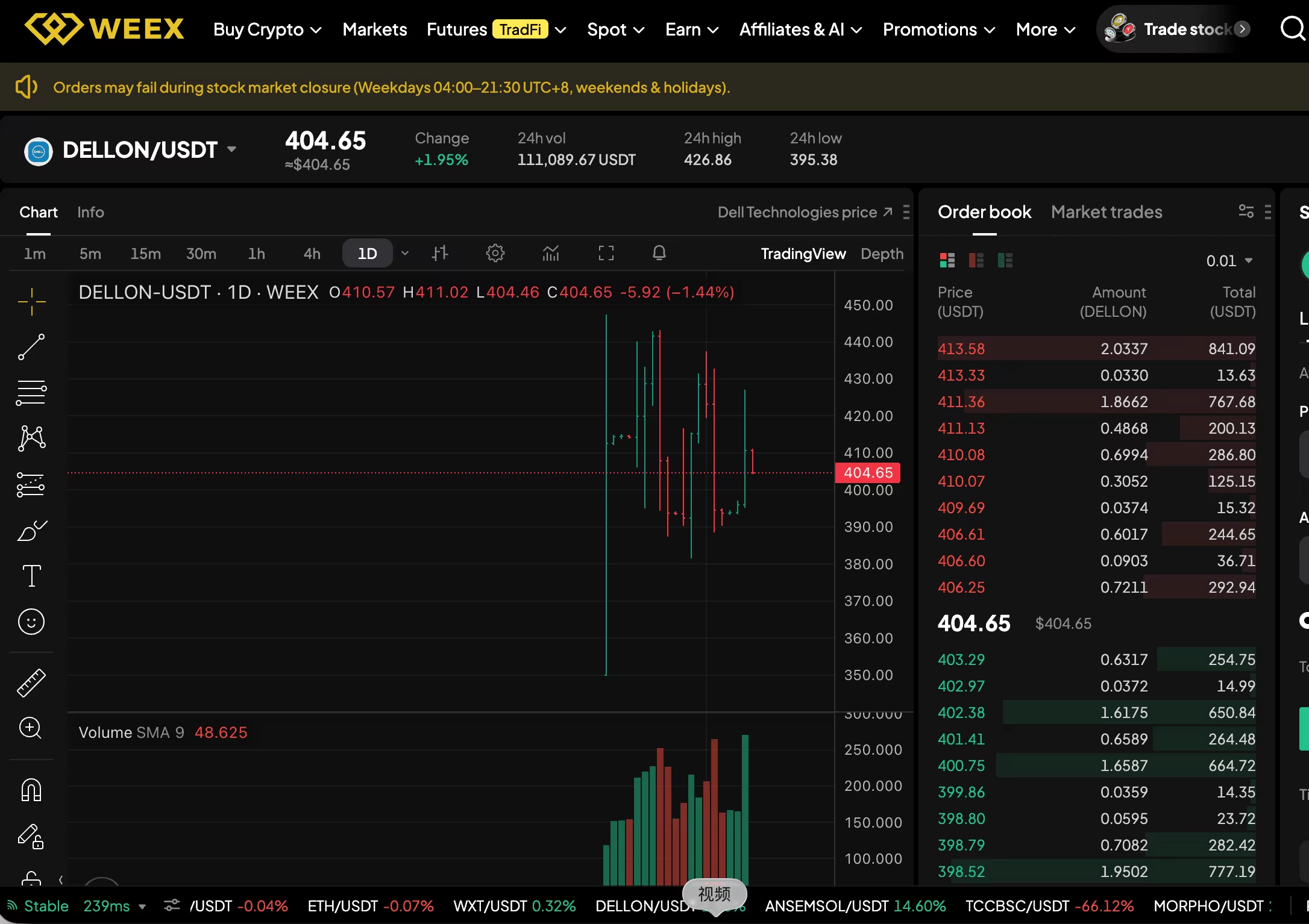
- Current DELLON level: The WEEX chart showed DELLON/USDT near $404.65, with a 24h move around +1.95%.
- Short-term range: The visible 24h high was near $426.86, while the 24h low was near $395.38.
- Forecast question: The main 2026 setup is whether DELLON can hold the $395-$400 support zone and build toward $500.
- Main driver: Dell's AI server and enterprise infrastructure narrative remains the key bullish theme.
- Main risk: DELLON is tokenized Dell-linked exposure, not direct Dell common stock ownership, and it can be affected by liquidity and product-structure risk.
WEEX lists DELLON/USDT spot trading for users who want Dell-linked tokenized exposure. New users can create a WEEX account before reviewing product eligibility, liquidity, fees, and local requirements.
Dell Stock Forecast 2026: Can DELLON Reach $500?
DELLON/USDT was shown near $404.65 on WEEX, with a visible 24h range between about $395.38 and $426.86. That gives traders a clear short-term map: the $395-$400 zone is the first support area, while the $426-$430 zone is the first resistance area to reclaim.
A 2026 recovery target near $500 is possible only if buyers keep defending support and the market continues to reward Dell-linked AI infrastructure exposure. The $500 level is not a guaranteed target. It is a bullish scenario that requires stronger momentum, better risk appetite, and continued interest in AI server demand.
DELLON Price Levels to Watch
- Immediate support: $395-$400, based on the visible 24h low and round-number support.
- First resistance: $426-$430, where the chart recently showed selling pressure.
- Recovery trigger: A clean move above $430 could reopen the $450-$470 area.
- Bullish target: $500 if momentum improves and AI infrastructure sentiment stays constructive.
- Bearish invalidation: A break below $395 would weaken the near-term recovery setup.
What Could Push Dell Higher?
The bullish case for Dell is tied to enterprise hardware, AI servers, storage, and data-center demand. If investors keep looking for AI infrastructure exposure beyond chip designers, Dell-linked products may continue to attract attention.
Another factor is execution. If Dell can convert AI server demand into profitable growth, the market may be more willing to price DELL and DELLON around stronger forward expectations.
What Could Stop DELLON From Reaching $500?
The biggest risk is that AI server revenue does not always translate into higher margins. Hardware growth can be competitive, capital intensive, and sensitive to customer spending cycles. A fast rally can also create valuation risk if traders move ahead of fundamentals.
- Liquidity risk: DELLON trading depth can affect entries and exits.
- Product risk: DELLON is not the same as direct ownership of Dell common shares.
- AI sentiment risk: If AI infrastructure stocks cool, Dell-linked exposure can pull back.
- Support failure: A break below $395 would make the $500 path less likely in the near term.
Bottom Line
DELLON can reach $500 in a bullish 2026 scenario, but the path depends on holding the $395-$400 support zone and reclaiming $426-$430 resistance first. The cleaner setup is a staged recovery rather than a straight-line move.
Users interested in broader stock-linked markets can also review the WEEX TradeFi market and eligible campaign details on the WEEX U.S. stock contract promotion.
Before you go, you can learn about the WEEX Token (WXT) for ecosystem participation, and new users may explore the WEEX welcome bonus with limited-time rewards such as trading coupons and task-based incentives.
FAQ
Can DELLON reach $500 in 2026?
It is possible in a bullish scenario, but DELLON needs to hold support near $395-$400 and regain momentum above $430 first.
Is DELLON the same as Dell stock?
No. DELLON is Dell-linked tokenized exposure available on WEEX, not direct ownership of Dell Technologies common shares.
What is the key DELLON support level?
The key short-term support zone is around $395-$400 based on the visible WEEX chart range.
Disclaimer: This content is provided for general informational and educational purposes only and should not be considered financial, investment, legal, or tax advice. Nothing in this article constitutes an offer, recommendation, solicitation, or invitation to buy, sell, or trade any crypto asset or use any specific service. Crypto assets are highly volatile and involve a high degree of risk. You may lose some or all of the value of your investment and should not invest funds you cannot afford to lose.WEEX services may not be available in all regions and are subject to applicable laws, regulations, and user eligibility requirements. Please carefully assess risks and confirm local requirements before making any financial decisions.
You may also like

SHA-256 vs Other Hashing Algorithms: What’s the Difference
This guide breaks down sha-256 alongside SHA-1, SHA-3, and MD5 in clear terms: what each hash does, where…
What Is SHA-256? How This Hashing Algorithm Works
SHA-256 is a cryptographic hashing algorithm that turns any input—short or long—into a fixed 256-bit output. Think of…
Leverage Trading Risks Every Beginner Should Know
Leverage can amplify gains and losses in crypto derivatives. This guide breaks down why leverage trading carries extra…
How to Calculate Leverage and Position Size?
Leverage lets you control a larger position with smaller capital. This guide shows how to calculate leverage and…
What Is Leverage in Trading? A Complete Guide
Leverage lets you control a larger position with a smaller amount of capital, but it also raises the…
What Is Initial Margin vs Maintenance Margin
Margin trading lets you control a larger crypto position with less capital, but it also introduces liquidation risk.…
What Is a Limit Order? A Beginner’s Guide
A limit order lets you set your own price. Your trade only executes if the market reaches that…
When Market Orders Can Cost You More Than Expected
A market order is simple: you click buy or sell, and the trade executes at the best available…
Market Order vs Limit Order: Which Should You Use
Choosing between a market order and a limit order comes down to one trade-off: speed versus price. This…
What Is a Market Order? A Beginner’s Guide
A market order is the simplest way to buy or sell: you tell the exchange to execute immediately…
Is SHA-256 Still Secure in 2026?
Updated: 2026-07-08 SHA-256 underpins Bitcoin mining, block integrity, and countless wallets and exchanges. This article explains whether SHA-256…
How SHA-256 Secures the Bitcoin Blockchain
SHA-256 is the cryptographic hash function that powers Bitcoin’s proof-of-work and the chain of blocks. This article explains…
What Happens When You Get Liquidated on Leveraged Trades?
Leverage lets you control a large position with a small margin, but it also narrows the price move…
How Margin Calls Work and How to Avoid Them
Margin trading lets you borrow against your collateral to amplify exposure, but it also introduces the risk of…
Margin Trading vs Spot Trading: What’s the Difference
Margin trading lets you borrow funds to amplify exposure, while spot trading uses only your own capital to…
What Is Margin Trading? A Beginner’s Guide
Margin trading lets you use your own funds as collateral to borrow extra capital, so you can take…
What is The White Bull (LEVI) Coin? Everything You Need to Know Before Trading LEVI/USDT
This article explains what The White Bull (LEVI) is, why it’s drawing attention on Solana, and how LEVI/USDT…
Should You Store Large Crypto Holdings in a Cold or Hot Wallet
Choosing between a cold wallet and a hot wallet is not just a preference—large crypto holders face a…
SHA-256 vs Other Hashing Algorithms: What’s the Difference
This guide breaks down sha-256 alongside SHA-1, SHA-3, and MD5 in clear terms: what each hash does, where…
What Is SHA-256? How This Hashing Algorithm Works
SHA-256 is a cryptographic hashing algorithm that turns any input—short or long—into a fixed 256-bit output. Think of…
Leverage Trading Risks Every Beginner Should Know
Leverage can amplify gains and losses in crypto derivatives. This guide breaks down why leverage trading carries extra…
How to Calculate Leverage and Position Size?
Leverage lets you control a larger position with smaller capital. This guide shows how to calculate leverage and…
What Is Leverage in Trading? A Complete Guide
Leverage lets you control a larger position with a smaller amount of capital, but it also raises the…
What Is Initial Margin vs Maintenance Margin
Margin trading lets you control a larger crypto position with less capital, but it also introduces liquidation risk.…