
GDOR Coin Explained: Price Surge, Oil Narrative, and Solana’s Global Digital Oil Reserve Token

Introduction
GDOR (Global Digital Oil Reserve) is one of a growing number of oil-themed tokens appearing on Solana. It sits in the same narrative wave as other reserve-style tickers like WCOR and UNOS, where traders are increasingly drawn to tokens that borrow language from energy markets, commodities, and global supply systems.
On the surface, the name sounds like something tied to real-world oil reserves or energy infrastructure. In practice, however, GDOR behaves like a speculative Solana token whose value is driven by liquidity, attention cycles, and narrative momentum rather than any verified physical backing.
There is currently no clear public evidence that GDOR represents ownership of oil reserves, petroleum rights, or any regulated commodity exposure. It should be understood as a narrative-driven crypto asset rather than a real-world oil instrument.
For users exploring crypto markets, centralized platforms like WEEX offer a more structured trading environment with clearer execution, risk tools, and access to a wider range of listed assets beyond early-stage narrative tokens.
GDOR Overview: What the Token Actually Is
GDOR stands for Global Digital Oil Reserve and is a Solana-based token built around the idea of digitalized oil reserves. The branding positions it within the broader commodity narrative trend, but its on-chain behavior is typical of early-stage meme tokens.
Key Information
| Item | Details |
|---|---|
| Token Name | Global Digital Oil Reserve |
| Ticker | GDOR |
| Blockchain | Solana |
| Contract Address | gdBA26LYzR4TJfMhGNe7ib7WEnDuxZopXWn8o2jrpump |
| Category | Narrative / Meme Token |
Despite the name, GDOR does not provide verifiable oil backing, custody structure, or redemption rights linked to physical commodities.
GDOR Price Overview
GDOR is currently trading at approximately $0.0006526, reflecting a highly volatile early-stage market typical of Solana narrative tokens.
Over the observed period, the token has recorded a surge of around +3,650% (3.65K%), driven primarily by speculative inflows, short-term liquidity movements, and increased attention around oil-themed narrative tokens.
Key Market Snapshot
| Metric | Value |
|---|---|
| Current Price | $0.0006526 |
| Recent Performance | +3.65K% |
| Market Behavior | High volatility / narrative-driven |
| Primary Driver | Speculation & attention cycles |
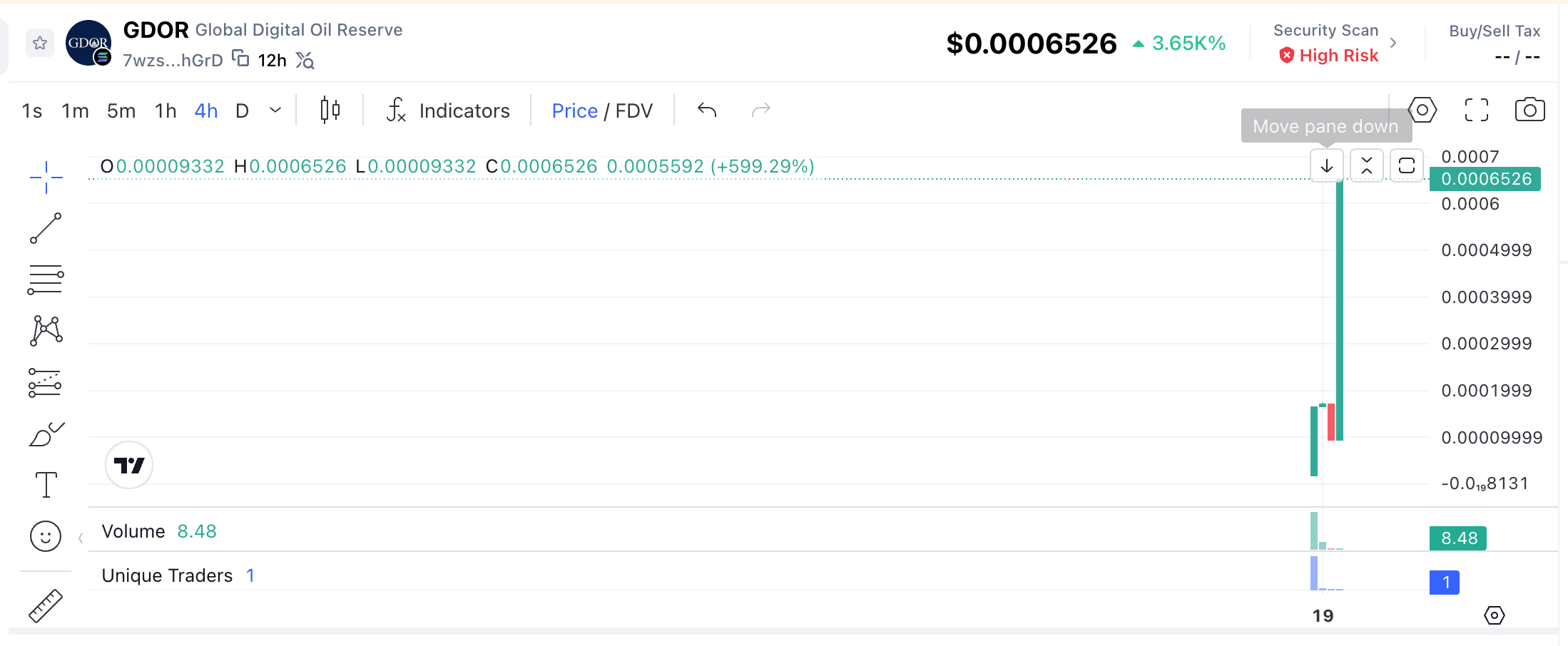
Despite the sharp percentage increase, movements of this scale are common in low-liquidity meme tokens and should not be interpreted as stable trend formation. Price action in this category is often heavily influenced by:
- Sudden liquidity injections
- Short-term trading clusters
- Narrative rotation across similar tokens
- Low float sensitivity
As with most early-stage Solana tokens, rapid gains can be followed by equally sharp retracements, especially when attention shifts away from the narrative.
The Narrative Behind GDOR
GDOR is not an isolated case. It belongs to a broader trend where Solana traders rotate into tokens built around macro-style themes such as energy, geopolitics, and global reserves.
Tokens in this category often include:
- WCOR (World Collective Oil Reserve)
- UNOS (United Nations Oil Supply narrative tokens)
- GDER / VDOR-style reserve-themed assets
What makes these tokens attractive is not technical innovation, but familiarity. Words like “oil,” “reserve,” and “global supply” create a sense of scale that standard meme coins usually lack.
However, beneath the narrative layer, these assets still behave like highly speculative tokens driven by market attention.
Is GDOR Backed by Real Oil?
This is the most important question—and currently the answer is not supported by verifiable public data.
For a real oil-backed token, you would normally expect:
- Documented custody of physical reserves
- Independent audits
- Legal claims tied to commodities
- Redemption or settlement mechanisms
In the case of GDOR, none of these elements are clearly established in publicly available information. That means the “oil reserve” framing should be treated as narrative branding rather than proof of asset backing.
GDOR Contract and Token Safety
In Solana ecosystems, contract-level verification matters more than naming conventions, because multiple tokens can share similar narratives.
GDOR’s main contract address is:
gdBA26LYzR4TJfMhGNe7ib7WEnDuxZopXWn8o2jrpump
Tokens in this narrative category often appear alongside similar tickers, and copycat deployments are common once a theme gains traction. Because of this, traders should always verify:
- Contract address
- Liquidity pool depth
- Source of listings across platforms
Even small differences in contracts can represent entirely different assets.
Why Traders Are Watching GDOR
GDOR is part of a shift in meme coin behavior on Solana.
Instead of purely meme-based branding, the market has started gravitating toward tokens that sound closer to real-world systems:
- Energy and oil markets
- Government and reserve structures
- Global commodity flows
- Macroeconomic narratives
This makes tokens like GDOR feel more “serious” than traditional meme coins, even though their underlying mechanics remain speculative.
The key driver is still the same: attention cycles.
Risks You Should Not Ignore
GDOR carries the same structural risks as most early-stage narrative tokens:
- No confirmed real-world asset backing
- High volatility driven by liquidity conditions
- Limited transparency around development structure
- Potential contract confusion with similar tokens
- Rapid sentiment shifts in Solana meme cycles
A common mistake is assuming that “oil reserve” in the name implies commodity exposure. In reality, naming is often purely narrative-driven.
GDOR vs Real Oil Tokenization
| Aspect | GDOR | Real Oil Tokenization |
|---|---|---|
| Asset Type | Narrative token | Regulated commodity product |
| Backing | None verified | Physical reserves |
| Legal Structure | Not established | Legal custody frameworks |
| Redemption Rights | No | Yes |
| Regulation | Unregulated | Regulated markets |
Real-world asset tokenization requires audits, custody, and enforceable rights. GDOR does not currently demonstrate these characteristics.
Conclusion
GDOR (Global Digital Oil Reserve) is part of a broader Solana trend where commodity language is used to structure narrative-driven crypto assets.
While the name suggests exposure to global oil reserves, there is no verified evidence of real commodity backing. Instead, GDOR should be viewed as a speculative token whose value depends on liquidity and narrative momentum.
As with other reserve-themed tokens like WCOR and UNOS, the key distinction is simple: the story is macro, but the asset is still a meme coin.
For traders who prefer more structured exposure to crypto markets, centralized exchanges like WEEX provide a more controlled environment compared to early-stage narrative tokens.
WEEX is a centralized crypto exchange, and its native token WEEX Token (WXT) is typically presented as a utility asset inside that ecosystem.
Risk Disclaimer:This article is for informational purposes only and does not constitute financial or investment advice. GDOR is a high-risk speculative crypto asset with no verified real-world backing. Cryptocurrency markets are volatile and may result in total loss of capital. Always conduct independent research before making investment decisions.
You may also like
COAR vs WCOR: How Two Oil Narrative Tokens on Solana Stack Up
COAR vs WCOR comparison: two oil-themed crypto tokens. Learn their differences, tokenomics, price predictions, risks, and which fits your risk profile.
ROAF vs COAR: Two Oil Narrative Tokens Compared on Solana
ROAF vs COAR comparison: two Solana-based oil narrative meme tokens. Learn differences in structure, risks, tokenomics, and market positioning.
What Is Modern American Gas Asset Crypto? MAGA Oil Narrative Explained
Modern American Gas Asset (MAGA) is a Solana meme coin using Trump-era branding and oil narrative. Learn how it works, risks, and the difference from real energy assets.
What Is Chinese Oil Asset Reserve (COAR)? Solana Oil Narrative Token Explained
Chinese Oil Asset Reserve (COAR) is an oil-themed Solana token, not a verified claim to real physical oil ownership
The contract address is CoARSp4P9Yr7MEnKMZE7chyAkK3mNbPFyArdQeMm9a1G
Total supply is 1 billion tokens with distribution including liquidity pool, community, team lock, reserves, and marketing
Stated utilities include staking (12% APY), governance (1 COAR = 1 vote), revenue share (30%), and 2% burn per transaction
Roadmap includes three phases from launch to institutional partnerships and real-world oil reserve verification

How to Buy COAR Crypto and When to Sell for Maximum Gains
Learn how to buy COAR Crypto safely on Solana. Read our expert guide on the speculative Chinese Oil Asset Reserve coin and discover strategic buy and sell points.

How to Buy Mom Trust Fund Reserve (MTFR): Legit Opportunity or High-Risk Trap?
Is MTFR Coin a legit opportunity or a high-risk trap? Read our Mom Trust Fund Reserve buying guide to analyze real on-chain data, liquidity, and key risks.
What Is Global Digital Oil Reserve (GDOR) Coin? Can It Really Explode Like GDER?
What is GDOR crypto? This guide explains its token data, missing fundamentals, and why it is unlikely to replicate explosive tokens like GDER.
What Is SAOS? Strategic American Oil Supply Token Explained
SAOS is a meme token on Solana with a 75,000 USD market cap and 22,000 USD locked liquidity, positioned around oil supply themes but lacking real asset backing
It thrives on pure narrative speculation, with no utility, website, or doxxed team, making it highly volatile and attention-dependent
Traders should distinguish SAOS from legitimate real-world asset projects, as its branding is speculative rather than substantive
Positive aspects include locked liquidity reducing rug pull risks, but low trading activity signals high uncertainty
What Is Public Asset Control (PAC) Coin? Explained for Beginners
Public Asset Control (PAC) is a Solana-based token that uses a “government asset control” narrative involving oil and gold themes, but it has no verified ties to any real institutions or governments. It is mainly an entertainment-focused, speculative meme coin.
The project’s claims about links to entities like BlackRock or Palantir are unverified, and its own disclaimer states it is not a real financial or institutional asset. Like many new Solana tokens, PAC is highly volatile, with low liquidity and limited transparency, including no fully verified audit.
Overall, PAC is a high-risk speculative token driven by hype and storytelling rather than real utility. Beginners are advised to be cautious, verify contract details, and prioritize risk control before considering any trading.

Why Is Chinese Oil Asset Reserve (COAR Crypto) Trending Now?
Why is Chinese Oil Asset Reserve trending now? Learn the latest COAR crypto price action, trading volume, oil narrative, Solana pair data, and what is driving attention today.

How to Buy Chinese Oil Asset Reserve (COAR) Token in 2026: Latest Step-by-Step Guide, Contract Address, and Safe Buying Tips
How to buy Chinese Oil Asset Reserve (COAR) token step by step, including the official COAR contract address, Solana wallet setup, SOL funding, and latest market data.
Did the CLARITY Act Pass Today? Latest Status and the History of the Crypto Bill
SEO meta description: Did the CLARITY Act pass today? Read the latest crypto bill update, the history of the CLARITY Act, House and Senate votes, and what happens next for U.S. crypto regulation.
What Is Chinese Oil Asset Reserve (COAR) Token? $COAR and Coar Stock Relationship Explained
Chinese Oil Asset Reserve (COAR) token explained, $COAR price, Solana details, and the relationship between COAR and Coar stock. Learn the latest facts.
What Is World Cup Meme Coin? Football Meme Crypto Narrative Explained
World Cup meme coin $WCMEME is a Solana token that collapsed 96% in 24 hours. Learn how football meme narratives work and the risks involved.
What Is WEEX Token (WXT)? A Complete Guide
WEEX Token (WXT) is the native utility token within the WEEX ecosystem. Its main purpose is to improve the trading experience rather than serve purely as a speculative asset.
In simple terms, WXT is mainly used for fee discounts (the more you hold, the lower your trading fees), staking rewards, and participation in platform events and governance voting. It also allows users to engage more deeply in the WEEX ecosystem, including promotional campaigns and future Web3 integrations.
In terms of acquisition, users can typically buy WXT directly on the WEEX exchange using assets like USDT, or earn it through platform events. For storage, it can be kept in an exchange wallet for convenience or transferred to external wallets (such as cold wallets) for enhanced security.
From a tokenomics and market perspective, WXT’s value is closely tied to WEEX’s user growth, trading volume, and overall crypto market conditions, making it relatively volatile and high-risk. Analysts generally view it as more suitable for users interested in the long-term development of the platform rather than short-term speculation.
Overall, WXT is a “trading utility token” that enhances user experience through fee discounts, staking benefits, and eco
How to Buy Global Digital Oil Reserve ($GDOR): Is It Legit or Just Hype?
Learn how to buy Global Digital Oil Reserve (GDOR) on the Solana network. This comprehensive guide covers step-by-step swap instructions, official contract verification, and a critical look at the "digital oil" narrative.
What Is $PAC Token? Legitimate Crypto or Just A High-Risk Meme Coin?
Is Public Asset Control ($PAC) a real asset-backed token or just another meme coin narrative? We analyze its official website, market data, and risks.
How to Buy $WCOR Coin: Should I Invest or Is It Just Hype?
Learn how to buy $WCOR coin on Solana and explore its latest 57% price surge. This expert guide analyzes whether WCOR is a solid investment or speculative hype.
COAR vs WCOR: How Two Oil Narrative Tokens on Solana Stack Up
COAR vs WCOR comparison: two oil-themed crypto tokens. Learn their differences, tokenomics, price predictions, risks, and which fits your risk profile.
ROAF vs COAR: Two Oil Narrative Tokens Compared on Solana
ROAF vs COAR comparison: two Solana-based oil narrative meme tokens. Learn differences in structure, risks, tokenomics, and market positioning.
What Is Modern American Gas Asset Crypto? MAGA Oil Narrative Explained
Modern American Gas Asset (MAGA) is a Solana meme coin using Trump-era branding and oil narrative. Learn how it works, risks, and the difference from real energy assets.
What Is Chinese Oil Asset Reserve (COAR)? Solana Oil Narrative Token Explained
Chinese Oil Asset Reserve (COAR) is an oil-themed Solana token, not a verified claim to real physical oil ownership
The contract address is CoARSp4P9Yr7MEnKMZE7chyAkK3mNbPFyArdQeMm9a1G
Total supply is 1 billion tokens with distribution including liquidity pool, community, team lock, reserves, and marketing
Stated utilities include staking (12% APY), governance (1 COAR = 1 vote), revenue share (30%), and 2% burn per transaction
Roadmap includes three phases from launch to institutional partnerships and real-world oil reserve verification
How to Buy COAR Crypto and When to Sell for Maximum Gains
Learn how to buy COAR Crypto safely on Solana. Read our expert guide on the speculative Chinese Oil Asset Reserve coin and discover strategic buy and sell points.
How to Buy Mom Trust Fund Reserve (MTFR): Legit Opportunity or High-Risk Trap?
Is MTFR Coin a legit opportunity or a high-risk trap? Read our Mom Trust Fund Reserve buying guide to analyze real on-chain data, liquidity, and key risks.


