MSFT Stock Analysis 2026: Why Microsoft's 33% Drop Could Be a Generational Buying Opportunity?




Microsoft (MSFT) stock has endured a brutal 2026, falling approximately 18% in June alone—its worst single-month decline since 2000—and trading roughly 33% below its all-time high of $555.45 . The selloff has erased over $530 billion in market value, pushing the company's valuation to approximately $2.76 trillion .
Yet the business itself just delivered a "record third quarter," with Azure growing 40% year-over-year and AI revenue crossing a $37 billion annual run rate, up 123% . This disconnect between stock price and business performance raises a critical question: is this a temporary dislocation or the start of something structural? This MSFT stock analysis examines the forces behind the decline, the company's fundamentals, and whether now is the right time to invest in MSFT stock.
Key Takeaways
- MSFT stock trades at ~21–22x forward earnings—its cheapest since 2023, below its five-year average near 30x
- Microsoft's AI business reached a $37 billion annual revenue run rate, up 123% year-over-year
- Azure grew 40% last quarter—its fifth consecutive quarter of acceleration
- The company plans $190 billion in capex for calendar 2026, up 61% from 2025, with $25 billion attributed to component-price inflation
- Analysts rate MSFT a "Strong Buy" with average 12-month targets near $560, implying significant upside
The 2026 Selloff: Macro Pressures Meet Company-Specific Concerns
The Fed's Hawkish Shift
The decline in MSFT stock isn't happening in isolation. The broader technology sector has been under pressure, with one late-June session erasing more than $1 trillion from the Nasdaq 100 . Much of this pressure traces back to the Federal Reserve: Kevin Warsh's first meeting as Fed Chair delivered a hawkish surprise, shifting the median rate expectation for year-end from 3.4% to 3.8% .
This matters disproportionately for a company like Microsoft. A higher expected cost of capital compresses the present value of future cash flows—even when nothing about the underlying business has changed. The reintroduction of hike risk into the Fed's own projections is the more durable story markets are still digesting .
The Capex Shock
Microsoft's fiscal third-quarter capital expenditures came in at $31.9 billion, up 49% year-over-year. The market is now digesting guidance for roughly $190 billion in calendar-2026 capex—up 61% from 2025, with CFO Amy Hood attributing about $25 billion of that increase to component-price inflation rather than added capacity . That figure landed well above the roughly $155 billion analysts had modeled .
Key capex breakdown:
- ~Two-thirds: Short-lived assets (GPUs, CPUs) that depreciate faster
- ~One-third: Long-duration infrastructure (15+ years)
The OpenAI Backlog Concentration Question
Questions have emerged around the composition of Microsoft's commercial remaining performance obligation (RPO), which surged 99% year-over-year to $627 billion . Roughly 45% of that backlog ties back to a single customer: OpenAI . Commercial bookings grew a healthy 7% year-over-year excluding OpenAI but fell 4% including it—a reminder that some headline growth in prior quarters was inflated by a single commitment that isn't repeating at the same pace .
What You Get for the Current Price
Azure and AI: The Growth Engine
Despite the stock's decline, Microsoft's underlying business is performing at a high level:
- Azure grew 40% year-over-year last quarter—outpacing AWS and marking its fifth consecutive quarter of acceleration
- AI business: $37 billion annualized revenue run rate, +123% year-over-year
- Microsoft Cloud: $54.5 billion revenue, +29% year-over-year
- Commercial RPO: $627 billion, +99% year-over-year
- Microsoft 365 Copilot: Over 20 million paid seats, with customers holding 50,000+ seats growing significantly
Management expects Azure growth to show "modest acceleration in the second half of the calendar year compared with the first half" as new capacity comes online .
The Valuation Case
MSFT stock valuation metrics :
| Metric | Value |
| Forward P/E | ~21–22x |
| Trailing P/E | ~22.6x |
| P/E vs. 5-Year Average | Well below ~30x |
| P/E vs. S&P 500 | Below S&P 500's ~24.4x |
| Price/Sales | ~8.9x |
| Price/Cash from Ops | Cheapest since 2019 |
At roughly 21–22 times forward earnings, MSFT stock is trading at its cheapest multiple since 2023, well below its five-year average of closer to 30x . It is also one of the cheapest among the "Magnificent Seven" stocks, only edged out by Meta Platforms .
The AI Spending Debate: Bubble or Infrastructure Build?
The scale of the selloff has reignited debate over whether the broader AI trade is entering bubble territory, with comparisons to the dot-com era . That comparison deserves scrutiny rather than reflexive agreement.
Why today is different:
- Profitability: Microsoft's revenue grew 18% year-over-year last quarter, while EPS grew 23%—profitability outpacing revenue growth even as the company absorbs record capex
- Contracted backlog: Microsoft has $627 billion in contracted future revenue—roughly 2.5 years of revenue visibility
- Capacity constraints: Demand for Azure infrastructure continues to exceed available supply, meaning every gigawatt of power capacity Microsoft brings online converts directly into revenue it cannot currently recognize
Speculative pockets within the AI trade certainly exist, as they do in any sustained cycle. But a systemic bubble, in the strict sense, requires broad disconnection between valuations and real economic output—and that evidence isn't clearly present today .
How to Buy MSFT Stock on WEEX: Full Guide for Beginners
Here is the Step-by-Step Guide to buy Nvidia and Microsoft stock:
- Step 1: Go to WEEX official website and register with your email or phone number.
- Step 2: Transfer USDT to your WEEX account or buy directly via fiat or quick buy. Choose any network — ERC-20, TRC-20, BEP-20 — all are supported.
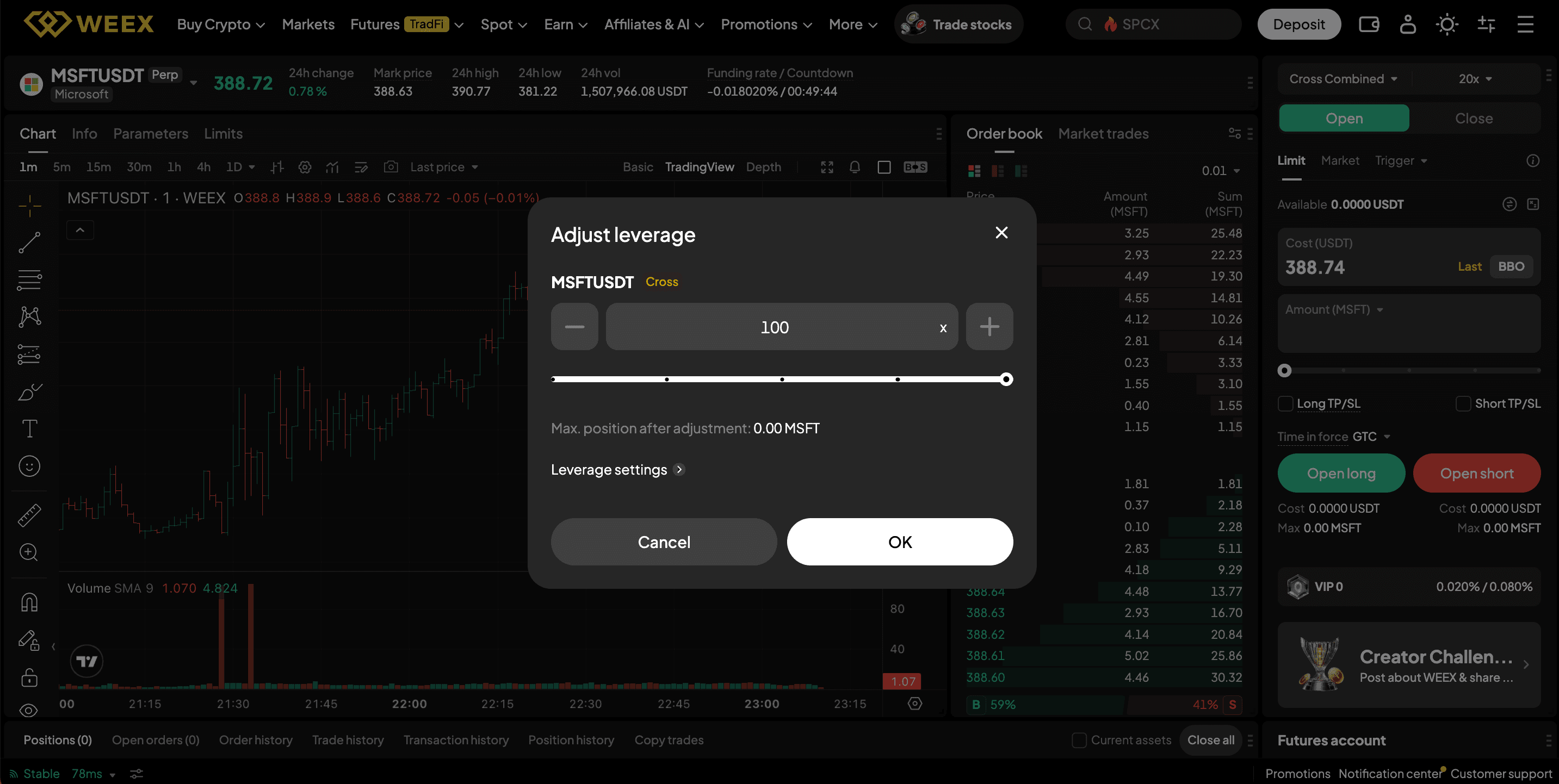
- Step 3: Go to the WEEX Futures page and search for MSFTUSDT.
- Step 4: Adjust leverage from 1x to 50x. You can access up to 100x leverage on NVDA.
- Step 5: Choose Long or Short.
- Step 6: Set Stop Loss or Take Profit. Then place your order.
Conclusion: Is MSFT Stock a Buy Right Now?
The decision to buy MSFT stock today comes down to conviction in the company's capital plan. Microsoft holds a commanding position in a technological shift, with management guiding for "another year of double-digit revenue and operating income growth" . Yet the sheer scale of that bet—$190 billion in capex—gives investors pause.
MSFT stock appears to be a compelling buy at current levels for investors with a long-term horizon. The selloff reflects macro pressures and spending concerns rather than business deterioration. For aggressive traders, WEEX offers 24/7 access to MSFT futures with leverage. For long-term investors, buying the dip at these valuation levels has historically been rewarded.
Ready to trade? Sign up on WEEX Now and Start Trading!
Q1: Why is Microsoft stock down so much in 2026?
MSFT stock fell approximately 18% in June and trades ~33% below its all-time high due to hawkish Fed policy shifts, concerns over $190 billion in AI capex spending, component-price inflation adding $25 billion to costs, and questions about the composition of its OpenAI-related backlog .
Q2: Is Microsoft stock undervalued right now?
Yes. MSFT trades at ~21–22x forward earnings—its cheapest since 2023, below its five-year average near 30x, and below the S&P 500's ~24x. On a price-to-cash-from-operations basis, it hasn't been this cheap since 2019 .
Q3: How can I buy MSFT stock on WEEX?
On WEEX, search for MSFTUSDT in the spot market for tokenized stock with no leverage, or use the TradFi perpetual futures section for up to 100x leverage and 24/7 trading. You can start with as little as ~$5 USDT .
Q4: What is Microsoft's AI revenue run rate?
Microsoft's AI business reached a $37 billion annual revenue run rate in Q3 2026, up 123% year-over-year. Azure grew 40%, and Microsoft 365 Copilot has surpassed 20 million paid seats .
Q5: Is MSFT stock a good investment for 2026?
Analysts rate MSFT a "Strong Buy" with average 12-month targets near $560, implying meaningful upside. The stock's valuation is historically cheap, and underlying fundamentals—Azure growth, AI revenue, and commercial backlog—remain strong. However, near-term margin pressure from AI spending and capacity constraints are risks to consider .
Disclaimer: This content is provided for general informational and educational purposes only and should not be considered financial, investment, legal, or tax advice. Nothing in this article constitutes an offer, recommendation, solicitation, or invitation to buy, sell, or trade any crypto asset or use any specific service. Crypto assets are highly volatile and involve risk, including the potential loss of capital. WEEX services may not be available in all regions and are subject to applicable laws, regulations, and user eligibility requirements. Please carefully assess risks and confirm local requirements before making any financial decisions.