Polymarket Prediction Market: How It Works and Is It Legit




Polymarket is the world's largest prediction market — a place where you trade the outcome of real events, from a World Cup group stage match to the next US election, at prices that read like probabilities. When Switzerland trades at 27 cents to beat Colombia, the market is telling you it sees roughly a 27% chance. That single number, set by thousands of traders putting money behind their opinions, is why the Polymarket prediction market has become a reference point for journalists, traders, and analysts, not just gamblers.
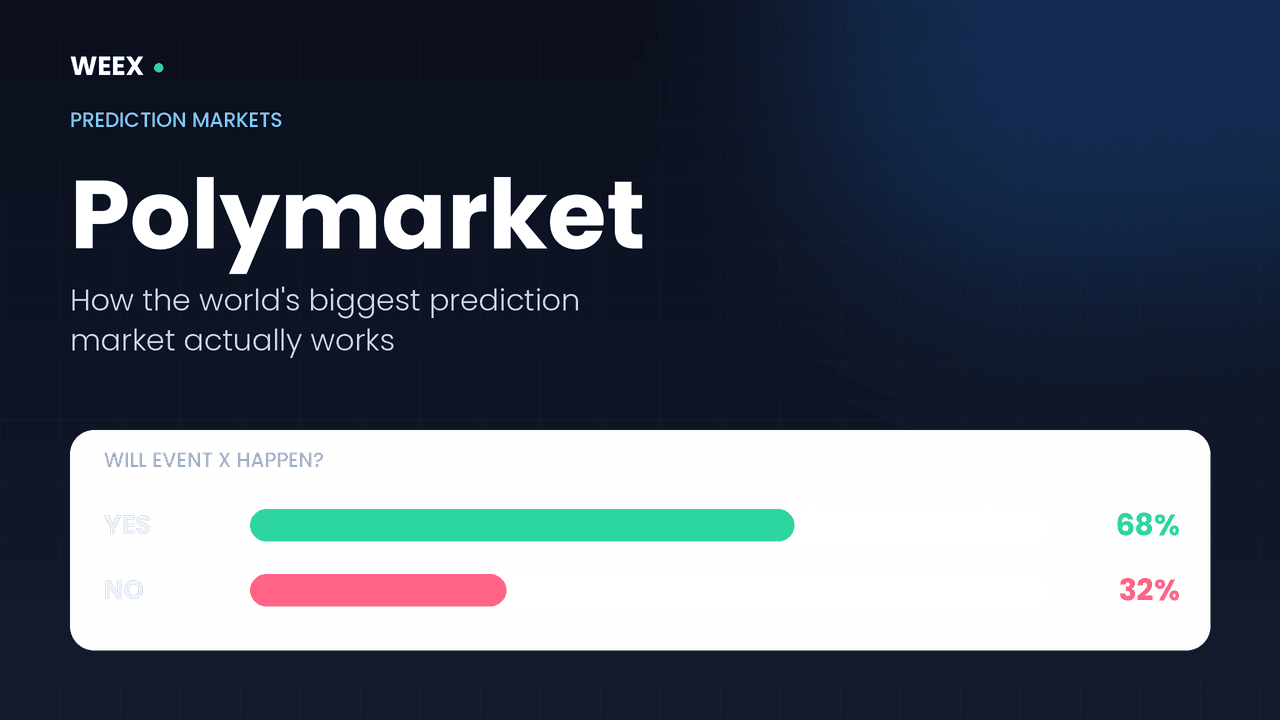
This guide covers what Polymarket is, how its odds actually work, where it stands legally after its 2025 US return, how to fund an account, the long-awaited POLY token, and the harder question underneath all of it — whether you can consistently make money.
What Is Polymarket, and Why It Matters Now
Polymarket is a peer-to-peer prediction market built on the Polygon blockchain. Instead of betting against a house, you buy and sell "Yes" and "No" shares on a specific question with other users. Each share pays $1 if the outcome resolves in your favor and $0 if it doesn't, so the live price sits between $0.00 and $1.00 and behaves like an implied probability.
The platform runs non-custodially — trades settle through smart contracts and you hold your own funds — and it has grown well beyond politics into sports, economics, crypto, and pop culture. It gained mainstream attention during the 2024 US election and has kept scaling since.
| Feature | Detail |
|---|---|
| Type | Peer-to-peer prediction market |
| Blockchain | Polygon |
| Settlement currency | USDC, migrating to PUSD (Polymarket's own $1-pegged stablecoin) |
| Share payout | $1 if correct, $0 if wrong |
| Founded | 2020, by Shayne Coplan |
| US status (2026) | Relaunched Dec 2025 as a CFTC-regulated market; some state limits |
| Native token | POLY — confirmed, not yet live as of mid-2026 |
How Polymarket Prices Turn Into Probabilities
A Polymarket price is a probability in disguise. A "Yes" share at $0.63 implies the market thinks there's about a 63% chance the event happens — before fees and slippage. If you think the real odds are higher than the price, you buy; if you think the crowd is overpricing an outcome, you sell or buy the "No" side. You can exit any time before the event resolves to lock in a gain or cut a loss.
That mapping from order flow to odds is not magic — it comes from either an order book or an automated market maker, and the mechanics behind how prediction market prices are calculated determine how far your trade moves the number. In thin markets, a single large order can swing the price several points, which is exactly where the odds stop being a clean signal.
The more useful way to read Polymarket is as an aggregator of dispersed information with real money on the line. That incentive is what makes its odds competitive with polls and pundits — but it also means the number is only as sharp as the liquidity behind it.
Is Polymarket Legal in the US in 2026?
Short answer: yes for most US users, but with real state-level gaps. After a 2022 CFTC enforcement action pushed it out of the US for roughly three years, Polymarket acquired QCEX, a CFTC-licensed derivatives exchange, received an amended Order of Designation, and began onboarding US users again in December 2025. That makes it a Designated Contract Market (DCM) — the same federal regulatory tier as CME Group.
The catch is at the state level. Several states have pushed back on prediction-market contracts, particularly around sports and elections.
| Jurisdiction | Stance (2026) |
|---|---|
| Federal (CFTC) | Approved as a Designated Contract Market |
| Most US states | Available to verified users |
| Nevada | Blocked sports, entertainment, and election contracts |
| Ohio, Michigan, Arizona, Maryland, Massachusetts | Moved against prediction-market offerings |
The regulatory picture is still moving, so availability and the exact contracts you can trade depend on where you live. Treat "is it legal here?" as a question to re-check, not a settled fact.
Is Polymarket Safe and Legit?
Polymarket is a legitimate, regulated venue — but "legit" and "safe for your money" are two different claims. On the platform side, it enforces KYC identity checks before you can deposit, uses a non-custodial wallet structure so you control your funds, and now operates under CFTC oversight. Those are meaningful safeguards.
The financial reality is harsher. Most users lose money. A May 2026 Washington Post review found roughly 1.7 million users had lost money on Polymarket versus about 765,000 who came out ahead. That ratio is the single most important fact for a newcomer: the platform being regulated and non-custodial does nothing to change the fact that trading event outcomes is a hard, negative-sum-after-fees game for the average participant.
The better reading is that Polymarket is safe as infrastructure and risky as an activity. Don't confuse the two.
How to Start Trading on Polymarket
Getting started is straightforward, but the funding step is where beginners lose money to avoidable mistakes. You connect a wallet, complete KYC, deposit, and start trading YES/NO shares.
Funding runs on Polygon. Historically the settlement currency has been USDC on Polygon, and Polymarket has been migrating incoming deposits to PUSD, its own dollar-pegged stablecoin. A few practical rules:
- Network matters most. Deposits historically require the correct network — sending on the wrong chain can mean permanent loss. Verify the network before every transfer.
- Copy the address, never type it. A single wrong character on a 40-plus-character address loses the funds.
- Start small. A $50–$200 starting bankroll lets you spread across several markets while you learn, without betting money you can't lose.
- Card and bank deposits cost more. They're easier but typically carry a few percent premium versus a direct crypto transfer.
The POLY Token and Airdrop Everyone's Waiting For
Polymarket has confirmed a native token, POLY, and an accompanying airdrop, with the company's CMO tying the timing to the completion of the US relaunch. As of mid-2026, though, there is no live token, no published snapshot date, no confirmed eligibility criteria, and no token supply figure. Community reports suggest 5–10% of supply may be reserved for airdrop participants, but that is expectation, not policy.
The practical takeaway: be skeptical of any site claiming a live "POLY airdrop" or a tradable POLY spot price today. Until Polymarket publishes official terms, treat token speculation as exactly that — and note that leveraged POLYMARKET/USDT perpetual futures listed on some exchanges are a separate, high-risk derivative, not the airdrop.
Can You Actually Make Money on Polymarket?
Yes, it's possible — but the edge is narrow and rare, which the loss statistics make plain. Profit generally comes from one of three places: processing public information faster or more cleanly than the crowd, converting fundamentals into better-calibrated probabilities than the market, or providing liquidity and earning the spread. What consistently doesn't work is trading on news everyone already sees, or making big all-in bets near resolution when spreads widen and fees bite hardest.
If you want to test whether you can make money on prediction markets, the discipline that separates the ~765,000 winners from the majority is unglamorous: size positions small, only take trades where your probability estimate clearly beats the price after costs, and track your calibration over time instead of chasing hot markets.
The Bottom Line on the Polymarket Prediction Market
The Polymarket prediction market is a genuinely useful tool — its odds aggregate real-money conviction into probabilities that often rival experts, and its 2025 US return under CFTC oversight gives it a legitimacy most crypto venues lack. But usefulness as a signal and profitability as a trader are different things. Most participants lose, funding mistakes are unforgiving, and the POLY token remains a promise, not a product. Read Polymarket's odds freely; risk your capital carefully.
If you're exploring the broader crypto markets around prediction trading — spot, futures, and stablecoin pairs — you can create a free account on WEEX to access trading tools and market data.
FAQ
1. Is the Polymarket prediction market legal in the US?
For most US users, yes. Polymarket relaunched in December 2025 as a CFTC-regulated Designated Contract Market. However, some states — including Nevada — have restricted certain contracts such as sports and elections, so availability depends on where you live.
2. How do Polymarket odds work?
Each market has "Yes" and "No" shares priced between $0 and $1. The price equals the implied probability: a share at $0.40 means the market sees about a 40% chance. Winning shares pay $1; losing shares pay $0.
3. What currency does Polymarket use?
Trades settle in stablecoins on the Polygon network. Historically that has been USDC, and Polymarket has been moving to PUSD, its own $1-pegged stablecoin, with deposits converted on arrival.
4. Is there a POLY token or airdrop yet?
Polymarket has confirmed plans for a native POLY token and an airdrop, but as of mid-2026 no token is live and no official snapshot date, eligibility, or supply has been published. Be cautious of sites claiming otherwise.
5. Can you actually make money on Polymarket?
Some people do, but most lose. A May 2026 review found roughly 1.7 million users had lost money versus about 765,000 who profited. Consistent gains come from calibration, small sizing, and genuine informational edge — not big one-off bets.
Risk Warning
Prediction markets are high-risk. On the Polymarket prediction market, outcomes are binary — a losing position can go to zero, and most users lose money overall. Beyond outcome risk, be aware of liquidity risk (thin markets distort odds and widen spreads), custody and operational risk (wrong-network deposits can be permanently lost), stablecoin risk (a depeg of USDC or PUSD affects the value of your balance), regulatory risk (availability and permitted contracts vary by state and can change), and counterparty and oracle risk (disputed or ambiguous event resolutions). Leveraged POLYMARKET/USDT perpetual futures offered elsewhere carry additional, amplified risk of total loss. Never commit funds you cannot afford to lose, and confirm what is legal in your jurisdiction before trading.
Disclaimer: This content is provided for general informational and educational purposes only and should not be considered financial, investment, legal, or tax advice. Nothing in this article constitutes an offer, recommendation, solicitation, or invitation to buy, sell, or trade any crypto asset or use any specific service. Crypto assets are highly volatile and involve a high degree of risk. You may lose some or all of the value of your investment and should not invest funds you cannot afford to lose. WEEX services may not be available in all regions and are subject to applicable laws, regulations, and user eligibility requirements. Please carefully assess risks and confirm local requirements before making any financial decisions.